Quick Answer
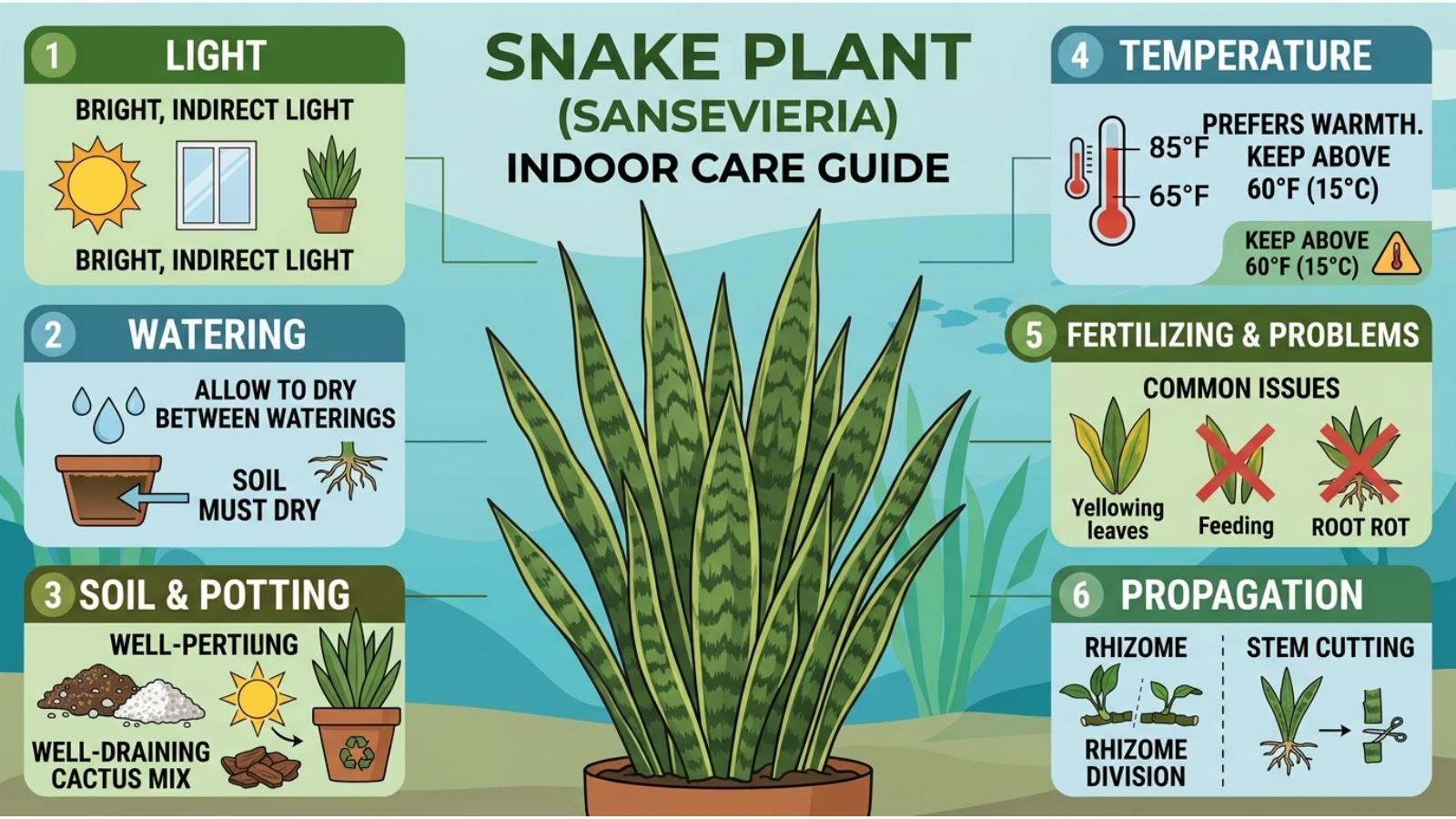
To take care of a snake plant indoors, place it in bright, indirect light, use well-draining soil, and water only when the soil has dried out thoroughly.
Always choose a pot with drainage holes and remove excess water from the saucer. Snake plants tolerate low humidity and occasional missed watering, but consistently wet soil can cause root rot. Keep the plant in comfortable indoor temperatures and fertilize lightly during active growth.
Introduction
Learning how to take care of snake plant indoor is easy once you understand one important rule: snake plants prefer being slightly dry rather than constantly wet.
Snake plants, also known as Dracaena trifasciata, have thick, water-storing leaves and underground rhizomes. These features allow them to handle periods of dryness better than many common houseplants. However, their drought tolerance does not mean they can thrive in complete darkness or survive indefinitely in waterlogged soil.
The most common mistake beginners make is watering too frequently. A snake plant may look fine immediately after watering, while excessive moisture is quietly damaging its roots underneath the soil.
With the right balance of light, water, soil, temperature, and occasional feeding, a snake plant can stay attractive and healthy indoors for many years.
Snake Plant Indoor Care at a Glance
| Care Requirement | Ideal Approach |
|---|---|
| Light | Bright, indirect light is ideal |
| Low Light | Tolerated, but growth may slow |
| Water | Water after the soil dries thoroughly |
| Soil | Fast-draining and well-aerated |
| Pot | Use drainage holes |
| Humidity | Normal household humidity |
| Temperature | Comfortable indoor temperatures |
| Fertilizer | Light feeding during active growth |
| Repotting | Only when necessary |
| Biggest Risk | Overwatering |
Where Should You Put a Snake Plant Indoors?
Location has a major effect on how well your snake plant grows.
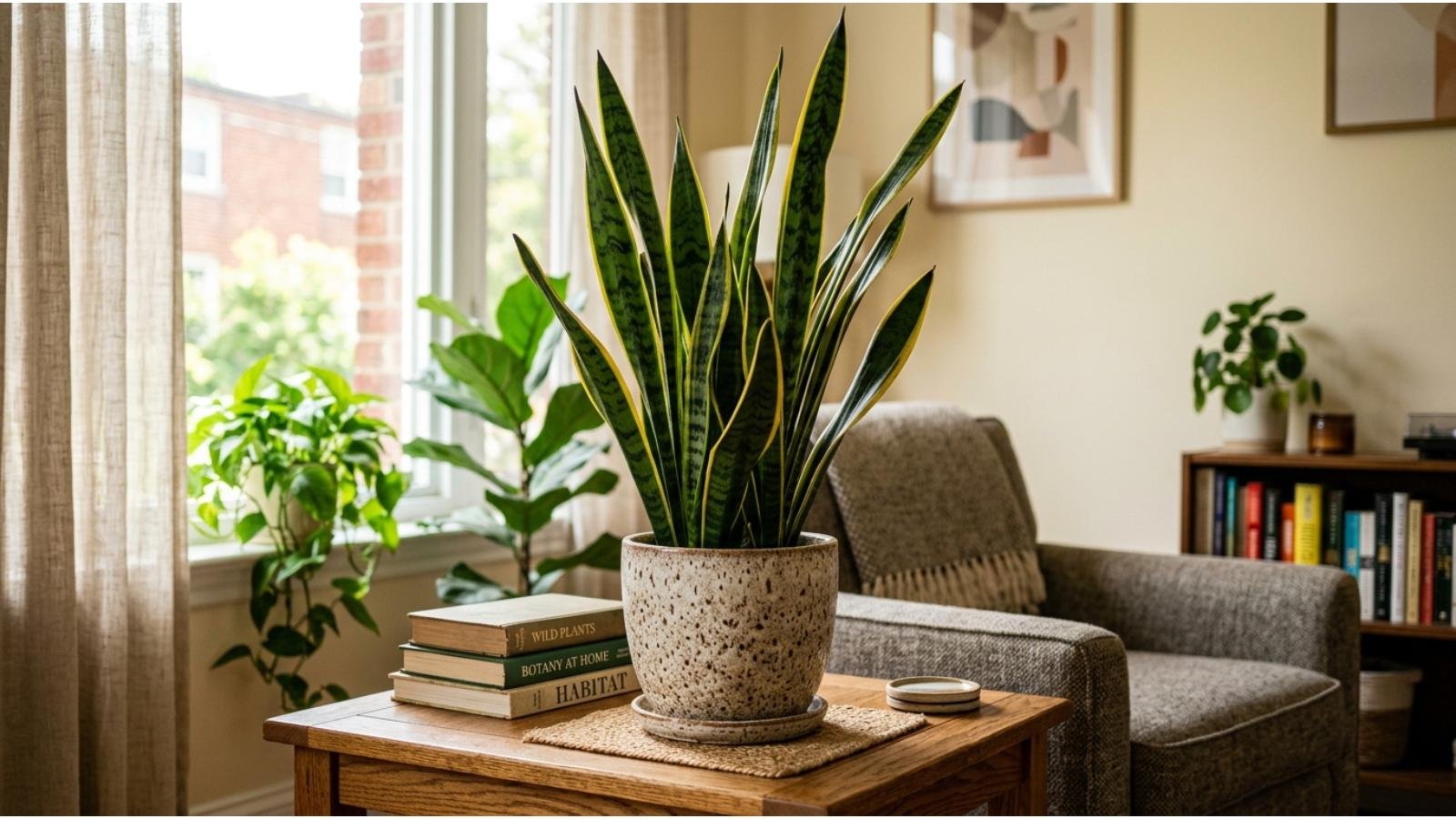
A bright room with filtered or indirect sunlight is usually an excellent choice. An east-facing window can provide gentle morning light, while a plant near a brighter south- or west-facing window may need some protection from intense afternoon sunlight.
Snake plants can tolerate lower-light conditions, which makes them useful for offices, bedrooms, hallways, and other areas that do not receive strong natural light. However, low-light tolerance should not be confused with ideal growing conditions.
A snake plant sitting in a very dark corner may survive but produce little new growth.
Good indoor locations include:
- Near a bright window.
- A few feet away from strong sunlight.
- In a bright bedroom.
- In a well-lit office.
- Under a suitable grow light.
- In an area protected from extreme temperature changes.
Avoid placing it directly beside:
- Heating vents.
- Air-conditioning vents.
- Very cold windows.
- Radiators.
- Areas exposed to intense afternoon sunlight for long periods.
Practical tip: If your snake plant has been growing in low light, introduce stronger sunlight gradually rather than moving it suddenly into intense direct sun.
Image Suggestion: Indoor snake plant placement diagram showing bright indirect light, low light, and harsh direct sunlight.
How Much Light Does a Snake Plant Need?
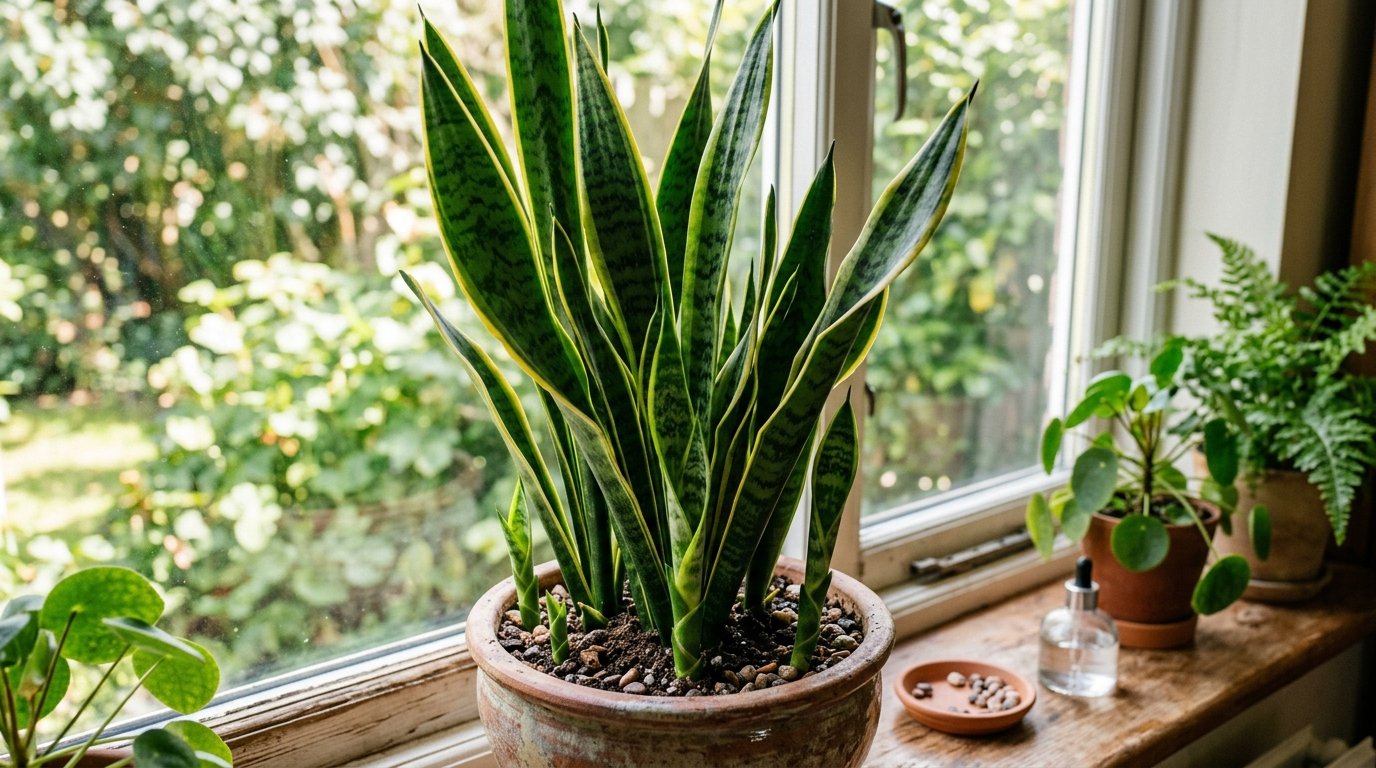
Snake plants are adaptable, but bright indirect light generally provides better conditions for healthy growth.
Low light can slow growth considerably. You may notice that the plant produces new leaves very slowly or that the foliage becomes less vigorous.
Bright indirect light means the room is well illuminated, but the plant is not exposed to intense sunlight for hours at a time.
Some snake plants can handle direct morning sunlight, particularly after gradual acclimation. Strong afternoon sunlight through a window can be much harsher and may cause leaf scorching.
Signs your snake plant may need more light
- Very slow growth.
- Long periods without new leaves.
- The plant leaning strongly toward a window.
- Variegated foliage becoming less pronounced.
- Weak-looking new growth.
If watering is already correct but growth remains extremely slow, examine the lighting before adding more fertilizer.
How Often Should You Water a Snake Plant Indoors?
There is no perfect watering schedule for every snake plant.
Instead of watering every seven or fourteen days, check the soil.
Snake plants store moisture in their leaves and rhizomes, so they can go longer between waterings than many other indoor plants. The amount of water they need depends on light, temperature, pot size, soil composition, and season.
Before watering, check:
- Feel the potting soil several centimeters below the surface.
- Determine whether it is still noticeably moist.
- If the soil is wet, wait.
- If the soil has dried thoroughly, water the plant.
- Allow excess water to drain completely.
- Empty water that collects beneath the pot.
The goal is not to keep the soil slightly wet all the time.
Why overwatering is dangerous
Snake plants are often killed by excessive moisture rather than a lack of water.
When soil stays wet for too long, roots may struggle to function properly and can eventually rot. The problem can become serious before visible symptoms appear on the leaves.
This is why checking soil moisture is much more reliable than following a fixed watering calendar.
How Much Water Does a Snake Plant Need?
When the plant actually needs water, water thoroughly rather than giving it a tiny splash.
Pour water evenly over the soil until some excess begins draining from the bottom of the container. Then allow the pot to drain completely.
Do not leave the pot sitting in a tray of water.
A small amount of water every few days can sometimes be worse than a thorough watering followed by a proper drying period because the soil may remain consistently damp.
Remember this simple rule:
Water thoroughly, then let the soil dry before watering again.
What Is the Best Soil for a Snake Plant?
Snake plants perform best in soil that drains efficiently.
A cactus or succulent-style potting mix is a practical option because it is generally designed to drain faster than heavy standard potting soil.
You can also use a regular houseplant mix improved with drainage materials such as perlite.
The objective is to create soil that:
- Drains excess water quickly.
- Does not remain saturated for long periods.
- Provides enough air around the roots.
- Holds enough moisture for the plant to use.
- Does not become dense and compacted easily.
Heavy soil that remains wet for a long time increases the risk of root problems.
Image Suggestion: Comparison of compact wet soil versus airy, well-draining snake plant soil.
Does a Snake Plant Need a Drainage Hole?
Yes.
A drainage hole is one of the most useful features a snake plant pot can have.
Without drainage, excess water has nowhere to escape. Even if you think you are watering carefully, water can accumulate at the bottom of the container.
A decorative pot without drainage can still be used as an outer container, but the snake plant should ideally remain in a nursery-style pot with drainage holes inside it.
After watering, allow the inner pot to drain before returning it to the decorative container.
What Size Pot Is Best for a Snake Plant?
Do not automatically choose a huge pot for your snake plant.
A container that is dramatically larger than the root system can hold a large amount of unused soil. That soil can stay wet for a long time after watering.
Choose a pot that provides enough room for the roots and rhizomes without being excessively oversized.
Snake plants can tolerate being somewhat root-bound, so repotting is not something you need to do simply because another year has passed.
Choose a larger pot when:
- Roots have heavily filled the container.
- Rhizomes are pushing against the sides.
- The plant has become unstable.
- The existing soil drains poorly.
- The container is damaged or too small for the growing plant.
What Temperature Is Best for an Indoor Snake Plant?
Snake plants generally do well in comfortable household temperatures.
You do not need to create a tropical environment for them.
Try to keep the plant away from sudden temperature extremes and prolonged exposure to very cold conditions.
Avoid placing it directly beside a heating system or air-conditioning outlet. Rapid temperature changes can stress the plant and dry the soil unevenly.
A stable indoor environment is usually more important than maintaining an exact temperature.
Does a Snake Plant Need High Humidity?
No.
One of the advantages of snake plants is their ability to tolerate ordinary household humidity.
You generally do not need to mist the leaves every day or purchase a humidifier specifically for a snake plant.
If your home has normal indoor humidity, concentrate your attention on light, soil, drainage, and watering.
Avoid excessive misting
Constantly misting a snake plant does not solve poor watering or lighting problems.
If the plant is struggling, inspect its growing conditions rather than assuming it needs more humidity.
Should You Fertilize a Snake Plant?
Snake plants are relatively light feeders.
During active growth, you can use a balanced indoor-plant fertilizer according to the product’s recommended dilution.
There is no advantage to heavily fertilizing a plant that is already struggling because of poor drainage or insufficient light.
A simple feeding routine:
- Fertilize during active growth.
- Follow the recommended dilution.
- Avoid excessive applications.
- Reduce feeding when growth slows.
- Do not use fertilizer as a substitute for proper light and watering.
If your snake plant is healthy and growing slowly, that does not necessarily mean it needs more fertilizer. Snake plants naturally tend to grow at a moderate pace indoors.
How to Clean Snake Plant Leaves
Dust can accumulate on the broad surfaces of snake plant leaves.
Every few weeks or whenever the leaves become visibly dusty, gently wipe them with a clean, slightly damp cloth.
Support the leaf while wiping rather than bending it sharply.
Avoid household cleaning products, oils, or polishing substances that can leave residues on the foliage.
Clean leaves also make it easier to notice pests, discoloration, or physical damage.
Image Suggestion: Step-by-step illustration showing how to clean snake plant leaves safely.
Why Are My Snake Plant Leaves Turning Yellow?
Yellow leaves can have several causes, but excessive moisture is one of the first things to investigate.
Check the soil before adding more water.
Possible causes include:
- Overwatering.
- Poor drainage.
- Naturally aging leaves.
- Environmental stress.
- Root problems.
- Sudden changes in growing conditions.
If several leaves are yellow while the soil remains wet for long periods, review your watering and drainage practices.
Do not automatically assume yellow leaves mean the plant is thirsty.
Why Are My Snake Plant Leaves Soft?
Soft or mushy leaves can be a warning sign, especially when the soil is consistently wet.
Healthy snake plant leaves should generally feel firm.
If the leaves are becoming soft at the base, check the roots and rhizomes if necessary. Persistent wet soil can contribute to rot.
What to do:
- Stop watering temporarily.
- Check how wet the soil is.
- Confirm that the container drains properly.
- Inspect the roots if symptoms are severe.
- Remove obviously damaged or rotten material with a clean tool.
- Repot into fresh, well-draining soil when appropriate.
- Correct the watering routine.
The most important step is fixing the underlying moisture problem.
Why Is My Snake Plant Falling Over?
A snake plant can lean or fall for several reasons.
One possibility is that it is growing toward a light source. Another is that the plant has become top-heavy or the container is too light.
However, falling leaves that are soft near the base can indicate a more serious moisture-related problem.
Check these things:
- Is the plant receiving enough light?
- Is the pot stable?
- Are the leaves firm?
- Is the soil excessively wet?
- Are the roots healthy?
- Has the plant recently been moved?
If the plant is healthy but leaning toward a window, rotating the pot occasionally can help encourage more balanced growth.
Why Are My Snake Plant Leaves Wrinkled?
Wrinkled or puckered leaves can indicate that the plant is becoming dehydrated.
Check the soil first.
If the soil is completely dry and the leaves have lost their firmness, give the plant a thorough watering and allow excess water to drain away.
However, do not respond to wrinkled leaves by repeatedly watering without checking the soil. Root damage from overwatering can also interfere with the plant’s ability to absorb water.
This is why both the leaves and the soil should be examined together.
Can a Snake Plant Grow in Low Light?
Yes, snake plants can tolerate low-light conditions.
That is one of their most useful qualities as indoor plants.
However, there is an important difference between surviving low light and growing actively in good light.
A snake plant kept in a dim room may produce very little new growth. If you want stronger growth, move it toward a brighter location with indirect light.
Do this gradually if the plant has been adapted to low light for a long time.
Can a Snake Plant Grow in a Bedroom?
Yes.
A snake plant can be grown indoors in a bedroom as long as it receives appropriate light and is not overwatered.
There is no need to create special nighttime conditions. Treat it like any other indoor plant and focus on its basic growing requirements.
Can a Snake Plant Grow in an Office?
Yes.
Snake plants are particularly adaptable to indoor environments and can work well in offices.
An office plant may receive less natural light than one near a large home window, so monitor its growth and position it in the brightest suitable location.
If natural light is very limited, supplemental plant lighting can help.
How Do You Repot a Snake Plant?
Repotting is relatively straightforward.
Step 1: Prepare the new container
Choose a pot with drainage holes that is only moderately larger than the current container.
Step 2: Prepare fresh soil
Use a well-draining potting mix suitable for succulents or other plants that dislike waterlogged conditions.
Step 3: Remove the plant
Gently loosen the plant from its current container.
Avoid pulling forcefully on individual leaves.
Step 4: Inspect the roots
Look for healthy, firm roots and rhizomes. If you find obviously rotten material, remove it carefully with a clean cutting tool.
Step 5: Replant
Place the plant at an appropriate depth and fill around the roots with fresh soil.
Step 6: Allow it to settle
Avoid turning repotting into a reason for constant watering. Let the plant adjust while maintaining sensible moisture levels.
When Should You Repot a Snake Plant?
Repotting should be based on the plant’s condition rather than an arbitrary yearly schedule.
Consider repotting when:
- The root system has become heavily crowded.
- Rhizomes are pushing against the container.
- The pot is physically damaged.
- The plant repeatedly becomes unstable.
- The soil has deteriorated.
- Drainage has become poor.
A snake plant can remain in the same container for quite some time when conditions are suitable.
How to Propagate a Snake Plant
Snake plants can be propagated through division or leaf cuttings.
Propagation by division
Division is especially useful when a mature snake plant has developed several shoots.
- Remove the plant from its container.
- Examine the underground rhizomes.
- Separate suitable sections.
- Make clean cuts when necessary.
- Plant the divisions in appropriate soil.
- Keep moisture under control while they establish.
Division is often the easiest approach when the parent plant already has multiple established growth points.
Propagation from leaf cuttings
Healthy leaves can be divided into sections and rooted under suitable conditions.
However, propagation from leaf cuttings does not always preserve the exact appearance of certain variegated cultivars.
For maintaining the characteristics of a particular plant, division can be preferable when suitable offsets are available.
Image Suggestion: Snake plant propagation diagram showing division of rhizomes and leaf-cutting propagation.
How to Care for a Snake Plant in Winter
Winter care often requires one major adjustment: water less frequently when the soil dries more slowly.
Shorter days and lower indoor temperatures can reduce the plant’s water use.
Before watering during winter, check the soil carefully.
Winter care checklist:
- Keep the plant away from cold drafts.
- Provide as much suitable light as possible.
- Reduce watering when the soil dries slowly.
- Avoid cold, saturated soil.
- Limit fertilizer when growth is minimal.
- Keep the plant away from extreme heat sources.
Do not continue a summer watering routine automatically during winter.
Snake Plant Care During Summer
Summer can increase evaporation and plant activity, particularly in bright rooms.
But warmer weather does not automatically mean your snake plant needs daily watering.
Check the soil more frequently, especially if the plant receives strong indirect light.
If the pot dries quickly, water thoroughly when appropriate and allow excess water to drain.
Common Snake Plant Care Mistakes
Watering on a fixed schedule
A plant does not know what day of the week it is.
Better approach: Check the soil before watering.
Using heavy garden soil
Dense soil can retain too much moisture indoors.
Better approach: Use a fast-draining potting mix.
Choosing a pot without drainage
Excess water becomes trapped.
Better approach: Use a container with drainage holes.
Keeping the plant in complete darkness
Low-light tolerance does not mean no-light tolerance.
Better approach: Give it brighter indirect light whenever possible.
Giving too much fertilizer
More fertilizer does not automatically mean faster or healthier growth.
Better approach: Feed lightly and only when appropriate.
Misting constantly
Snake plants do not require tropical humidity.
Better approach: Focus on soil moisture and drainage.
Repotting too often
Frequent repotting can create unnecessary disturbance.
Better approach: Repot when the plant actually needs a larger container or fresh growing medium.
Moving directly from low light to harsh sunlight
Sudden changes can damage foliage.
Better approach: Increase light exposure gradually.
A Simple Snake Plant Care Routine
You do not need to spend hours caring for a snake plant.
Once a week, check:
- Soil moisture.
- Leaf firmness.
- Overall leaf color.
- Light exposure.
- Signs of pests.
- Water sitting beneath the pot.
- Dust accumulation.
Most weeks, the correct action may simply be to do nothing.
If the soil is still moist, leave the plant alone.
This is an important lesson with snake plant care: sometimes the best care is knowing when not to interfere.
Snake Plant Problems at a Glance
| Problem | Possible Cause | What to Check |
|---|---|---|
| Yellow leaves | Excess moisture or aging | Soil and drainage |
| Soft leaves | Overwatering or rot | Soil and leaf bases |
| Wrinkled leaves | Dehydration or root problems | Soil moisture and roots |
| Slow growth | Low light or natural growth rate | Light levels |
| Leaning leaves | Uneven light or instability | Position and pot |
| Brown patches | Sun stress or physical damage | Light exposure |
| Mushy base | Serious moisture problem | Roots and rhizomes |
| Pests | Insect infestation | Leaf surfaces and bases |
Frequently Asked Questions
How often should I water a snake plant indoors?
Water when the soil has dried thoroughly rather than watering according to a fixed schedule. The exact timing depends on light, temperature, pot size, soil, and season.
Does a snake plant need direct sunlight?
No. Bright indirect light is usually ideal. Snake plants can tolerate some direct sunlight when properly acclimated, but intense sunlight can damage the leaves.
What is the best soil for a snake plant?
Choose a fast-draining, well-aerated potting mix. A cactus or succulent-style mix is a convenient option.
Should I mist my snake plant?
Regular misting is unnecessary. Snake plants generally tolerate normal household humidity.
Why is my snake plant turning yellow?
Excessive moisture is one possible cause. Check whether the soil remains wet for long periods and make sure the pot drains properly.
Why are my snake plant leaves falling over?
Soft leaves can indicate moisture-related problems, while healthy leaves that lean may simply be reaching toward a light source. Check the soil, roots, light, and stability of the container.
Can snake plants survive in low light?
Yes. They tolerate low light, but growth may become very slow. Brighter indirect light generally supports better growth.
Does a snake plant need fertilizer?
It can benefit from light feeding during active growth, but excessive fertilizer is unnecessary.
When should I repot my snake plant?
Repot when the plant becomes significantly crowded, the container is no longer suitable, or the potting mix has deteriorated. Do not repot simply because a particular amount of time has passed.
Can I keep a snake plant in my bedroom?
Yes. A bedroom can be a suitable location as long as the plant receives appropriate light and is not overwatered.
How do I save an overwatered snake plant?
Stop watering and assess the soil and roots. Improve drainage and remove severely rotten roots or rhizomes when necessary. Replanting into fresh, well-draining soil may be appropriate for serious cases.
Final Thoughts
The secret to successful how to take care of snake plant indoor care is surprisingly simple: give it enough light, let the soil dry between waterings, and provide excellent drainage.
Do not treat a snake plant like a thirsty tropical houseplant. Its thick leaves and underground rhizomes allow it to store water, which means frequent watering can cause more problems than occasional dryness.
Pay attention to the plant instead of following a rigid calendar. Check the soil before watering, observe the leaves, adjust care as seasons change, and avoid unnecessary intervention.
With the right combination of bright indirect light, well-draining soil, a suitable pot, moderate watering, and occasional feeding, your snake plant can remain a healthy and attractive indoor plant for years.