Quick Answer
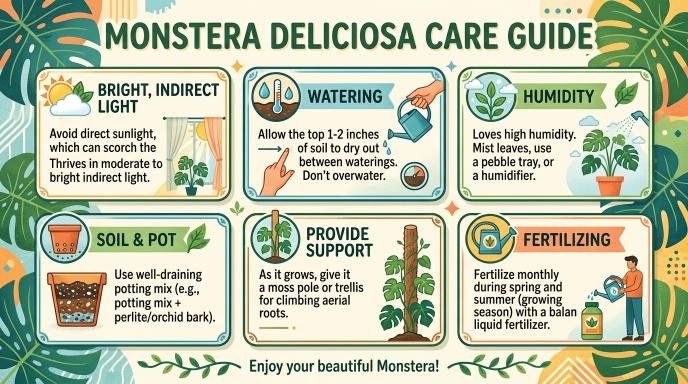
Monstera deliciosa care is mainly about providing bright indirect light, well-draining soil, moderate watering, warmth, humidity, and enough space for the plant to climb.
Water when the upper few inches of soil become dry rather than following a rigid schedule. Support mature plants with a moss pole or sturdy trellis, rotate the pot regularly, and inspect leaves and roots for early signs of stress.
Introduction
Monstera deliciosa is one of the most recognizable tropical houseplants, but keeping it healthy involves more than placing it near a window and watering it occasionally. Its large leaves, natural climbing habit, and characteristic splits develop best when its growing conditions match the way it grows in tropical forests.
The biggest problems with Monstera deliciosa usually come from simple care mistakes: watering too frequently, insufficient light, compacted soil, poor drainage, or failing to provide climbing support. Understanding what the plant is telling you makes care much easier. Yellow leaves, curling foliage, slow growth, and brown edges can all point to different environmental problems.
This guide explains Monstera deliciosa care from the basics through advanced maintenance, including watering, lighting, soil, humidity, fertilizing, pruning, repotting, propagation, support, seasonal care, and troubleshooting.
Understanding Monstera Deliciosa Growth
Monstera deliciosa is a tropical climbing plant that naturally uses trees and other structures for support. Indoors, it may initially grow horizontally or produce long stems as it searches for stronger light and something to climb.
This climbing behavior is important when planning care.
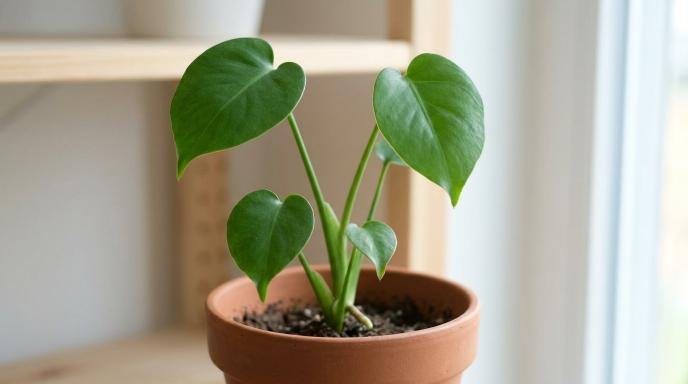
A young Monstera may have relatively small, solid leaves. As the plant matures and receives appropriate light and support, its leaves can become considerably larger and develop fenestrations, which are the characteristic splits and holes associated with mature Monstera foliage.
Not every leaf will suddenly become highly fenestrated. Plant age, genetics, light, growing conditions, and overall health all influence leaf development.
How Much Light Does Monstera Deliciosa Need?
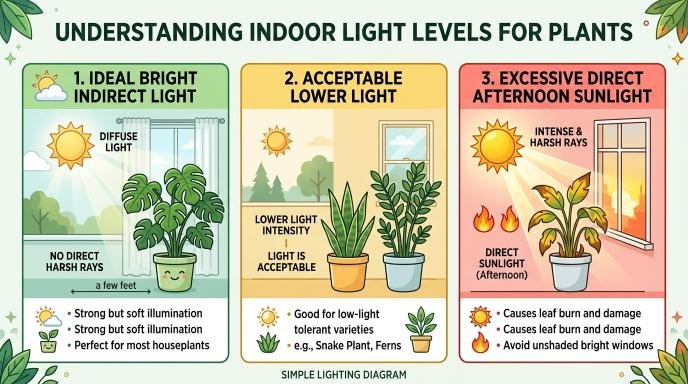
Bright, indirect light is usually the best indoor lighting condition for Monstera deliciosa.
Place the plant near a bright window where it receives plenty of filtered or indirect daylight. A little gentle direct morning sunlight can be tolerated by many plants, but intense afternoon sun through glass can scorch leaves, particularly when the plant has been growing in lower light.
Light matters because the plant needs sufficient energy for new leaves, strong stems, and healthy root growth.
Signs Your Monstera Needs More Light
Watch for:
- Slow or stalled growth.
- Long gaps between leaves along the stem.
- Small new leaves.
- Pale or weak-looking foliage.
- A plant leaning strongly toward the window.
- Reduced development of mature leaf fenestrations.
If your Monstera is growing slowly, increasing light is often more useful than immediately adding fertilizer.
Can Monstera Deliciosa Grow in Low Light?
It can survive in lower light, but survival is different from vigorous growth.
A Monstera kept too far from a window may produce smaller leaves and longer, weaker growth. Water also tends to remain in the soil longer when light levels are low, which increases the risk of overwatering.
Practical Tip: If the plant is several feet away from a bright window and growing poorly, move it gradually toward stronger filtered light rather than dramatically changing its environment overnight.
Watering Monstera Deliciosa Correctly
Watering is one of the most important parts of Monstera deliciosa care, and a fixed calendar schedule is rarely reliable.
Instead, check the soil before watering.
When the upper portion of the potting mix has dried and the deeper soil is beginning to lose its moisture, water thoroughly until excess water drains from the bottom of the pot. Empty standing water from a decorative cachepot or saucer rather than allowing the roots to sit in it.
The exact interval varies according to:
- Light intensity.
- Temperature.
- Humidity.
- Pot size.
- Soil composition.
- Plant size.
- Season.
- Root health.
A large Monstera in bright light may use water considerably faster than a small plant sitting in a cool, dim room.
How to Tell When It Needs Water
Check several areas rather than judging only the surface.
You can:
- Insert a finger several centimeters into the soil.
- Lift the pot to judge whether it feels noticeably lighter.
- Use a moisture meter as an additional reference.
- Observe the plant for multiple symptoms rather than relying on leaf drooping alone.
The surface can look dry while deeper soil remains wet, especially in a large container.
What Happens When You Overwater?
Overwatering does not simply mean giving the plant too much water during one watering session. More commonly, it means the roots remain in wet soil for too long.
Persistently wet conditions reduce air around the roots and can contribute to root deterioration.
Possible symptoms include:
- Yellowing leaves.
- Soft or deteriorating roots.
- A persistently wet potting mix.
- Leaf drop.
- Slow growth.
- An unpleasant smell from severely deteriorating soil.
The solution is not automatically to stop watering for a long period. First determine why the soil is staying wet.
Poor drainage, oversized containers, compacted soil, low light, and cool conditions can all contribute.
What Happens When a Monstera Is Underwatered?
A severely dry Monstera may develop:
- Drooping leaves.
- Dry or crispy brown edges.
- Curling foliage.
- Very dry potting mix.
- Rapid loss of moisture after watering.
If the soil has become extremely dry and pulled away from the sides of the container, water slowly and thoroughly so the entire root zone can rehydrate.
Choosing the Right Soil for Monstera Deliciosa
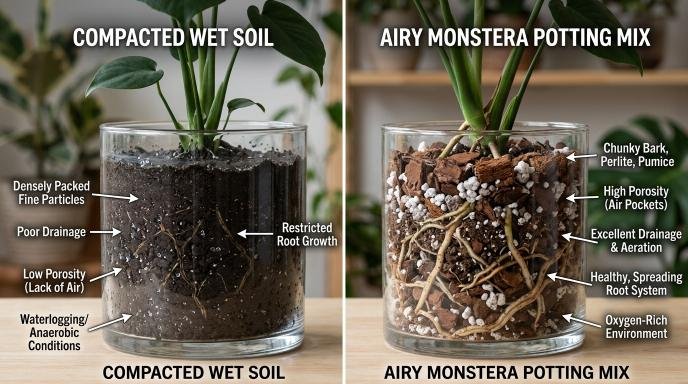
Monstera deliciosa prefers a growing medium that retains some moisture while allowing plenty of air around the roots.
A useful mix can contain:
- Quality indoor potting mix.
- Orchid bark.
- Perlite or another material that improves aeration.
- A modest amount of moisture-retaining organic material when appropriate.
The exact recipe is less important than the result.
You want a mix that drains efficiently without becoming bone dry immediately after watering.
A dense, muddy mix can remain wet for too long. An extremely coarse mix may drain so rapidly that the roots struggle to receive consistent moisture.
Why Soil Aeration Matters
Roots require oxygen as well as water.
When all the spaces between soil particles remain filled with water for extended periods, the root environment becomes poorly aerated. This is one reason drainage and watering should be considered together rather than separately.
Expert Tip: If you frequently find that the soil remains wet for many days, changing the watering schedule alone may not solve the problem. Examine the potting mix, container size, drainage holes, and light level.
Choosing the Right Pot
A Monstera should generally be grown in a container with adequate drainage holes.
Do not automatically choose an enormous pot because the plant is expected to become large.
An oversized container can hold more moisture than the current root system can use. This can make moisture management more difficult.
When repotting, moving into a moderately larger container is often more practical than jumping into a dramatically larger one.
Terracotta, plastic, and glazed ceramic containers can all work. The material influences how quickly moisture evaporates, so watering should be adjusted accordingly.
Humidity Requirements
Monstera deliciosa comes from tropical environments and generally appreciates moderate to higher humidity indoors.
However, extremely high humidity is not a substitute for proper watering, airflow, light, or drainage.
Low indoor humidity can contribute to:
- Brown leaf margins.
- Crispy leaf tips.
- Faster moisture loss from foliage.
- Stress during very dry weather.
Helpful approaches include:
- Grouping compatible plants together.
- Using a humidifier when indoor air is consistently dry.
- Keeping the plant away from strong heating or cooling vents.
- Maintaining reasonable airflow around the foliage.
Misting leaves can temporarily wet the surface but does not reliably maintain elevated humidity for long periods.
Practical Tip: If the room is dry, improving the overall room humidity is generally more useful than repeatedly spraying the leaves.
Temperature for Monstera Deliciosa
Monstera deliciosa grows best in warm indoor conditions without dramatic temperature swings.
Protect it from:
- Cold drafts.
- Freezing temperatures.
- Direct blasts from heating vents.
- Strong air-conditioning currents.
- Abrupt environmental changes.
A warm, stable room is generally easier for the plant to handle than a location that repeatedly shifts between hot and cold.
Fertilizing Monstera Deliciosa
A Monstera actively producing new leaves benefits from regular nutrition during its growing period.
Use a balanced houseplant fertilizer according to its label directions rather than assuming more fertilizer means faster growth.
Overfertilization can cause salt accumulation in the growing medium and damage roots.
When to Fertilize
During active growth:
- Apply fertilizer at an appropriate diluted strength.
- Follow the product’s recommended frequency.
- Avoid repeatedly increasing the dose because growth appears slow.
During periods of substantially reduced growth, fertilizer demand generally decreases.
Expert Tip: If a Monstera has poor light, correcting the light problem should usually come before increasing fertilizer. A plant cannot compensate for inadequate light simply by receiving more nutrients.
Why Monstera Leaves Split
Fenestrated leaves are a major reason people grow Monstera deliciosa.
However, leaf splits do not appear simply because the plant reaches a particular number of months or receives fertilizer.
Fenestration is associated with maturity and the plant’s growing conditions.
Young plants commonly produce more solid leaves. As they mature, new foliage can develop more pronounced splits and holes.
How to Encourage Mature Foliage
Focus on the fundamentals:
- Provide strong, suitable light.
- Keep roots healthy.
- Avoid chronic overwatering.
- Provide consistent nutrition during active growth.
- Give the plant something sturdy to climb.
- Allow the plant to mature.
Do not cut holes into leaves to imitate natural fenestrations. Artificial cuts do not make a leaf mature.
Supporting a Climbing Monstera
A mature Monstera looks and grows differently when given vertical support.
A moss pole, coir pole, trellis, or another sturdy structure can help the plant grow upward instead of sprawling across furniture.
Attach the main stem gently using soft plant ties. Avoid tightly wrapping ties around stems because stems expand as the plant grows.
Why Support Matters
A climbing structure can:
- Keep growth more organized.
- Reduce sprawling.
- Help the plant orient itself vertically.
- Make large plants easier to manage.
- Complement the plant’s natural growth habit.
Do not confuse the petiole with the main stem when securing the plant. The petioles are the structures that hold individual leaves and need freedom to move.
Expert Tip: Secure the main stem at several points instead of forcing every leaf stalk against the support.
Pruning Monstera Deliciosa
Pruning is useful for controlling size, removing damaged foliage, and shaping an overgrown plant.
Use clean, sharp pruning tools.
Remove:
- Completely dead leaves.
- Severely damaged foliage.
- Diseased tissue when necessary.
- Unwanted growth when reshaping the plant.
Avoid removing healthy leaves simply because they have one minor cosmetic imperfection. Healthy foliage contributes to photosynthesis and supports the plant’s growth.
If you want to make a major cut for propagation or restructuring, identify the nodes carefully before cutting.
Repotting Monstera Deliciosa
A Monstera does not need to be repotted simply because a certain amount of time has passed.
Look for signs such as:
- Roots emerging extensively from drainage holes.
- The root system becoming extremely crowded.
- Soil breaking down and draining poorly.
- Water passing through unusually quickly because the root mass has filled the container.
- Growth slowing despite otherwise suitable conditions.
When repotting:
- Select a container with drainage holes.
- Choose a pot only moderately larger than the current one.
- Prepare a fresh, airy growing medium.
- Remove the plant carefully.
- Inspect the roots.
- Remove clearly dead or severely damaged roots with clean tools.
- Position the plant at approximately the same depth.
- Fill around the root ball without heavily compacting the mix.
- Water appropriately after repotting.
- Return the plant to suitable light.
Avoid burying the stem substantially deeper than it was previously planted.
Propagating Monstera Deliciosa
Monstera deliciosa is commonly propagated from stem cuttings.
The crucial feature is the node.
A leaf by itself generally cannot produce a complete new Monstera because the necessary growth point is associated with the stem node.
A viable cutting should include a healthy node, and depending on the propagation method, it may also include an aerial root.
Basic Propagation Process
- Select a healthy section of stem.
- Make a clean cut around the appropriate node.
- Choose water, an appropriate propagation medium, or another suitable method.
- Keep the node in the appropriate environment while avoiding unnecessary saturation of the cutting.
- Provide warmth and bright indirect light.
- Wait for roots and new growth to develop.
- Transfer to a suitable potting medium when the cutting has established sufficiently.
Common Mistake: Taking a cutting that contains a leaf but no node. The leaf may remain attractive for a while, but it does not contain the growth point required to produce a new plant.
Cleaning Monstera Leaves
Large Monstera leaves naturally collect dust.
Dust can make foliage look dull and may interfere with the plant’s ability to use light efficiently.
Wipe leaves gently with clean water and a soft cloth when needed.
Avoid routinely applying oily products or household cleaners to leaves.
When cleaning, inspect the underside of leaves and the junctions around stems. These areas can reveal pests before an infestation becomes obvious.
Common Monstera Deliciosa Care Mistakes
Watering on a Fixed Schedule
Watering every few days regardless of conditions is unreliable.
The plant’s water consumption changes with light, temperature, humidity, season, and pot size.
Keeping It Too Far From a Window
A Monstera can survive in surprisingly low light but may become stretched and produce smaller foliage.
Using Heavy Soil
Dense soil can remain wet around roots for too long.
Choosing a Huge Pot
More soil means more moisture-holding capacity. A container that is too large can make root-zone moisture harder to manage.
Overfertilizing
Extra fertilizer cannot replace suitable light and healthy roots.
Ignoring the Climbing Habit
A mature Monstera may become difficult to manage when allowed to sprawl without support.
Cutting Leaves to Create Fenestrations
Artificial holes do not reproduce the plant’s natural maturation process.
Moving the Plant Constantly
Repeatedly changing its location makes it harder to determine which environmental conditions are helping or hurting the plant.
Monstera Deliciosa Troubleshooting Guide
| Problem | Possible Causes | What to Check |
|---|---|---|
| Yellow leaves | Excess moisture, aging foliage, stress | Soil moisture, drainage, light, roots |
| Brown crispy edges | Dry conditions, inconsistent watering, low humidity | Soil moisture and room humidity |
| Curling leaves | Water stress, heat, environmental stress | Soil and temperature |
| Small new leaves | Insufficient light, juvenile growth, limited resources | Light and overall plant health |
| Long gaps between leaves | Insufficient light or climbing growth | Window placement and support |
| Drooping leaves | Underwatering, root problems, environmental stress | Soil and roots |
| Slow growth | Low light, poor nutrition, cool conditions, root problems | Light, temperature, roots, fertilizer |
| Black or deteriorating roots | Excessive moisture and poor aeration | Root condition and soil drainage |
| Brown spots | Physical damage, watering stress, pests, environmental issues | Both sides of leaves |
| No fenestrations | Juvenile plant, insufficient maturity, growing conditions | Plant age, light, support, health |
The important point is that a single symptom does not always have a single cause.
For example, yellow leaves can occur after excessive watering, but an individual older leaf can also naturally age and turn yellow. Look at the entire plant and the growing environment before making a major change.
How to Diagnose a Struggling Monstera
When your Monstera starts looking unhealthy, avoid changing five things simultaneously.
Instead, work through the environment systematically.
Step 1: Check the Light
Is it receiving enough bright indirect light?
If not, improve the location gradually.
Step 2: Check the Soil
Determine whether it is genuinely dry, moderately moist, or staying wet for an unusually long time.
Step 3: Inspect the Pot
Confirm that drainage holes are open and water can escape freely.
Step 4: Examine the Roots if Necessary
If the soil stays wet for an extended period and the plant continues declining, inspect the roots for signs of deterioration.
Step 5: Inspect the Leaves
Look underneath leaves, around petioles, and along stems for pests or unusual discoloration.
Step 6: Make One or Two Targeted Changes
Give the plant time to respond before making another major adjustment.
This approach is more useful than reacting to every new leaf symptom with a different treatment.
Seasonal Monstera Deliciosa Care
Spring and Summer
During active growth, a healthy Monstera may require more frequent watering and regular feeding.
Monitor the soil instead of automatically increasing watering frequency.
This is also a useful period for:
- Repotting.
- Propagation.
- Adding climbing support.
- Pruning.
- Training new growth.
Fall and Winter
Growth often slows when light levels decrease.
As the plant uses less water, the soil may remain moist for longer.
Reduce watering frequency when necessary, but do not automatically stop watering.
Keep the plant away from cold drafts and heating vents.
Practical Tip: Many winter watering problems happen because people continue using a summer watering schedule after the plant’s light and growth have decreased.
Monstera Deliciosa Care for Beginners
If you are new to houseplants, focus on five priorities rather than trying to optimize everything at once.
- Give it bright indirect light.
- Use a pot with drainage holes.
- Let the soil partially dry before watering again.
- Use an airy, well-draining potting mix.
- Provide support as the plant begins climbing.
Once these basics are working, you can fine-tune humidity, fertilization, pruning, propagation, and training.
Advanced Tips for Larger Monsteras
Large Monsteras require a slightly different approach because their size changes how quickly they use water and how much structural support they need.
For mature plants:
- Inspect the entire root zone rather than only the soil surface.
- Use sturdy climbing support.
- Rotate the plant when appropriate for balanced growth.
- Avoid weak stakes that cannot support mature stems.
- Monitor the weight and stability of the container.
- Keep large leaves free from excessive dust.
- Prune strategically instead of removing healthy foliage unnecessarily.
- Consider the plant’s future size before choosing its permanent location.
A mature Monstera can become top-heavy. A stable container and strong support are therefore practical safety considerations, not merely decorative choices.
Frequently Asked Questions
How often should I water Monstera deliciosa?
Water when the upper portion of the potting mix has dried sufficiently and the plant needs moisture. The exact timing depends on light, temperature, humidity, pot size, soil, and plant size.
Does Monstera deliciosa need direct sunlight?
It generally performs well in bright indirect light. Gentle direct morning light may be tolerated, while intense direct sunlight can scorch foliage, especially when the plant is not acclimated.
Why are my Monstera leaves turning yellow?
Yellow leaves can result from excessive moisture, root stress, natural aging, or other environmental problems. Check soil moisture, drainage, light, and the condition of the roots before changing the care routine.
Why is my Monstera not producing split leaves?
Young Monsteras often produce solid leaves. Fenestrations become more common as the plant matures. Appropriate light, healthy roots, adequate nutrition, and climbing support can help the plant develop mature foliage.
Should I mist my Monstera?
Misting can temporarily wet the leaf surface but does not provide lasting humidity. If your indoor air is consistently dry, improving room humidity is generally more effective.
Does Monstera deliciosa need a moss pole?
It does not absolutely require one, but a sturdy climbing support can be very useful because Monstera deliciosa naturally climbs. Support can also help organize mature growth.
Can I grow Monstera deliciosa in low light?
It can tolerate lower light, but growth is often slower and foliage may remain smaller. Brighter indirect light generally supports stronger growth.
Why are my Monstera leaves curling?
Curling can be associated with underwatering, excessive heat, low humidity, root problems, or other environmental stress. Check the soil and growing conditions before assuming humidity is the cause.
When should I repot my Monstera?
Repot when the root system has substantially filled the container, drainage has deteriorated, or the growing medium has broken down. Choose a moderately larger pot rather than an excessively large one.
Can a Monstera grow from a leaf cutting?
A leaf without a node generally cannot produce a new complete Monstera plant. Propagation should include a viable stem node.
How do I make my Monstera grow bigger?
Provide strong indirect light, healthy roots, appropriate watering, suitable nutrition, and climbing support. Consistency is more important than using a single growth-boosting trick.
Can Monstera deliciosa grow outdoors?
In suitable warm climates, Monstera deliciosa can grow outdoors, particularly where temperatures remain warm and the plant is protected from harsh direct sunlight. In cooler climates, it may need to be grown indoors or protected during colder periods.
Final Takeaways
Successful Monstera deliciosa care comes down to understanding the plant rather than following a rigid watering calendar.
Give it bright indirect light, an airy growing medium, effective drainage, appropriate moisture, warmth, and enough room to climb. Check the soil before watering, pay attention to changes in leaf appearance, and investigate the root environment when problems persist.
Most importantly, treat symptoms as clues. A yellow leaf, curling edge, or slow-growing stem is not automatically a signal to add more water, fertilizer, or humidity. Look at the plant’s complete environment and make targeted adjustments.
With consistent conditions and patience, a Monstera deliciosa can develop larger foliage, stronger climbing growth, and the mature fenestrations that make this tropical plant so distinctive.