Quick Answer
Anthurium crystallinum care is mainly about providing bright indirect light, high humidity, warmth, an airy well-draining growing mix, and consistent but controlled moisture.
Water when the upper portion of the mix begins to dry, avoid standing water, and protect the velvety leaves from harsh direct sun. Good airflow and careful watering are especially important because overly wet roots can lead to root rot.
Introduction
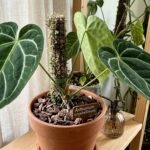
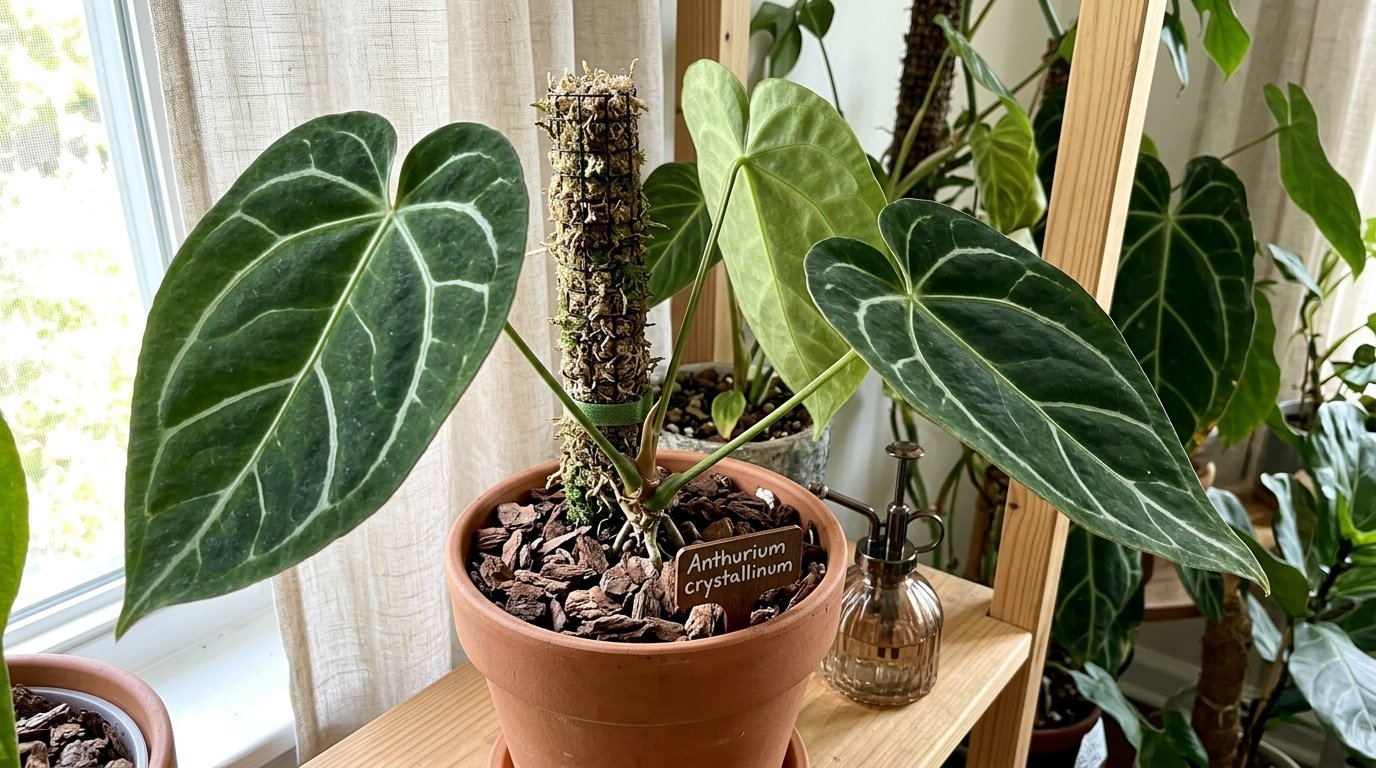
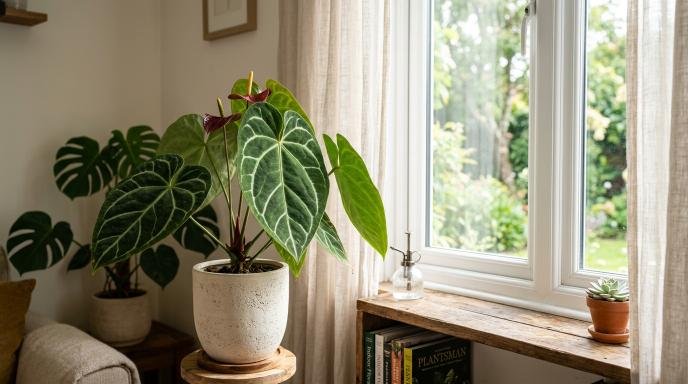
Anthurium crystallinum is a prized tropical foliage plant known for its large, dark green, velvety leaves and striking pale veins. Unlike the brightly colored florist anthuriums commonly sold for their flowers, this species is primarily grown for its dramatic foliage.
The biggest challenge with Anthurium crystallinum care is creating the balance between moisture and airflow. It likes humid conditions and evenly available moisture, but its roots still need oxygen. Keeping the pot constantly saturated can be just as damaging as allowing the plant to become severely dry.
For beginners, the most useful approach is not to follow a rigid watering calendar. Instead, learn to read the plant, the potting mix, the roots, and the growing environment.
What Is Anthurium Crystallinum?
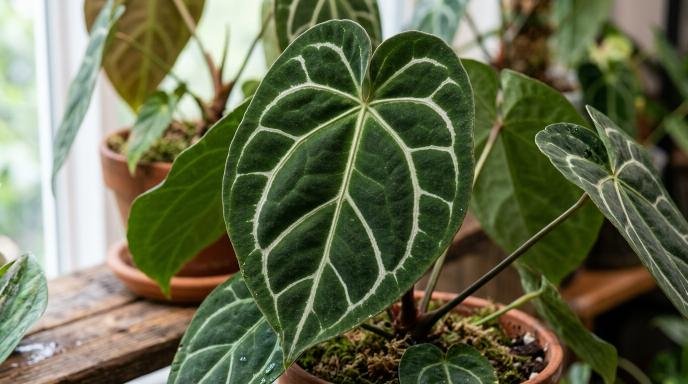
Anthurium crystallinum is a tropical evergreen species in the Araceae family. It is native to tropical regions extending from Panama to Colombia and is an epiphytic perennial, meaning it can naturally grow above ground rather than relying exclusively on dense terrestrial soil.
Its appeal comes primarily from its foliage. Mature leaves can become large, dark green, and distinctly velvety, with contrasting pale veins that create the characteristic crystal-like appearance.
The plant can produce greenish inflorescences consisting of a spathe and spadix, but flowering is usually less important to collectors than maintaining attractive foliage.
Because of its tropical and epiphytic nature, it performs best when its roots have access to both moisture and air.
Anthurium Crystallinum Care Requirements at a Glance
| Care Factor | Recommended Conditions |
|---|---|
| Light | Bright, indirect light |
| Water | Water when the upper mix begins approaching dryness |
| Humidity | High humidity is preferred |
| Temperature | Warm conditions, ideally around 18–27°C |
| Soil | Airy, moisture-retentive but fast-draining mix |
| Soil pH | Slightly acidic to neutral conditions |
| Fertilizer | Regular feeding during active growth |
| Pot | Drainage holes are essential |
| Repotting | Usually every few years or when the root system needs more room |
| Propagation | Division, stem/rhizome cuttings, offsets, or seed |
| Main risks | Root rot, leaf scorch, dry-air damage, pests |
These conditions reflect established cultivation guidance for the species and closely related anthuriums.
How Much Light Does Anthurium Crystallinum Need?
Anthurium crystallinum prefers bright, indirect light.
A position near an east- or west-facing window can work well when intense sunlight is filtered. A bright location helps the plant maintain strong growth and attractive foliage without exposing its leaves to prolonged harsh sunlight.
Too Much Light
Strong direct sunlight, particularly through hot glass, can scorch the leaves.
Signs may include:
- Pale or bleached-looking areas.
- Brown patches.
- Dry, crispy sections.
- Sudden deterioration after moving the plant into direct sun.
The solution is usually to move the plant farther from the window or add a sheer curtain rather than placing it in a dark corner.
Too Little Light
Insufficient light can cause slower growth and weaker, stretched growth.
A common mistake is assuming that because Anthurium crystallinum is a forest plant, it should be kept in a dim room. Tropical forest conditions can actually provide bright filtered light even when direct overhead sun is limited.
Practical tip: If you can comfortably read near the plant during the daytime without turning on a lamp, the location may have useful ambient light. If the area is consistently gloomy, consider supplementing with a suitable grow light.
How to Water Anthurium Crystallinum
Watering is one of the most important parts of Anthurium crystallinum care.
The goal is to keep the growing medium from becoming bone dry for prolonged periods while also preventing it from remaining saturated.
A useful method is:
- Check the potting mix with your finger or a moisture meter.
- If the upper portion has started to dry, assess the moisture deeper in the pot.
- Water thoroughly when the plant needs it.
- Allow excess water to drain completely.
- Empty any decorative cachepot or saucer that holds standing water.
Established cultivation guidance recommends watering when the compost is approaching dryness rather than maintaining permanently waterlogged conditions.
How Often Should You Water?
There is no universal watering schedule.
A plant growing in a warm, bright, humid room may need water considerably sooner than one growing in a cool room with low light.
Check the plant instead of automatically watering every seven days.
Factors that affect watering frequency include:
- Pot size.
- Growing-medium composition.
- Temperature.
- Humidity.
- Light intensity.
- Root density.
- Season.
- Air movement.
What Water Should You Use?
Rainwater or filtered water can be useful, particularly where tap water is hard or contains high levels of dissolved minerals. Room-temperature water is preferable to very cold water.
If brown edges repeatedly appear despite otherwise appropriate care, water quality is one environmental factor worth investigating.
Humidity Requirements
High humidity is one of the most important environmental factors for Anthurium crystallinum.
A humid environment helps reduce excessive moisture loss from the leaves and is especially useful for plants grown indoors in dry rooms. Some cultivation guidance recommends humidity around 70% or higher for this species.
However, humidity alone does not solve every problem.
A plant sitting in stagnant, constantly wet air can still develop problems. Good humidity should be combined with reasonable air circulation.
Best Ways to Increase Humidity
You can increase local humidity by:
- Using a humidifier.
- Grouping compatible tropical plants.
- Growing the plant in an naturally humid room.
- Using a pebble tray where appropriate.
- Maintaining consistent environmental conditions.
A humidifier is generally easier to control than repeatedly misting the leaves.
Important: Avoid treating misting as a substitute for proper humidity management. Wet foliage combined with poor airflow can create conditions favorable to leaf problems.
Best Temperature for Anthurium Crystallinum
Anthurium crystallinum prefers warm conditions and should be protected from cold drafts and sudden temperature changes.
A practical indoor target is approximately 18–27°C, with temperatures outside this range requiring greater attention to watering and environmental stability.
Cold conditions can slow growth and increase stress.
Keep the plant away from:
- Cold windows during winter.
- Air-conditioning vents.
- Exterior doors with frequent drafts.
- Strong heating vents.
- Radiators and other direct heat sources.
The goal is not simply high temperature. Stable warmth is more useful than repeatedly moving the plant between hot and cold conditions.
The Best Soil Mix for Anthurium Crystallinum
Anthurium crystallinum needs a growing medium that holds some moisture while remaining open and well aerated.
A dense garden-soil mixture is usually unsuitable because it can remain wet around the roots for too long.
A practical homemade mix can include:
- Peat-free acidic compost or a suitable fine organic component.
- Perlite or another drainage/aeration component.
- Orchid bark or another coarse material.
A commonly recommended formulation for anthuriums is approximately two parts acidic peat-free compost, one part perlite, and one part medium orchid bark.
The exact proportions do not need to be treated as a universal formula. The more important objective is an open structure that drains efficiently while retaining enough moisture for the roots.
Why Soil Structure Matters
Think of the potting mix as a balance between two requirements:
Moisture: roots need access to water.
Oxygen: roots also need air spaces around them.
If the mix collapses into a dense, muddy mass, the roots can remain oxygen-starved even though the plant is technically being watered correctly.
Choosing the Right Pot
Always use a container with drainage holes.
The pot should not be dramatically larger than the root system. An oversized container can hold more wet mix than the plant can use, increasing the time required for the substrate to dry. This is particularly risky for plants that are sensitive to prolonged wet conditions.
When repotting, moving only one size up is usually a safer approach than immediately placing a small plant into a very large container.
Clear nursery pots can also be useful for growers who want to observe root development and moisture levels, although they are not essential.
How to Fertilize Anthurium Crystallinum
Anthurium crystallinum benefits from feeding during active growth.
A balanced or suitable orchid-type fertilizer can be used according to its label instructions. Established cultivation guidance recommends regular orchid fertilizer during the growing season.
Avoid the common mistake of assuming that more fertilizer produces larger leaves faster.
Excess fertilizer can contribute to salt buildup in the growing medium and may damage roots.
A better strategy is:
- Feed during active growth.
- Follow the fertilizer’s recommended dilution.
- Avoid repeatedly applying excessive doses.
- Reduce feeding when growth slows significantly.
- Occasionally flush the growing medium thoroughly if mineral accumulation is suspected.
Repotting Anthurium Crystallinum
Anthurium crystallinum does not necessarily need repotting every year.
Repot when:
- Roots have substantially filled the container.
- The growing mix has broken down.
- Drainage has become poor.
- The plant dries out unusually quickly because of root crowding.
- Roots are showing signs of serious deterioration.
- The existing pot is no longer stable for the plant.
Established guidance suggests that anthuriums can often remain in their original containers for a year or two and may then be repotted every two or three years, depending on conditions.
Repotting Steps
- Prepare a fresh, airy growing mix.
- Choose a pot only slightly larger if the roots need additional space.
- Carefully remove the plant.
- Inspect the roots.
- Remove clearly dead or rotten material with clean tools.
- Place the plant at approximately the same depth.
- Fill around the roots without heavily compacting the mix.
- Water appropriately and allow excess water to drain.
Do not bury the crown deeply simply to make the plant appear more stable.
How to Encourage Larger, Healthier Leaves
Large leaves are one of the main reasons people grow Anthurium crystallinum.
Leaf size is influenced by several factors rather than a single fertilizer or humidity trick.
Focus on:
- Strong but filtered light.
- Consistent warmth.
- High humidity.
- Adequate nutrition.
- Healthy roots.
- Appropriate watering.
- A well-aerated substrate.
- Sufficient time for the plant to mature.
A plant with excellent humidity but weak light may still produce disappointing growth. Likewise, high light cannot compensate for chronically damaged roots.
The best results usually come from getting several environmental factors reasonably right at the same time.
How to Propagate Anthurium Crystallinum
Anthurium crystallinum can be propagated through methods including division, stem or rhizome cuttings, offsets, and seed.
Propagation by Division
Division is practical when a mature plant has naturally developed multiple growth points.
Carefully separate suitable sections while retaining enough roots and growth tissue for each new plant.
Propagation From Stem or Rhizome Sections
Appropriate stem or rhizome material can sometimes be used to produce new plants when viable growth points are present.
The important detail is that a random leaf without the necessary growth tissue will not automatically produce a complete new plant.
Seed Propagation
Seed propagation is possible but is generally more demanding for home growers.
Fresh seed is typically more viable than seed that has been stored for long periods, and warm conditions are important during germination.
Common Anthurium Crystallinum Problems
Brown Leaf Edges
Brown edges can have several causes.
Common possibilities include:
- Low humidity.
- Inconsistent watering.
- Excessive fertilizer salts.
- Water-quality issues.
- Root problems.
- Environmental stress.
Dry air is specifically associated with browning leaf edges in anthuriums.
Do not immediately assume that every brown edge means the plant needs more water. Check the roots, substrate, humidity, and watering pattern first.
Yellow Leaves
Yellowing may occur when the roots remain excessively wet, particularly when combined with poor drainage.
Other factors can include:
- Natural aging of older leaves.
- Root damage.
- Watering stress.
- Environmental changes.
- Nutritional problems.
If several leaves yellow while the potting mix stays wet for an unusually long time, inspect the root system.
Brown or Scorched Patches
Large dry patches on exposed portions of leaves can indicate excessive direct sunlight.
Move the plant into brighter filtered light rather than simply placing it farther into a dark room.
Curling Leaves
Curling may indicate environmental stress, including insufficient moisture, low humidity, excessive heat, or root problems.
Look at the entire growing environment instead of treating curling leaves as a single-condition diagnosis.
Root Rot
Root rot is one of the most serious problems associated with poor watering practices.
Warning signs can include:
- Persistently wet substrate.
- Yellowing leaves.
- Sudden decline.
- Soft or dark roots.
- Unpleasant smells from the pot.
- Poor new growth.
Overwatering and prolonged wet compost are recognized causes of root rot in anthuriums.
If root rot is suspected, remove the plant from the container, inspect the roots, remove severely damaged tissue with sterile tools, and repot into fresh, airy substrate.
Pests
Anthuriums can be susceptible to pests such as mealybugs and scale insects.
Check regularly around:
- Leaf undersides.
- Petioles.
- New growth.
- Crowded areas around the plant’s base.
Early detection is much easier to manage than a severe infestation.
Anthurium Crystallinum Care by Season
Spring
As growth increases, gradually monitor moisture and begin regular feeding.
This is also a useful period for:
- Repotting.
- Propagation.
- Root inspection.
- Increasing feeding gradually.
Summer
Warm temperatures can increase water consumption.
Check the growing medium more frequently, particularly if the plant receives strong filtered light.
Avoid allowing intense afternoon sunlight to hit the leaves directly.
Autumn
As light levels decrease, watering may need to become less frequent.
Do not continue watering according to a summer schedule if the growing medium is staying wet longer.
Winter
Winter care is primarily about maintaining warmth and avoiding excessive moisture.
Water less frequently when growth slows, but do not allow the root system to remain completely dry for extended periods.
Established species guidance recommends keeping Anthurium crystallinum above approximately 18°C and watering more sparingly during winter.
7 Common Anthurium Crystallinum Care Mistakes
1. Watering on a Fixed Schedule
Calendar-based watering ignores changes in temperature, light, humidity, and soil moisture.
Check the plant instead.
2. Using Heavy Garden Soil
Dense soil can restrict drainage and airflow.
Use an open, chunky medium instead.
3. Putting It in Harsh Direct Sun
Bright light is useful, but intense direct sunlight can scorch the leaves.
4. Ignoring Airflow
High humidity without reasonable circulation can create an unhealthy environment.
5. Using an Oversized Pot
A huge pot can remain wet for too long.
6. Fertilizing Too Heavily
More fertilizer does not automatically mean faster growth.
7. Focusing Only on Humidity
Humidity matters, but healthy roots, light, temperature, substrate, and watering must work together.
A Simple Weekly Anthurium Crystallinum Care Routine
You do not need to constantly fuss over the plant.
Once or twice a week, check:
- Leaves: Look for pests, spots, scorch, or unusual discoloration.
- Growing mix: Check how much moisture remains.
- Roots: Inspect only when repotting or when problems suggest root damage.
- Humidity: Check whether the environment is becoming unusually dry.
- Temperature: Make sure the plant is not exposed to cold drafts.
- New growth: Healthy new leaves are useful evidence that the overall environment is working.
This routine takes only a few minutes and can catch problems before significant damage occurs.
Is Anthurium Crystallinum Difficult to Grow?
It can be more demanding than many common houseplants because it prefers warm, humid conditions and an airy root environment.
However, the plant becomes considerably easier once its basic environmental requirements are stable.
The biggest misconception is that it requires constant watering because it is tropical.
It does not.
A tropical plant can need high humidity and regular moisture while still suffering when its roots remain saturated. The objective is humid air and a well-aerated root zone, not permanently wet soil.
Is Anthurium Crystallinum Safe Around Pets?
Anthuriums contain compounds that can be harmful if eaten and may irritate the skin or eyes.
Keep Anthurium crystallinum away from pets and children who may chew or handle the plant.
Wear gloves when handling the plant if you are sensitive to plant sap, and wash your hands after working with it.
Frequently Asked Questions
How often should I water Anthurium crystallinum?
Water when the growing medium has begun approaching dryness rather than following a strict calendar. Water thoroughly, then allow excess water to drain completely. The frequency depends on light, temperature, humidity, pot size, and substrate.
Does Anthurium crystallinum need high humidity?
Yes. It performs best in humid conditions, and higher humidity can help support healthy foliage. Around 70% or higher is often recommended for this species, although consistent environmental conditions and good airflow are also important.
Can Anthurium crystallinum grow in low light?
It can tolerate less light than direct-sun plants, but very low light is not ideal for vigorous growth. Bright, indirect light is a better target.
Can Anthurium crystallinum tolerate direct sunlight?
Strong direct sunlight can scorch its leaves. Filtered or indirect light is safer, especially during intense midday and afternoon sun.
Why are my Anthurium crystallinum leaves turning brown?
Brown edges may result from low humidity, inconsistent watering, mineral buildup, root problems, or environmental stress. Direct sunlight can also cause brown or scorched patches. Diagnose the growing conditions before changing one factor dramatically.
Why is my Anthurium crystallinum not growing?
Slow growth can result from insufficient light, cool temperatures, low humidity, weak roots, poor nutrition, or seasonal changes. Check the entire environment rather than assuming fertilizer is the answer.
What soil is best for Anthurium crystallinum?
Use an airy, moisture-retentive but fast-draining mix. A combination of acidic peat-free compost, perlite, and orchid bark provides a useful starting point.
Does Anthurium crystallinum like to be root bound?
It does not need an excessively large container, and slightly snug roots are generally less concerning than a pot that stays saturated. Repot when the root system has substantially filled the container or the growing medium has deteriorated.
Can Anthurium crystallinum grow outdoors?
It can be grown outdoors in suitable warm, sheltered, humid conditions, but cold temperatures, harsh direct sunlight, and sudden environmental changes can cause problems. In cooler climates, indoor or protected cultivation is safer.
How do I make Anthurium crystallinum leaves bigger?
Provide bright indirect light, warm temperatures, high humidity, appropriate nutrition, healthy roots, and a well-aerated substrate. Large leaves develop through consistent long-term care rather than a single growth trick.
Final Thoughts
Successful Anthurium crystallinum care comes down to balance. Give the plant bright filtered light rather than harsh sun, keep the environment warm and humid, use an airy growing mix, and water according to the moisture level of the substrate instead of a fixed schedule.
Most serious problems occur when one part of the environment is ignored—especially poor drainage, excessive watering, dry air, or insufficient light.
If you focus first on healthy roots, stable warmth, bright indirect light, humidity, and good airflow, the plant has a much better foundation for producing the large, velvety, beautifully veined leaves that make Anthurium crystallinum so desirable.