Quick Answer
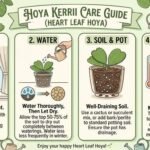
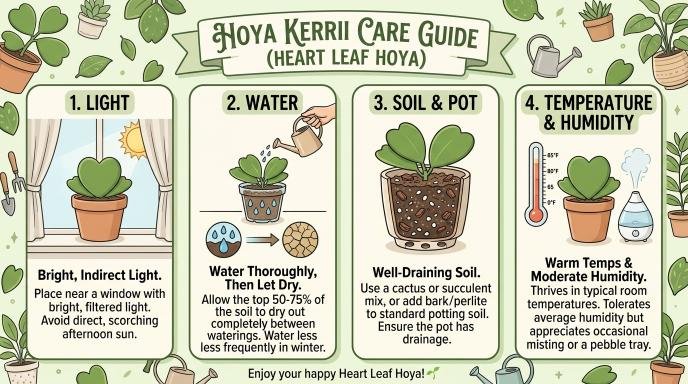
Hoya kerrii care is relatively easy once you understand that this succulent-like Hoya prefers bright indirect light, fast-draining soil, and thorough watering followed by a period of drying.
Allow the soil to become mostly dry before watering again, avoid constantly wet roots, and provide warmth and moderate humidity. Patience is essential because single-leaf Hoya kerrii plants can remain unchanged for months before producing new growth.
Introduction
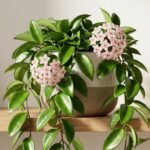
Hoya kerrii, commonly called the sweetheart plant or Valentine Hoya, is loved for its thick, heart-shaped leaves and low-maintenance nature. Its appearance makes it especially popular as a small indoor plant, but its unusual growth pattern can confuse new growers.
The biggest mistake with Hoya kerrii care is treating it like a typical tropical houseplant. Although Hoya kerrii appreciates warmth and humidity, its thick leaves store water, so constantly moist soil can create more problems than occasional dryness.
A healthy plant does not need to be watered on a rigid weekly schedule. Instead, its light, temperature, potting mix, pot size, and season should determine when it needs water. Once you learn to read those conditions, Hoya kerrii becomes a remarkably manageable houseplant.
Understanding Hoya Kerrii Growth
Hoya kerrii is a succulent-leaved Hoya native to Southeast Asia. Its thick leaves are adapted to conserve moisture, which explains why the plant can tolerate periods of dryness better than many thin-leaved tropical plants.
One important detail is that not every single-leaf Hoya kerrii will eventually become a large vine.
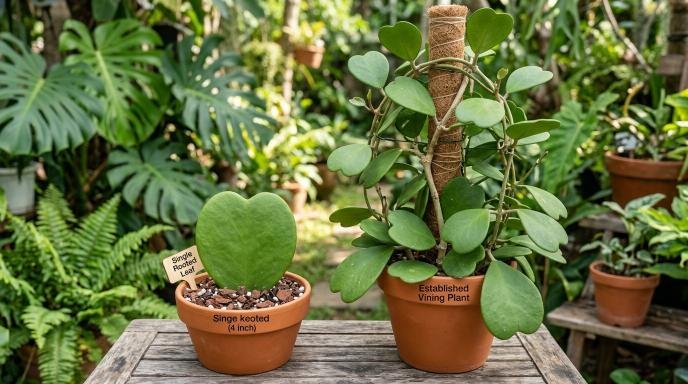
Many plants sold as individual heart-shaped leaves are rooted leaf cuttings. If the cutting was made without an appropriate piece of stem containing a growth node, it may remain as a living leaf with roots but produce little or no new growth.
This is why patience matters.
Single Leaf vs. Vining Hoya Kerrii
| Plant type | What you may notice | Growth potential |
|---|---|---|
| Single rooted leaf | One heart-shaped leaf with little visible growth | May stay unchanged for a long time |
| Leaf with stem/node | Leaf attached to a piece of stem | Better chance of producing new shoots |
| Established plant | Several leaves and visible vine growth | Can eventually develop long trailing or climbing stems |
| Mature Hoya kerrii | Multiple vines and larger root system | More vigorous growth under suitable conditions |
Practical insight: If your single-leaf Hoya has healthy, firm leaves and the roots are not rotting, lack of visible growth does not automatically mean something is wrong.
Hoya Kerrii Light Requirements
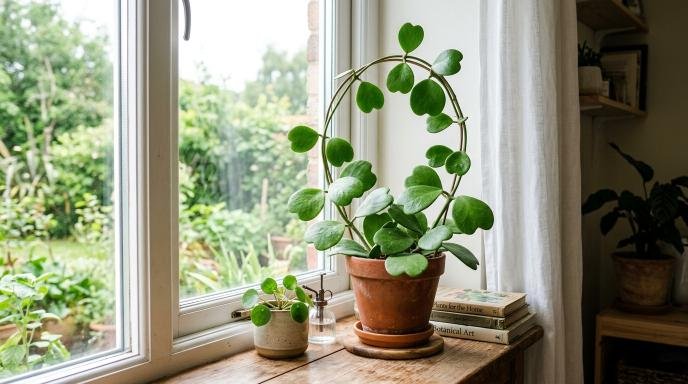
Bright, indirect light is one of the most important factors in successful Hoya kerrii care.
Place the plant close to a bright window where it receives plenty of natural light without being exposed to harsh, prolonged midday sunlight through glass.
A few hours of gentle direct morning or late-afternoon sunlight can be beneficial, particularly when the plant has been gradually acclimated.
Signs Your Hoya Kerrii Needs More Light
Watch for:
- Very slow growth.
- Long gaps between leaves on new vines.
- Pale or unusually small new leaves.
- Soil staying wet for an unusually long time.
- A plant leaning strongly toward a window.
Low light is particularly frustrating because the plant may remain alive while appearing to do almost nothing.
Can Hoya Kerrii Handle Direct Sun?
Yes, but sudden exposure to strong sunlight can scorch the leaves.
If your plant has been growing indoors in moderate light, move it gradually into brighter conditions rather than placing it immediately in intense afternoon sun.
Brown, bleached, or crispy patches can indicate excessive light or heat stress.
How Often Should You Water Hoya Kerrii?
There is no universally correct watering schedule.
Instead, check the soil before watering.
Allow much of the potting mix to dry before giving the plant another thorough watering. Then water slowly until excess moisture drains from the bottom of the pot.
Do not leave the container sitting in collected water.
A plant receiving strong light and growing in a warm room may need water more frequently than one sitting in low light during winter.
A Simple Watering Test
Before watering:
- Check the top several centimeters of soil.
- Push a finger or wooden stick deeper into the pot if possible.
- Check whether the mix still feels noticeably damp.
- Consider the weight of the pot.
- Water thoroughly when the mix has dried sufficiently.
The pot-weight method becomes especially useful once you learn how a freshly watered Hoya feels compared with a dry one.
Why Overwatering Is Dangerous
Overwatering does not simply mean giving too much water at one time. The bigger problem is keeping the root zone wet for too long.
Poor drainage, compact soil, a large pot, insufficient light, and frequent watering can all contribute to this problem.
Roots require access to oxygen as well as moisture. Constantly saturated soil reduces air spaces around the roots and can encourage root deterioration.
Expert tip: A Hoya kerrii is generally easier to rescue from mild dryness than from advanced root rot.
Best Soil for Hoya Kerrii
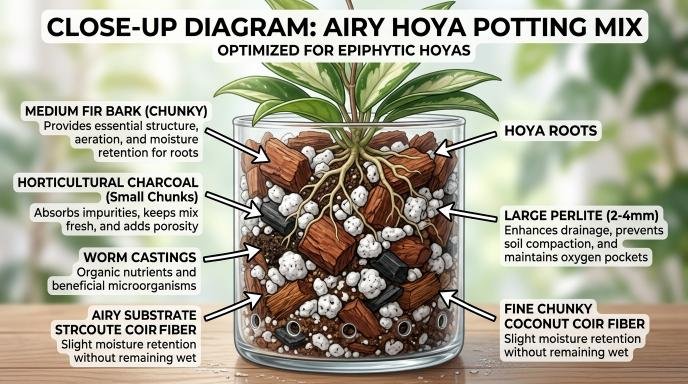
Hoya kerrii needs a loose, airy, fast-draining growing medium.
A useful mix can contain:
- High-quality indoor potting mix.
- Orchid bark.
- Perlite or pumice.
- A small amount of additional organic material if needed.
The exact recipe is less important than the final structure.
When you squeeze slightly moist soil, it should not behave like dense mud. Water should move through the container without leaving the roots submerged in a compact mass.
Why Soil Structure Matters
A dense mix can remain wet for too long, particularly in low light.
An airy mix allows excess water to move away while leaving small amounts of moisture available to the roots.
For advanced growers, adjusting the ratio of bark, perlite, and organic material can be useful depending on the growing environment.
A Hoya growing in a warm, bright room may tolerate a somewhat more moisture-retentive mix than one kept in a cool, dim location.
Choosing the Right Pot
The container should have drainage holes.
This is not optional for reliable Hoya kerrii care.
A decorative container without drainage can trap water around the roots and make watering much harder to manage.
Avoid Oversized Pots
A common beginner mistake is moving a small Hoya into a very large pot because they expect it to grow faster.
A large volume of soil can retain moisture around a small root system for a long time.
Choose a container that comfortably accommodates the root system with some room for future growth rather than dramatically increasing the pot size.
Terracotta can be useful because it allows some moisture to escape through the container walls, although good soil and correct watering remain more important than the material itself.
Hoya Kerrii Temperature Requirements
Hoya kerrii prefers warm indoor conditions and generally grows best when protected from cold temperatures and sudden temperature changes.
Keep the plant away from:
- Cold drafts.
- Frequently opened exterior doors.
- Strong air-conditioning vents.
- Heating vents.
- Extremely cold windows during winter.
Warmth supports active growth, while prolonged cold combined with wet soil can increase stress.
If growth slows during cooler months, do not automatically compensate by watering more often. Lower temperatures often mean the plant uses water more slowly.
Humidity for Hoya Kerrii
Moderate humidity is beneficial, but extremely high humidity is not required for healthy growth.
The plant can often adapt to normal household humidity if light, temperature, watering, and airflow are appropriate.
If your home is particularly dry, especially during heating or air-conditioning periods, you can improve the surrounding environment with a humidifier.
Avoid assuming that misting leaves is a substitute for proper humidity management. Briefly wetting the leaves does not necessarily create sustained humidity around the plant.
Good airflow is also important because stagnant, constantly damp conditions can contribute to fungal or other plant-health problems.
Fertilizing Hoya Kerrii
Hoya kerrii can benefit from regular fertilization during active growth.
Use a balanced, diluted houseplant fertilizer according to the product’s directions rather than applying concentrated fertilizer repeatedly.
Fertilizer is most useful when the plant is actively growing.
Avoid heavy feeding when:
- The plant is severely stressed.
- Roots are damaged.
- The soil is extremely dry.
- The plant is dormant or growing very slowly.
A nutrient deficiency is not always the cause of slow growth. If a Hoya receives insufficient light, adding more fertilizer will not solve the underlying problem.
Practical rule: Fix light, watering, roots, and soil problems before assuming fertilizer is the solution.
When Should You Repot Hoya Kerrii?
Hoya kerrii does not necessarily need frequent repotting.
In fact, keeping the plant slightly snug in its container can make moisture management easier.
Consider repotting when:
- Roots are emerging extensively from drainage holes.
- The potting mix has broken down and drains poorly.
- The plant repeatedly dries out extremely quickly.
- The container is damaged.
- Root problems require inspection and treatment.
When repotting, avoid jumping into a dramatically larger container.
Move to the next appropriate size and use fresh, well-draining soil.
How to Propagate Hoya Kerrii
Hoya kerrii can be propagated from stem cuttings containing viable nodes.
A stem cutting with at least one healthy node has a much better opportunity to produce new growth than a leaf without a node.
Basic Propagation Process
- Select a healthy stem with a viable node.
- Make a clean cutting with a sterile cutting tool.
- Allow the cutting to dry briefly if appropriate for the propagation method.
- Place the node into a suitable propagation medium.
- Keep the medium lightly moist rather than saturated.
- Provide warmth and bright indirect light.
- Wait for roots and new growth to develop.
Root development can take time, so avoid repeatedly disturbing the cutting to check for roots.
Why Some Hoya Kerrii Leaf Cuttings Never Become Vines
A leaf can successfully develop roots while lacking the stem tissue required to produce a new shoot.
This creates the classic “heart leaf that never grows” situation.
If you are purchasing Hoya kerrii specifically because you want a climbing or trailing plant, look for a cutting or plant that includes a visible stem and node rather than relying only on a single rooted leaf.
Pruning and Training Hoya Kerrii
Established Hoya kerrii can be trained to climb or allowed to trail.
A trellis, hoop, or other suitable support can guide the vines upward.
Do not remove healthy growth simply because it looks untidy. Hoya vines can produce new leaves along their growth points, and unnecessary pruning can reduce the plant’s ability to expand.
If pruning is necessary:
- Use clean cutting tools.
- Remove dead or damaged material.
- Avoid excessive pruning at one time.
- Keep healthy nodes whenever propagation is desired.
Do Not Automatically Remove Old Flower Spurs
Hoya plants can produce flowers from specialized structures commonly called peduncles or flower spurs.
These structures can produce flowers again, so avoid cutting them off after flowering unless there is a specific reason to do so.
How to Encourage Hoya Kerrii to Grow Faster
There is no safe shortcut that forces a Hoya kerrii to grow rapidly.
The best strategy is to create consistently favorable conditions.
Focus on:
- Bright indirect light.
- Warm temperatures.
- Appropriate watering.
- Airy, well-draining soil.
- Adequate nutrition during active growth.
- A suitable pot size.
- Minimal unnecessary disturbance.
If all conditions are good and the plant still grows slowly, patience may be the correct solution.
This is particularly true for young or single-leaf plants.
A plant that is slowly building roots may spend a long time showing little above-ground growth before suddenly producing a new shoot.
Hoya Kerrii Seasonal Care
Spring
Spring is often an excellent time to increase attention to growth.
As light levels rise, monitor the soil more frequently because the plant may begin using water faster.
This can also be a suitable time for repotting, propagation, or gentle fertilization if the plant is actively growing.
Summer
During hot weather, bright light and high temperatures can increase water use.
However, do not automatically water every day.
Check the actual moisture level of the potting mix.
Protect the plant from extreme afternoon heat through glass if the leaves begin showing signs of scorching.
Fall
Growth may gradually slow as light levels decrease.
Reduce watering frequency based on soil drying rather than following the summer routine.
Winter
Winter often requires the greatest adjustment.
Lower light and cooler temperatures can significantly slow water consumption. Continuing a frequent summer watering schedule can leave the roots wet for too long.
Keep the plant warm, provide as much suitable light as possible, and allow the soil to dry appropriately between waterings.
Common Hoya Kerrii Care Mistakes
Watering on a Fixed Schedule
Watering every seven days regardless of conditions can lead to problems.
Better approach: Check the soil and consider temperature, light, pot size, and season.
Using Heavy Garden Soil
Dense soil can restrict drainage and airflow around the roots.
Better approach: Use a loose, well-aerated container mix.
Keeping the Plant in Low Light
A Hoya may survive in low light but fail to grow vigorously.
Better approach: Move it gradually toward brighter indirect light.
Using a Huge Pot
A large container can hold moisture much longer than a small root system requires.
Better approach: Choose a pot appropriate for the root ball.
Expecting a Single Leaf to Become a Vine
A rooted leaf is not necessarily a complete plant.
Better approach: Check whether the cutting contains stem tissue and a viable growth node.
Fertilizing a Stressed Plant
More fertilizer does not repair rotten roots or compensate for poor lighting.
Better approach: Identify the underlying problem first.
Hoya Kerrii Troubleshooting Guide
| Problem | Likely causes | What to do |
|---|---|---|
| Leaves turning yellow | Overwatering, poor drainage, natural aging | Check soil moisture and roots |
| Soft or mushy leaves | Excess moisture, root problems | Inspect roots and improve drainage |
| Wrinkled leaves | Underwatering or damaged roots | Check root health and soil moisture |
| Brown crispy patches | Excessive sunlight, dryness, heat stress | Adjust light and watering |
| No new growth | Low light, young plant, single-leaf cutting | Improve light and allow time |
| Leaves dropping | Stress, watering problems, temperature changes | Review recent environmental changes |
| Black or rotten roots | Prolonged wet conditions | Remove damaged roots and repot appropriately |
| Plant growing very slowly | Low light or naturally slow growth | Increase suitable light and be patient |
| Soil stays wet for many days | Dense mix, large pot, low light | Improve soil structure and conditions |
Why Are My Hoya Kerrii Leaves Wrinkled?
Wrinkled leaves usually indicate that the plant is losing water faster than it can replace it, but the solution is not always simply “water more.”
Check the roots first if the soil is already moist.
A plant with damaged roots may have wet soil while still showing dehydration symptoms because its roots cannot absorb water effectively.
If the soil is dry and the roots are healthy, a thorough watering may restore firmness over time.
Do not expect severely dehydrated leaves to immediately return to their original appearance.
Why Is My Hoya Kerrii Turning Yellow?
Yellow leaves can result from several different conditions.
Overwatering is one of the first things to investigate, particularly when multiple leaves are yellowing and the soil remains wet.
However, one older leaf occasionally yellowing can be part of normal aging.
Look at the overall pattern rather than diagnosing the plant from a single leaf.
Check:
- Soil moisture.
- Drainage.
- Root condition.
- Light levels.
- Recent watering changes.
- Temperature changes.
- Whether the affected leaf is old or newly developed.
Why Is My Hoya Kerrii Not Growing?
Slow growth is one of the most common complaints about Hoya kerrii.
Before changing everything, determine what type of plant you have.
If it is a single-leaf cutting, limited growth may be expected.
If it is an established plant, examine its light first. Insufficient light is a common reason a Hoya remains alive but produces little new growth.
Other possibilities include:
- Poor root health.
- Nutrient limitations.
- Cold conditions.
- Seasonal dormancy.
- Recently disturbed roots.
- Natural slow growth.
Avoid repeatedly repotting a healthy but slow-growing Hoya. Frequent disturbance can create additional stress without solving the original issue.
Can Hoya Kerrii Grow Indoors?
Yes. Hoya kerrii is well suited to indoor growing when it receives adequate light and appropriate drainage.
A bright room near a suitable window is often more useful than a dark location simply because the plant is considered “low maintenance.”
If natural light is inadequate, supplemental grow lighting can help maintain stronger growth.
The goal is not maximum light at any cost. The goal is sufficient light without causing heat or sun damage.
Does Hoya Kerrii Flower?
Mature Hoya kerrii plants can produce clusters of small, star-shaped flowers under suitable conditions.
Flowering usually requires a sufficiently mature plant and appropriate environmental conditions.
Young single-leaf specimens should not be expected to flower quickly.
Bright light can support flowering, but increasing light alone does not guarantee blooms.
If your established plant is healthy but not flowering, consider its maturity, light exposure, nutrition, and seasonal growth pattern.
Hoya Kerrii Care Checklist
For a simple routine, remember:
- Light: Bright indirect light.
- Water: Allow the soil to dry substantially before watering again.
- Soil: Loose, airy, and fast draining.
- Pot: Always use drainage holes.
- Temperature: Warm and stable conditions are preferred.
- Humidity: Moderate household humidity is generally sufficient.
- Fertilizer: Feed lightly during active growth.
- Repotting: Repot only when necessary.
- Propagation: Use stem cuttings containing viable nodes for reliable new growth.
- Patience: Especially important with single-leaf plants.
Frequently Asked Questions
How often should I water Hoya kerrii?
Water when the potting mix has dried sufficiently rather than following a fixed calendar. The exact interval depends on light, temperature, humidity, pot size, and soil composition.
Does Hoya kerrii need direct sunlight?
It can tolerate some gentle direct sunlight when gradually acclimated, but bright indirect light is a safer general recommendation. Strong afternoon sun through glass can scorch the leaves.
Why is my Hoya kerrii not growing?
Low light is a common reason, but young plants and single-leaf cuttings can naturally grow very slowly. Check the plant’s roots and growing conditions before making major changes.
Can a Hoya kerrii grow from one leaf?
A single leaf can remain alive and produce roots, but it may not develop into a vining plant if it lacks suitable stem tissue and a viable growth node.
Is Hoya kerrii a succulent?
Hoya kerrii has thick, water-storing leaves and succulent-like characteristics, but it is a Hoya rather than a conventional desert succulent. Its care should reflect its tropical climbing-plant nature as well as its water-storing leaves.
What is the best soil for Hoya kerrii?
A loose, well-draining mix containing components such as potting mix, orchid bark, and perlite or pumice works well. The objective is excellent drainage and good air movement around the roots.
Does Hoya kerrii like humidity?
Moderate humidity can support healthy growth, but the plant does not require extremely humid conditions. Good airflow and appropriate watering remain important.
Should I mist my Hoya kerrii?
Misting is not necessary for routine care. Maintaining suitable environmental humidity is more useful than repeatedly spraying the leaves.
Why are my Hoya kerrii leaves soft?
Soft leaves can indicate dehydration, but they can also occur when roots are damaged and cannot absorb water properly. Check both the soil moisture and the condition of the roots.
How can I make Hoya kerrii grow faster?
Provide strong indirect light, warm conditions, suitable nutrition during active growth, airy soil, and correct watering. Avoid excessive fertilizer or watering because these shortcuts can damage the roots rather than accelerate growth.
Conclusion
Successful Hoya kerrii care comes down to balance rather than constant attention. Give the plant bright suitable light, let the soil dry appropriately between waterings, use an airy potting mix, provide warmth, and avoid oversized containers.
The most important lesson is to judge the plant’s actual growing conditions instead of following a rigid watering or fertilizing schedule. And if you own a single heart-shaped Hoya kerrii leaf that seems to be doing nothing, do not immediately assume you have failed. If the leaf and roots remain healthy, patience may be exactly what the plant needs.
For an established Hoya kerrii, consistent conditions usually matter more than complicated care routines. Once the plant has good light, healthy roots, and appropriate moisture, it can gradually reward you with new vines, thicker foliage, and eventually the possibility of its distinctive flowers.