Quick Answer
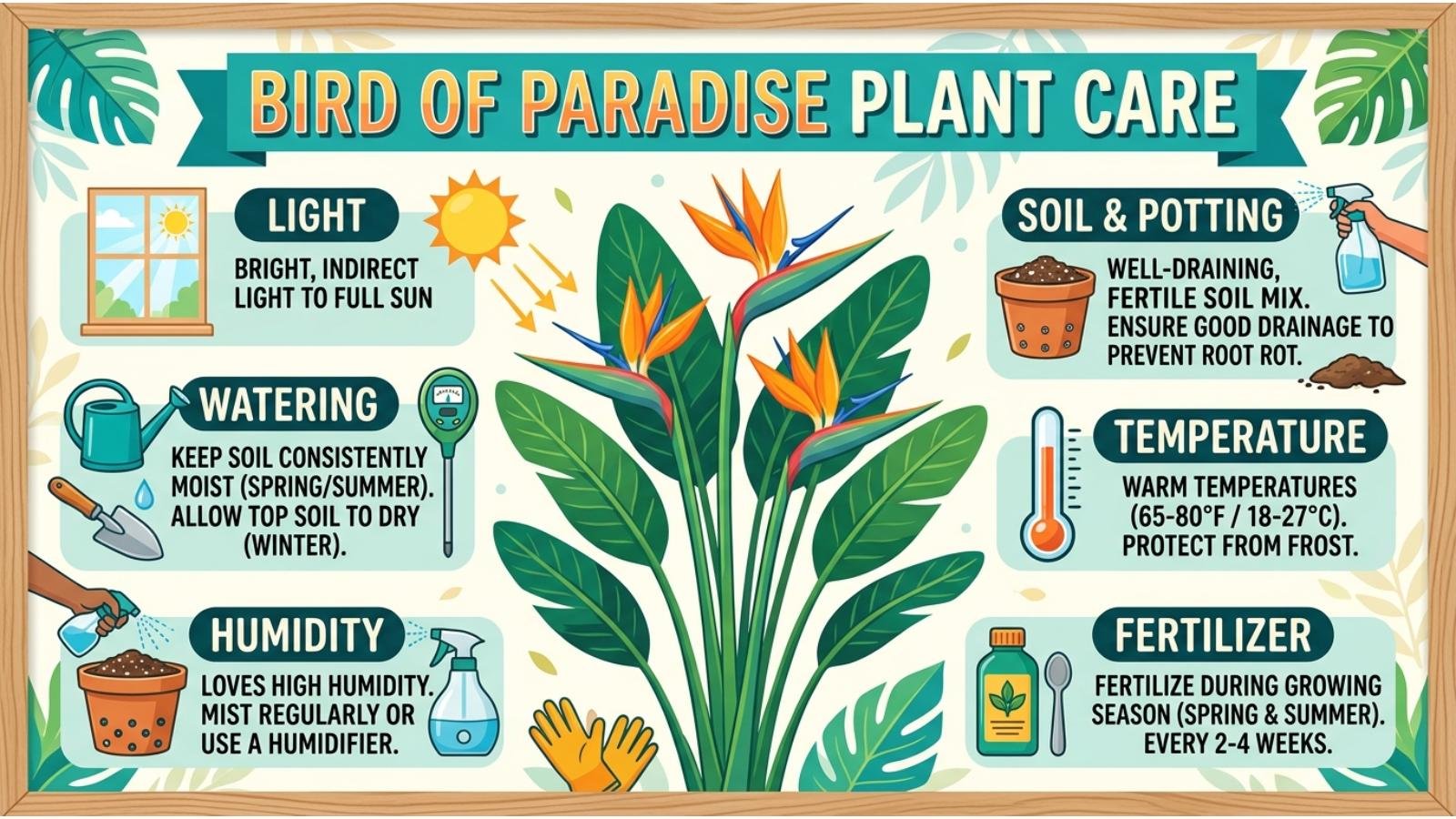
Bird of paradise plant care is mainly about giving Strelitzia plenty of bright light, warm temperatures, good drainage, consistent moisture during active growth, and adequate humidity. Let the soil partially dry before watering again rather than keeping it soggy. Feed during the growing season, rotate the pot for even growth, and repot only when the roots have substantially filled the container. Mature plants may eventually flower when light, nutrition, warmth, and growing conditions are right.
Introduction
The bird of paradise, or Strelitzia, is one of the most dramatic houseplants you can grow. Its enormous paddle-shaped leaves can turn an ordinary room into a tropical-looking space, while mature plants can produce spectacular orange-and-blue flowers. But those impressive leaves also tell you exactly why this plant needs more attention than a typical low-light houseplant: Strelitzia is a vigorous, light-hungry plant that needs room, warmth, moisture, and good growing conditions.
The good news is that bird of paradise plant care is not complicated once you understand what the plant is trying to tell you. Brown edges, curling leaves, slow growth, split leaves, and a complete lack of flowers are often clues about light, watering, humidity, temperature, or nutrition rather than mysterious diseases. This guide explains how to care for Strelitzia from the moment you bring it home through mature growth, including watering, soil, fertilizing, repotting, pruning, propagation, seasonal care, and troubleshooting.
What Is a Bird of Paradise Plant?
Bird of paradise is the common name for plants in the Strelitzia genus, a group of evergreen perennial plants native to southern Africa.
Two types are especially relevant to indoor growers:
| Type | Botanical name | General character |
|---|---|---|
| Orange bird of paradise | Strelitzia reginae | More compact, commonly grown for its distinctive orange-and-blue flowers |
| White bird of paradise | Strelitzia nicolai | Much larger, architectural plant with broad leaves and white flowers when mature |
Strelitzia reginae can reach roughly 1–1.5 m (3–5 ft), while Strelitzia nicolai can become dramatically larger.
The common name comes from the unusual flowers, which resemble the head of a brightly colored bird. The large leaves are equally important, however, because a healthy Strelitzia can develop an impressive tropical canopy even when it is not flowering.
Why identification matters
Not every “bird of paradise” has exactly the same mature size or appearance.
If you purchased a plant labeled Strelitzia nicolai, do not expect it to remain a small tabletop houseplant. Likewise, Strelitzia reginae is generally the more manageable choice if your main goal is eventually enjoying the characteristic bird-shaped flowers.
Image Suggestion: Create a labeled comparison image showing Strelitzia reginae and Strelitzia nicolai side by side.
How Much Light Does a Bird of Paradise Need?
Light is probably the most important factor in successful bird of paradise plant care.
Strelitzias prefer very bright light and perform best near a large sunny window or in another exceptionally bright location. RHS guidance lists full sun to partial shade as suitable positions, while indoor plants benefit from strong natural light.
The best indoor location
A good starting point is:
- A bright south-, southeast-, or west-facing window
- Several hours of strong natural light
- Some direct sunlight if the plant has been acclimated
- Enough surrounding space that large leaves are not constantly pressed against walls or furniture
A plant sitting several feet away from a bright window may receive dramatically less usable light than a plant directly beside it.
Can bird of paradise tolerate direct sunlight?
Yes, but acclimation matters.
A plant that has spent months in a relatively dim room can develop leaf damage if suddenly placed in intense afternoon sun. Move it gradually toward stronger light rather than making a dramatic overnight change.
Very strong sun through glass can also cause bleaching or scorching under some conditions, so watch the leaves after changing its position.
Why your plant may not flower
Flowering requires more than simply keeping the plant alive.
Mature Strelitzias need adequate light, nutrition, and appropriate growing conditions to flower. RHS notes that plants may take several years to bloom and generally flower better when they have sufficient light and feed.
If your plant is healthy but never flowers, first ask:
- Is it mature enough?
- Is it receiving enough light?
- Is it actively growing?
- Is it being fed appropriately during the growing season?
- Is it severely stressed by temperature or watering problems?
Do not assume that adding more fertilizer will compensate for inadequate light.
Image Suggestion: Show a bird of paradise beside a bright window versus one kept in a dim corner, with arrows indicating likely growth differences.
How to Water a Bird of Paradise Correctly
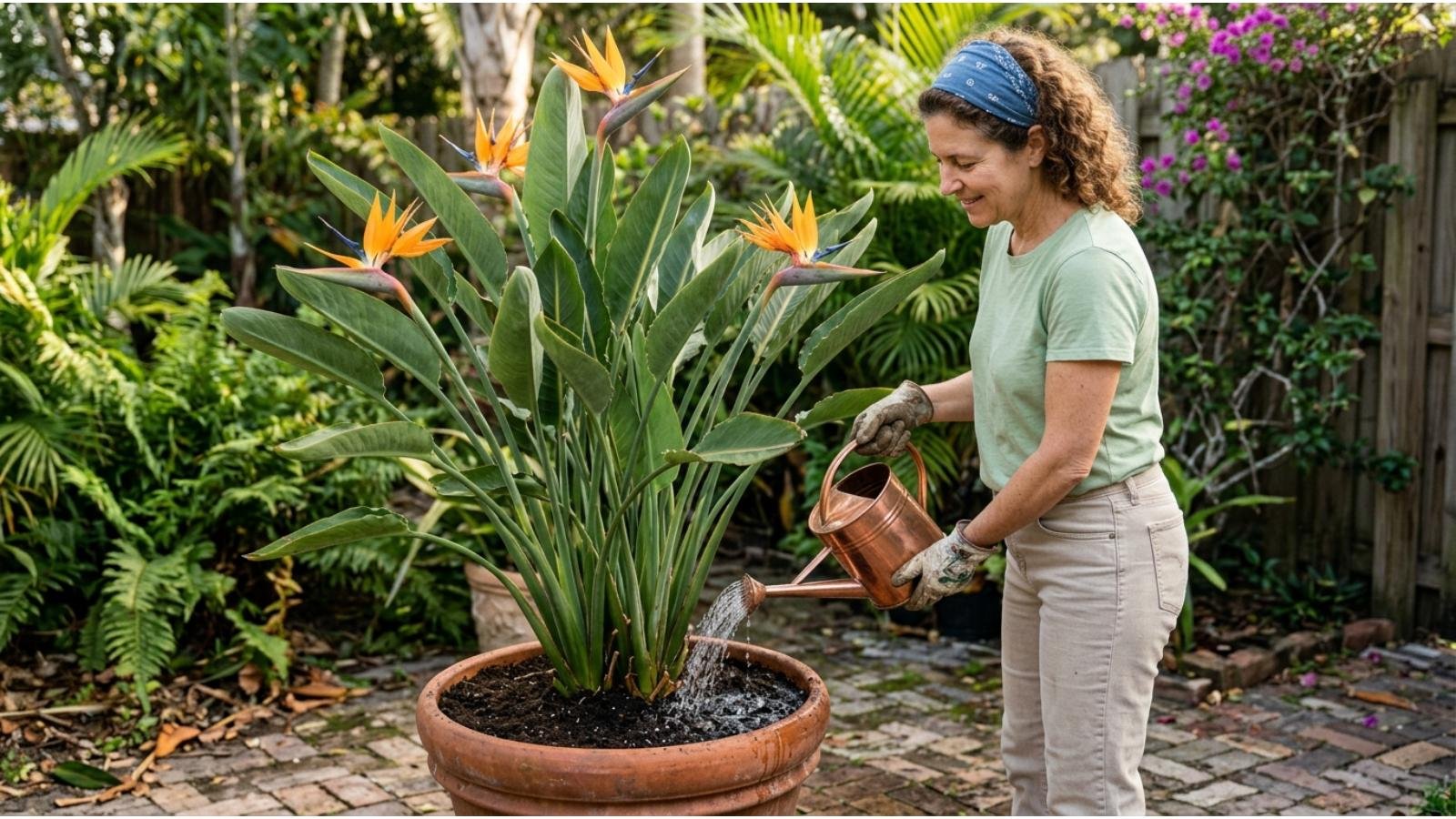
Bird of paradise plants appreciate regular moisture during active growth, but consistently saturated soil is a different matter.
RHS recommends regular, plentiful watering during spring and summer while keeping the compost moist rather than saturated. Watering should be reduced as growth slows in autumn and winter.
The better rule: check the soil
Instead of watering on a rigid Monday-or-Sunday schedule, check the plant.
Before watering:
- Feel the upper layer of the potting mix.
- Check whether excess water can drain freely.
- Consider the room temperature and amount of light.
- Remember that a plant in bright, warm conditions may use water much faster than one in a cool, dim room.
Then water thoroughly enough for excess water to escape through the drainage holes.
How often should you water?
There is no universal number of days.
A large plant in a warm, sunny room may need water much more frequently than a smaller plant in a cooler room. During winter, reduced light and slower growth generally mean the soil remains wet for longer.
The goal is not “water every seven days.” The goal is “water when the plant actually needs it.”
Signs of watering problems
| Symptom | Possible cause |
|---|---|
| Soft, persistently wet soil | Overwatering or poor drainage |
| Yellowing leaves with wet soil | Root stress may be involved |
| Brown, crispy edges | Dry soil, low humidity, salt buildup, or environmental stress |
| Drooping with very dry soil | Underwatering |
| Slow growth with constantly wet soil | Roots may not be receiving enough oxygen |
One common beginner mistake is responding to a drooping plant by immediately adding more water. Drooping does not always mean thirst. Check the soil first.
What Soil Is Best for Bird of Paradise?
A bird of paradise needs a growing medium that holds enough moisture for the large plant but still drains efficiently.
RHS recommends a loam-based, peat-free compost with added grit for drainage for Strelitzia grown under glass.
For a houseplant, the practical objective is a mix that is:
- Moisture-retentive without becoming muddy
- Well-draining
- Structurally stable
- Suitable for a large container
- Paired with a pot that has drainage holes
Why drainage matters
A drainage hole is not a minor feature. It gives excess irrigation water somewhere to go.
A beautiful decorative pot with no drainage can become a serious problem if it traps water around the roots.
If you use a decorative cachepot, keep the plant in a nursery pot with drainage and empty standing water rather than allowing the roots to remain submerged.
A simple approach to potting mix
You can use a quality houseplant or tropical-plant mix and improve its drainage with an appropriate coarse material if the mix remains excessively wet.
Avoid choosing soil simply because it says “tropical.” Evaluate how quickly water moves through it and how long it remains saturated after watering.
Humidity and Temperature: What Strelitzia Really Wants
Bird of paradise plants naturally favor warm, humid conditions.
RHS recommends warmth, humidity, and good ventilation for Strelitzia, with temperatures not dropping below approximately 10–12°C (50–54°F) in its cultivation guidance.
Ideal indoor conditions
A comfortable environment generally means:
- Warm temperatures
- Stable conditions
- No cold drafts
- Good air movement
- Moderate to high humidity
- Plenty of light
Cold windows, air-conditioning vents, heaters, and sudden temperature changes can all create stressful conditions.
Does bird of paradise need a humidifier?
Not necessarily.
If your indoor humidity is reasonably comfortable, the plant may grow perfectly well without special equipment. If the air is extremely dry, particularly during periods of indoor heating, increasing humidity can help reduce stress.
Options include:
- A room humidifier
- Grouping plants together
- A suitable pebble tray
- Moving the plant to a naturally more humid room with sufficient light
Do not turn humidity into a substitute for proper watering or ventilation.
What about misting?
Misting can temporarily wet the leaves, but it is not a magic solution for chronically dry indoor air.
If your entire room is extremely dry, a humidifier is generally a more controllable way to increase ambient humidity than repeatedly spraying the leaves.
Fertilizing Bird of Paradise for Strong Growth
Bird of paradise is a vigorous plant and can benefit from regular feeding during active growth.
RHS recommends feeding Strelitzia during the growing season, with guidance ranging from fortnightly liquid houseplant feed in its growing guide to monthly balanced liquid fertilizer in its plant profile.
The exact fertilizer frequency depends on the product concentration and growing conditions, so follow the label rather than assuming that more fertilizer equals faster growth.
When to fertilize
Focus feeding during active growth, particularly spring and summer in a typical indoor growing cycle.
As growth slows in autumn and winter, reduce or pause feeding as appropriate.
A mistake to avoid
Do not fertilize a severely stressed, dehydrated, or waterlogged plant simply because its leaves look unhealthy.
First correct the underlying growing conditions.
Fertilizer cannot fix:
- Root damage
- Severe lack of light
- Chronic overwatering
- Major temperature stress
- Pest infestations
In fact, unnecessary fertilizer applied to already stressed roots can make the situation worse.
How to Repot a Bird of Paradise
Bird of paradise plants do not need to be repotted every few months.
RHS notes that newly purchased plants may not require repotting for a year or two and that keeping Strelitzia somewhat pot-bound can encourage flowering. Once roots have filled the container, repotting can be done in spring, generally using a pot only slightly larger than the current one.
Signs it is time to repot
Look for:
- Roots filling most of the container
- Roots emerging from drainage holes
- Water passing through unusually quickly because the root mass has become dense
- The plant becoming unstable because the container is too small
- Noticeably restricted growth despite otherwise good care
How to repot
- Choose a container only moderately larger than the current pot.
- Make sure it has drainage holes.
- Prepare fresh, free-draining potting mix.
- Remove the plant carefully.
- Inspect the root system.
- Place the plant at approximately the same depth as before.
- Fill around the root ball with fresh mix.
- Water thoroughly.
- Allow excess water to drain away.
Avoid moving a plant from a relatively small container into a dramatically oversized pot.
A huge pot holds a large volume of soil, which can remain wet for a long time after watering.
Image Suggestion: Step-by-step repotting infographic showing the root ball, correctly sized new pot, fresh mix, and final planting depth.
Pruning and Cleaning Bird of Paradise Leaves
Bird of paradise does not require aggressive pruning to remain healthy.
Instead, remove damaged, dead, or severely unattractive leaves when necessary.
Use clean, sharp pruning tools and cut damaged leaves near their base without unnecessarily injuring healthy growth.
What about split leaves?
This surprises many new owners: split leaves are not automatically a sign that your plant is unhealthy.
Large Strelitzia leaves can naturally split or tear, particularly as they mature or when exposed to air movement.
Outdoor plants can become especially shredded in strong winds. RHS specifically recommends a sheltered position because strong wind can damage the large leaves and stems.
So don’t cut off every leaf simply because it has a few splits.
Cleaning the leaves
Large leaves collect dust.
Wiping them gently with a clean, damp cloth can improve their appearance and remove dust that otherwise sits on the leaf surface. RHS also recommends periodically wiping leaves so they can receive maximum light.
Avoid coating leaves with unnecessary commercial “leaf shine” products.
Why Are Bird of Paradise Leaves Turning Brown?
Brown leaves are one of the most common bird of paradise problems, but the color alone does not identify the cause.
Look at the pattern, location, and growing conditions.
Brown tips
Brown tips can be associated with:
- Dry air
- Inconsistent watering
- Excessive fertilizer or mineral buildup
- Root problems
- Environmental stress
RHS specifically identifies brown leaf tips and edges among symptoms that can occur when Strelitzia growing conditions are unsuitable.
Brown patches
Localized brown patches can have different causes, including physical damage, intense light changes, or environmental stress.
Check whether the damage appeared shortly after moving the plant into stronger sunlight.
Brown leaves with wet soil
This combination deserves more attention.
If the soil remains wet for long periods and leaves are deteriorating, do not automatically water again. Check drainage and inspect the roots if the problem continues.
The diagnostic approach
Instead of asking, “What fertilizer should I use for brown leaves?”
Ask:
What changed before the browning appeared?
That question often gets you closer to the real cause.
Why Are Bird of Paradise Leaves Curling?
Curling or folding leaves can indicate that the plant is under environmental stress.
Possible causes include:
- Soil becoming excessively dry
- Excessive heat
- Very dry air
- Root problems
- Sudden environmental changes
- Pest activity
Start by checking the soil moisture.
If the soil is bone dry, watering may be the obvious solution. If the soil is already saturated, adding more water is unlikely to solve the problem.
Also inspect the undersides of leaves and along stems for pests.
Bird of Paradise Pests: What to Look For
Strelitzia is generally vigorous, but it can still attract sap-sucking pests.
RHS identifies scale insects, red spider mites, and mealybugs as pests that may affect Strelitzia.
Mealybugs
Look for small white, cotton-like clusters around leaf joints and stems.
Scale
Scale insects can appear as small bumps attached to plant surfaces. They may be easy to overlook until the infestation becomes established.
Spider mites
These tiny pests can cause stippling, dull-looking foliage, and fine webbing in heavier infestations.
A useful weekly habit
Once a week, inspect:
- Leaf undersides
- Leaf joints
- New growth
- Stems
- Areas where leaves emerge from the central plant
Early detection is much easier than dealing with a major infestation.
Why Is My Bird of Paradise Not Growing?
Slow growth is not automatically a sign of disease.
Growth depends heavily on light, temperature, season, nutrition, root health, and the plant’s maturity.
If growth seems unusually slow, work through this checklist:
1. Check the light
This should be your first investigation.
A plant receiving inadequate light may survive but grow slowly and fail to develop the vigorous appearance you expect.
2. Check the roots
If the soil stays wet for too long, root health may be compromised.
3. Consider the season
Indoor plants often grow more slowly when light levels and temperatures fall.
4. Check nutrition
If the plant is actively growing and has been in the same depleted potting mix for a long time, appropriate feeding may help.
5. Check pot size
An extremely root-bound plant may need repotting, although being somewhat pot-bound is not necessarily a problem for Strelitzia.
Why Is My Bird of Paradise Not Flowering?
This is one of the biggest frustrations for indoor growers.
A healthy-looking bird of paradise can produce beautiful foliage for years without producing flowers.
That does not necessarily mean you are doing something wrong.
Age matters
Strelitzia may take years to reach flowering maturity. RHS notes that plants can take several years to bloom.
Light matters
Insufficient light is one of the first things to investigate.
Feeding matters
A mature plant needs adequate nutrition during active growth.
Root restriction can be beneficial
Unlike many plants that are immediately moved into larger containers, Strelitzia generally does not need excessive root space. RHS notes that plants often flower better when slightly pot-bound.
Be patient
Do not respond to a lack of flowers by dramatically increasing fertilizer.
If the plant is immature or lacks sufficient light, fertilizer alone will not manufacture flowers.
Seasonal Bird of Paradise Plant Care
Your care routine should change throughout the year.
| Season | Main priority |
|---|---|
| Spring | Increase watering as growth accelerates; begin regular feeding |
| Summer | Maximum bright light, regular watering, warmth, humidity, and ventilation |
| Autumn | Watch for slower soil drying and reduce watering as growth decreases |
| Winter | Protect from cold, avoid overwatering, and reduce feeding |
RHS recommends regular watering and feeding during active growth, followed by reduced watering during autumn and winter.
Moving the plant outdoors
A large bird of paradise can benefit from spending warm weather outdoors where conditions permit.
But don’t carry it from a dim living room directly into intense outdoor sun.
Acclimate it gradually.
Also protect the plant from strong winds, which can shred its large leaves and damage stems.
Before bringing it back indoors, inspect the foliage carefully for pests.
Image Suggestion: Seasonal care calendar showing spring, summer, autumn, and winter bird of paradise tasks.
How to Propagate Bird of Paradise
Bird of paradise can be propagated from seed or by dividing mature clumps.
For most home growers, division is the more practical method when a mature plant has produced offsets.
RHS recommends division of rooted offsets in early spring. A divided section should have its own healthy roots and leaves before being potted separately.
Propagating by division
- Choose a mature plant with established offsets.
- Remove the plant carefully from its container if necessary.
- Identify a division with roots and healthy foliage.
- Separate it using clean, sturdy tools.
- Pot the division into a well-draining growing medium.
- Water it thoroughly.
- Keep it warm and provide appropriate light while it establishes.
Growing from seed
Seed propagation is possible, but patience is essential.
RHS notes that germination can take approximately four to eight weeks and that seedlings may require five years or more before they are ready to flower.
For someone who wants a mature-looking plant quickly, purchasing an established plant or dividing a mature specimen is generally more practical.
10 Common Bird of Paradise Care Mistakes
1. Keeping it in a dark corner
The plant may survive, but vigorous growth and flowering are much less likely.
2. Watering by calendar
A fixed weekly schedule ignores changing light, temperature, pot size, and season.
3. Using a pot without drainage
Excess water has nowhere to escape.
4. Putting a small plant into a huge pot
More soil does not automatically mean faster growth and can make moisture management harder.
5. Overreacting to split leaves
Large Strelitzia leaves can naturally split and can be damaged by wind.
6. Fertilizing a stressed plant
Fix light, watering, drainage, or temperature problems first.
7. Expecting flowers immediately
Young plants can need years to reach flowering maturity.
8. Ignoring the undersides of leaves
Pests can establish themselves before they become obvious from across the room.
9. Moving the plant suddenly into intense sunlight
Gradual acclimation reduces the risk of leaf damage.
10. Treating every brown leaf as a watering problem
Brown foliage is a symptom, not a diagnosis.
A Simple Weekly Bird of Paradise Care Routine
You do not need to spend hours caring for your Strelitzia.
A short weekly inspection can prevent many problems.
Once a week
Check the soil:
Is it still wet, comfortably moist, or genuinely dry?
Inspect the leaves:
Look for new browning, curling, unusual spots, or pests.
Check underneath the leaves:
This is where small pests can hide.
Look at new growth:
Healthy new leaves provide useful information about the plant’s current conditions.
Rotate the pot:
Turning the container periodically helps prevent the plant from leaning strongly toward the light. RHS specifically recommends turning the pot by about a quarter each time you water.
Clean dusty leaves when needed:
Large leaves can accumulate significant dust.
This routine takes only a few minutes but makes it much easier to notice changes before they become serious.
Bird of Paradise Care Cheat Sheet
| Care factor | What to aim for |
|---|---|
| Light | Very bright light; plenty of sun when appropriately acclimated |
| Water | Regular moisture during active growth, but avoid saturated soil |
| Soil | Moisture-retentive yet well-draining |
| Humidity | Moderate to high humidity is beneficial |
| Temperature | Warm, stable conditions; protect from cold |
| Fertilizer | Regular feeding during active growth according to product directions |
| Repotting | When roots substantially fill the pot; spring is a good time |
| Pruning | Remove dead or badly damaged foliage |
| Rotation | Turn periodically for more balanced growth |
| Flowering | Requires maturity plus strong light and good overall conditions |
| Common pests | Mealybugs, scale, and spider mites |
These recommendations are consistent with RHS cultivation guidance for Strelitzia.
Frequently Asked Questions
How often should I water a bird of paradise?
Water when the plant’s growing medium has dried to an appropriate degree rather than following a fixed calendar. During active growth, Strelitzia generally needs more frequent watering; during cooler, darker periods, allow the soil to dry more between waterings.
Does bird of paradise need direct sunlight?
It can benefit from strong sunlight and bright conditions, particularly when mature. However, plants accustomed to low light should be acclimated gradually before being exposed to intense direct sun.
Why are my bird of paradise leaves splitting?
Large Strelitzia leaves can naturally split, and wind can cause additional tearing. Splitting alone does not necessarily mean the plant is unhealthy.
Should I cut off damaged bird of paradise leaves?
Remove dead or severely damaged leaves with clean, sharp tools. Leaves with minor splits or cosmetic damage can often remain if they are still functioning.
How much humidity does bird of paradise need?
Strelitzia prefers a humid atmosphere. If indoor air is very dry, increasing ambient humidity can help, especially when combined with appropriate watering and good air circulation.
Why is my bird of paradise turning brown?
Possible causes include inconsistent watering, dry air, unsuitable light, environmental stress, fertilizer or mineral buildup, and root problems. Examine the soil and growing environment before choosing a treatment.
How long does it take for bird of paradise to flower?
There is no single timetable for every plant. Strelitzias can take several years to reach flowering maturity, and adequate light and nutrition are important for flowering.
Can bird of paradise grow indoors?
Yes. Strelitzia can make an excellent indoor specimen when given sufficient light, warmth, space, moisture management, and humidity. The biggest challenge is usually providing enough light and room for its eventual size.
Should I repot my bird of paradise every year?
Not necessarily. Strelitzia generally does not require annual repotting. Repot when the roots have substantially filled the container, using a pot only somewhat larger than the existing one.
Can I put my bird of paradise outside?
In an appropriate warm climate, yes. Outdoor placement should be sheltered from strong winds, and plants moved from indoors should be acclimated gradually to stronger light.
Final Thoughts: The Key to Healthy Bird of Paradise Care
Successful bird of paradise plant care comes down to giving Strelitzia the conditions it naturally prefers rather than trying to compensate for poor conditions with fertilizer or frequent watering.
Give it strong light, warmth, sensible watering, good drainage, adequate humidity, regular nutrition during active growth, and enough space to mature. Most importantly, learn to read the plant instead of following a rigid watering calendar.
If the leaves are browning, curling, splitting, or failing to grow, investigate the environment before treating the symptom. And if your ultimate goal is those spectacular flowers, remember that maturity and strong growing conditions matter just as much as day-to-day care.
A bird of paradise is not a low-light, forget-it-in-the-corner houseplant. But once you provide the light and growing conditions it actually wants, it can become one of the most impressive plants in your home.
Suggested Internal Links
For a broader houseplant-care content cluster, consider linking this article naturally to:
- Snake Plant Care
- Spider Plant Care
- Pothos Plant Care
- Monstera Plant Care
- Prayer Plant Care
- Jade Plant Care
- Aloe Plant Care
- Kalanchoe Plant Care
- Coleus Plant Care
- Elephant Ear Plant Care
Recommended Custom Images
- Hero image: Healthy bird of paradise in a bright modern room.
- Light guide: Bird of paradise positioned near different types of windows.
- Watering diagram: Correctly watered soil vs waterlogged soil.
- Repotting infographic: Root ball and correctly sized new container.
- Problem guide: Brown, curling, split, and healthy leaves with labels.
- Pest guide: Mealybugs, scale, and spider mite symptoms.
- Seasonal infographic: Bird of paradise care from spring through winter.
- Propagation diagram: Mature Strelitzia divided into rooted offsets.
Suggested Secondary Keywords
- bird of paradise care
- Strelitzia care
- bird of paradise plant care indoors
- how to care for bird of paradise
- bird of paradise watering
- bird of paradise light requirements
- bird of paradise soil
- bird of paradise humidity
- bird of paradise fertilizer
- bird of paradise repotting
- bird of paradise pruning
- bird of paradise leaves turning brown
- bird of paradise leaves curling
- bird of paradise not growing
- bird of paradise not flowering
- Strelitzia reginae care
- Strelitzia nicolai care
- white bird of paradise care
- indoor bird of paradise care
- bird of paradise propagation