Quick Answer
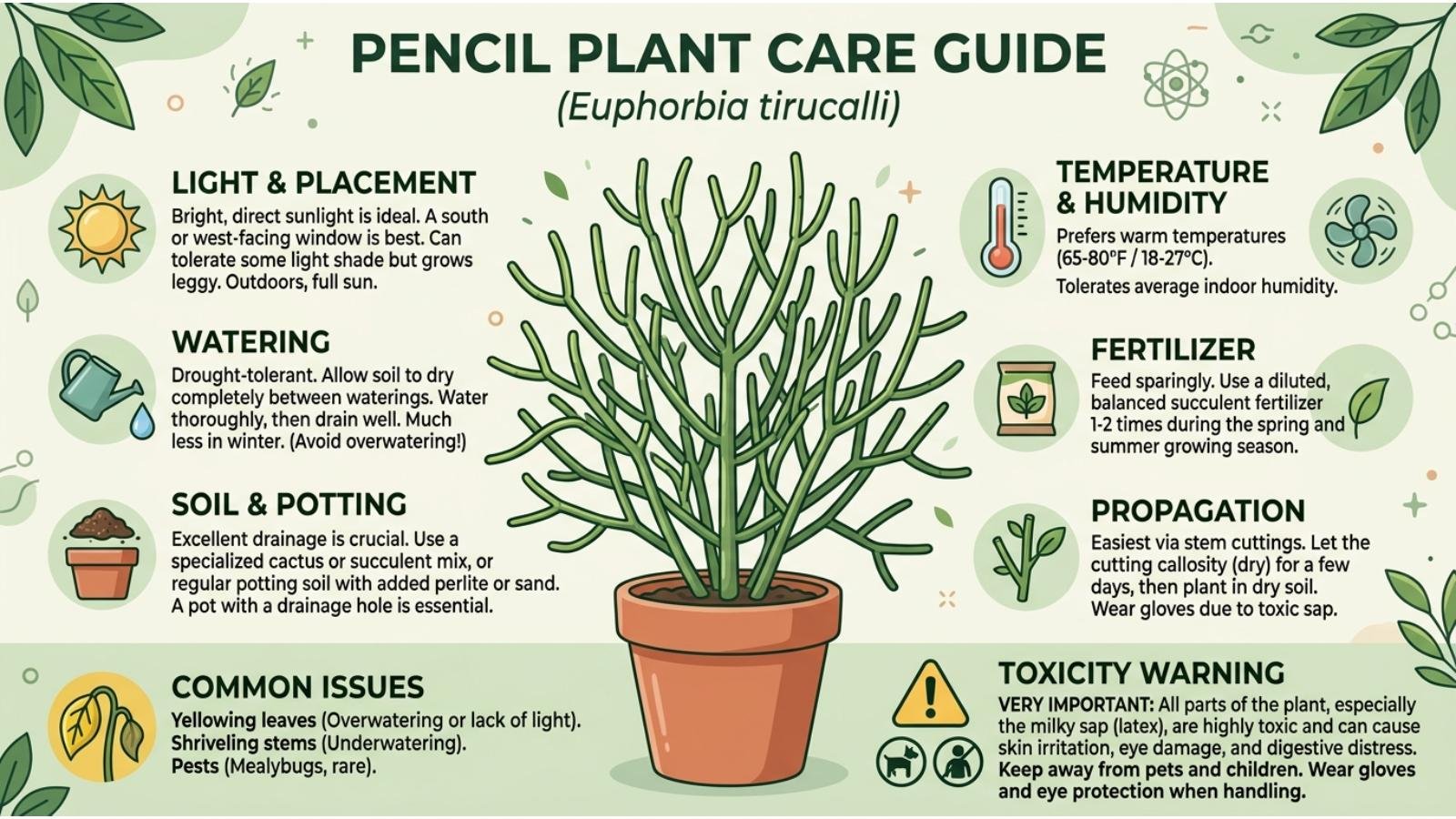
Pencil plant care is relatively easy because this drought-tolerant succulent prefers bright light, warm temperatures, and well-draining soil.
Water thoroughly only when the soil has dried out, and use a pot with drainage holes to prevent root rot. The pencil plant grows best near a sunny window or in a bright outdoor location with suitable temperatures. Handle it carefully because its milky sap is irritating and potentially toxic.
Introduction
The pencil plant is an unusual succulent with slender, green, pencil-like branches that create an architectural appearance. It can become an attractive focal point in a sunny room, succulent collection, or suitable outdoor garden.
However, its care requirements are different from those of many traditional houseplants. Giving it too much water, placing it in insufficient light, or handling it without protection can cause problems.
Understanding its natural growing habits makes caring for this plant much easier. In this guide, you will learn how to provide the right light, watering schedule, soil, temperature, and maintenance, along with practical ways to recognize and solve common problems.
Pencil Plant Care at a Glance
The pencil plant, scientifically known as Euphorbia tirucalli, is a drought-tolerant succulent shrub with narrow, cylindrical branches. Despite its common name, it is not a true cactus.
| Care requirement | What your plant needs |
|---|---|
| Light | Bright light; several hours of direct sunlight is beneficial once acclimated. |
| Water | Water thoroughly, then allow the soil to dry out before watering again. |
| Soil | A fast-draining succulent or cactus mix. |
| Pot | A container with drainage holes. |
| Temperature | Warm conditions; protect it from frost and prolonged cold. |
| Humidity | Ordinary indoor humidity is generally suitable. |
| Fertilizer | Light feeding during active growth, if needed. |
| Pruning | Occasional pruning to manage size and shape, using protective equipment. |
| Growth habit | Upright, branching, and potentially tree-like in warm climates. |
| Safety | Its milky sap can irritate or seriously injure skin and eyes. |
These recommendations reflect the plant’s succulent growth habit and horticultural guidance for Euphorbia tirucalli.
Understanding the Pencil Plant


The pencil plant belongs to the spurge family, Euphorbiaceae. It is also called pencil cactus, pencil tree, milkbush, and firestick plant. Its unusual appearance comes from its thin, cylindrical branches, which can develop into a dense, branching structure.
Although it may look like a cactus, it is botanically a succulent euphorbia.
Why does the pencil plant have so few leaves?
The plant produces tiny leaves that are short-lived and often fall off quickly. Its green stems perform much of the photosynthesis.
This is one reason it can look healthy even when you rarely see leaves. However, a sudden change in stem color, softness, or widespread branch loss should not be dismissed as normal leaf shedding.
How large does a pencil plant grow?
Its mature size depends heavily on the growing environment.
- Indoors: It can be maintained as a smaller architectural houseplant with appropriate pruning.
- Outdoors in warm climates: It can develop into a large shrub or small tree.
- In a container: Growth is influenced by the pot size, light, growing conditions, and pruning.
A young plant may look compact in a nursery pot but eventually require considerably more room. Plan for its mature size before placing it beside a walkway, doorway, or other frequently used space.
Image suggestion: A comparison showing a young potted pencil plant beside a mature outdoor specimen.
Choosing the Right Light for Healthy Growth
Light is one of the most important factors in successful pencil plant care. This succulent naturally grows in bright environments, and insufficient light can lead to weak, stretched growth.
How much sunlight does a pencil plant need?
Aim for a bright location with several hours of direct sunlight when the plant is acclimated to it.
A sunny window can work well indoors. Outdoors, a bright position with morning sun and some protection from intense afternoon heat may be suitable, especially in very hot climates.
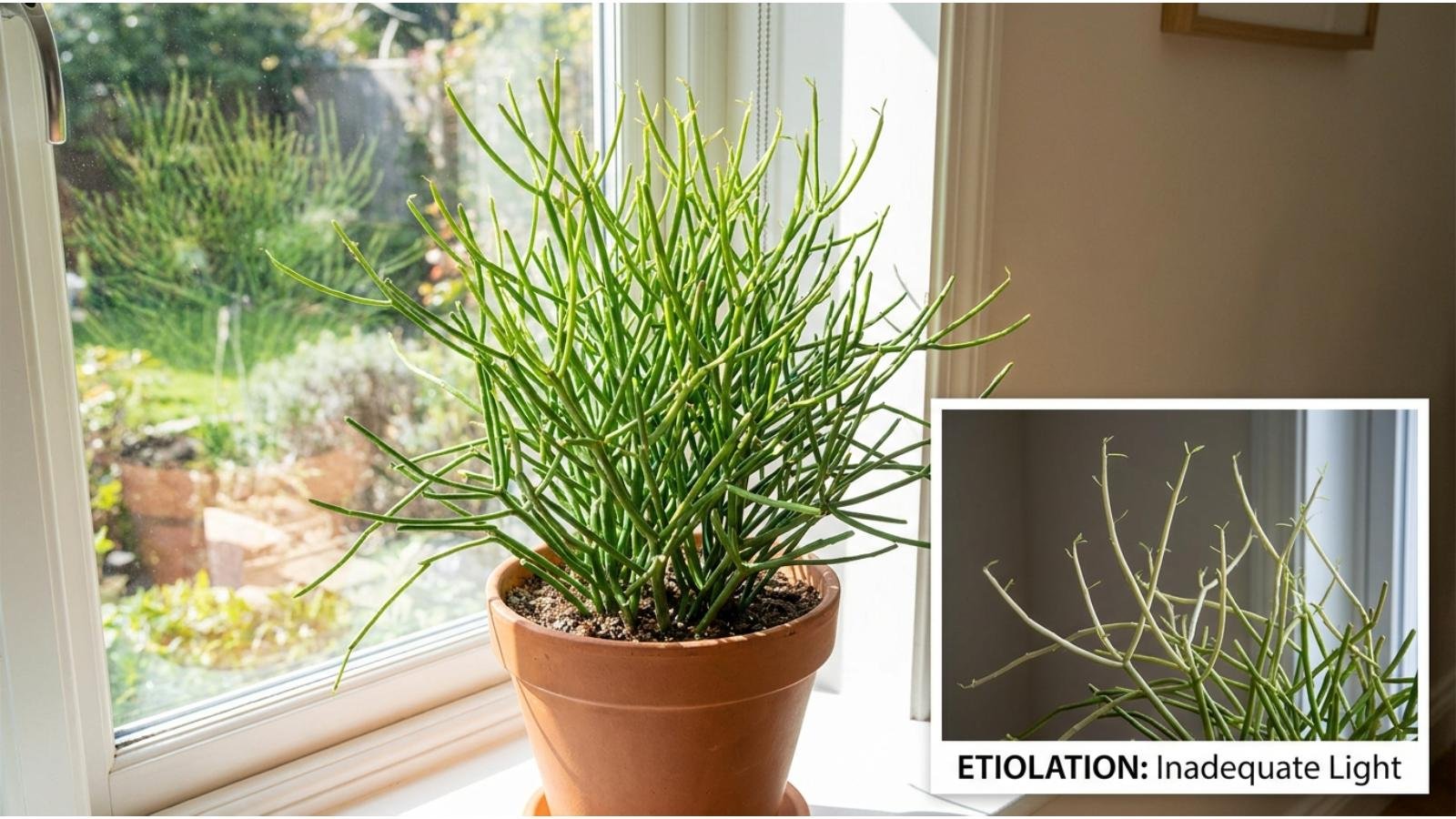
What happens when the plant receives too little light?
A pencil plant growing in insufficient light may develop:
- Long, stretched branches.
- Wider gaps between branches.
- Weaker or less upright growth.
- Reduced overall vigor.
If your plant has become stretched, move it gradually toward a brighter location. Increasing sunlight too suddenly can scorch growth that developed indoors or in shade.
Can a pencil plant tolerate direct sunlight?
Yes, it can grow well in direct sun, but acclimation matters.
A plant moved directly from a dim indoor room into intense outdoor sunshine may develop sunburn. Increase its exposure gradually over several days or longer, depending on the intensity of the sunlight and the plant’s response.
Practical tip: Rotate an indoor plant periodically if it grows unevenly toward a window. This can help maintain a more balanced shape.
Watering a Pencil Plant Correctly
Overwatering is one of the most important problems to avoid with pencil plants. Their succulent stems store water, allowing them to tolerate periods of dry soil.
A frequent watering routine that works for moisture-loving houseplants can keep this plant’s roots wet for too long.
When should you water a pencil plant?
Do not rely on a fixed calendar alone. Check the soil before watering.
Use this simple method:
- Insert a finger into the soil or use a wooden stick to check moisture below the surface.
- If the soil is still damp, wait before watering.
- When the soil has dried out, water thoroughly.
- Allow excess water to drain completely.
- Empty any water collected in the saucer or outer pot.
The goal is to provide a thorough drink followed by a period of drying.
How often should you water?
The appropriate interval depends on light, temperature, pot size, soil composition, and the season.
| Growing conditions | Watering approach |
|---|---|
| Bright, warm growing conditions | Check the soil regularly; it may dry relatively quickly. |
| Cool weather | Water less frequently as growth slows and soil dries more slowly. |
| Low-light indoor location | Be particularly cautious because water use may be reduced. |
| Small pot with a gritty mix | Monitor more frequently because it may dry faster. |
| Large pot with moisture-retentive soil | Allow extra drying time and watch carefully for prolonged wetness. |
A rough interval of one to two weeks may be a useful starting point in some indoor environments, but it is not a universal schedule. Soil moisture should determine when you water.
Signs of overwatering
Watch for:
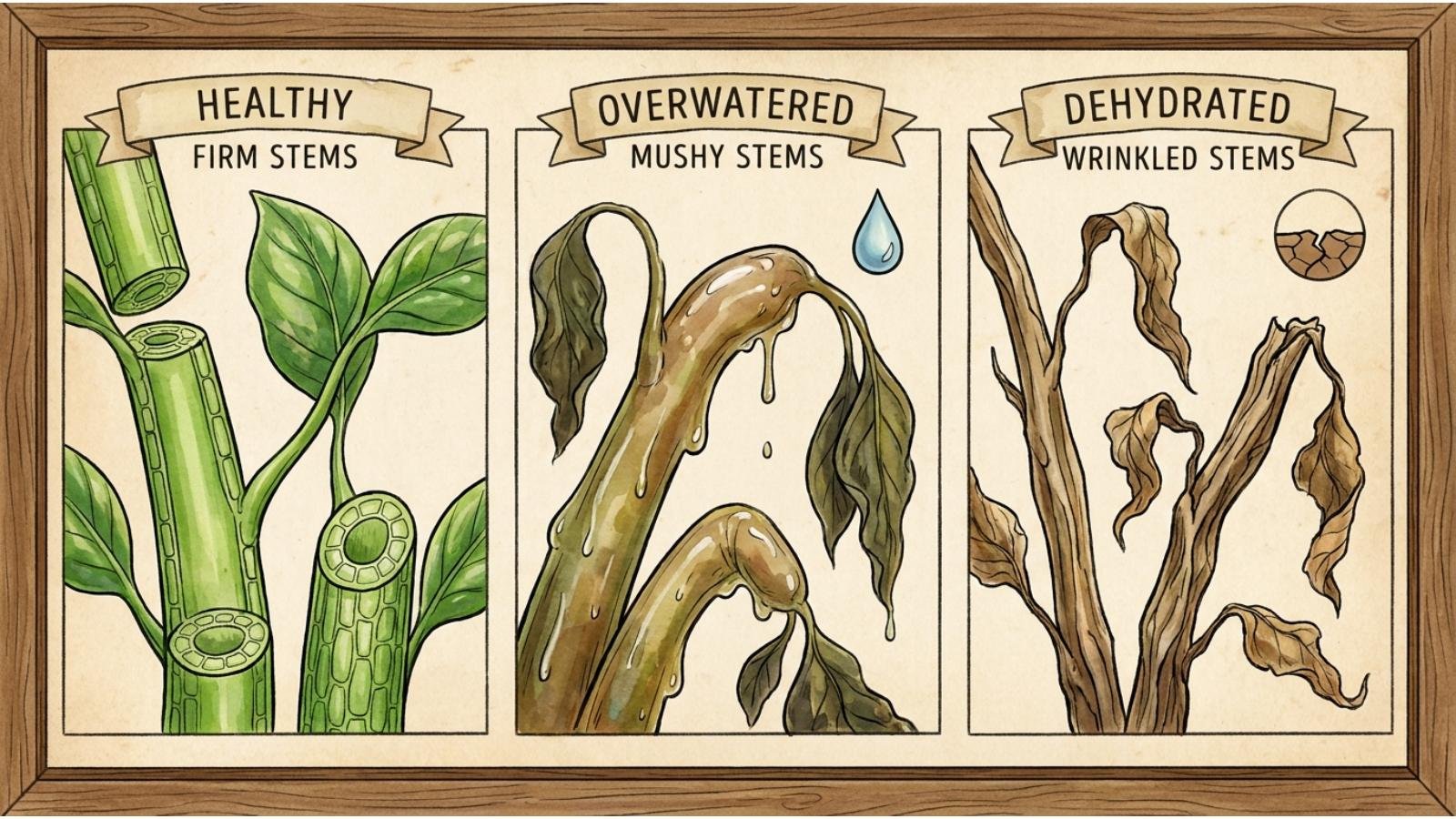
- Soft or mushy stems.
- Yellowing or collapsing branches.
- Soil that remains wet for an unusually long time.
- A foul smell coming from the potting mix.
- Dark, damaged roots if the plant is removed from its pot.
If you suspect overwatering, stop watering and inspect the drainage and root condition. If root rot is present, remove damaged roots with clean tools and repot the plant in fresh, well-draining soil.
Signs of underwatering
A plant that has remained dry for too long may show shriveling or loss of firmness in its stems.
However, shriveling can also occur when damaged roots cannot absorb water. Check the soil and roots before assuming that the plant simply needs more water.
The Best Soil and Pot for a Pencil Plant


The right soil helps prevent water from collecting around the roots. Pencil plants prefer a well-draining growing medium rather than dense soil that stays wet for extended periods.
What is the best soil for a pencil plant?
A suitable potting mix should:
- Drain excess water quickly.
- Allow air to reach the roots.
- Provide enough structure to support the plant.
- Avoid becoming compacted after repeated watering.
A commercial cactus and succulent mix is a convenient starting point.
If the mix retains too much moisture, improve its drainage by incorporating materials such as pumice or perlite. Coarse horticultural grit may also be useful when appropriate for the mix.
Avoid using heavy garden soil by itself in a container. It can become compacted and may drain poorly.
Which pot should you choose?
Choose a pot with drainage holes.
Terracotta is a useful option because its porous walls can help the growing medium dry more readily. However, a plastic or glazed pot can also work if the soil drains properly and you adjust watering accordingly.
The pot should be large enough to accommodate the root system without leaving an unnecessarily large volume of wet soil around it.
Important: A decorative outer pot without drainage should not be used as the plant’s only container. If you use one, keep the pencil plant in a separate draining pot and empty collected water after watering.
When should you repot a pencil plant?
Repot when:
- Roots are growing through the drainage holes.
- The plant has become unstable in its container.
- The growing medium has broken down or drains poorly.
- The root system has outgrown the available space.
Choose a container only modestly larger than the existing root ball. Moving a small plant into an excessively large pot can make moisture management more difficult.
Image suggestion: A simple diagram comparing a well-draining succulent mix with dense, water-retentive soil.
Temperature and Humidity Requirements
Pencil plants are adapted to warm environments and generally perform best when protected from frost and prolonged cold.
What temperature is best?
Aim to keep your plant in a warm, stable environment.
If you grow it outdoors, bring a container-grown specimen into a protected location before cold weather threatens it. A pencil plant that thrives outdoors in a warm climate may struggle when exposed to freezing temperatures.
Avoid placing it directly against a cold window during winter.
Does a pencil plant need high humidity?
No special humidity treatment is usually necessary.
Ordinary indoor humidity is generally suitable, provided the plant receives enough light and the soil drains well.
You generally do not need to mist the stems or use a humidifier specifically for this plant. Good air circulation and appropriate watering are more useful than trying to create a particularly humid environment.
Seasonal care adjustments
| Season | Recommended care |
|---|---|
| Spring | Resume monitoring for active growth, increase watering only as needed, and consider light feeding. |
| Summer | Provide bright light and check soil moisture more frequently if conditions are hot and sunny. |
| Autumn | Reduce watering as growth slows and temperatures begin to fall. |
| Winter | Protect from cold, avoid persistently wet soil, and provide the brightest suitable indoor location. |
The plant’s water requirements change with environmental conditions. Cooler temperatures and reduced light generally mean the soil will take longer to dry.
Fertilizing a Pencil Plant
Pencil plants do not need heavy feeding to remain healthy.
Too much fertilizer can encourage growth that is poorly suited to the available light and growing space. It may also contribute to an excessive buildup of soluble salts in the potting medium.
How should you fertilize it?
During active growth:
- Choose a balanced fertilizer suitable for succulents or houseplants.
- Follow the product’s dilution and application instructions.
- Apply it to a plant that is growing in suitable conditions.
- Avoid repeated heavy feeding.
A conservative feeding approach during the growing season is generally sufficient.
Reduce or stop fertilizing during periods when growth has slowed, particularly if the plant is receiving less light in winter.
Should you fertilize a struggling pencil plant?
Not immediately.
If the plant is dropping branches, developing soft stems, or growing poorly, first investigate its light, watering, drainage, and root condition.
Fertilizer cannot correct root rot, inadequate light, or cold damage. Address the underlying problem before considering additional nutrients.
Pruning and Maintaining the Plant’s Shape


Pencil plants can develop an upright, branching structure. Pruning can help manage their size, remove damaged growth, and maintain a balanced appearance.
However, pruning requires particular caution because cutting the plant releases irritating milky sap.
When should you prune?
Prune when necessary to:
- Remove damaged or dead branches.
- Manage growth that is becoming too large for the space.
- Improve the plant’s overall structure.
- Remove branches that interfere with nearby objects or pathways.
Avoid unnecessary pruning simply to encourage rapid growth.
How to prune safely
The sap can cause serious irritation, especially if it reaches the eyes. Wear appropriate protective equipment and keep other people and pets away from the work area.
Follow these precautions:
- Work in a well-ventilated area away from children and pets.
- Wear protective gloves, long sleeves, and eye protection.
- Use clean, sharp pruning tools.
- Make deliberate cuts while keeping your face and exposed skin away from the cut surfaces.
- Avoid allowing sap to drip onto your skin, clothing, or nearby surfaces.
- Clean the tools and work area carefully after finishing.
Do not handle cut branches with bare hands. The sap can remain irritating even after it dries.
How much can you prune?
For a manageable potted plant, remove only the growth necessary to achieve your intended shape.
Avoid removing large amounts of healthy growth at once, particularly if the plant is already stressed.
If the plant has become very large, top-heavy, or difficult to manage, consider whether it has outgrown its location rather than relying on increasingly severe pruning.
Image suggestion: A before-and-after illustration showing a pencil plant with a few carefully removed branches.
How to Propagate a Pencil Plant
Pencil plants can be propagated from stem cuttings. This allows you to produce new plants from suitable healthy growth.
However, propagation involves cutting the plant and therefore requires the same sap precautions as pruning.
Step-by-step propagation
Step 1: Select a healthy cutting.
Choose a suitable, healthy stem section from a mature plant. Avoid taking cuttings from branches that show signs of rot, pests, or serious damage.
Step 2: Protect yourself before cutting.
Wear gloves and eye protection, and keep children and pets away from the work area.
Step 3: Make a clean cut.
Use a clean, sharp tool. Handle the cutting carefully to avoid contact with the milky sap.
Step 4: Allow the cut end to dry.
Let the cut surface dry and form a callus before planting. This helps reduce the risk of the cutting rotting in the growing medium.
Step 5: Prepare the growing medium.
Use a clean pot containing a suitable, well-draining propagation mix.
Step 6: Plant the cutting.
Insert the callused end into the growing medium, positioning it securely without burying it excessively deeply.
Step 7: Provide suitable conditions.
Place the cutting in a warm location with bright, indirect light initially. Avoid keeping the medium continuously wet.
Step 8: Monitor for rooting.
Keep conditions stable and check for signs of new growth and root development. Avoid repeatedly pulling the cutting out to inspect it.
Stem cuttings are an established propagation method for this plant. Rooting time varies with temperature, cutting condition, and growing conditions, so avoid assuming every cutting will root on an identical schedule.
Common propagation mistakes
| Mistake | Why it causes problems |
|---|---|
| Planting a fresh, wet cutting immediately | The cut surface may be more vulnerable to rot. |
| Using dense, soggy soil | Excess moisture can damage the developing cutting. |
| Watering too frequently | The cutting may rot before establishing roots. |
| Placing it in intense sun immediately | Unacclimated tissue may become damaged. |
| Handling the cutting without protection | The irritating sap can contact skin or eyes. |
Image suggestion: A step-by-step propagation diagram showing cutting selection, callusing, planting, and early growth.
Common Pencil Plant Problems and How to Fix Them
Even though pencil plants are relatively low-maintenance, their appearance can change when growing conditions are unsuitable.
The key is to identify the underlying cause instead of automatically increasing watering or applying fertilizer.
Why is my pencil plant turning yellow?
Yellowing can have several causes, including excessive moisture, root damage, insufficient light, or environmental stress.
What to do:
- Check whether the soil is remaining wet for too long.
- Inspect the drainage holes.
- Examine the stems for softness or discoloration.
- Review recent changes in light and temperature.
- Inspect the roots if you suspect rot.
If the roots are healthy and the soil has dried appropriately, consider whether the plant has recently experienced a significant environmental change.
Why is my pencil plant dropping branches?
Branch loss can occur when the plant is stressed.
Potential causes include:
- Overwatering and root damage.
- Cold exposure.
- Insufficient light.
- Physical damage.
- Major changes in growing conditions.
Remove dead or damaged material carefully, but do not begin heavy pruning until you understand why the branches are falling.
Why is my pencil plant growing tall and thin?
Tall, weak, stretched growth commonly indicates inadequate light.
Move the plant gradually to a brighter location and rotate it periodically if it is growing toward one side.
Remember that pruning alone will not correct a lack of light. If the growing conditions remain unsuitable, new growth may continue to stretch.
Why are my pencil plant’s stems turning brown?
A few woody brown branches near the base may be part of normal maturation.
However, brown or black areas accompanied by softness, collapse, or spreading discoloration may indicate damage or disease.
Check the plant’s watering history, root condition, and exposure to cold before deciding how to treat it.
Why is my pencil plant leaning?
A pencil plant may lean because its growth is uneven, its container is unstable, or its upper growth has become too heavy.
Check whether the plant receives balanced light and whether the pot provides adequate support.
If the plant has become excessively large for its container, repotting into a suitably sized, stable pot may help.
Troubleshooting table
| Problem | Possible cause | Practical response |
|---|---|---|
| Yellowing stems | Excess moisture, root problems, or environmental stress | Check soil moisture, drainage, roots, and recent changes. |
| Mushy branches | Possible rot from excessive moisture | Stop watering temporarily, inspect the roots, and remove damaged tissue as appropriate. |
| Wrinkled stems | Prolonged dryness or impaired root function | Check soil and roots before watering. |
| Stretched growth | Insufficient light | Gradually increase light exposure. |
| Branch drop | Watering problems, cold, or other stress | Review environmental conditions and inspect damaged growth. |
| Brown, woody lower stems | May be normal maturation | Check whether the tissue is firm and whether discoloration is spreading. |
| Leaning growth | Uneven light, unstable pot, or excessive top growth | Improve light distribution and assess container stability. |
Image suggestion: A pencil plant diagnostic chart showing healthy stems, stretched growth, and symptoms associated with root problems.
Pests and Diseases to Watch For
Pencil plants generally have relatively few serious pest problems, but they are not completely immune.
Potential pests include mealybugs, spider mites, aphids, and scale insects. Root rot can also develop when the growing medium stays excessively wet.
How to identify common pests
Mealybugs: Look for small insects and white, cotton-like material around branch joints and other protected areas.
Spider mites: Check for fine webbing, tiny speckling, or a generally unhealthy appearance, particularly in warm, dry indoor conditions.
Scale insects: Look for small, stationary bumps attached to stems.
Aphids: Inspect tender new growth for clusters of small insects.
How to manage an infestation
- Inspect the entire plant, including branch joints and less visible areas.
- Separate an affected indoor plant from other plants when practical.
- Identify the pest before selecting a treatment.
- Use a treatment labeled for the pest and plant type, following all instructions.
- Monitor the plant and repeat treatment only as directed by the product label.
Because the plant produces irritating sap, wear gloves and avoid touching your face during inspection and treatment.
If the plant develops soft, collapsing stems and the soil remains wet, investigate possible root rot rather than assuming the problem is an insect infestation.
Is the Pencil Plant Toxic to Humans and Pets?
Yes. Pencil plants require careful handling because their milky sap can irritate the skin and cause serious eye injuries.
This is an important part of responsible pencil plant care, especially when the plant is grown indoors or in a garden used by children and pets.
The sap may be released when a stem is cut, broken, or damaged. Contact can cause skin irritation, while eye exposure can result in severe inflammation and potentially lasting damage. Ingestion can also cause harmful symptoms.
Safety precautions
- Wear gloves and eye protection when pruning or propagating.
- Keep the plant out of reach of children and pets.
- Avoid placing it where people may accidentally brush against or break its branches.
- Wash your hands thoroughly after handling the plant, even if you wore gloves.
- Clean tools and surfaces carefully after pruning.
- Do not ingest any part of the plant.
What should you do if sap gets on your skin?
Stop handling the plant and wash the affected skin thoroughly with soap and water.
If irritation develops or persists, seek appropriate medical advice.
What should you do if sap gets into your eyes?
Treat eye exposure as urgent.
Immediately rinse the eye with clean running water for at least 15 minutes and seek urgent medical attention. Do not delay medical evaluation, even if the initial discomfort seems manageable.
If someone swallows part of the plant or its sap, seek medical or poison-information advice promptly.
For pets, contact a veterinarian if ingestion or significant exposure is suspected.
Growing a Pencil Plant Indoors vs. Outdoors
Pencil plants can be grown in containers indoors or planted outdoors in climates that meet their temperature and growing requirements.
The main difference is how much space, sunlight, and environmental protection each setting provides.
| Feature | Indoors | Outdoors |
|---|---|---|
| Light | Requires a bright position, ideally near a sunny window | Can receive substantial direct sunlight after acclimation |
| Space | Often maintained as a smaller specimen through pruning | May develop into a large shrub or small tree |
| Temperature | Easier to protect from cold | Requires a suitable warm climate or seasonal protection |
| Watering | Depends on indoor light, temperature, and potting mix | Depends on rainfall, soil drainage, heat, and exposure |
| Maintenance | Monitor for stretching and indoor pests | Monitor size, access, weather exposure, and nearby foot traffic |
| Safety | Keep away from children, pets, and frequently touched areas | Position away from paths and areas where people may brush against branches |
The plant can become very large in frost-free conditions, so its location should be selected with mature size and sap exposure in mind.
Can you grow a pencil plant outdoors in a cold climate?
You can grow it in a container and move it into a protected location when temperatures become unsuitable.
In climates with freezing winters, leaving it outdoors year-round can expose it to damaging cold.
Can you move an indoor pencil plant outside in summer?
Yes, if outdoor conditions are appropriate.
Move it gradually into stronger light rather than placing it immediately in intense direct sunshine. Before bringing it back indoors, inspect it for pests and allow it to adjust to the new environment.
Image suggestion: A side-by-side illustration of a pencil plant growing in a sunny indoor container and a mature outdoor planting.
Frequently Asked Questions About Pencil Plant Care
Is a pencil plant easy to care for?
Yes. Pencil plants are relatively easy to maintain when given bright light, well-draining soil, and careful watering. Their drought tolerance makes them suitable for people who prefer plants that do not require frequent watering.
How often should I water my pencil plant?
Water when the growing medium has dried out, then allow excess water to drain completely. The interval depends on light, temperature, pot size, and soil composition. Avoid following a rigid schedule without checking the soil.
Can a pencil plant grow indoors?
Yes. A pencil plant can grow indoors in a bright location, particularly near a sunny window. Provide adequate space, a draining pot, and protection from cold drafts.
Does a pencil plant need direct sunlight?
It can grow well in direct sunlight once acclimated. Bright indirect light can also be suitable, but insufficient light may cause stretched, weak growth.
Why is my pencil plant losing its leaves?
Pencil plants naturally produce small leaves that often fall off quickly. However, widespread branch loss, soft stems, or sudden discoloration may indicate a problem with watering, temperature, light, or root health.
Can a pencil plant survive without frequent watering?
Yes. Its succulent stems store water, allowing it to tolerate periods of dry soil. However, prolonged neglect can still cause dehydration, so check the plant regularly.
Does the pencil plant flower?
Yes. It can produce small, inconspicuous flowers, although flowering is not usually its main ornamental feature when grown as a houseplant.
Can I propagate a pencil plant from a cutting?
Yes. Stem cuttings are a common propagation method. Allow the cut end to callus before planting it in a suitable growing medium, and avoid keeping the medium excessively wet.
Always wear protective equipment because the cut stems release irritating sap.
Why is my pencil plant turning brown?
Some lower branches may become woody as the plant matures. However, soft, dark, or spreading brown areas can indicate damage or disease. Inspect the soil, roots, and affected stems before deciding on a treatment.
Can I grow a pencil plant in a small pot?
Yes, while the plant is small. However, it may eventually need a larger, stable container as its roots and branches develop. Avoid using an excessively large pot that remains wet for too long.
Is the pencil plant safe for cats and dogs?
No. The plant’s sap can be harmful to pets. Keep it away from animals that might chew its branches, and contact a veterinarian if ingestion is suspected.
Is a pencil plant a cactus or a succulent?
It is a succulent, not a true cactus. It belongs to the genus Euphorbia and stores water in its stems
Conclusion
Successful pencil plant care comes down to understanding its succulent growth habits and avoiding conditions that keep its roots excessively wet.
Give your plant plenty of suitable light, use a well-draining potting mix, water according to soil moisture, and protect it from prolonged cold. Prune only when necessary, and investigate changes in stem condition rather than automatically adding more water or fertilizer.
Most importantly, treat its milky sap with care. Protective equipment, thoughtful placement, and safe pruning practices are essential because the sap can cause serious skin and eye irritation.
With the right growing conditions and a little attention to its changing needs, a pencil plant can develop into an attractive, architectural feature in your home or garden.
The most useful habit to develop is checking the soil and the stems before watering. That simple practice can help you avoid many common problems and keep your pencil plant growing well