Quick Answer
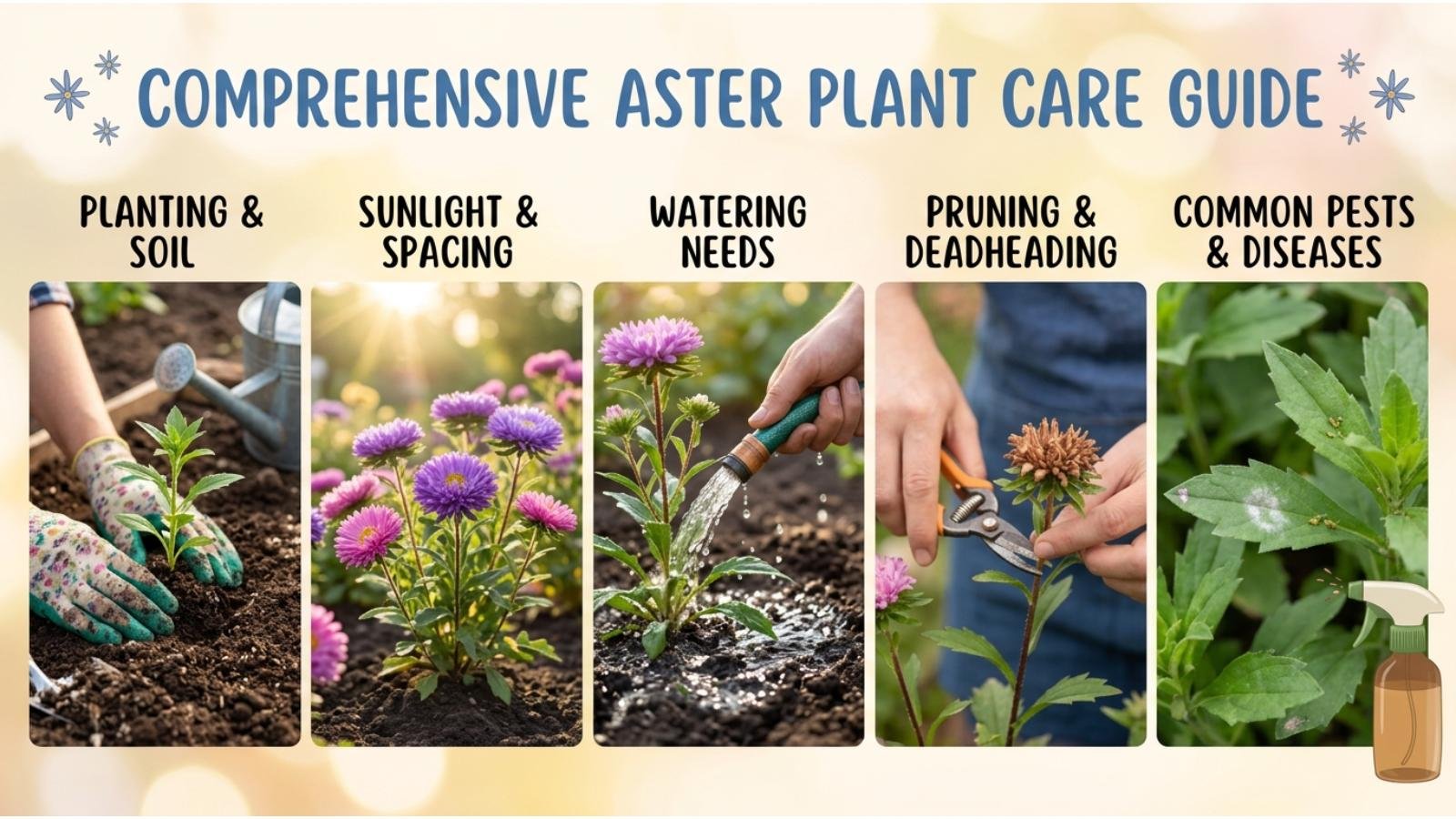
Aster plant care is mainly about providing 6–8 hours of sunlight, well-draining soil, consistent moisture, good airflow, and regular deadheading.
Water when the top inch of soil begins to dry, avoiding constantly wet roots. Feed lightly during active growth, pinch young plants to encourage branching, and divide established perennials every few years. Good spacing is especially important because crowded asters are more vulnerable to powdery mildew and other fungal problems.
Introduction
Aster plant care becomes much easier when you understand what these flowering plants actually need. Asters are valued for their daisy-like flowers and late-season color, but they can become leggy, develop mildew, or produce fewer blooms when their growing conditions are poorly balanced.
One common mistake is treating asters like plants that simply need lots of water and fertilizer to flower heavily. In practice, sunlight, drainage, airflow, and watering consistency have a much greater effect on long-term performance.
Because “aster” can refer to several related plants and cultivars with different growth habits, always check the requirements of your particular variety. The following guide focuses primarily on commonly grown perennial asters while also explaining where care can differ.
Understanding Asters Before You Plant
Asters are flowering plants in the daisy family, with many garden varieties producing flowers in shades of purple, blue, pink, white, and red.
Depending on the variety, asters can range from compact plants suitable for containers to tall plants that work better toward the back of a flower border.
Their flowering period is one of their major attractions. Many perennial asters bloom from late summer into fall, providing color when some earlier summer flowers are beginning to fade.
Asters generally prefer
- Full sun.
- Well-draining soil.
- Even but not excessive moisture.
- Good air circulation.
- Moderate fertility.
- Regular removal of spent flowers.
- Enough space to prevent overcrowding.
How Much Sunlight Do Asters Need?
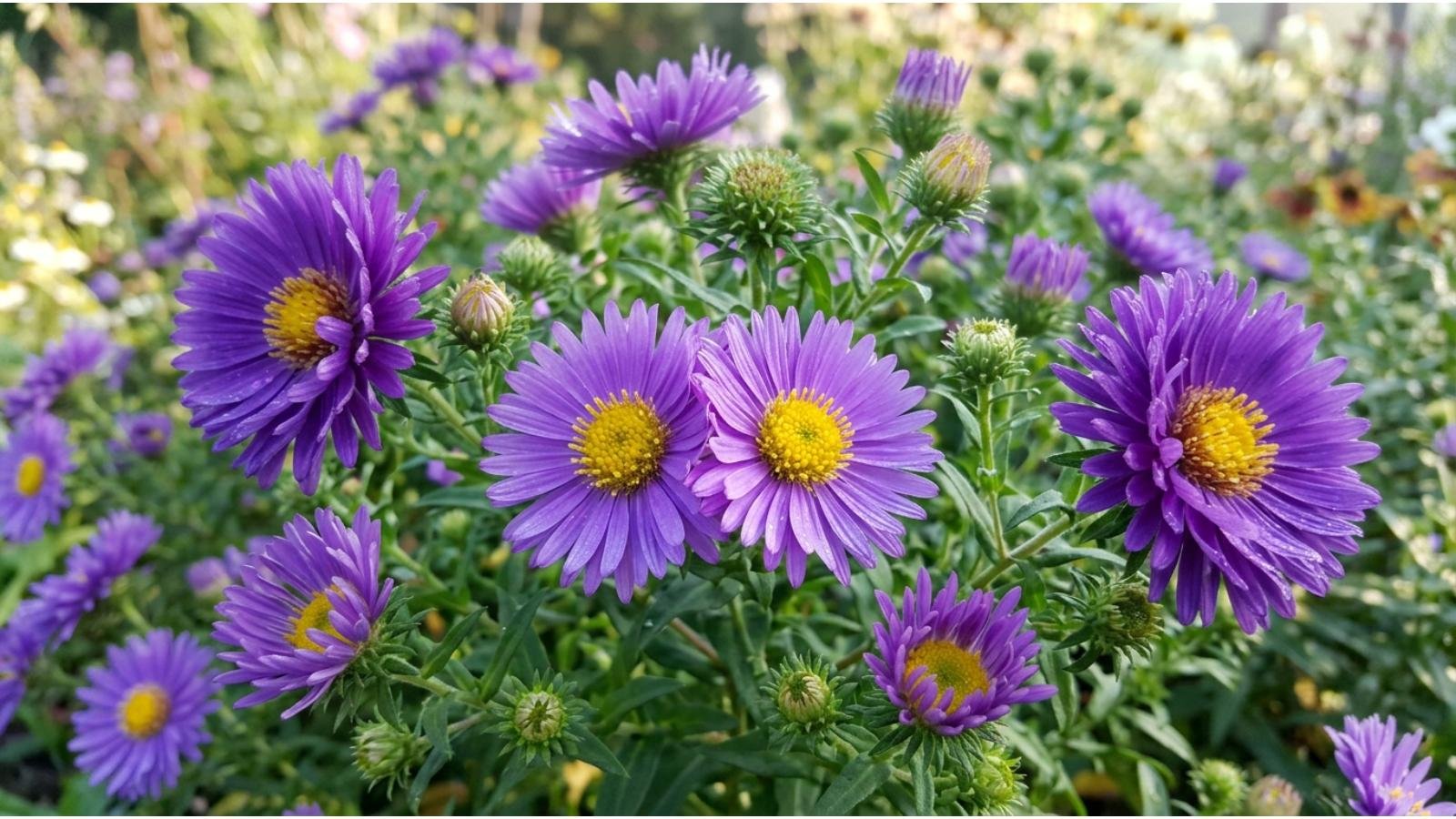
Asters generally perform best in full sun, meaning around six or more hours of direct sunlight per day.
Sunlight affects much more than flower production. Plants growing in insufficient light may become tall and floppy as they stretch toward a brighter location.
Signs your aster may need more light
- Weak or elongated stems.
- Fewer flowers.
- Smaller blooms.
- Flowering that occurs later than expected.
- The plant leaning toward one direction.
In very hot climates, some afternoon protection can be helpful, particularly if the plant is exposed to intense heat and reflected sunlight. However, excessive shade can create another problem: reduced flowering and poorer airflow.
Practical tip
If you’re growing asters in a hot location, morning sun with some protection from the strongest afternoon heat can sometimes be a useful compromise.
The Best Soil for Asters
Asters don’t require unusually rich soil, but they do need soil that drains efficiently.
The ideal growing medium is:
- Loose.
- Well-draining.
- Moderately fertile.
- Rich in organic matter.
- Able to retain some moisture without becoming soggy.
Heavy, poorly drained soil can keep the root zone wet for too long. This is particularly problematic after frequent watering or heavy rainfall.
Improving garden soil
If your soil is heavy clay, incorporate organic matter before planting and improve drainage where possible.
For containers, use a quality potting mix rather than dense garden soil. The container must also have drainage holes.
Important: Adding a small amount of water to dry soil isn’t the same as fixing poor drainage. If water consistently remains around the roots, the underlying drainage problem needs to be addressed.
How to Water Asters Correctly
Asters prefer consistent moisture, especially while establishing new roots and during active growth.
However, consistently wet soil can be just as problematic as drought.
A simple watering method
- Check the soil near the plant.
- If the upper portion has started to dry, water thoroughly.
- Allow excess water to drain away.
- Check the soil again before watering next time.
- Increase monitoring during hot, dry weather.
Newly planted asters generally require more frequent attention than established plants.
Avoid shallow watering
Giving the plant a tiny amount of water every day can encourage a shallow moisture pattern in the soil. When appropriate, a deeper watering followed by a period of partial drying can encourage roots to explore the surrounding soil.
Signs of watering problems
| Symptom | Possible cause |
|---|---|
| Wilting during dry weather | Insufficient moisture |
| Yellowing with consistently wet soil | Possible overwatering/root stress |
| Crispy leaf edges | Drought or heat stress |
| Slow growth in soggy soil | Poor drainage |
| Sudden decline after repeated heavy watering | Root problems |
Don’t diagnose a problem from one symptom alone. Check the soil moisture, drainage, weather, and recent watering history together.
Fertilizing Asters
Asters generally benefit from moderate fertility rather than constant heavy feeding.
Too much nitrogen can encourage lush leafy growth while reducing the balance between foliage and flowers.
A practical approach is to:
- Improve the soil with organic matter before planting.
- Use a balanced fertilizer when appropriate during active growth.
- Follow the fertilizer label rather than applying extra.
- Avoid repeatedly feeding a struggling plant without identifying the underlying problem.
If the plant has good foliage and is flowering normally, additional fertilizer may not be necessary.
A frequently overlooked point
More fertilizer does not automatically mean more flowers. If an aster isn’t blooming, first investigate sunlight, pruning, plant maturity, watering, and cultivar characteristics.
When and How to Plant Asters
Planting time depends on your climate and whether you’re starting with nursery plants or dividing an established perennial.
Choose a location where the plant can receive adequate sunlight and mature without becoming crowded.
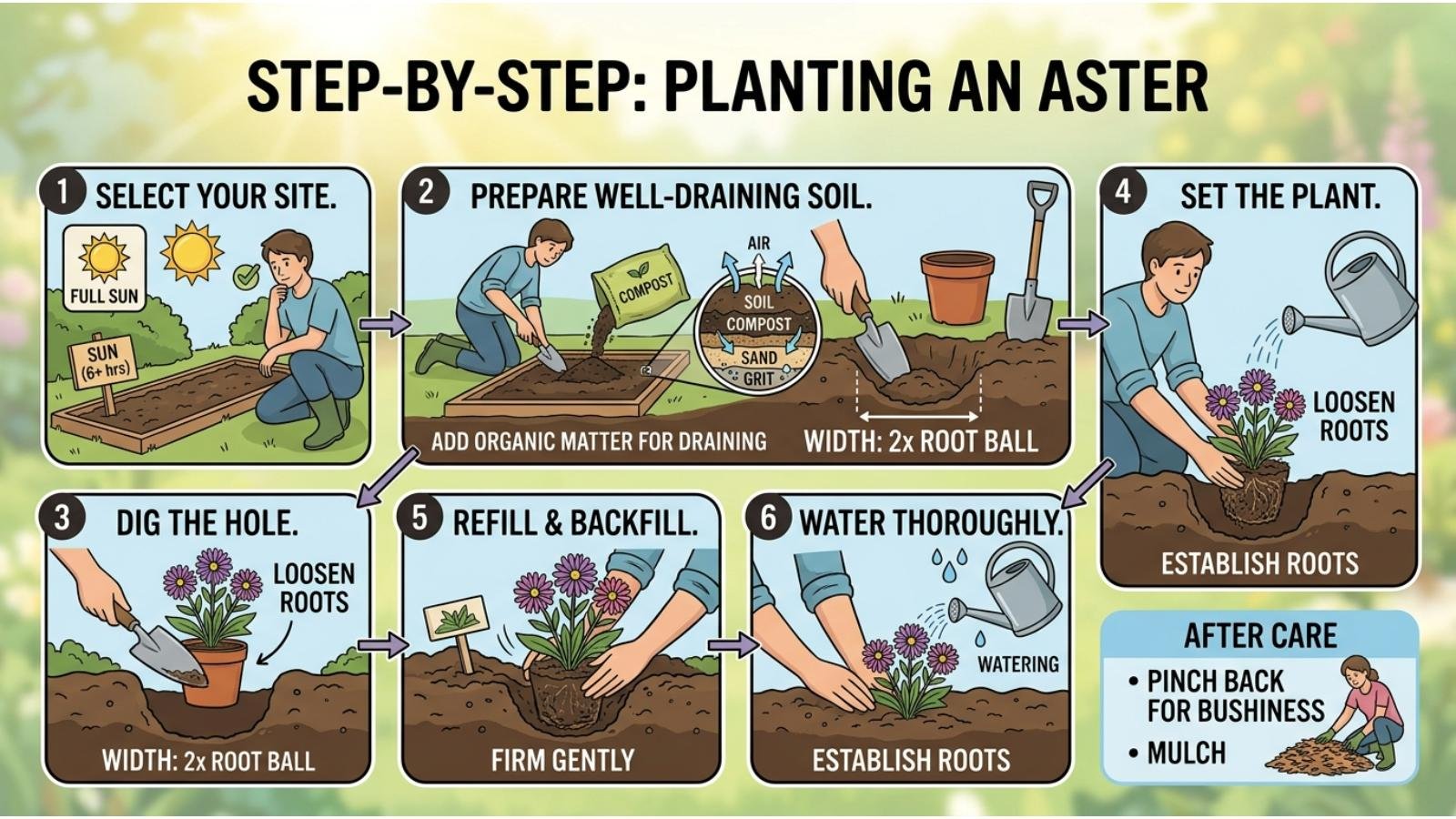
Planting steps
- Select a sunny location with good drainage.
- Prepare the soil and remove large weeds.
- Dig a hole slightly wider than the root system.
- Position the plant at approximately the same depth it was growing previously.
- Backfill with soil.
- Water thoroughly.
- Add a light layer of mulch around the plant.
Keep mulch slightly away from the base of the stems. Constant moisture against the crown can contribute to problems.
Image Suggestion: Step-by-step illustration showing an aster being planted in well-draining garden soil.
How to Grow Asters in Containers
Many compact aster varieties can be grown successfully in containers.
Choose a pot with:
- Drainage holes.
- Enough depth for the mature root system.
- Sufficient width to prevent the plant from becoming unstable.
- Fresh, well-draining potting mix.
Container plants usually dry out faster than plants growing in the ground, so check their soil more frequently.
Container watering mistake to avoid
Don’t follow a rigid calendar such as “water every two days” regardless of weather. A container exposed to hot sun can dry considerably faster than one sitting in cooler conditions.
Check the soil instead.
Pruning and Pinching Asters
Pruning can help control the plant’s shape and encourage a fuller appearance.
Pinching young plants
When an aster is actively growing, lightly pinching the growing tips can encourage branching.
This can result in:
- More side shoots.
- A bushier plant.
- Better stem structure.
- Potentially more flowering points.
Avoid excessive late-season pruning because removing developing growth too close to flowering can reduce the display.
Deadheading
Remove faded flowers when you want to keep the plant looking tidy and potentially encourage additional flowering.
Simply cut the spent flower and its stem back to an appropriate leaf node or branching point.
Image Suggestion: Before-and-after illustration showing where to cut a spent aster flower stem.
How to Prevent Asters From Becoming Leggy
Leggy growth is often related to insufficient sunlight, excessive nitrogen, or inadequate pruning during early growth.
To encourage stronger plants
- Provide sufficient sunlight.
- Avoid excessive nitrogen fertilizer.
- Pinch young plants when appropriate.
- Give tall varieties adequate spacing.
- Consider staking varieties that naturally grow tall.
Don’t automatically assume a floppy aster needs more fertilizer. If the plant is stretching because of low light, additional nutrients won’t solve the fundamental issue.
Aster Plant Spacing and Airflow
Good spacing is one of the easiest ways to reduce problems later.
A dense group of plants can trap humidity around leaves and stems. This creates an environment where fungal diseases can spread more easily.
When planting, consider the mature width, not just the size of the young plant you purchase.
Good airflow means
- Leaves dry more quickly after rain.
- Humidity is reduced around the foliage.
- Plants compete less for sunlight.
- Routine inspection becomes easier.
This is particularly important in humid climates.
Common Aster Pests
Asters can occasionally attract pests such as aphids, leafhoppers, and other insects.
Rather than automatically treating the entire plant, inspect the foliage first.
Look underneath leaves and around:
- New growth.
- Flower buds.
- Tender stems.
- Leaf joints.
A practical first step
For a small infestation, physically removing affected insects or using an appropriate gentle control method may be sufficient.
If a pest problem continues, identify the insect before selecting a treatment. Different pests require different approaches.
Common Aster Diseases
Asters can experience fungal and other disease problems, particularly when plants are crowded or foliage remains wet for long periods.
Powdery mildew
Powdery mildew often appears as a pale, powdery coating on leaves.
It is more likely to become troublesome when:
- Air circulation is poor.
- Plants are crowded.
- Humidity is high.
- Foliage stays damp.
- Plants are growing in stressful conditions.
What helps
Improve spacing and airflow, avoid unnecessarily wetting the foliage, and remove severely affected plant material when appropriate.
Aster yellows
Aster yellows is a serious plant disease associated with phytoplasmas and transmitted by leafhoppers.
Affected plants may show unusual growth, distorted flowers, yellowing, or abnormal shoots.
This condition is different from a simple nutrient deficiency.
If a plant shows unmistakable symptoms consistent with aster yellows, removing the affected plant can help prevent the problem from spreading to other susceptible plants.
Why Is My Aster Not Blooming?
Poor flowering can have several causes.
Check these factors first:
1. Not enough sunlight
Asters generally need substantial direct light for strong flowering.
2. Excessive nitrogen
Heavy nitrogen feeding can encourage foliage instead of balanced flowering.
3. Incorrect pruning timing
Removing developing growth too late can interfere with flowering.
4. Immature plants
Recently planted or divided plants may need time to establish.
5. Water stress
Repeated drought can interfere with healthy growth.
6. Variety differences
Flowering time varies significantly among different asters.
Don’t immediately add fertilizer when an aster fails to bloom. Light and plant maturity are often more relevant.
Why Are My Aster Leaves Turning Yellow?
Yellow leaves can result from several different conditions.
| Possible cause | What to investigate |
|---|---|
| Excess moisture | Check drainage and soil moisture |
| Drought | Check whether the root zone is drying excessively |
| Nutrient deficiency | Look at overall growth and soil fertility |
| Natural aging | Determine whether only older leaves are affected |
| Disease | Look for spots, distortion, or unusual patterns |
| Root stress | Check whether soil stays wet for long periods |
The location and pattern of yellowing can provide useful clues.
For example, a few older leaves turning yellow naturally is very different from widespread yellowing accompanied by wet soil and declining growth.
Aster Care Through the Seasons
Spring
Spring is an important growth period.
Focus on:
- Removing damaged old growth.
- Checking emerging shoots.
- Improving soil if necessary.
- Maintaining appropriate moisture.
- Pinching young plants when suitable.
- Monitoring early pest activity.
Summer
Summer care is largely about maintaining healthy growth.
- Monitor soil moisture.
- Water during prolonged dry periods.
- Maintain airflow.
- Watch for powdery mildew.
- Support tall varieties if necessary.
- Avoid excessive fertilizer.
Fall
Many asters provide valuable late-season flowers.
Continue:
- Watering during dry weather.
- Removing badly damaged foliage.
- Deadheading if desired.
- Monitoring disease.
Winter
Care varies according to species and climate.
Once growth naturally dies back, many perennial asters can be left with some above-ground material for winter protection and habitat, depending on your garden-management preferences.
Avoid assuming every aster should be cut completely to the ground at exactly the same time. Variety and local conditions matter.
Dividing Established Asters
Perennial asters can become crowded over time.
Division can help rejuvenate an established clump and provide additional plants.
General process
- Dig around the established plant.
- Lift the root clump carefully.
- Separate it into healthy sections.
- Ensure each division has viable roots and shoots.
- Replant promptly.
- Water thoroughly.
- Keep the newly divided plants consistently moist while they establish.
Division is generally best performed during a suitable cool growing period rather than during extreme heat.
Growing Asters From Seed
Asters can also be grown from seed, although germination and flowering time depend on the species or cultivar.
Starting from seed is particularly useful when you want to grow multiple plants economically or experiment with different varieties.
Basic approach
- Use a clean seed-starting medium.
- Sow according to the seed packet’s depth requirements.
- Keep the medium appropriately moist.
- Provide sufficient light after germination.
- Gradually acclimate young plants before transplanting outdoors.
Remember that plants grown from seed may not always be identical to a named parent cultivar.
Aster Plant Care Mistakes to Avoid
Overwatering
Constantly wet soil can damage roots and create conditions favorable to disease.
Planting in deep shade
Asters may survive but often won’t produce their best flowering display.
Overfertilizing
Excessive feeding can produce abundant foliage without improving the overall flower display.
Ignoring mature plant size
A tiny nursery plant can become surprisingly large during the growing season.
Crowding plants
Poor airflow can increase the likelihood of foliar disease.
Watering on a rigid schedule
Plant needs change with temperature, rainfall, soil type, and container size.
Pruning without considering flowering time
Different asters have different growth habits. Timing matters.
A Simple Aster Care Routine
If you want a straightforward maintenance routine, use this checklist.
Weekly
- Check soil moisture.
- Inspect leaves for pests.
- Look for signs of disease.
- Remove obviously damaged material.
During active growth
- Pinch young plants if appropriate.
- Maintain adequate sunlight.
- Monitor plant spacing and airflow.
- Fertilize only when needed.
During flowering
- Deadhead faded flowers if desired.
- Stake tall plants if they begin leaning.
- Continue checking moisture.
Every few years
- Evaluate whether established clumps have become overcrowded.
- Divide perennial asters when appropriate.
- Rejuvenate the surrounding soil if necessary.
Aster Plant Care Quick Reference
| Care Requirement | General Recommendation |
|---|---|
| Light | Full sun is generally preferred |
| Soil | Fertile, loose, well-draining soil |
| Water | Consistent moisture without waterlogging |
| Fertilizer | Moderate feeding when needed |
| Pruning | Pinch young growth and deadhead as appropriate |
| Spacing | Allow room for mature growth and airflow |
| Containers | Use drainage holes and well-draining potting mix |
| Main concern | Poor drainage and inadequate airflow |
| Propagation | Division and seed, depending on variety |
| Flowering | Often late summer through fall for perennial types |
Frequently Asked Questions
How often should I water an aster plant?
Water when the upper layer of soil begins to dry, then water thoroughly. The exact frequency depends on temperature, rainfall, soil type, and whether the plant is growing in the ground or a container.
Do asters need full sun?
Most garden asters perform best in full sun. Adequate direct sunlight is especially important for strong stems and abundant flowering.
Can asters grow in pots?
Yes. Compact varieties can perform well in containers when provided with sufficient sunlight, a suitable pot, good drainage, and appropriate watering.
Why is my aster falling over?
Tall growth, insufficient light, excessive nitrogen, wind, or lack of support can contribute. Pinching young plants and providing adequate light can help create a more compact structure.
Should I deadhead asters?
Deadheading is useful for keeping plants tidy and can encourage continued flowering in some varieties. It isn’t always necessary if you prefer to leave seed heads for wildlife or winter interest.
Can asters grow in shade?
Asters generally prefer substantial sunlight. Some may tolerate partial shade, but flowering can be reduced when light levels are too low.
Are asters drought tolerant?
Established plants can tolerate some dry periods, but they generally perform better with consistent moisture, especially during active growth and flowering.
Why are my aster leaves covered in white powder?
A white powdery coating is commonly associated with powdery mildew. Crowding, humidity, and poor airflow can increase the risk.
When should I divide asters?
Established perennial asters can be divided during a suitable cool growing period. The exact timing depends on the species, climate, and local growing conditions.
Do asters come back every year?
Many garden asters are perennial and can return each growing season when grown in an appropriate climate. However, some plants sold as asters are annual or have different growth cycles, so identify the specific variety before assuming it will return.
Conclusion
Successful aster plant care is less about constant attention and more about getting the basic growing conditions right. Give asters enough sunlight, plant them in well-draining soil, maintain consistent moisture without keeping the roots saturated, and provide enough space for good airflow.
For healthier plants, pay particular attention to the details that are easy to overlook: don’t overwater, don’t overfertilize, don’t crowd mature plants, and don’t prune without considering the variety’s flowering habit. With those fundamentals in place, asters can provide a long-lasting display of colorful flowers while requiring relatively straightforward maintenance.