Quick Answer
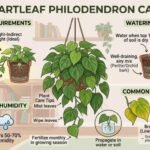
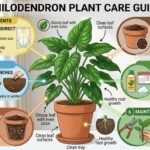
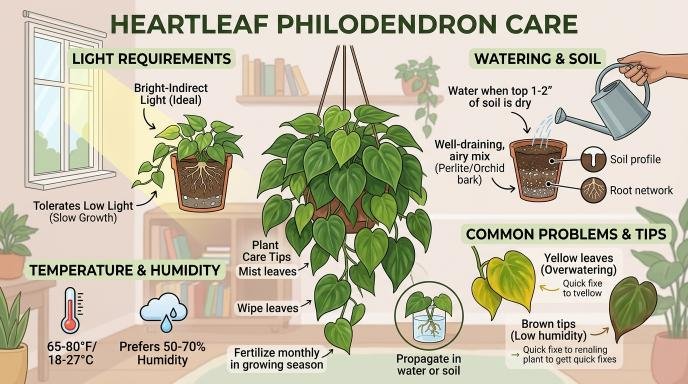
Heartleaf philodendron care is simple when you provide bright, indirect light, well-draining soil, moderate watering, and warm temperatures.
Let the top inch or two of soil dry before watering again, and avoid keeping the roots constantly wet. Regular pruning encourages fuller growth, while occasional feeding during active growth supports healthy leaves and long vines.
Introduction
Heartleaf philodendron (Philodendron hederaceum) is one of the easiest tropical houseplants to grow, but “easy” does not mean it can tolerate every mistake. Most problems come from too much water, insufficient light, poor drainage, or sudden environmental changes.
The plant is especially popular for its heart-shaped leaves and trailing habit. It can grow from a hanging basket, climb a moss pole or other support, or trail from a shelf. With the right routine, a single plant can develop long, attractive vines without requiring complicated maintenance.
The key to successful heartleaf philodendron care is learning to respond to the plant and its growing conditions rather than following a rigid watering schedule.
Understanding the Heartleaf Philodendron
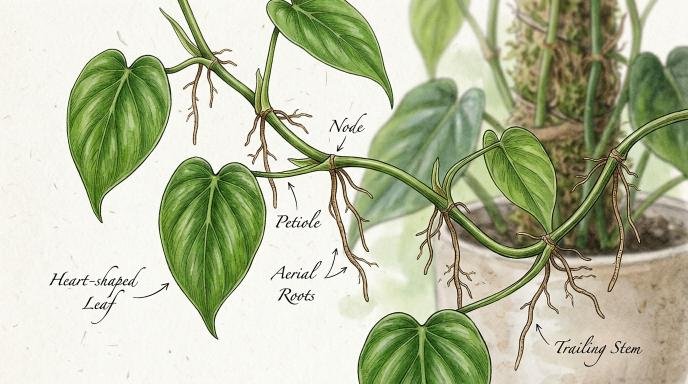
The heartleaf philodendron is a tropical aroid native to parts of Central America and the Caribbean. In its natural environment, it grows among other vegetation and can climb trees using aerial roots.
Its growth habit explains several of its indoor-care preferences:
- Heart-shaped leaves: Mature leaves can become larger when the plant receives suitable light and climbing support.
- Trailing or climbing vines: The stems naturally continue growing and can be trained upward.
- Aerial roots: These help the plant attach to surfaces and absorb moisture from the surrounding environment.
- Tropical growth pattern: It prefers warmth, indirect light, and soil that remains lightly moist but never waterlogged.
Light Requirements
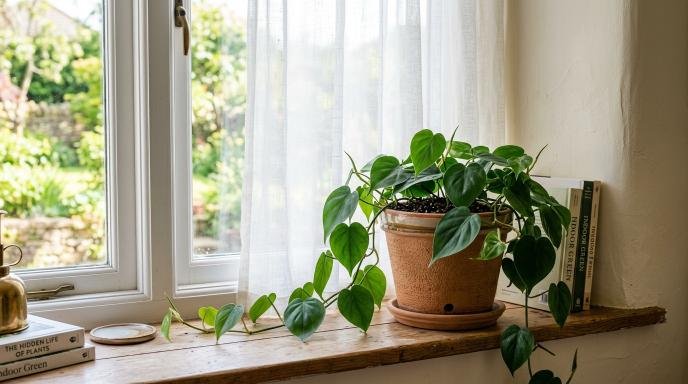
Bright, indirect light is generally ideal for a heartleaf philodendron.
Place it near an east- or west-facing window with filtered light, or a little farther from a brighter south-facing window. Direct, intense afternoon sunlight through glass can scorch the foliage.
Low light does not necessarily kill the plant, but it can change its appearance and growth.
Signs of insufficient light
- Long gaps between leaves.
- Slow or weak growth.
- Smaller new leaves.
- A plant that becomes increasingly sparse.
- Loss of strong leaf coloration in cultivars that have variegation.
Signs of excessive direct sunlight
- Brown or bleached patches.
- Crispy leaf edges.
- Faded foliage.
- Leaves becoming unusually pale.
A useful practical rule is to increase light gradually rather than moving a plant suddenly from a dim room into several hours of strong sunlight.
How Often Should You Water a Heartleaf Philodendron?
Water when the upper portion of the potting mix has dried rather than watering according to a fixed calendar.
For many indoor plants, checking the soil every several days is more reliable than saying “water once a week.” Temperature, pot size, soil composition, humidity, season, and light exposure can all change how quickly the soil dries.
When watering:
- Check the top 1–2 inches of soil with your finger.
- If that layer is still noticeably moist, wait.
- When the upper layer has dried, water thoroughly.
- Allow excess water to drain from the pot.
- Empty water collected in a saucer or decorative container.
The biggest mistake is watering again simply because several days have passed.
What overwatering looks like
Overwatering is usually a problem of frequency and poor drainage, not simply the amount of water used during one watering.
Possible symptoms include:
- Yellowing leaves.
- Soft or collapsing stems.
- Persistently wet soil.
- An unpleasant smell from the potting mix.
- Root damage.
- Sudden leaf drop in severe cases.
What underwatering looks like
A plant that stays too dry may develop:
- Drooping leaves.
- Curling foliage.
- Dry, brown edges.
- Very dry potting mix pulling away from the container.
- Slower growth.
If the plant becomes severely dehydrated, water thoroughly rather than giving it only a small splash.
Best Soil for Heartleaf Philodendron
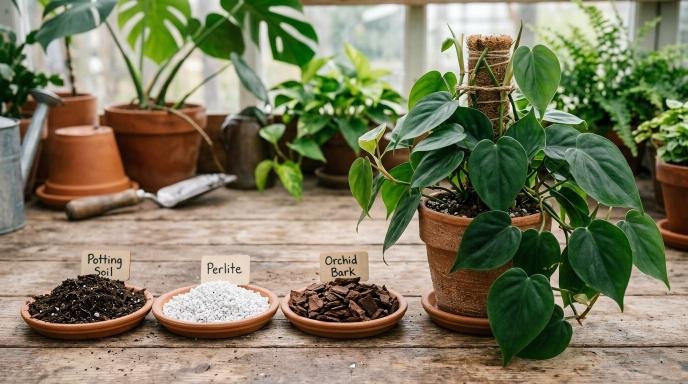
Heartleaf philodendrons need a potting mix that holds some moisture while allowing excess water and air to move through the root zone.
A practical mix can contain:
- Quality indoor potting soil.
- Perlite or another aerating material.
- Orchid bark or another chunky organic component.
The exact recipe is less important than the result: the soil should not become dense, muddy, or permanently saturated.
Why drainage matters
Roots require oxygen as well as water. When water occupies nearly all the spaces between soil particles for extended periods, the root environment becomes poorly aerated and root problems become more likely.
A container with drainage holes is therefore much more important than using an expensive specialized pot.
Choosing the Right Pot
Choose a container with drainage holes and avoid moving the plant into a dramatically oversized pot.
A pot that is much larger than the root system can hold excess moisture for longer because there is more unused soil around the roots.
Repot when:
- Roots are circling heavily around the root ball.
- Roots are emerging from drainage holes.
- Water passes unusually quickly through the container because the root mass has become dense.
- Growth has slowed despite appropriate light and care.
- The plant repeatedly becomes root-bound.
You usually do not need to repot a healthy heartleaf philodendron simply because a certain amount of time has passed.
Temperature and Humidity
Heartleaf philodendrons prefer warm indoor conditions and generally perform poorly when exposed to prolonged cold.
Keep the plant away from:
- Cold drafts.
- Air-conditioning vents.
- Heating vents.
- Frequently opened exterior doors during cold weather.
- Sudden temperature changes.
Average household humidity can be adequate, especially if the plant receives appropriate light and watering.
Higher humidity can support healthy foliage, but increasing humidity cannot compensate for waterlogged soil or poor drainage.
Fertilizing Heartleaf Philodendron
During active growth, a balanced houseplant fertilizer can provide nutrients that are not continuously available in the potting mix.
Follow the fertilizer manufacturer’s dilution and application instructions rather than assuming stronger feeding produces faster growth.
A sensible approach is:
- Fertilize during active growth.
- Avoid excessive applications.
- Reduce or pause feeding when growth naturally slows.
- Water appropriately before or according to the fertilizer directions to reduce the risk of concentrated fertilizer salts around roots.
Too much fertilizer can cause leaf-edge damage and salt buildup in the growing medium.
Pruning for Fuller Growth
Heartleaf philodendrons naturally produce long vines. If you want a compact, bushier plant, pruning is one of the most useful techniques.
Cut just above a healthy node using clean, sharp scissors or pruning shears.
Pruning can:
- Control excessive vine length.
- Encourage branching.
- Remove damaged foliage.
- Improve the plant’s overall appearance.
- Provide material for propagation.
Don’t throw away every healthy cutting. Stem sections containing viable nodes can often be used for propagation.
How to Make a Heartleaf Philodendron Fuller
A common misconception is that simply giving a trailing plant more water will make it bushier. It won’t.
For fuller growth:
- Provide adequate indirect light.
- Prune long, sparse vines.
- Root healthy cuttings.
- Plant several rooted cuttings together when appropriate.
- Rotate the container periodically so growth receives more even exposure.
- Consider giving the plant a support structure if you want larger, more mature foliage.
Multiple rooted cuttings in one container can create a fuller appearance much faster than waiting for a single vine to branch extensively.
Climbing vs. Trailing Growth
Heartleaf philodendrons can be grown as trailing plants or trained to climb.
Trailing
Allow the stems to cascade naturally from:
- Hanging baskets.
- Shelves.
- Tall plant stands.
This produces a relaxed, cascading appearance.
Climbing
Provide a suitable vertical support and gently guide the stems toward it.
Climbing can encourage more mature-looking growth, particularly when the plant receives sufficient light and has appropriate growing conditions.
Propagating Heartleaf Philodendron
Stem cuttings are one of the simplest ways to propagate this plant.
Water propagation
- Select a healthy stem.
- Cut below a node.
- Remove leaves that would sit underwater.
- Place the node in clean water.
- Keep the cutting in bright, indirect light.
- Change the water regularly.
- Transfer it to an appropriate potting mix once a useful root system has developed.
The important part is the node. A leaf without a node generally cannot produce a new vine.
Soil propagation
You can also place a suitable node directly into a moist, well-draining propagation medium.
Keep the medium lightly moist rather than saturated while roots develop.
Image Suggestion: Step-by-step heartleaf philodendron propagation showing the stem, node, water rooting, and newly rooted cutting.
Common Heartleaf Philodendron Problems
| Problem | Likely Cause | What to Check |
|---|---|---|
| Yellow leaves | Excess moisture, aging leaves, or environmental stress | Soil moisture and drainage |
| Brown crispy edges | Dry conditions, underwatering, or fertilizer buildup | Soil, humidity, and feeding |
| Drooping leaves | Underwatering or root problems | Check the soil before watering |
| Leggy growth | Insufficient light | Move toward brighter indirect light |
| Slow growth | Low light, cool conditions, poor roots, or lack of nutrients | Review the complete care routine |
| Soft stems | Severe moisture stress or root problems | Inspect roots and soil |
| Small new leaves | Limited light or lack of climbing support | Improve light and consider support |
| Curling leaves | Water stress or environmental conditions | Check soil moisture and temperature |
Symptoms can overlap, so avoid diagnosing the plant from one symptom alone.
For example, a yellow leaf does not automatically mean the plant needs more fertilizer. If the soil remains wet for long periods, adding fertilizer may make the underlying problem worse.
Why Are Heartleaf Philodendron Leaves Turning Yellow?
Occasional yellowing of an older leaf is normal as foliage ages.
If many leaves are turning yellow at once, examine the growing conditions.
Start with the soil. If it remains wet for an extended period, investigate watering frequency, pot drainage, and soil structure.
Also consider whether the plant has recently experienced:
- Repotting.
- Sudden light changes.
- Temperature fluctuations.
- Extended drought.
- Heavy fertilizer application.
Look at the pattern rather than treating every yellow leaf as the same problem.
Why Are the Leaves Turning Brown?
Brown areas can have several causes.
Dry, crispy brown edges may occur when the plant experiences inconsistent watering or dry environmental conditions. Strong direct sunlight can cause localized damage, while fertilizer buildup can also contribute to damaged leaf margins.
If only one leaf has a small brown area, it may simply be physical damage or normal aging.
If many new leaves are developing brown areas, investigate the plant’s overall environment.
Why Is My Heartleaf Philodendron Not Growing?
First, examine light.
A heartleaf philodendron can survive in relatively low light, but survival is different from vigorous growth. If the plant has long bare sections of stem and small leaves, insufficient light is a likely factor.
Other possibilities include:
- Cool temperatures.
- Root problems.
- Nutrient depletion.
- Recent repotting.
- Severe underwatering.
- Naturally slower growth during a low-light season.
Avoid solving slow growth by immediately increasing fertilizer. Light and root health should be checked first.
Pests to Watch For
Indoor heartleaf philodendrons can occasionally experience pests such as:
- Spider mites.
- Mealybugs.
- Scale insects.
- Thrips.
Inspect the undersides of leaves, stems, and new growth when the plant looks unusually stressed.
Early detection makes pest management considerably easier. Isolating an affected plant from nearby houseplants can also reduce the chance of pests spreading.
Seasonal Heartleaf Philodendron Care
Spring and Summer
Growth may increase as light and temperatures become more favorable.
Monitor the soil more frequently because the plant may use water faster.
This is also a useful period for:
- Pruning.
- Propagation.
- Repotting when necessary.
- Regular feeding.
Fall and Winter
Lower light and cooler conditions can slow growth.
As growth slows, the plant may need water less frequently. Continue checking the soil instead of maintaining the same watering schedule used during summer.
Do not compensate for low winter light by keeping the soil constantly wet.
Common Mistakes to Avoid
Watering on a fixed schedule
A calendar cannot account for changing indoor conditions. Check the soil instead.
Keeping the soil permanently moist
Tropical does not mean aquatic. Healthy roots need both moisture and oxygen.
Placing the plant in harsh direct sunlight
Bright indirect light is generally safer for maintaining attractive foliage indoors.
Using a pot without drainage
Even excellent soil cannot fully compensate for a container that traps excess water.
Ignoring leggy growth
Long spaces between leaves are useful feedback. The plant may need more light or pruning.
Fertilizing too aggressively
More fertilizer does not automatically mean more growth. Excess nutrients can damage roots and foliage.
Repotting unnecessarily
Repotting is useful when the root system or soil condition requires it, not simply because the plant has been in its current container for a particular number of months.
A Simple Weekly Care Routine
You do not need to spend a lot of time maintaining a heartleaf philodendron.
Once a week, check:
- Soil: Is the upper layer dry enough to require watering?
- Leaves: Are there yellow, brown, damaged, or unusual leaves?
- Stems: Is new growth healthy?
- Pests: Are there insects, webbing, or sticky residue?
- Light: Has the plant’s position changed?
- Support: Do climbing stems need guidance?
This quick inspection is more useful than blindly following a complicated care calendar.
Frequently Asked Questions
Is heartleaf philodendron easy to care for?
Yes. It is generally forgiving and adapts well to typical indoor conditions when provided with suitable indirect light, drainage, and watering practices.
How much light does a heartleaf philodendron need?
Bright, indirect light is ideal. It can tolerate lower light, but growth may become slower and more stretched.
How often should I water a heartleaf philodendron?
Water when the top portion of the soil has dried rather than following a fixed weekly schedule. Always consider the plant’s pot, soil, light, and indoor temperature.
Can heartleaf philodendrons grow in low light?
They can tolerate lower-light conditions, but prolonged low light often results in slower and leggier growth.
Should I mist my heartleaf philodendron?
Misting is not essential for healthy growth. Consistent watering, suitable soil, good drainage, and appropriate light are more important.
Why is my heartleaf philodendron getting leggy?
Leggy growth commonly occurs when the plant does not receive enough light. Pruning can also help create a fuller appearance.
Can I grow heartleaf philodendron in water?
Stem cuttings can root successfully in water. Long-term growth is also possible in water under suitable conditions, but a properly managed growing medium provides a more conventional setup for mature plants.
How do I make my heartleaf philodendron grow faster?
Give it suitable indirect light, healthy roots, appropriate moisture, adequate nutrients during active growth, and warm conditions. Avoid trying to force growth with excessive watering or fertilizer.
Is heartleaf philodendron toxic to pets?
Yes. Philodendrons contain insoluble calcium oxalates and can cause irritation if chewed or ingested. Keep the plant away from pets and children who may try to eat the foliage.
Conclusion
Successful heartleaf philodendron care comes down to a few fundamentals: provide bright indirect light, use an airy and well-draining growing medium, water according to soil moisture, and protect the plant from prolonged cold or harsh direct sunlight.
The most useful habit is to observe the plant rather than follow a rigid schedule. Check the soil before watering, inspect new growth, watch for pests, and respond to changes in leaf color or growth pattern. With those simple habits, heartleaf philodendron can remain a vigorous, attractive trailing or climbing houseplant for years.