Quick Answer
Chinese money plant care is mainly about providing bright, indirect light, well-draining soil, moderate watering, and good airflow.
Allow the top layer of soil to dry before watering again, and use a pot with drainage holes. Rotate the plant regularly for even growth, remove damaged leaves, and repot when roots become crowded. With stable indoor conditions, a Chinese money plant can remain compact, healthy, and attractive for years.
Introduction
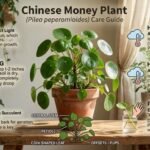
The Chinese money plant, scientifically known as Pilea peperomioides, is popular for its distinctive round, coin-shaped leaves and relatively simple care requirements. Its unusual foliage makes it an excellent choice for windowsills, desks, shelves, and other bright indoor spaces.
However, “easy-care” does not mean the plant can tolerate every condition. Most problems with Chinese money plants come from a few basic issues: watering too frequently, insufficient light, poor drainage, or placing the plant in an unsuitable location.
Good Chinese money plant care is less about following a rigid watering schedule and more about learning what the plant is telling you. Leaf color, soil moisture, growth direction, and stem strength can all provide useful clues.
Chinese Money Plant Care at a Glance
| Care Requirement | Best Condition |
|---|---|
| Botanical name | Pilea peperomioides |
| Common names | Chinese money plant, pancake plant, UFO plant |
| Light | Bright, indirect light |
| Direct sun | Gentle morning sun can be tolerated; avoid harsh midday exposure |
| Water | Water when the upper soil layer begins to dry |
| Soil | Loose, well-draining potting mix |
| Humidity | Average household humidity is usually adequate |
| Temperature | Comfortable indoor temperatures with protection from cold drafts |
| Fertilizer | Balanced houseplant fertilizer during active growth |
| Pot | Container with drainage holes |
| Growth habit | Upright stems with round leaves |
| Repotting | When roots become crowded or soil drainage declines |
Understanding the Chinese Money Plant
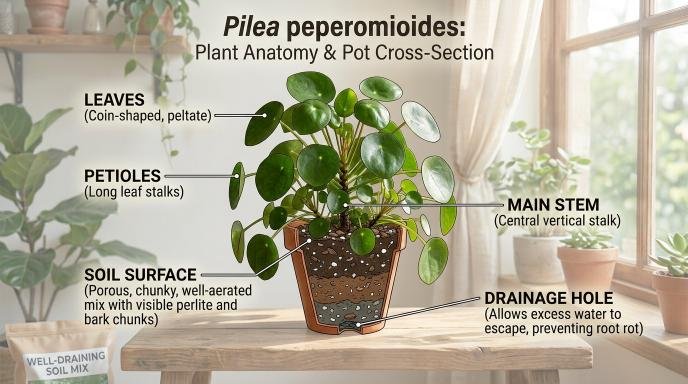
The Chinese money plant is a compact perennial species in the nettle family. It produces long leaf stalks from a central stem, with rounded leaves that give the plant its recognizable appearance.
One reason it is relatively forgiving is that it does not demand constantly wet soil. In fact, keeping the roots wet for prolonged periods can create more problems than allowing the soil to dry slightly between waterings.
Its growth pattern also provides an important care clue. A healthy plant generally produces firm stems and leaves that remain reasonably well positioned toward the available light.
How Much Light Does a Chinese Money Plant Need?
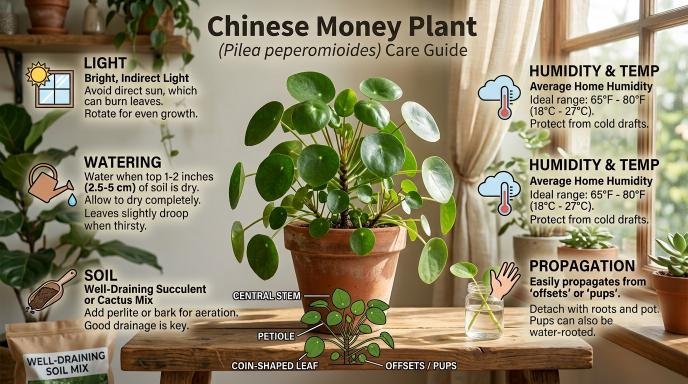
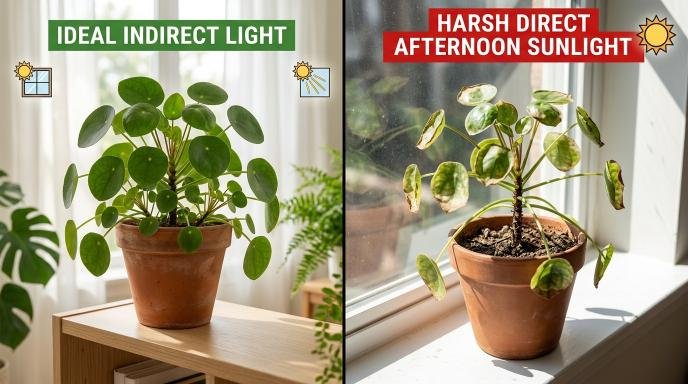
Bright, indirect light is one of the most important requirements for healthy Chinese money plant growth.
Place the plant near a bright window where it receives plenty of natural light without being exposed to intense afternoon sunlight for long periods.
Light affects more than just growth. When light is inadequate, the plant may become stretched, develop longer gaps between leaves, or lean strongly toward one direction.
Signs Your Plant Needs More Light
Watch for:
- Long, weak-looking stems.
- Large spaces between leaves.
- Strong leaning toward a window.
- Slower new growth.
- Smaller or less vigorous new leaves.
If these symptoms appear, gradually move the plant closer to a bright window.
Can Chinese Money Plants Get Direct Sun?
Yes, but intensity matters.
A little gentle morning sunlight may be beneficial, while strong afternoon sunlight through glass can scorch the foliage. Brown patches or bleached areas on leaves can indicate excessive exposure.
If your plant has been growing in low light, do not suddenly place it in strong direct sunlight. Increase exposure gradually.
How Often Should You Water a Chinese Money Plant?
There is no universal watering schedule because indoor conditions vary.
Instead of watering every week on the same day, check the soil.
Insert your finger about an inch into the soil. If the upper layer feels noticeably dry, it is generally time to water. If it still feels moist, wait and check again later.
When watering, soak the soil thoroughly until excess water begins draining from the bottom of the container.
Then empty any standing water from the saucer.
Why Overwatering Is a Common Problem
Beginners often assume that frequent watering will encourage faster growth. For Chinese money plants, the opposite can happen.
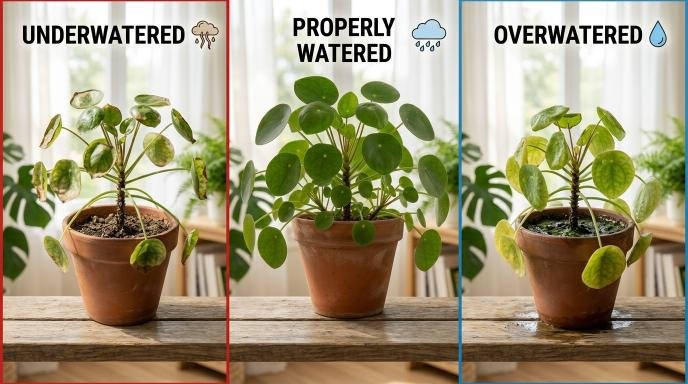
Constantly wet soil reduces air around the roots and can encourage root problems. The plant may begin developing yellowing leaves, soft stems, drooping foliage, or a generally unhealthy appearance.
The key is not to keep the soil bone-dry for long periods. The goal is a balance between adequate moisture and sufficient drying.
Signs of Underwatering
Possible symptoms include:
- Drooping leaves.
- Dry, crispy leaf edges.
- Very dry soil pulling away from the container.
- Slower growth.
- Leaves losing their normal firmness.
Signs of Overwatering
Possible symptoms include:
- Yellowing leaves.
- Persistently wet soil.
- Soft or darkened stems.
- Leaf drop.
- Unpleasant-smelling soil.
- Root deterioration.
The Best Soil for a Chinese Money Plant
Chinese money plants perform best in a loose, well-draining potting medium.
The purpose of good soil is not simply to hold the plant upright. It needs to retain enough moisture for the roots while allowing excess water and air to move through the root zone.
A practical indoor mix can contain:
- Quality indoor potting soil.
- Perlite or another drainage-enhancing material.
- A small amount of compost or another organic component if needed.
Avoid extremely dense soil that remains wet for a long time.
Why Drainage Matters
Even excellent watering habits cannot compensate for a container that has nowhere for excess water to escape.
A pot with drainage holes allows surplus moisture to leave the root zone. This is particularly important for indoor plants because containers often dry more slowly than outdoor soil.
Choosing the Right Pot
A Chinese money plant does not need an enormous container.
Choose a pot only moderately larger than the existing root system when repotting. An oversized pot can hold a large amount of unused wet soil around relatively small roots, increasing the time required for the soil to dry.
Always prioritize drainage.
A Simple Potting Rule
When moving the plant into a larger container, increase the pot size gradually rather than jumping to a very large container.
This makes moisture management easier and allows the root system to occupy the new soil more efficiently.
Temperature and Humidity
Normal indoor temperatures are generally suitable for Chinese money plants.
Keep the plant away from:
- Freezing temperatures.
- Cold drafts.
- Very hot heating vents.
- Strong air-conditioning airflow.
- Sudden temperature changes.
Average household humidity is usually sufficient. You do not necessarily need a humidifier simply because the plant is tropical-looking.
If indoor air becomes extremely dry, especially during prolonged heating or air-conditioning, monitor the leaves and soil more closely.
Fertilizing Chinese Money Plants
Fertilizer can support healthy foliage and new growth during the active growing season, but more fertilizer does not mean more growth.
Use a balanced houseplant fertilizer according to its label directions and avoid repeatedly applying concentrated fertilizer to dry soil.
Too much fertilizer can cause salt accumulation around the roots and damage the plant.
A useful approach is to fertilize during active growth and reduce or stop routine feeding when growth naturally slows.
How to Fertilize Safely
Before fertilizing:
- Check whether the plant is actively growing.
- Make sure the plant is not severely stressed.
- Follow the fertilizer’s recommended dilution.
- Avoid excessive applications.
- Monitor the plant for changes after feeding.
If the plant is already suffering from root problems, severe dehydration, or major environmental stress, correcting the underlying issue should come before increasing fertilizer.
Rotating Your Chinese Money Plant
Chinese money plants naturally respond to light.
If the same side of the plant continuously faces a window, growth can become noticeably one-sided.
Rotate the pot periodically so different sides receive comparable exposure.
This simple habit can help create a more balanced shape.
Expert Tip: If your plant suddenly begins leaning after being moved, do not assume it is unhealthy. It may simply be adjusting its growth toward the strongest light source.
Pruning Chinese Money Plants
Chinese money plants generally require little pruning.
Remove leaves that are:
- Completely yellow or dead.
- Severely damaged.
- Diseased-looking.
- Blocking healthy growth unnecessarily.
Use clean, sharp scissors or pruning tools.
Avoid removing large amounts of healthy foliage simply to make the plant smaller. Leaves are the plant’s primary energy-producing structures, so unnecessary pruning can slow recovery and growth.
How to Make a Chinese Money Plant Bushier
A common question is how to make a Chinese money plant look fuller.
The plant’s natural growth habit can produce an upright, somewhat open appearance rather than a dense bush.
Good light is the starting point.
If the plant is stretched because of insufficient light, improving its lighting conditions can encourage stronger growth. Regular rotation also helps prevent excessive leaning.
You can also propagate offsets and grow several plants together in an appropriately sized container if you want a fuller visual effect.
Do not overcrowd the container, however. Too many plants competing for limited root space can eventually create watering and nutrient-management problems.
Chinese Money Plant Propagation
One of the most interesting features of Pilea peperomioides is its ability to produce offsets, often called pups.
These young plants develop around the base of a mature plant.
Propagating From Offsets
A simple approach is:
- Wait until a healthy offset has developed sufficiently.
- Carefully separate it from the parent plant while preserving as much of its developing root system as possible.
- Plant it in a small container with well-draining potting mix.
- Keep the soil lightly and consistently moist while the young plant establishes.
- Provide bright, indirect light.
- Avoid excessive fertilizer until the new plant is actively growing.
Propagation is usually easier when the young plant already has its own roots.
When Should You Repot a Chinese Money Plant?
Repotting is not something you need to do on a fixed annual schedule.
Consider repotting when:
- Roots are tightly crowded.
- Water runs through the pot unusually quickly.
- Growth has slowed despite suitable light and care.
- The pot has become unstable because the plant is top-heavy.
- Soil has broken down and drains poorly.
- Roots are emerging from drainage holes.
Choose a container only slightly larger than the previous one.
After repotting, avoid immediately compensating with excessive fertilizer or watering. Give the plant time to adjust.
Seasonal Chinese Money Plant Care
Spring
Spring often brings increased growth as light levels rise.
This is a good time to:
- Check whether the plant needs repotting.
- Begin or increase appropriate feeding.
- Inspect for pests.
- Adjust watering as the soil begins drying faster.
Summer
Higher temperatures and brighter light can increase water use.
Check soil moisture more frequently, but do not automatically increase watering simply because it is summer.
A plant in an air-conditioned room may dry differently from one near a hot, bright window.
Autumn
As daylight decreases, growth may slow.
Reduce watering according to actual soil moisture rather than continuing a summer routine.
Winter
Indoor heating can create dry air, while reduced light can make the soil stay wet longer.
This combination makes winter overwatering particularly easy.
Move the plant to a bright location and allow the soil to dry appropriately between waterings.
Common Chinese Money Plant Care Mistakes
Watering on a Fixed Schedule
Watering every seven days may sound simple, but plants do not use water at exactly the same rate every week.
Check the soil instead.
Using a Pot Without Drainage
Decorative containers can look attractive but become problematic if excess water cannot escape.
If you want to use a decorative outer pot, keep the plant in a suitable inner container with drainage.
Keeping the Plant Too Far From a Window
A bright room is not necessarily bright enough for a plant.
Light intensity can drop substantially as you move farther from a window.
Giving Too Much Direct Sun
More light is not always better. Strong sunlight can scorch leaves, particularly when a plant has previously been growing in lower light.
Using an Oversized Pot
A huge pot does not automatically give roots more opportunity to grow. It can instead create a large reservoir of wet soil.
Fertilizing a Stressed Plant
Fertilizer is not a cure for poor lighting, root problems, or severe underwatering.
Correct the environmental problem first.
Chinese Money Plant Troubleshooting
| Problem | Likely Causes | What to Check |
|---|---|---|
| Yellow leaves | Excess moisture, aging foliage, stress | Soil moisture and drainage |
| Drooping leaves | Underwatering, root problems, temperature stress | Soil and roots |
| Brown crispy edges | Dry conditions, inconsistent watering, intense light | Moisture and light |
| Leaning plant | Uneven lighting | Window position and rotation |
| Leggy growth | Insufficient light | Distance from bright window |
| Leaf spots | Environmental stress or possible disease | Moisture, airflow, affected leaves |
| Slow growth | Low light, poor roots, seasonal slowdown | Light, soil, roots, temperature |
| Leaves falling | Watering problems, stress, temperature changes | Recent care and environment |
| Soft stem | Severe moisture/root problems | Soil and root condition |
Why Are Chinese Money Plant Leaves Turning Yellow?
Yellow leaves do not automatically mean the plant needs more fertilizer.
Look at the whole situation.
If the soil stays wet for long periods, overwatering or poor drainage may be involved. If only an older leaf occasionally turns yellow while new growth looks healthy, natural leaf aging may be responsible.
Check:
- Soil moisture.
- Drainage.
- Light levels.
- Recent watering changes.
- Root condition.
- Temperature changes.
Treat the cause rather than the yellow leaf itself.
Why Is My Chinese Money Plant Drooping?
Drooping can have several causes.
If the soil is very dry, the plant may need water. If the soil is wet but the plant continues drooping, the problem may be related to damaged roots rather than a lack of water.
This distinction is important.
Adding more water to an already saturated pot can make a root-related problem worse.
Why Is My Chinese Money Plant Losing Leaves?
Occasional leaf loss can happen naturally, especially with older leaves.
More significant leaf drop may result from:
- Overwatering.
- Severe underwatering.
- Sudden temperature changes.
- Poor lighting.
- Root problems.
- Relocation stress.
Think about what changed immediately before the problem appeared. That often provides a better clue than the leaf color alone.
Pests That Can Affect Chinese Money Plants
Chinese money plants can occasionally experience common houseplant pests such as:
- Spider mites.
- Mealybugs.
- Scale insects.
- Aphids.
- Fungus gnats, particularly when soil stays excessively wet.
Inspect the undersides of leaves and areas around stems.
Early detection is much easier to manage than a large infestation.
If pests are found, isolate the affected plant from nearby houseplants and use an appropriate treatment according to the product’s instructions.
How to Keep Chinese Money Plant Leaves Clean
Dust can accumulate on broad, rounded leaves and interfere with their appearance.
Gently wipe leaves with a soft, damp cloth when necessary.
Avoid aggressive rubbing, abrasive materials, or frequent use of leaf-shine products. The goal is simply to remove dust without damaging the leaf surface.
Is Chinese Money Plant Safe for Homes With Pets?
If pets or children may chew on houseplants, plant safety should be considered before bringing any species indoors.
For a household with curious pets, avoid relying on common-name assumptions about toxicity. Verify the specific plant species and keep plants inaccessible whenever there is uncertainty.
How Long Can a Chinese Money Plant Live?
With suitable indoor conditions, a Chinese money plant can remain healthy for many years.
Longevity depends less on a particular fertilizer or special product and more on consistent fundamentals:
- Adequate light.
- Sensible watering.
- Healthy roots.
- Good drainage.
- Appropriate temperatures.
- Occasional feeding during active growth.
- Timely pest detection.
A plant that grows slowly but steadily is often healthier than one pushed into rapid growth through excessive watering or fertilizer.
Advanced Tips for Healthier Growth
Judge Watering by the Root Zone
Do not rely solely on the surface appearance of soil. The top can look dry while deeper soil remains wet.
Use your finger or an appropriate moisture-checking method to assess conditions below the surface.
Watch New Growth
New leaves provide useful information about current conditions.
If new growth is consistently small, weak, or distorted, investigate lighting, watering, pests, or root health rather than focusing only on older leaves.
Keep Environmental Changes Gradual
Plants respond to changes in light, temperature, and watering.
When moving a plant from a dim location to a much brighter one, acclimate it rather than exposing it immediately to intense sunlight.
Inspect Roots When Problems Do Not Match the Symptoms
If the plant remains unhealthy despite apparently correct watering and light, inspect the root system.
Healthy roots should generally be firm rather than mushy and deteriorating.
Root inspection can reveal problems that are impossible to diagnose from leaves alone.
A Simple Chinese Money Plant Care Routine
For beginners, a practical routine is more useful than a complicated schedule.
Weekly
- Check soil moisture.
- Inspect leaves for pests.
- Look for unusual yellowing or spotting.
- Rotate the plant if it is leaning toward the light.
Monthly
- Check drainage.
- Inspect the plant closely for pests.
- Remove dead or severely damaged foliage.
- Assess whether growth is healthy and balanced.
During Active Growth
- Provide appropriate fertilizer according to label directions.
- Monitor whether the plant is drying faster as light and temperatures change.
- Watch for new offsets.
When Problems Appear
Do not immediately change several things at once.
Identify the most likely cause, make one sensible adjustment, and observe how the plant responds.
This makes troubleshooting much easier.
Frequently Asked Questions
How often should I water a Chinese money plant?
Water when the upper portion of the soil has begun to dry rather than following a fixed calendar. Water thoroughly, then allow excess water to drain away.
Does a Chinese money plant need direct sunlight?
It generally prefers bright, indirect light. Gentle morning sun may be tolerated, but strong direct afternoon sunlight can scorch the leaves.
Why is my Chinese money plant leaning?
Uneven light is a common reason. Rotate the pot regularly and provide brighter, indirect light to encourage more balanced growth.
Can Chinese money plants grow in low light?
They may survive in lower light, but insufficient light can lead to weak, stretched growth and slower development. A bright location with indirect light is preferable.
Should I mist my Chinese money plant?
Routine misting is generally unnecessary when normal indoor humidity is adequate. More important factors are proper watering, drainage, and suitable light.
What type of soil is best for a Chinese money plant?
Use a loose, well-draining indoor potting mix that retains some moisture without becoming waterlogged.
How do I make my Chinese money plant grow faster?
Provide adequate light, appropriate moisture, healthy soil, and nutrients during active growth. Avoid trying to accelerate growth through excessive watering or fertilizer.
Can I propagate a Chinese money plant from a leaf?
Leaf propagation is not as straightforward as propagating from a rooted offset. For reliable results, use a healthy pup or offset with its own developing roots.
Why are my Chinese money plant leaves curling?
Curling can result from inconsistent watering, excessive light or heat, dry conditions, pests, or root problems. Check the plant’s environment and soil before assuming there is one specific cause.
How do I know when to repot my Chinese money plant?
Repot when the root system becomes crowded, drainage deteriorates, or the existing container no longer supports healthy growth. Move it into a slightly larger pot rather than a dramatically oversized one.
Is Chinese money plant easy to care for?
Yes, it can be relatively easy to maintain when given bright indirect light, appropriate watering, good drainage, and stable indoor conditions. Its biggest problems usually come from extremes rather than a lack of complicated care.
Conclusion
Successful Chinese money plant care comes down to a few dependable principles: bright indirect light, well-draining soil, careful watering, adequate drainage, and regular observation.
Instead of watering according to a strict calendar, check the soil. Instead of adding fertilizer whenever growth slows, investigate light and root health first. And instead of reacting to one yellow leaf, look at the entire growing environment.
The best routine is one that responds to the plant’s actual needs. Once you learn to recognize changes in soil moisture, leaf condition, growth direction, and new growth, maintaining a healthy Chinese money plant becomes much more predictable—and much easier.