Quick Answer
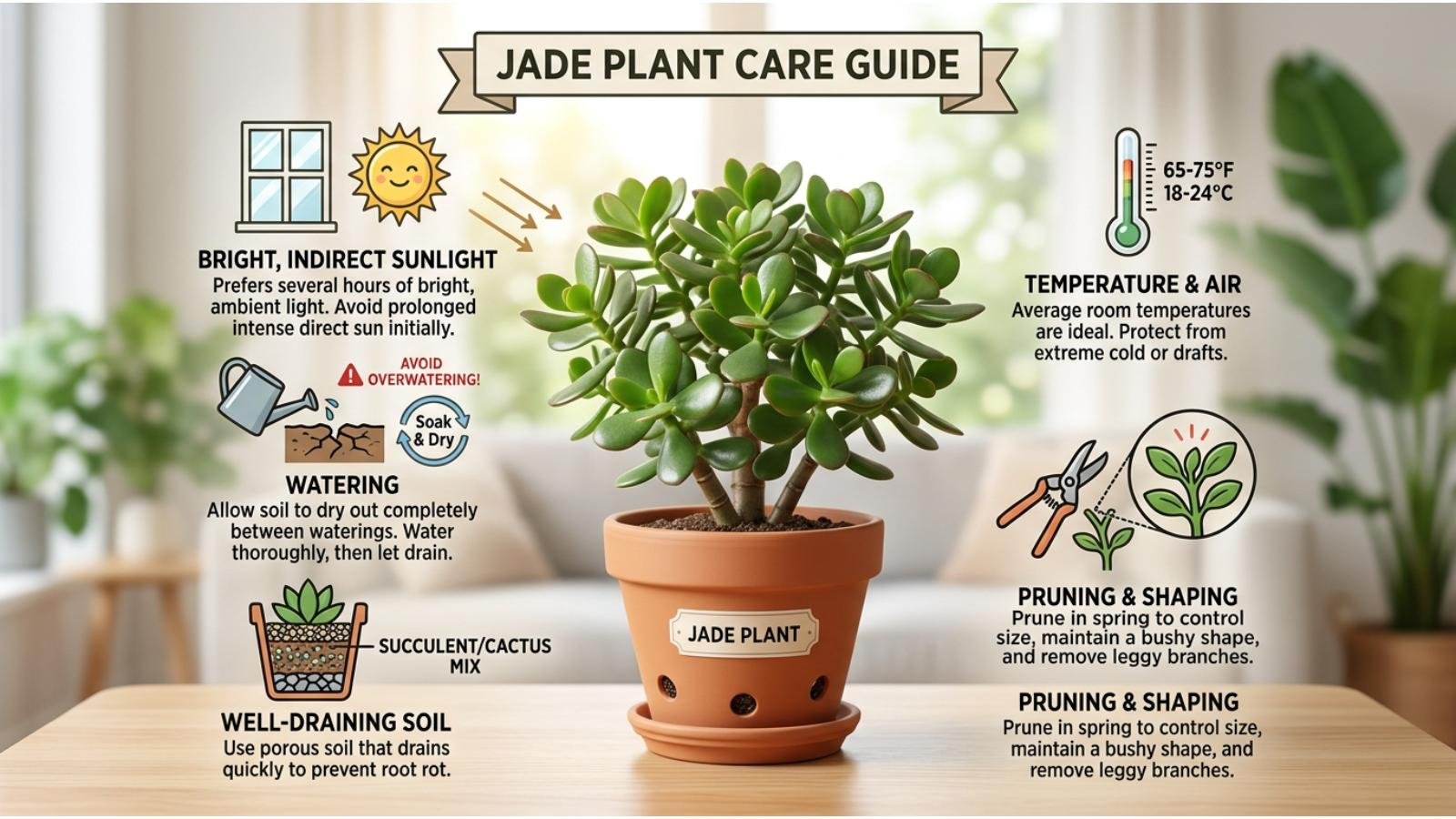
Jade plant care is mainly about giving Crassula ovata plenty of light, using fast-draining soil, and avoiding frequent watering. Place your jade plant in a bright location, preferably with several hours of direct or very bright light, and let the soil dry thoroughly between waterings. Use a pot with drainage holes and a cactus or succulent-style mix. Reduce watering during periods of slow growth, and prune leggy stems to maintain a compact shape.
Introduction
Jade plants are popular houseplants for good reason: their thick, glossy leaves, woody stems, and slow-growing habit make them attractive without demanding constant attention. But “easy care” does not mean “care-free.” Most jade plant problems come from a small handful of mistakes—especially keeping the soil wet for too long, providing too little light, or choosing a container that drains poorly.
The good news is that jade plant care becomes much easier once you understand what the plant is designed to do. Jade plants are succulents, so their fleshy leaves and stems store water. Instead of treating them like tropical houseplants that need frequent drinks, think of them as plants that prefer a thorough watering followed by a period of drying. That simple change in approach can make a dramatic difference in the health, shape, and longevity of your plant.
Understanding the Jade Plant
The common jade plant is Crassula ovata, a succulent native to South Africa. It develops thick branches and fleshy, rounded leaves and can eventually take on a small tree-like appearance. The Royal Horticultural Society lists it as an evergreen succulent and recommends full light and well-drained growing conditions.
Jade plants are sometimes called:
- Jade tree
- Money tree
- Friendship tree
- Crassula ovata
They are slow growers compared with many tropical houseplants. That is important when setting expectations. A healthy jade plant may not visibly change every week, but consistent care over several years can produce a substantial, highly branched specimen.
Why jade plants store water
Those thick leaves aren’t just decorative. They function as water-storage structures.
That means a jade plant can tolerate periods when the soil becomes dry. It also means the plant has less need for constantly moist soil than plants with thin, delicate foliage.
Practical takeaway: If you’re deciding whether to water because the calendar says it’s “watering day” or because the soil and plant actually need water, choose the second approach.
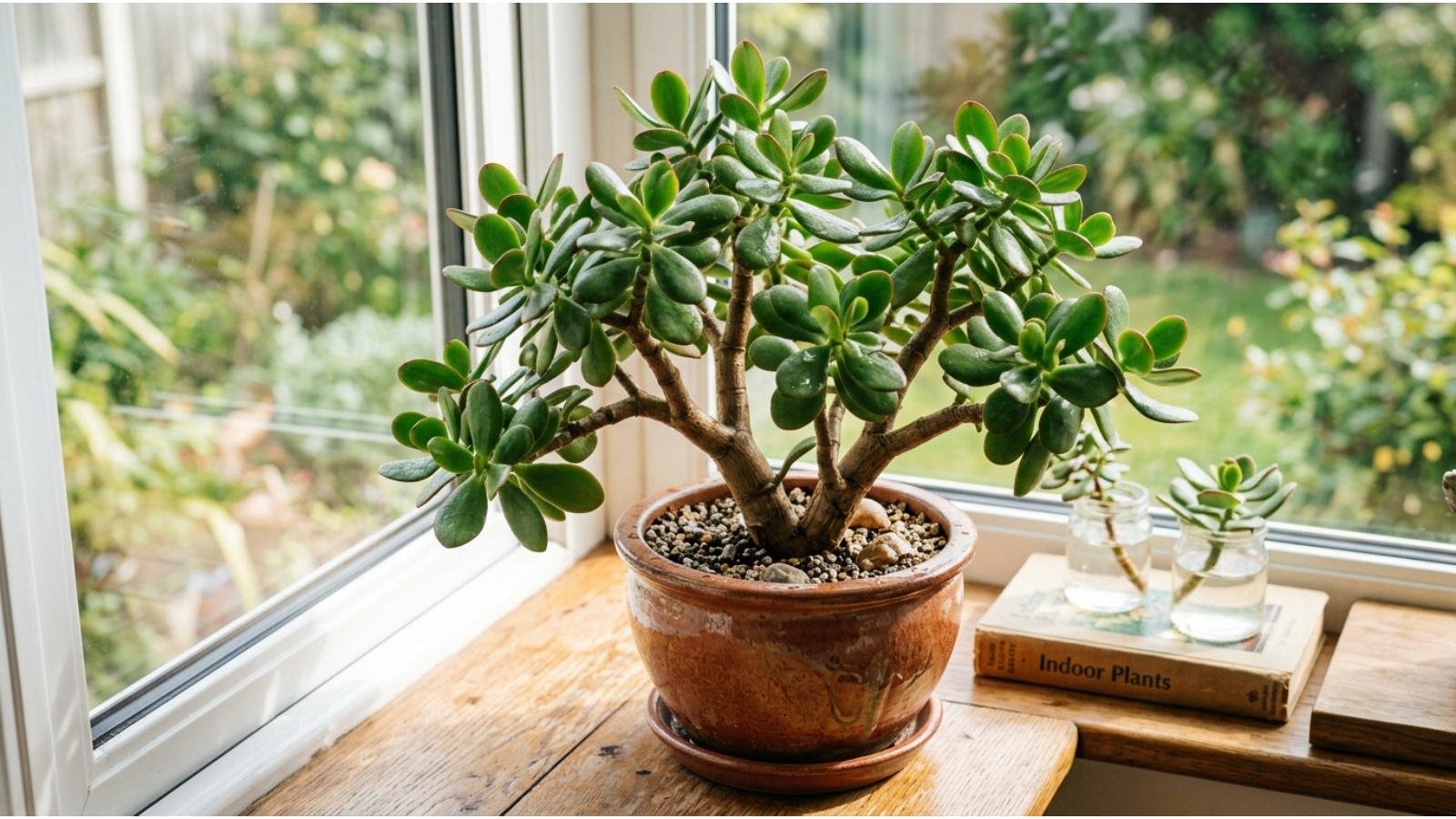
Image Suggestion: Close-up botanical photograph of a healthy Crassula ovata, showing thick leaves and woody stems.
Jade Plant Light Requirements
Light is one of the most important parts of successful jade plant care.
A jade plant kept in insufficient light may survive, but it often becomes stretched, sparse, and weakly branched. This elongated growth is commonly called leggy growth. The Missouri Botanical Garden recommends at least four hours of direct sunlight or approximately 12 hours of bright indirect light for best growth.
The RHS also recommends full light for Crassula ovata, while noting that jade plants can be grown as houseplants in bright conditions.
Where should you put a jade plant?
Good indoor locations include:
- A bright south-facing window
- A bright west-facing window
- A sunny room where the plant receives several hours of strong light
- A bright spot supplemented by a suitable grow light when natural light is inadequate
A useful test is to examine the growth rather than relying solely on the clock.
If new stems become unusually long and the spaces between leaves increase, the plant may be asking for more light.
Can a jade plant get too much sunlight?
Yes.
A jade plant that has been growing indoors in relatively weak light can react poorly if suddenly moved into intense outdoor sunlight. Leaves may develop scorch or discoloration.
Instead of moving it directly from a dim room to harsh midday sun, increase exposure gradually.
This is especially important when moving a houseplant outdoors for summer.
A simple light rule
More light generally supports more compact growth, but sudden changes should be avoided.
That distinction prevents two common mistakes: leaving a jade plant permanently in a dark corner or abruptly placing a low-light plant into intense sunlight.
How Often Should You Water a Jade Plant?
There is no universally correct watering schedule such as “once a week.”
The better rule is:
Water thoroughly when the growing medium has dried out, then allow excess water to drain completely.
The RHS specifically recommends allowing the compost to dry between waterings and reducing watering during winter when growth slows.
How to tell when your jade plant needs water
Check the soil before watering.
You can:
- Push a finger into the growing medium.
- Check whether the deeper soil remains damp.
- Lift the pot and learn how heavy it feels after watering versus when dry.
- Look at the plant for additional clues, rather than using leaf appearance alone.
The pot-weight method becomes surprisingly useful after you’ve cared for the plant for a while. A thoroughly watered pot has a noticeably different weight from one that has dried.
How to water correctly
When the plant needs water:
- Water the soil thoroughly.
- Allow excess water to escape through the drainage holes.
- Empty standing water from the saucer or outer container.
- Wait until the soil has dried adequately before watering again.
Avoid giving tiny amounts of water repeatedly just to keep the surface damp.
Why overwatering causes problems
The problem with excessive watering isn’t simply “too much water in the leaves.” Constantly wet growing media reduces the air available around the roots and can create conditions favorable to root problems.
This is why a jade plant can actually suffer more from a well-intentioned owner who waters too frequently than from someone who occasionally forgets to water.
Winter watering
During cooler, darker periods, jade plants generally grow more slowly and use water more slowly.
The Missouri Botanical Garden similarly notes that indoor plant watering needs change according to temperature, growth, light, soil type, and the type of plant. Succulents generally need less water than plants from moist environments.
Don’t water on autopilot. Check the soil first.
Image Suggestion: Side-by-side illustration showing dry jade plant soil versus freshly watered soil, with drainage holes visible underneath the pot.
Choosing the Right Soil and Pot
A healthy jade plant needs a growing medium that drains efficiently.
The RHS recommends cactus compost for Crassula ovata and describes its preferred moisture conditions as well-drained.
What makes good jade plant soil?
A suitable succulent or cactus potting mix is a convenient starting point.
The goal is not to find a magical recipe. The goal is to prevent the root zone from remaining saturated for long periods.
A practical mix should:
- Drain freely
- Contain enough structure to prevent compaction
- Allow air into the root zone
- Avoid holding excessive moisture
Does a jade plant need a drainage hole?
Yes, a drainage hole is strongly recommended.
A decorative container without drainage can look attractive but makes watering much harder to manage. Excess water has nowhere to escape.
If you want to use a decorative outer pot, place the plant in a properly draining nursery or growing pot inside it.
What size pot should you use?
Avoid automatically choosing a huge container.
A pot that is dramatically larger than the root system can contain a large volume of unused soil that stays wet longer after watering.
When repotting, choose a container that gives the roots room to develop without creating an unnecessarily large reservoir of wet soil.
Jade Plant Temperature and Humidity
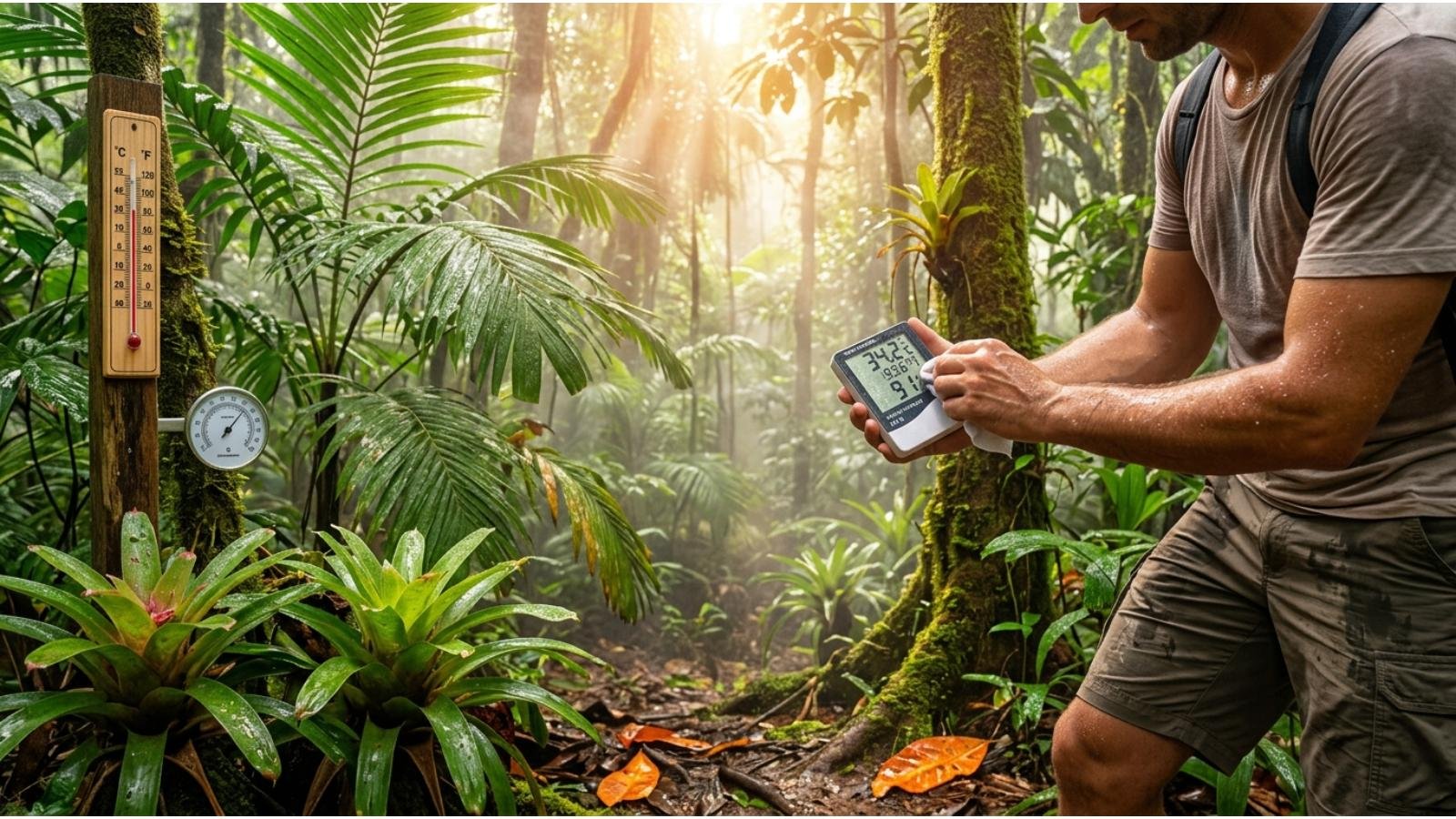
Jade plants are relatively adaptable houseplants, and they do not require tropical humidity.
The RHS notes that jade plants adapt to average indoor humidity and do not require misting or special humidity measures. It recommends protecting them from drafts and sudden temperature changes.
What temperature is best?
Typical comfortable household temperatures work well.
The bigger concern is avoiding extremes, particularly:
- Freezing temperatures
- Sudden temperature changes
- Cold drafts
- Very hot locations immediately next to heating equipment
- Abrupt environmental changes
The Missouri Botanical Garden notes that jade plants can tolerate a fairly broad temperature range, but average home temperatures are preferred.
Should you mist a jade plant?
Usually, no.
Misting is not a substitute for proper watering, and jade plants do not need artificially humid air simply to remain healthy.
If your jade plant is struggling, check light, soil drainage, watering habits, and temperature before reaching for a spray bottle.
Fertilizing Jade Plants
Jade plants do not need heavy feeding.
During active growth, a balanced liquid fertilizer used according to its label directions can provide nutrients. The RHS recommends monthly general liquid fertilizer during spring and summer for Crassula ovata.
When should you fertilize?
A reasonable approach is to feed during the plant’s active growing period and reduce or stop routine fertilization when growth slows substantially.
Do not assume that more fertilizer equals faster or healthier growth.
Excess fertilizer can create unnecessary problems, particularly when the plant is already stressed.
A common beginner mistake
Some owners fertilize a struggling plant because they assume yellowing or weak growth means it needs more nutrients.
But yellow leaves can have many causes.
Before fertilizing, ask:
- Is the plant getting enough light?
- Is the soil staying wet?
- Is the root system healthy?
- Has the plant recently been moved?
- Are pests present?
- Is the plant naturally slowing its growth?
Fix the growing conditions before automatically adding fertilizer.
Pruning Jade Plants for Bushier Growth
Pruning isn’t mandatory, but it can be extremely useful.
A jade plant can develop long branches that make the plant look sparse or unbalanced. Strategic pruning encourages a more controlled shape and can help create a fuller-looking specimen over time.
The RHS notes that pruning can help maintain a bushier shape and recommends pruning during spring or early summer in its houseplant guidance.
How to prune a jade plant
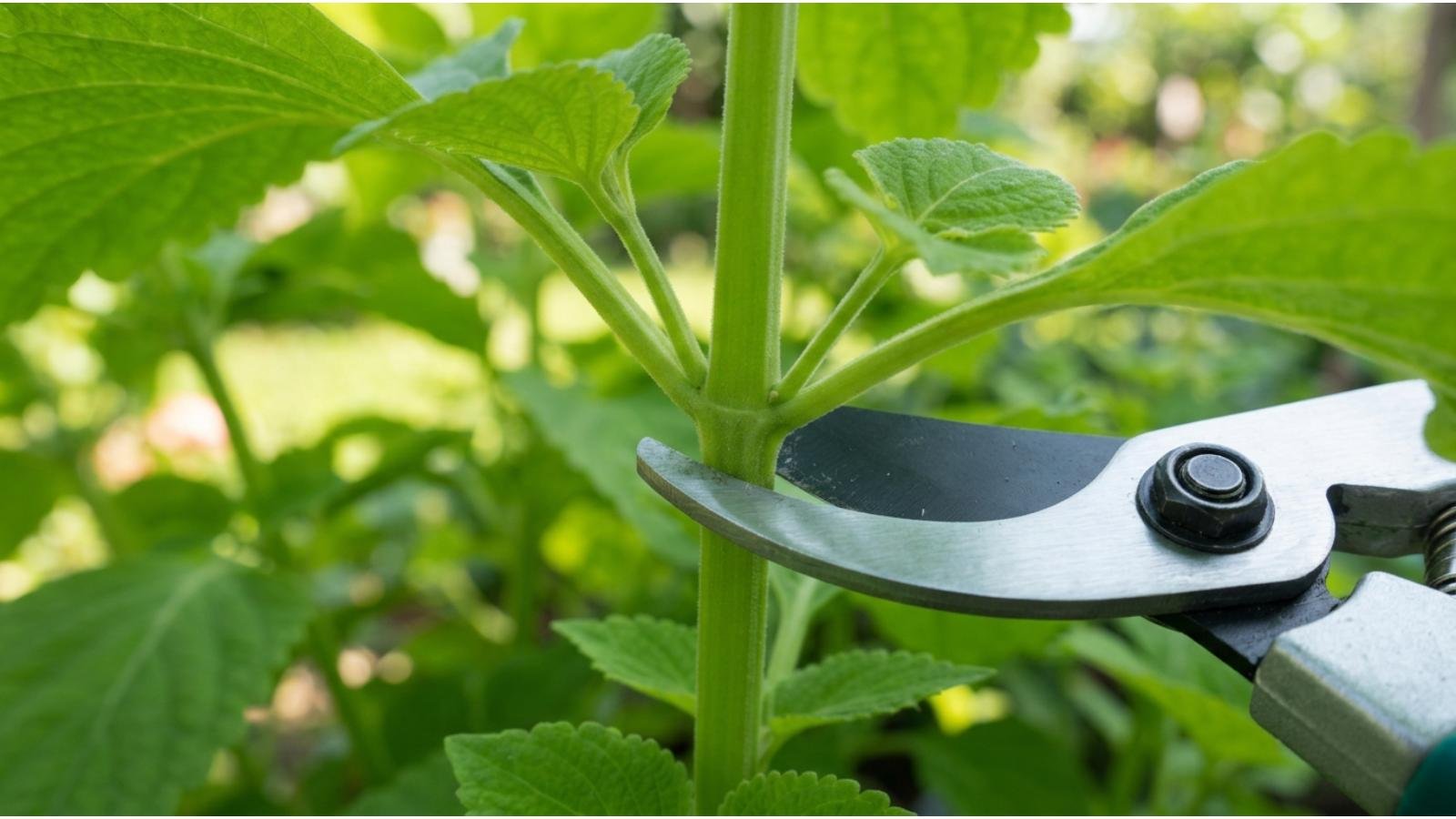
Use clean, sharp scissors or pruning shears.
Look for:
- Extremely long branches
- Weak or damaged growth
- Crossed branches
- Unbalanced areas
- Stems growing in an unwanted direction
Make your cut above a healthy node or branching point when possible.
Don’t remove large amounts of healthy growth simply because you’re impatient for a different shape. Jade plants grow slowly, so thoughtful pruning generally works better than aggressive cutting.
Why pruning can improve the plant
Pruning changes where the plant directs future growth.
When a long stem is shortened, new branches can develop from lower points, eventually producing a more branched appearance.
It also gives you an opportunity to remove damaged growth and maintain a manageable size indoors.
Image Suggestion: Step-by-step pruning diagram showing a leggy jade stem, the correct cutting point, and new branching after pruning.
How to Propagate a Jade Plant
One of the enjoyable aspects of jade plant ownership is propagation.
Jade plants can be propagated from stem or leaf cuttings. The RHS lists seed, offsets, root, stem, and leaf cuttings among propagation methods for Crassula ovata.
Stem cutting method
Stem propagation is often straightforward:
- Select a healthy stem.
- Make a clean cut with a sanitized tool.
- Allow the cutting surface to dry before planting.
- Place it into an appropriate well-draining growing medium.
- Keep conditions bright and avoid keeping the medium constantly wet.
- Wait for rooting and new growth.
Leaf propagation
A healthy leaf can also produce new growth under suitable conditions.
The important point is patience. Propagation isn’t instant, and repeatedly disturbing a cutting to “check the roots” can do more harm than good.
What happens after pruning?
Don’t automatically throw healthy jade cuttings away.
Suitable pieces can potentially become new plants, giving you an easy way to produce additional specimens or share them with friends.
Repotting a Jade Plant
Jade plants don’t need constant repotting.
The RHS recommends repotting jade plants approximately every two to three years or when they become root-bound, using a well-draining succulent or cactus mix and a pot with adequate drainage.
Signs your jade plant may need repotting
Consider checking the roots when:
- Roots are becoming tightly packed
- The plant repeatedly dries out unusually quickly
- The growing medium has broken down or compacted
- The plant has become unstable
- The container is clearly too small for its established root system
Don’t repot solely because a calendar says two years have passed.
The condition of the plant, roots, pot, and growing medium matters more than an exact date.
After repotting
Avoid immediately responding to transplanting stress with excessive watering.
Give the plant appropriate light and allow the new growing medium to behave as intended—draining rather than remaining saturated.
Common Jade Plant Problems and What They Mean
Jade plant problems become easier to solve when you diagnose the pattern instead of reacting to a single leaf.
| Problem | Possible cause | What to check |
|---|---|---|
| Yellow leaves | Overwatering, poor drainage, stress | Soil moisture and drainage |
| Soft or mushy leaves | Excess moisture or root problems | Roots, soil, watering frequency |
| Wrinkled leaves | Dehydration or root dysfunction | Soil dryness and root health |
| Long, stretched stems | Insufficient light | Window position and light intensity |
| Leaf drop | Environmental stress, watering issues, temperature changes | Recent changes and growing conditions |
| Brown/scorched patches | Excessive sudden sun exposure or environmental stress | Recent light changes |
| Slow growth | Low light, seasonal slowdown, poor conditions | Light, roots, temperature |
| White cottony insects | Possible mealybugs | Inspect leaf joints and stems |
| Small insects around growth | Possible aphids or other pests | Inspect new growth |
The RHS identifies pests such as mealybugs, aphids, and vine weevils among potential jade plant problems.
Yellow leaves: don’t immediately panic
One yellow leaf does not necessarily mean your jade plant is dying.
Older leaves naturally age and may eventually drop. The concern increases when yellowing is widespread, accompanied by soft tissue, persistently wet soil, or a deteriorating stem.
Look at the whole plant and its environment.
Wrinkled leaves
Wrinkled leaves can indicate that the plant is short of available water, but watering immediately isn’t always the correct solution.
If the soil is already wet and the leaves are still wrinkled, investigate the roots. A plant can have plenty of water in its pot but still have damaged roots that cannot function properly.
That’s why “wrinkled = water more” is an incomplete diagnosis.
Leggy growth
If the spaces between leaves become unusually long, inadequate light is a prime suspect.
Move the plant toward a brighter location gradually rather than making an abrupt transition to intense direct sunlight.
seasonal Jade Plant Care
Your jade plant’s needs change throughout the year.
Spring
Spring is often a useful time to:
- Increase attention to watering as growth resumes
- Begin appropriate fertilization
- Prune unwanted growth
- Propagate healthy cuttings
- Evaluate whether repotting is necessary
Summer
Bright light and active growth can increase water use.
Outdoor placement may work in suitable climates, but acclimate the plant gradually to stronger sunlight. Protect it from conditions that could cause overheating, sun damage, or excessive rainfall.
Autumn
As light levels and growth change, begin watching the soil more carefully.
Don’t continue a summer watering routine automatically if the plant’s environment has become cooler or darker.
Winter
Growth often slows.
Reduce watering accordingly and prioritize bright light. Avoid keeping the plant in cold drafts or locations where temperatures can approach freezing.
The RHS specifically recommends much more sparing watering during winter dormancy or slow growth.
Image Suggestion: Four-panel seasonal jade plant care infographic showing spring, summer, autumn, and winter maintenance.
How to Get a Jade Plant to Look Like a Miniature Tree
Mature jade plants can develop thick, woody stems that resemble small trees.
If you want this appearance, don’t simply let every branch grow unchecked.
Instead:
- Provide strong, consistent light.
- Remove weak or poorly positioned branches.
- Allow the main structure to develop.
- Prune selectively rather than constantly trimming everything.
- Rotate the pot periodically if growth becomes strongly directional.
- Give the plant time to develop a woody framework.
This is a long-term project rather than a quick transformation.
The RHS lists mature Crassula ovata as capable of reaching substantial dimensions under suitable conditions, although indoor specimens may remain considerably smaller depending on their environment and container.
An important shaping lesson
Don’t try to force a mature tree-like appearance in a few months.
The attractive trunk-and-branch structure comes from repeated cycles of growth and selective pruning.
Think years, not weeks.
Jade Plant Care Mistakes to Avoid
Some of the most common problems are caused by reasonable intentions.
1. Watering on a fixed schedule
“Every Sunday” may sound organized, but plants don’t consume water at exactly the same rate every week.
Check the growing medium instead.
2. Keeping the plant in a dark corner
Jade plants can survive less-than-ideal conditions for a while, but survival isn’t the same as strong growth.
Insufficient light commonly results in stretched growth.
3. Using a pot without drainage
This makes excess moisture much harder to manage.
4. Moving suddenly into harsh sunlight
A jade plant accustomed to indoor light may need time to acclimate.
5. Fertilizing a stressed plant automatically
Nutrients aren’t a cure for poor drainage, inadequate light, root damage, or pest infestations.
6. Repotting too frequently
Repotting is useful when needed, but unnecessary disturbance doesn’t automatically improve a slow-growing succulent.
7. Treating every yellow leaf as an emergency
Look for patterns rather than reacting to one leaf.
8. Ignoring the roots
If the visible symptoms don’t match the watering you’ve been providing, inspect the root zone.
The roots can explain what the leaves cannot.
A Simple Jade Plant Care Routine
If you prefer a practical routine instead of memorizing dozens of rules, use this checklist.
Weekly
- Look at the plant.
- Check for pests.
- Observe new growth.
- Check whether the soil is drying appropriately.
- Rotate the pot if growth is becoming uneven.
When the soil dries
- Water thoroughly.
- Allow excess water to drain.
- Don’t leave the pot sitting in water.
Monthly during active growth
- Inspect overall shape.
- Check for pests hiding around stems and leaf joints.
- Consider whether feeding is appropriate.
- Remove damaged material if necessary.
Every few months
- Evaluate light exposure.
- Look for leggy growth.
- Check whether the pot still drains properly.
- Clean accumulated dust from leaves gently if necessary.
Every few years—or when genuinely needed
- Inspect roots.
- Refresh degraded growing medium.
- Repot if the plant has become root-bound or the current container is unsuitable.
This routine is deliberately simple. Good jade plant care depends more on observing the plant than following an unnecessarily complicated schedule.
Advanced Jade Plant Care: Reading the Plant’s Signals
Once you’ve cared for jade plants for a while, you can become less dependent on fixed instructions.
The plant itself provides useful clues.
New growth tells you about current conditions
Fresh growth is often more useful than old leaves when evaluating the current environment.
Ask:
- Is new growth compact?
- Are new leaves healthy?
- Are stems becoming stretched?
- Is the plant producing balanced branches?
Soil tells you more than the calendar
A plant in a small terracotta container in a warm, bright room may dry much faster than the same species in a large plastic pot in a cool room.
The Missouri Botanical Garden specifically notes that watering frequency depends on environmental conditions and soil/container characteristics.
The pot is part of the care system
Don’t think of the pot as decoration alone.
Pot material, size, drainage, and growing medium all influence how quickly moisture leaves the root zone.
This is one reason two identical jade plants can require different watering schedules.
Frequently Asked Questions About Jade Plant Care
How often should I water a jade plant?
Water when the growing medium has dried sufficiently rather than following a fixed calendar. Water thoroughly and let excess water drain away. During slower winter growth, watering generally needs to become less frequent.
Does a jade plant need direct sunlight?
Jade plants perform well with strong light, including direct sunlight when properly acclimated. The Missouri Botanical Garden recommends a minimum of four hours of direct sunlight or about 12 hours of bright indirect light for best growth.
Why are my jade plant leaves falling off?
Leaf drop can have several causes, including watering problems, sudden environmental changes, temperature stress, insufficient light, or root problems. Examine the entire growing environment before changing one factor at random.
Why are my jade plant leaves turning yellow?
Yellow leaves can result from excessive moisture, poor drainage, aging foliage, or environmental stress. If many leaves are yellow and the soil remains wet, investigate watering and root conditions first.
Why is my jade plant getting tall and thin?
This is commonly associated with insufficient light. Move the plant to a brighter location and consider pruning excessively stretched growth to encourage a better structure.
Can jade plants grow indoors?
Yes. Jade plants are widely grown as houseplants and can adapt well to indoor conditions when provided with adequate light and well-draining soil.
Do jade plants like humidity?
They generally don’t require high humidity or misting. Average indoor conditions are usually adequate.
What is the best soil for a jade plant?
Use a well-draining cactus or succulent potting mix. The most important characteristic is efficient drainage rather than a single mandatory recipe.
Should I mist my jade plant?
Misting is generally unnecessary. Focus instead on proper watering, light, drainage, and root health.
When should I repot a jade plant?
Repot when the plant becomes root-bound, the growing medium has deteriorated, drainage has become poor, or the container is no longer suitable. The RHS suggests approximately every two to three years when needed.
Can I grow a jade plant from a leaf?
Yes. Jade plants can be propagated from leaf and stem cuttings under appropriate conditions.
How do I make my jade plant bushier?
Provide strong light and selectively prune long or poorly positioned stems. Pruning can encourage a more branched appearance over time.
Final Takeaway: The Three Rules That Matter Most
Successful jade plant care doesn’t require a complicated routine.
Remember these three fundamentals:
Give it plenty of light.
Let the growing medium dry between thorough waterings.
Use a pot and soil combination that drains efficiently.
Everything else—fertilizing, pruning, repotting, propagation, and seasonal adjustments—builds on those basics.
A jade plant is a slow-growing succulent, so patience is part of the process. Don’t judge its health by how quickly it produces new leaves. Instead, watch for sturdy growth, healthy foliage, good drainage, and a stable root environment. With consistent conditions, Crassula ovata can develop from a small houseplant into an impressive, branching specimen that can remain part of an indoor plant collection for many years.
Related Topics Worth Exploring
For a broader indoor gardening guide, readers may also benefit from articles covering:
- Succulent soil and drainage
- Indoor plant watering techniques
- How to propagate succulents
- Best grow lights for houseplants
- Common succulent pests
- How to prune indoor plants
- Repotting houseplants without damaging roots
Suggested Article Images
For a stronger visual experience, consider adding:
- Hero image: Healthy mature jade plant beside a bright indoor window.
- Light guide: Jade plant showing ideal bright-light placement versus a dark corner.
- Watering diagram: Dry soil → thorough watering → complete drainage → dry-down cycle.
- Soil comparison: Well-draining succulent mix versus dense moisture-retaining potting soil.
- Troubleshooting chart: Healthy, underwatered, overwatered, and light-starved jade plants.
- Pruning diagram: Correct pruning points for creating a bushier jade plant.
- Propagation guide: Stem cutting and leaf propagation stages.
- Seasonal infographic: Jade plant care adjustments from spring through winter.