Quick Answer
Prayer plant care is mainly about balancing bright, indirect light, evenly moist but well-drained soil, warm temperatures, and consistent humidity. Maranta leuconeura dislikes harsh direct sunlight, soggy roots, cold drafts, and very dry air. Water when the surface begins to dry rather than following a rigid calendar, and use good-quality water if brown leaf tips persist.
Introduction
Prayer plants are popular houseplants because their patterned leaves are beautiful by day and move upward at night, creating the appearance of praying hands. That movement is normal, but keeping the foliage lush can be more challenging than simply remembering to water. A plant can have adequate moisture and still develop brown tips, curled leaves, faded markings, or yellow foliage if the light, humidity, temperature, drainage, or water quality is wrong.
The good news is that prayer plant care becomes much easier when you stop treating every symptom as a watering problem. Marantas respond best to stable conditions rather than dramatic changes, so learning how to read the leaves and growing medium is more useful than following a fixed watering schedule. This guide explains exactly what your plant needs, how to establish a reliable routine, and what to do when something goes wrong.
What Is a Prayer Plant?
The plant most commonly called a prayer plant is Maranta leuconeura, an evergreen tropical perennial in the Marantaceae family. It is native to Brazil and is grown primarily for its decorative foliage rather than its flowers.
Its most recognizable feature is its patterned, oval foliage. The leaves can move between daytime and nighttime positions, folding upward in darkness. This natural movement is known as nyctinasty.
Unlike many upright houseplants, Maranta tends to grow relatively low and spread horizontally. Mature plants can work especially well in shallow containers, hanging baskets, or locations where their foliage has room to spread.
Common prayer plant varieties
Depending on the plant you buy, you may encounter names such as:
- Red prayer plant
- Red-veined prayer plant
- Herringbone plant
- Rabbit’s Tracks
- Lemon Lime prayer plant
- Black prayer plant
These plants can look dramatically different, but their basic growing requirements are broadly similar.
Image Suggestion: A labeled comparison image showing several popular Maranta varieties side by side.
Prayer Plant Care at a Glance
| Care factor | What to aim for | What to avoid |
|---|---|---|
| Light | Bright, indirect or filtered light | Harsh direct afternoon sun |
| Water | Evenly moist soil | Constantly soggy soil |
| Humidity | Consistently humid conditions | Very dry indoor air |
| Temperature | Warm, stable conditions | Cold drafts and frost |
| Soil | Moisture-retentive but well-draining | Heavy, waterlogged mix |
| Pot | Drainage holes and appropriate size | Containers with poor drainage |
| Fertilizer | Moderate feeding during active growth | Heavy fertilizing |
| Location | Sheltered indoor position | Hot, exposed windows |
| Maintenance | Regular inspection | Ignoring recurring symptoms |
There is no universal watering interval because room temperature, light, pot size, soil, and season all change how quickly a plant uses water. University and botanical sources consistently emphasize moisture without waterlogging rather than a rigid watering schedule.
Give Your Prayer Plant the Right Light
Light is one of the easiest ways to accidentally damage a prayer plant.
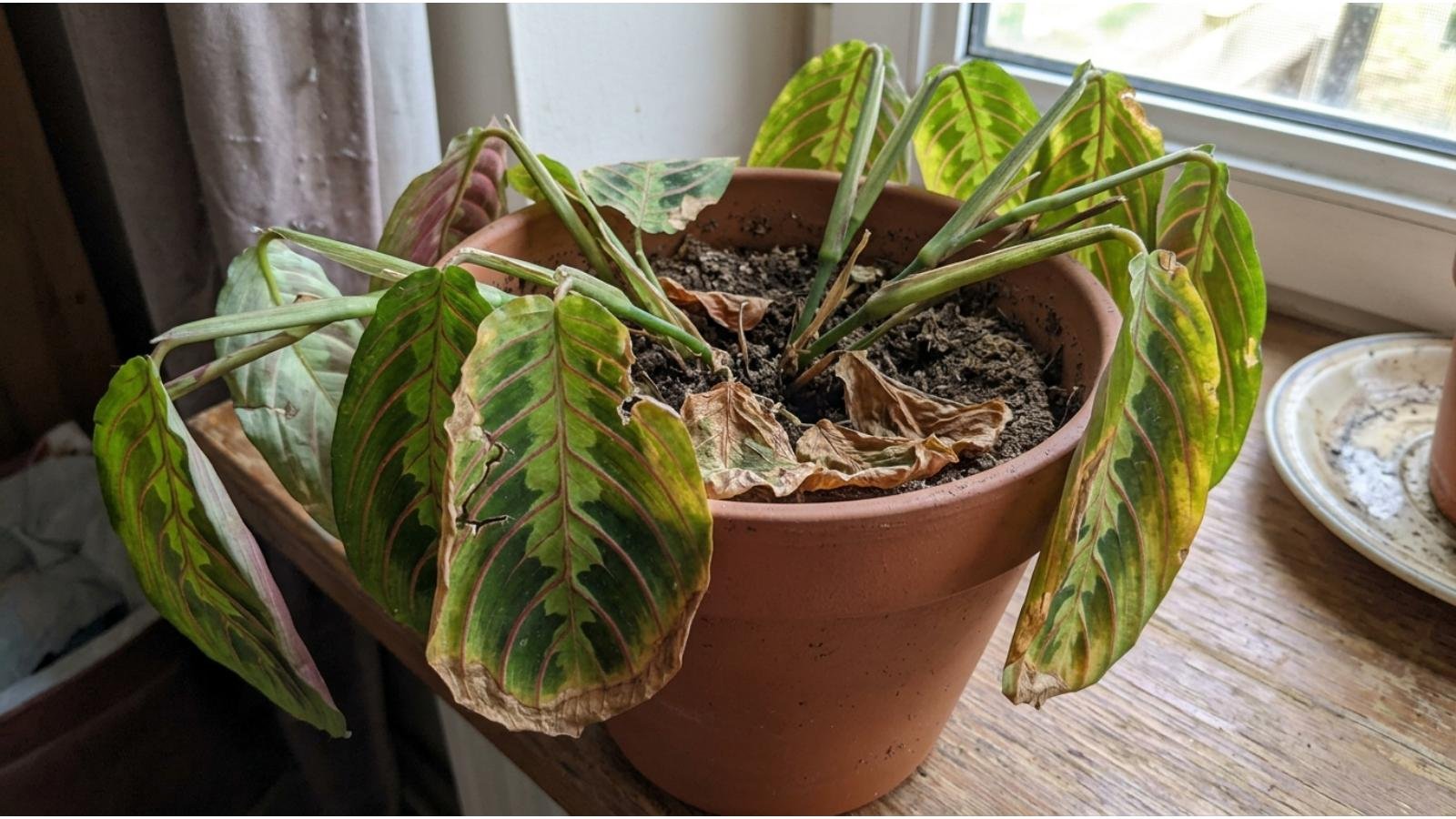
Maranta generally performs best in bright, indirect or filtered light. It can tolerate lower light, but weak light may reduce growth and diminish the intensity of its foliage markings. Strong direct sunlight can bleach or scorch the leaves.
Where should you place it?
Good locations include:
- Near an east-facing window
- A few feet away from a brighter south- or west-facing window
- Behind a sheer curtain
- In a bright room where sunlight is diffused
A window does not automatically mean the plant is receiving suitable light. Direct midday sunlight through glass can be much more intense than the soft, filtered light Maranta experiences beneath a tropical forest canopy.
Signs the light is wrong
Too much light may cause:
- Bleached-looking foliage
- Faded patterns
- Brown or scorched patches
- Crispy leaf margins
Too little light may cause:
- Slow growth
- Smaller new leaves
- Less vibrant coloration
- Long, stretched growth
Practical tip: Move the plant gradually rather than suddenly placing it in a dramatically different light level.
Image Suggestion: Diagram showing ideal bright indirect light versus harsh direct sunlight for a prayer plant.
Watering Prayer Plants Without Overwatering
Watering is where many new Maranta owners struggle.
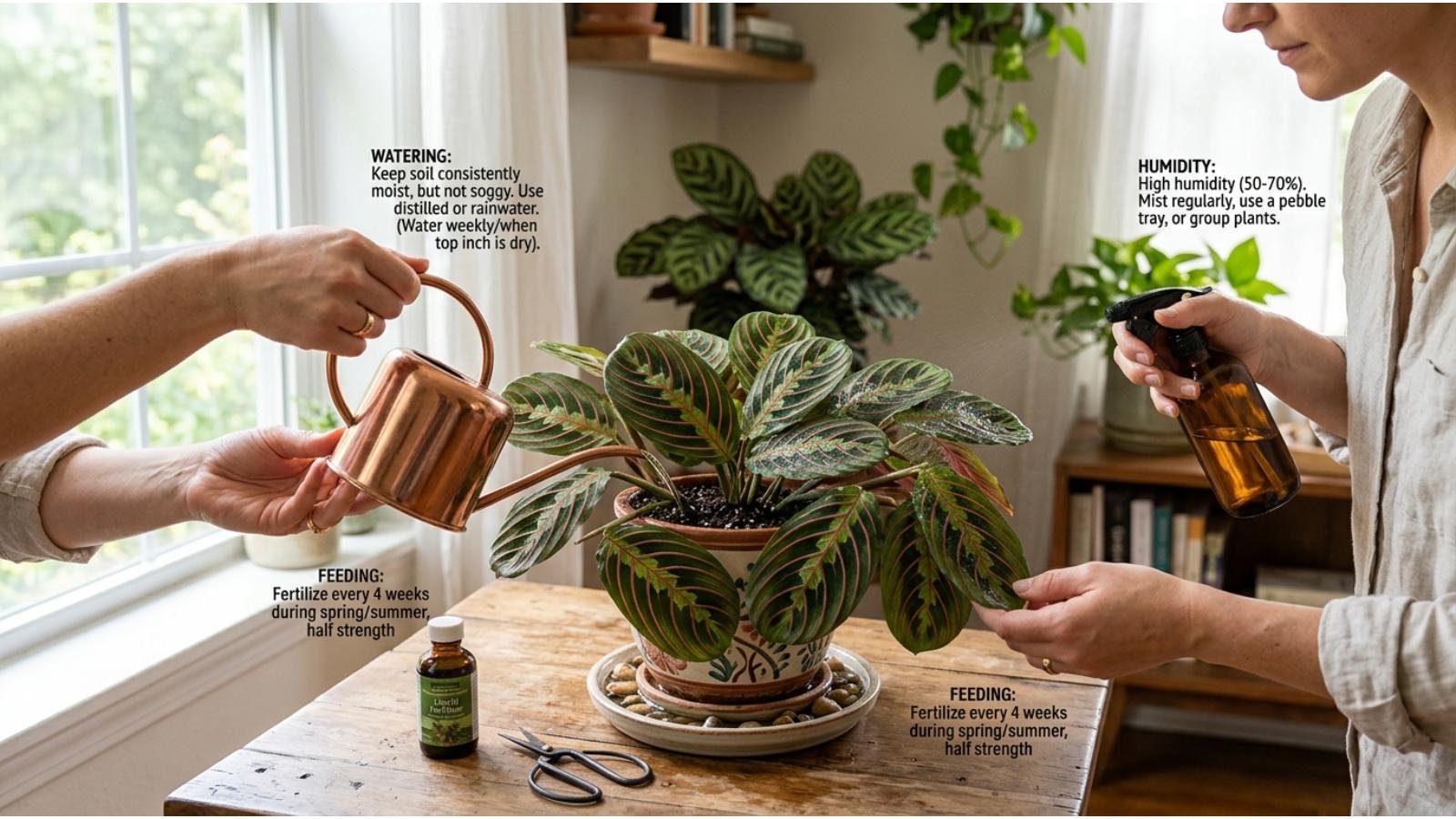
The goal is moist soil with good drainage—not permanently wet soil. NC State Extension recommends keeping the potting medium evenly moist during active growth while reducing watering as conditions become cooler and growth slows.
Because prayer plants have relatively shallow roots, the surface of the soil can dry faster than you might expect. At the same time, a pot that remains saturated underneath can create an entirely different problem: root or stem rot.
A better watering method
Instead of automatically watering every five or seven days:
- Check the surface of the potting mix.
- Feel deeper into the mix with your finger.
- If the upper layer has begun to dry but the root zone is still lightly moist, assess whether watering is needed.
- Water thoroughly when appropriate.
- Allow excess water to drain completely.
- Empty any standing water from the saucer.
The exact interval may be shorter during hot, bright weather and longer during cooler, darker periods.
Why a calendar can fail
Imagine two identical prayer plants:
- Plant A sits in a warm, bright room.
- Plant B sits in a cool room with limited light.
If both receive water every Monday, Plant B may remain wet for too long while Plant A may become dry sooner.
Water according to the plant and its soil—not the calendar.
Choose Water Carefully When Brown Tips Keep Appearing
Brown tips are often blamed on underwatering, but that is not the only possible explanation.
NC State Extension notes that prayer plants can be sensitive to high fluoride levels, while Missouri Botanical Garden also lists leaf-tip browning among potential problems.
If your plant receives consistent moisture yet repeatedly develops brown tips, consider:
- Water quality
- Very dry indoor air
- Fertilizer buildup
- Root stress
- Excessive direct sunlight
What can you try?
If your local tap water appears to be contributing to recurring tip burn, consider using filtered water or another suitable low-mineral water source.
Do not assume that letting tap water sit overnight removes every dissolved substance. It may help with some chlorine-related issues, but it does not eliminate fluoride or all dissolved minerals.
Practical observation: If older leaves have brown tips but newer leaves begin emerging clean after you improve water quality and growing conditions, that is a useful sign that your previous routine may have been contributing to the problem.
Humidity Matters More Than Many Beginners Expect
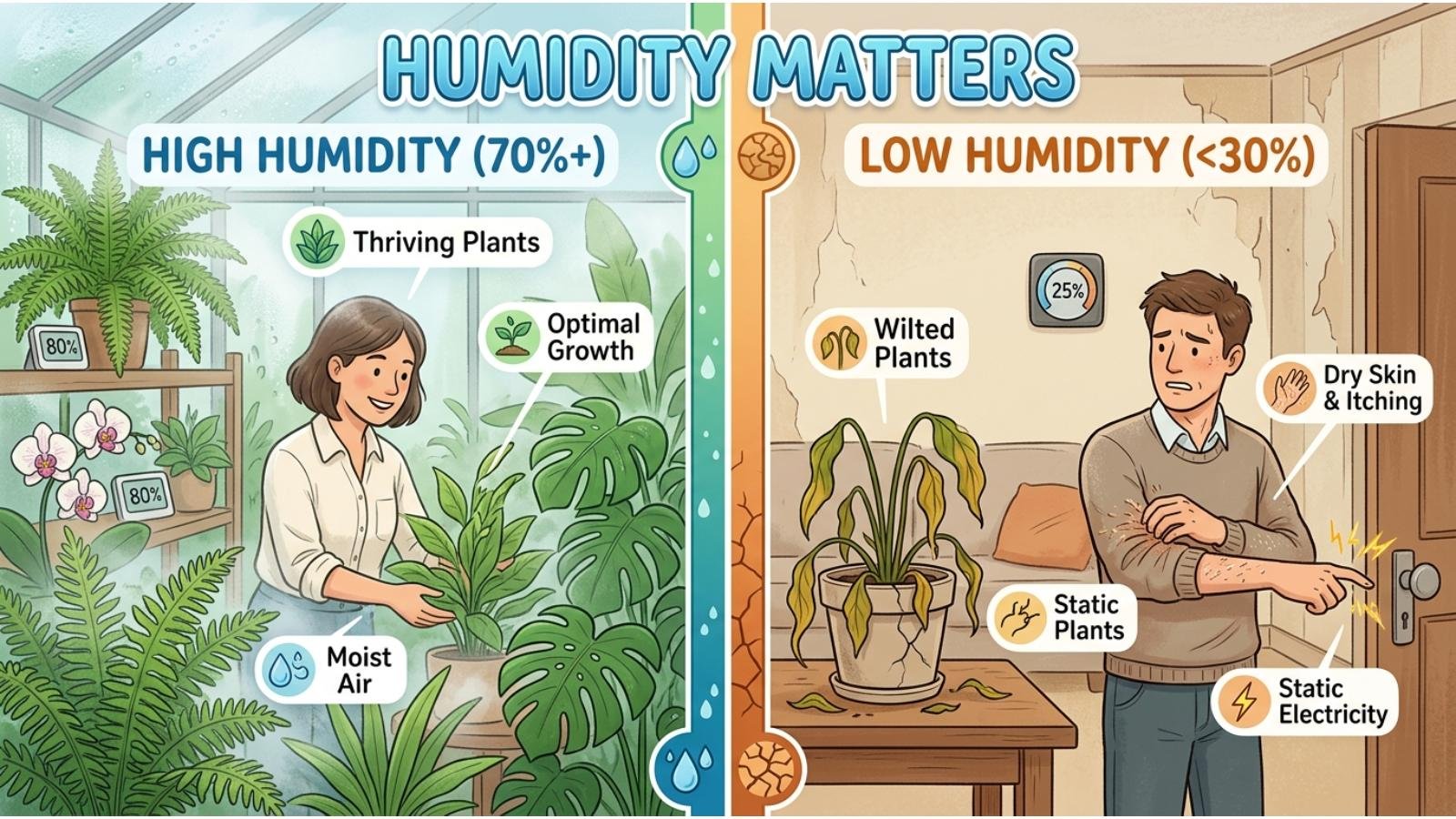
Prayer plants come from tropical environments, so dry indoor air can be challenging.
University extension guidance recommends high humidity for Maranta, while the RHS recommends maintaining high humidity through methods such as misting or a suitable gravel tray.
However, humidity is not about creating a tropical jungle at any cost.
Better ways to improve humidity
Consider:
- A room humidifier
- Grouping compatible plants
- Keeping the plant away from heating vents
- Keeping it away from strong air-conditioning drafts
- Using a humidity tray as a supplementary measure
A humidifier is usually more controllable than repeatedly misting leaves.
What about misting?
Misting can temporarily wet the leaf surface, but it does not necessarily maintain consistently elevated room humidity.
If the room itself is extremely dry, correcting the surrounding environment is more useful than repeatedly spraying the foliage.
Image Suggestion: Simple infographic comparing humidifier, plant grouping, misting, and dry-air conditions.
Keep Temperatures Warm and Stable
Prayer plants are tropical plants and dislike cold conditions.
Missouri Botanical Garden recommends avoiding temperatures below approximately 60°F for this plant, while university extension sources similarly emphasize warm conditions and protection from cold drafts.
Keep Maranta away from:
- Cold windows during winter
- Exterior doors that open frequently
- Air-conditioning vents
- Strong heating vents
- Unheated outdoor areas during cold weather
Temperature stability matters too. A plant can struggle when repeatedly moved between very different environments.
A simple rule
If the location is comfortable for you but has strong temperature swings, it may not be ideal for your prayer plant.
Use a Moisture-Retentive but Well-Draining Soil Mix
Prayer plants need moisture, but their roots still require oxygen.
The ideal growing medium therefore needs to hold enough water to prevent rapid drying while allowing excess moisture to escape.
Missouri Botanical Garden recommends a soil-based potting mix, while the RHS describes the preferred condition as moist but well-drained.
What makes a good mix?
A practical houseplant mix can combine:
- Quality indoor potting mix
- A drainage-improving material such as perlite
- Some organic material that helps retain moisture
The precise recipe is less important than the final result.
You want a medium that:
Holds moisture → drains excess water → does not become compacted → allows roots to breathe.
Avoid extremely heavy soil
Dense garden soil in an indoor container can stay wet for too long and may drain poorly.
Pick the Right Pot and Repot at the Right Time
Prayer plants have relatively shallow root systems, so a huge pot is usually unnecessary.
A container should have functional drainage holes.
If you move a small plant into a dramatically oversized pot, the extra soil may retain moisture for longer than the root system can use it. That increases the risk of chronic wetness.
Repot when the plant actually needs it
Consider repotting when:
- Roots are becoming crowded
- Water runs through unusually quickly because the root mass fills the container
- The potting mix has broken down
- The plant is clearly outgrowing its container
- Drainage has deteriorated
Do not repot simply because a calendar says it is time.
Missouri Botanical Garden and UF/IFAS both indicate that repotting should be based on plant needs rather than treating it as a constant requirement.
Fertilize Carefully During Active Growth
Prayer plants do not need aggressive fertilization.
Missouri Botanical Garden recommends monthly fertilization during the growing season and substantially reducing fertilizer applications from autumn through late winter.
A reasonable approach is:
- Feed during active growth.
- Follow the fertilizer manufacturer’s dilution instructions.
- Avoid repeatedly applying stronger-than-recommended fertilizer.
- Reduce feeding when growth slows.
Too much fertilizer can cause salt buildup and contribute to leaf damage.
The common beginner mistake
A plant with pale leaves is not automatically hungry.
Poor light, root problems, watering issues, or environmental stress can also affect foliage.
Diagnose the environment before reaching for more fertilizer.
Understand Why Prayer Plant Leaves Move
One of the most fascinating features of Maranta is its daily leaf movement.
During the day, the leaves generally spread outward. In darkness, they can fold upward, creating the appearance of praying hands.
This is normal.
Does constant movement mean something is wrong?
Not necessarily.
The movement is part of the plant’s natural biology. You should be more concerned when you see persistent symptoms such as:
- Severe curling during the daytime
- Crispy margins
- Rapid yellowing
- Collapsing stems
- Persistent wilting
- Sudden leaf loss
In other words, the prayer position itself is not a reliable sign that your plant is thirsty.
How to Diagnose Brown, Curling, or Yellow Leaves
Instead of treating every symptom with more water, use a process of elimination.
| Symptom | Possible causes | First thing to check |
|---|---|---|
| Brown crispy tips | Dry air, water quality, salts, inconsistent moisture | Humidity and water |
| Bleached leaves | Too much direct sunlight | Window exposure |
| Yellow leaves | Excess moisture, aging foliage, stress | Root-zone moisture |
| Curling leaves | Dryness, low humidity, temperature stress | Soil and room conditions |
| Mushy stems | Excess moisture or rot | Drainage and roots |
| Faded patterns | Low light or stress | Light level |
| Slow growth | Low light, poor conditions, seasonal slowdown | Light and environment |
| Fine webbing | Possible spider mites | Leaf undersides |
These symptoms overlap, so diagnosis should consider the whole environment rather than one visual clue. Missouri Botanical Garden lists spider mites, mealybugs, thrips, root rot, leaf spot, and tip browning among potential problems.
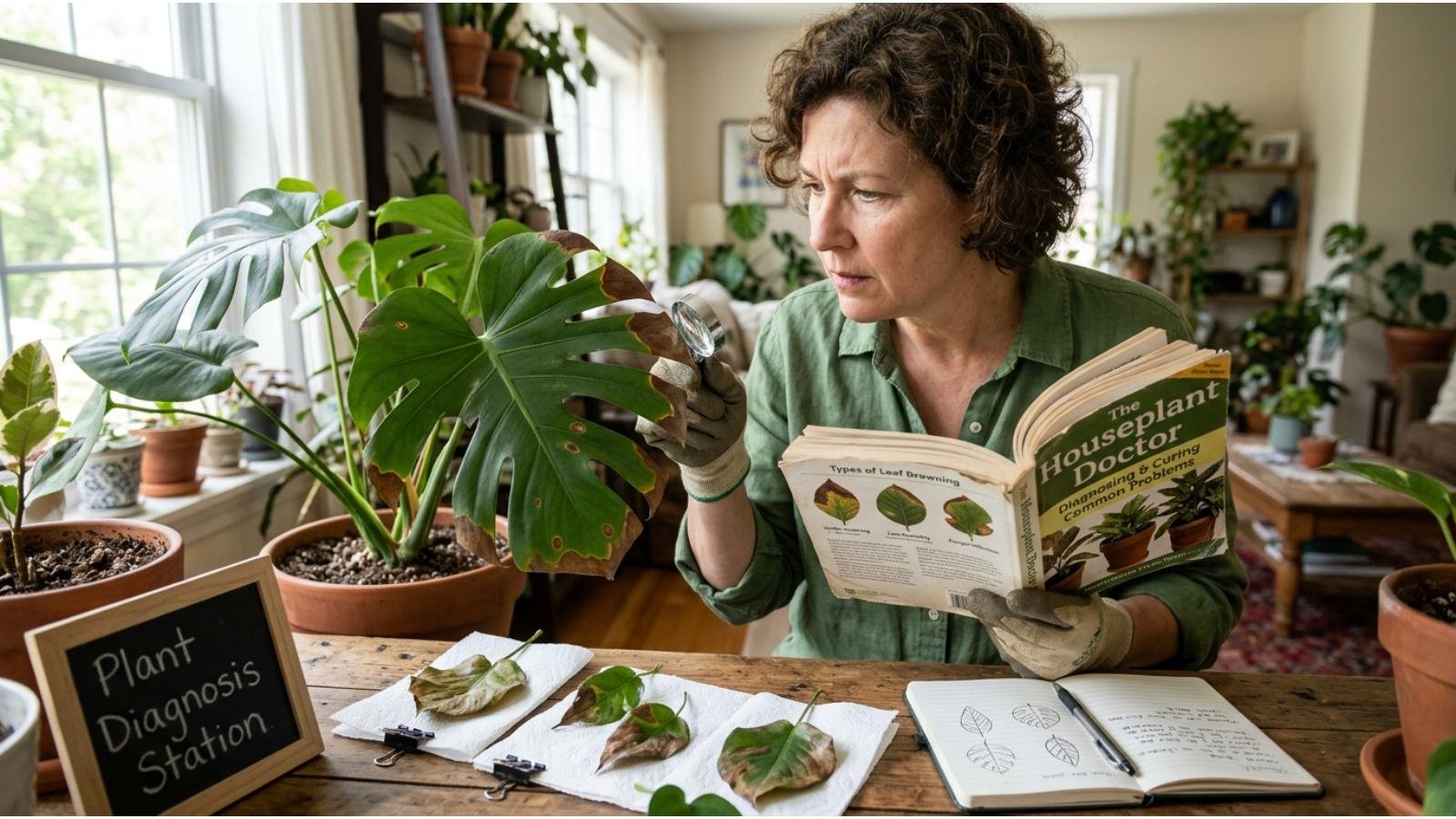
Prayer Plant Troubleshooting: What to Do First
Brown Leaf Tips
Start by checking:
- Humidity
- Water quality
- Fertilizer buildup
- Watering consistency
- Direct sunlight
Do not immediately increase watering.
If the soil is already wet and you add more water because of brown tips, you may create a root problem while the original cause remains unresolved.
Leaves Curling Inward
Curling can be associated with environmental stress.
Check:
- Is the soil too dry?
- Is the room unusually dry?
- Has the plant been exposed to direct sun?
- Is it near an air-conditioning or heating vent?
- Has the plant recently been moved?
Give the plant stable conditions and monitor the newest growth rather than changing five variables at once.
Yellow Leaves
One yellow leaf is not automatically a crisis.
Older leaves naturally age and eventually decline. But widespread yellowing can indicate that something in the growing environment needs attention.
If several leaves are yellowing at once, inspect the soil before watering again.
A consistently saturated root zone deserves particular attention because poorly drained conditions can contribute to root rot.
Leaves Drooping
Drooping can occur when the plant is stressed by inadequate moisture, root problems, temperature changes, or other environmental conditions.
Check the soil first.
If it is dry, water appropriately.
If it is already wet, do not automatically water again. Instead, investigate drainage, roots, light, and temperature.
Brown Spots or Damaged Leaves
Look closely at the entire plant.
Check:
- Both sides of leaves
- Stems
- Soil surface
- Nearby plants
- Recent changes in location
Pests such as spider mites, mealybugs, and thrips can affect prayer plants.
Early detection is much easier than trying to rescue a heavily infested plant.
Image Suggestion: Close-up diagnostic chart showing brown tips, yellowing, curling, pest damage, and healthy foliage.
A Simple Weekly Prayer Plant Care Routine
You do not need to fuss over your Maranta every day.
A short weekly inspection is often more useful.
Once a week
1. Inspect the leaves
Look at the upper and lower surfaces for discoloration or pests.
2. Check the soil
Determine whether it is still appropriately moist before watering.
3. Examine the environment
Make sure the plant has not drifted into harsh sunlight or a cold/dry draft.
4. Rotate if necessary
If the plant is leaning strongly toward its light source, gently rotate the pot.
5. Remove damaged foliage
Trim severely damaged leaves with clean tools when appropriate.
6. Check drainage
Make sure the pot is not sitting in standing water.
This routine takes only a few minutes but can catch problems before they become severe.
Seasonal Prayer Plant Care
Spring and Summer
During brighter and warmer months, growth may increase.
You may need to:
- Monitor soil moisture more frequently
- Provide adequate indirect light
- Resume regular feeding during active growth
- Watch for increased pest activity
- Maintain humidity
Do not assume summer automatically means watering every few days. Indoor conditions still vary considerably.
Fall and Winter
Growth can slow as light levels decrease.
That means the plant may use water more slowly.
Adjust accordingly:
- Check soil before watering
- Reduce fertilizer
- Protect the plant from cold drafts
- Monitor dry indoor air
- Keep it away from heating vents
Both NC State Extension and Missouri Botanical Garden recommend reducing watering or moisture and fertilizer as winter conditions slow growth.
How to Make Prayer Plant Care Easier
The best care routine is one you can actually maintain.
Instead of chasing perfect numbers, focus on five environmental basics:
1. Stable light
Give the plant bright, filtered light without harsh direct sun.
2. Sensible watering
Keep the medium appropriately moist while preventing waterlogging.
3. Useful humidity
Avoid extremely dry air, especially near heaters and air conditioners.
4. Good drainage
Use a container and potting mix that allow excess water to escape.
5. Consistency
Avoid repeatedly moving the plant, changing its light, flooding it with water, and then letting it dry completely.
The goal is not perfection. The goal is stability.
Common Prayer Plant Care Mistakes
Mistake 1: Watering on a fixed schedule
A calendar cannot account for changes in light, temperature, humidity, and pot size.
Better: Check the soil and plant conditions first.
Mistake 2: Assuming brown tips always mean thirst
Brown tips can have several causes, including humidity, water quality, salts, and environmental stress.
Better: Diagnose before watering more.
Mistake 3: Putting the plant in direct sunlight
Prayer plants appreciate light, but intense direct sunlight can damage or bleach their foliage.
Better: Use bright indirect light.
Mistake 4: Keeping the soil permanently wet
Moist does not mean saturated.
Better: Use a well-draining mix and container.
Mistake 5: Overfertilizing
More fertilizer does not necessarily mean faster or healthier growth.
Better: Feed moderately during active growth.
Mistake 6: Ignoring cold drafts
A warm tropical plant can struggle when repeatedly exposed to cold air.
Better: Choose a stable indoor location.
Mistake 7: Treating nighttime leaf movement as a problem
Closing leaves are part of the plant’s normal behavior.
Better: Judge plant health by its overall condition and new growth.
Propagating a Prayer Plant
Prayer plants can be propagated through methods such as division and cuttings. Missouri Botanical Garden lists both cutting and division as propagation methods, while NC State highlights rhizomatous division.
Division
Division is useful when the plant has developed multiple growth points.
A basic approach is:
- Remove the plant carefully from its container.
- Examine the root and rhizome structure.
- Separate a healthy section with viable roots and growth.
- Place the division into an appropriately sized container.
- Keep the new plant warm and appropriately moist.
- Provide bright, indirect light while it establishes.
Avoid making tiny divisions that have insufficient roots or growth points.
Is a Prayer Plant Difficult to Grow?
Prayer plants are often described as moderately easy to maintain, but they are less forgiving of environmental extremes than some tougher houseplants.
The challenge is usually not one complicated care technique.
It is maintaining the combination of moisture, humidity, light, warmth, and drainage.
Once those conditions are reasonably stable, routine maintenance becomes much easier.
For beginners, the most important lesson is simple:
Don’t react to one bad-looking leaf by completely changing your plant’s care routine.
Look for patterns.
If new leaves repeatedly emerge healthy, the plant is growing, and the older leaves are aging normally, your overall care may be working even if a few imperfect leaves remain.
Advanced Tips for Experienced Growers
Watch the newest leaf
Older leaves record the plant’s history. New growth tells you what is happening now.
If the newest leaves are:
- Well colored
- Opening normally
- Free of major damage
- Increasing in size
your current conditions are likely moving in the right direction.
Track environmental changes
If your plant repeatedly develops symptoms, make a simple note of:
- Watering date
- Location
- Light changes
- Fertilizing
- Repotting
- Temperature changes
- Pest observations
Patterns become easier to recognize when you stop relying entirely on memory.
Change one major variable at a time
Suppose the leaves are curling.
Do not simultaneously:
- Move it to another window
- Repot it
- Fertilize it
- Increase watering
- Start misting
- Change the soil
If the plant improves, you will not know what helped.
A more controlled approach is to identify the most likely problem, make one meaningful adjustment, and observe the response.
Prayer Plant Care Checklist
Use this quick checklist when your Maranta looks unhappy:
- Bright, indirect light
- No harsh direct afternoon sun
- Moist but not waterlogged soil
- Pot has drainage holes
- No standing water beneath the pot
- Warm, stable location
- No strong heating or AC draft
- Reasonably humid environment
- Moderate fertilizer during active growth
- Leaves checked regularly for pests
- Watering adjusted for the season
- Brown tips investigated instead of automatically watered
- New growth monitored for improvement
Frequently Asked Questions About Prayer Plant Care
How often should I water a prayer plant?
There is no reliable universal schedule. Check the growing medium and water when it has begun to dry appropriately while keeping the root zone from becoming bone dry or permanently saturated. Watering frequency changes with light, temperature, humidity, pot size, and season.
Do prayer plants need direct sunlight?
No. Bright, indirect or filtered light is generally preferable. Strong direct sunlight can bleach or scorch the attractive foliage.
Why are my prayer plant leaves turning brown?
Brown tips can result from several issues, including dry air, inconsistent moisture, unsuitable water quality, fertilizer buildup, or excessive light. Check the entire growing environment rather than assuming the plant simply needs more water.
Why does my prayer plant curl its leaves?
Some upward leaf movement is completely normal, particularly as light levels change. Persistent daytime curling can indicate stress related to moisture, humidity, temperature, or light.
Should I mist my prayer plant?
Misting may temporarily increase moisture around the foliage, but it is not a substitute for maintaining suitable room humidity. A humidifier can provide more consistent environmental humidity.
Can prayer plants grow in low light?
They can tolerate lower light conditions, but growth and foliage coloration may suffer. Bright indirect light is generally a better target for attractive, vigorous growth.
Why is my prayer plant losing leaves?
Investigate watering, drainage, temperature, light, and root health. Sudden environmental changes can also cause stress.
Can prayer plants live outside?
They can be grown outdoors in appropriate tropical or subtropical conditions, but they are sensitive to cold and frost. Missouri Botanical Garden lists outdoor hardiness only for USDA Zones 11–12 and recommends sheltered conditions.
Should I cut off brown prayer plant leaves?
Severely damaged leaves can be removed for appearance and to redirect the plant’s energy toward healthier growth. If only the tips are brown, you do not necessarily need to remove the entire leaf.
Do prayer plants flower indoors?
They can flower under suitable conditions, but the flowers are generally much less significant ornamentally than the foliage, and indoor flowering may be uncommon.
The Bottom Line: What Makes a Prayer Plant Thrive?
Successful prayer plant care is less about complicated tricks and more about getting several basic conditions to work together.
Give your Maranta bright indirect light, keep its soil appropriately moist without allowing it to stay waterlogged, provide warmth and useful humidity, and avoid harsh environmental swings. When problems appear, diagnose the symptoms instead of automatically adding water or fertilizer.
The most useful habit is to watch new growth. Healthy new leaves are evidence that your current environment is working. If the newest leaves continue to emerge damaged, pale, curled, or unusually small, revisit light, moisture, humidity, temperature, drainage, and water quality one variable at a time.
With that approach, prayer plant care becomes much less about guessing and much more about reading what the plant is telling you.
Related topics readers may also want to explore
- Calathea care guide
- How to increase humidity for houseplants
- Best indoor potting mixes for tropical plants
- How to identify common houseplant pests
- Houseplant watering guide
- How to propagate tropical houseplants
- Brown leaf tips on indoor plants: causes and solutions
Image Suggestion: Final hero image of a healthy, lush Maranta prayer plant in a bright indoor setting, showing its patterned leaves and natural nighttime folding behavior.
Sources and further reading
The care recommendations in this guide are supported by established horticultural references, including the Missouri Botanical Garden, NC State Extension, University of Illinois Extension, UF/IFAS Extension, and the Royal Horticultural Society.