Quick Answer
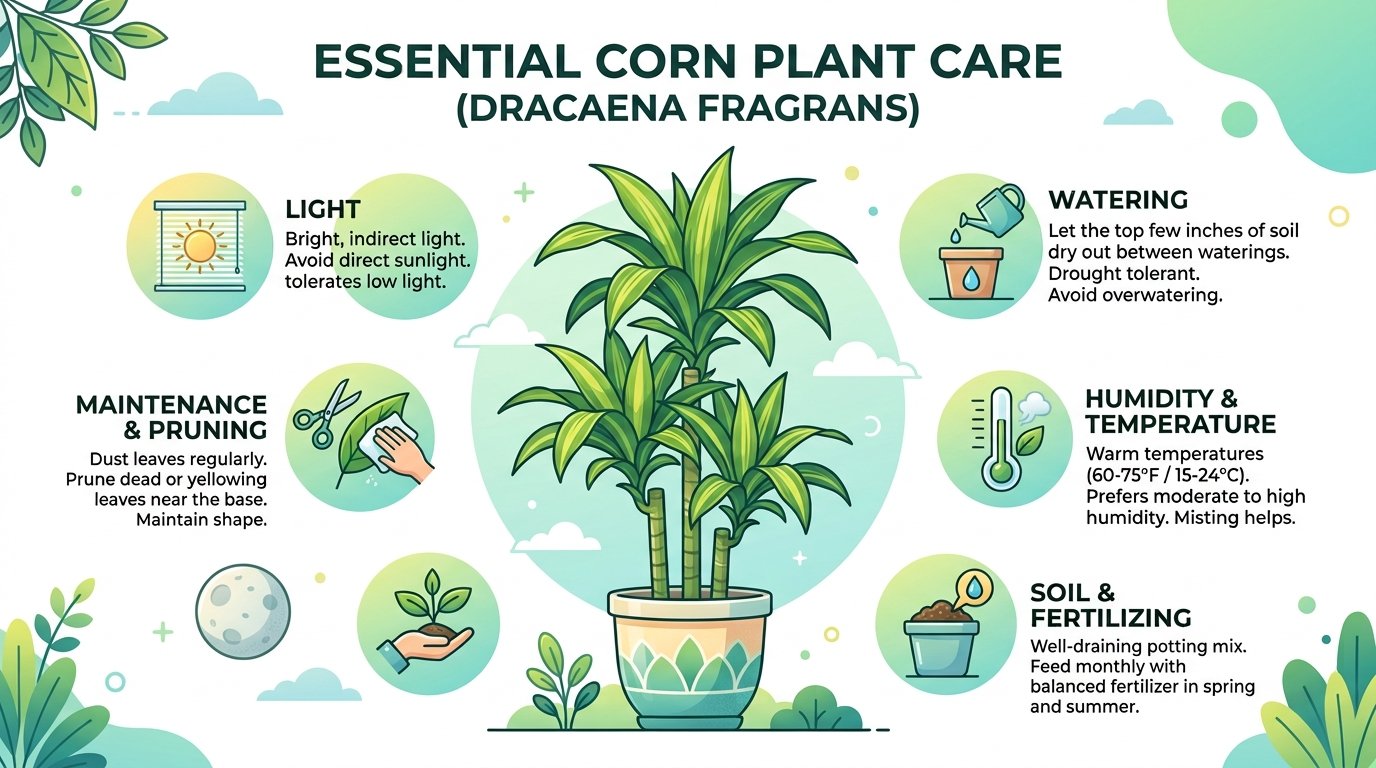
Corn plant care is mainly about providing bright, indirect light, well-draining soil, moderate watering, warmth, and good drainage. Corn plants (Dracaena fragrans) prefer to dry slightly between waterings rather than remain constantly wet. Keep them away from cold drafts and harsh direct sun, and use filtered or rainwater when possible because fluoride and hard tap water can contribute to brown leaf tips.
Introduction
Corn plant care is relatively simple once you understand what this tropical houseplant actually needs. Commonly known as the corn plant or cornstalk plant, Dracaena fragrans produces long, strap-shaped leaves from sturdy cane-like stems and can become an impressive indoor focal point. It tolerates a range of indoor conditions, but inconsistent watering, poor drainage, harsh sunlight, and cold temperatures can quickly lead to brown leaves or declining growth.
The biggest mistake is usually not neglect—it is giving the plant too much water while assuming more moisture means faster growth. A healthy corn plant needs a balance between moisture and oxygen around its roots. Once you learn how to judge the soil, light, and leaves together, caring for a corn plant becomes much more predictable.
What Is a Corn Plant?
The corn plant is the common name for Dracaena fragrans, a tropical evergreen plant grown widely as an indoor houseplant. It is not the same plant as field corn or sweet corn.
It typically develops one or more upright, woody stems with rosettes of long, glossy leaves at the top. Mature plants can become quite tall, making them useful for adding vertical interest to living rooms, offices, bedrooms, and other indoor spaces. The RHS lists Dracaena fragrans as capable of reaching roughly 1.5–2.5 meters under suitable growing conditions.
Popular forms include:
- Dracaena fragrans ‘Massangeana’ — commonly recognized for its central yellow-green stripe.
- ‘Lindenii’ — features lighter margins around the leaves.
- ‘Warneckei’ — known for white and gray-green striping.
- ‘Lemon Lime’ — has bright yellow-green variegated foliage.
- Compact cultivars — useful when you want the appearance of a corn plant without as much vertical growth.
Image Suggestion
Healthy corn plant identification: Show the cane-like trunk, leaf rosette, long strap-shaped leaves, and several common Dracaena fragrans cultivars side by side.
Corn Plant Light Requirements
The ideal corn plant lighting is bright, indirect light.
An east- or west-facing window can work well, while a south-facing window may require a sheer curtain to reduce intense direct sunlight. Corn plants can tolerate lower-light indoor locations, but insufficient light can slow growth and reduce the plant’s ability to maintain strong, attractive foliage. The RHS recommends bright but indirect light and protection from intense summer sun.
Signs of too much light
Watch for:
- Bleached-looking leaves
- Scorched brown patches
- Dry, crispy foliage
- Damage concentrated on the window-facing side
Signs of insufficient light
You may notice:
- Slow growth
- Smaller new leaves
- Weak or stretched growth
- Reduced color in some variegated varieties
Practical tip: Don’t move a corn plant suddenly from a dim room into strong sunlight. Gradual changes are safer because foliage accustomed to low light can be more vulnerable to sun damage.
Image Suggestion
Corn plant lighting diagram: Illustrate ideal placement near east, west, and filtered south windows, with direct midday sunlight marked as a potential problem.
How Often Should You Water a Corn Plant?
There is no reliable watering schedule that works for every corn plant.
Instead, check the soil before watering. The RHS recommends watering when the top 5 cm (about 2 inches) of compost feels dry. The exact interval depends on pot size, soil composition, temperature, humidity, light exposure, and the plant’s root system.
A simple watering method
- Push your finger about 2 inches into the soil.
- If the upper layer still feels damp, wait.
- If it feels dry, water thoroughly.
- Allow excess water to drain from the bottom.
- Empty standing water from the saucer or cachepot.
The goal is not to keep the soil permanently wet. Constantly saturated compost reduces air around the roots and can contribute to root rot.
Should you water less in winter?
Usually, yes.
Corn plants generally use less water when growth slows. Rather than automatically watering every week, inspect the soil and adjust your routine.
The plant’s soil should determine the watering day—not the calendar.
Why Are Corn Plant Leaves Turning Brown?
Brown leaf tips are one of the most common corn plant problems, but the symptom does not have a single cause.
Possible causes include:
| Symptom | Possible Cause | What to Check |
|---|---|---|
| Brown, crispy tips | Dry air or inconsistent watering | Soil moisture and room conditions |
| Brown tips with constantly wet soil | Overwatering/root stress | Drainage and watering frequency |
| Brown patches on sunny side | Excessive direct sunlight | Window exposure |
| Brown tips despite good watering | Fluoride or hard tap water | Try filtered or rainwater |
| Damage after moving plant | Environmental change | Temperature and light |
| Browning near heater | Dry heat | Move plant away from heat source |
| Sudden decline with wet soil | Root problems | Inspect roots if appropriate |
The RHS specifically identifies overwatering, underwatering, fluoride in tap water, excessive direct light, dry air, cold drafts, and proximity to heat sources as possible causes of brown foliage or tips.
Important distinction
A few older brown tips do not necessarily mean your entire plant is unhealthy. Look at the newest growth and overall pattern.
If new leaves are emerging normally while only a few older tips are brown, the problem may be relatively minor. If new leaves are deteriorating, the soil remains wet for long periods, or the stems are becoming soft, investigate more urgently.
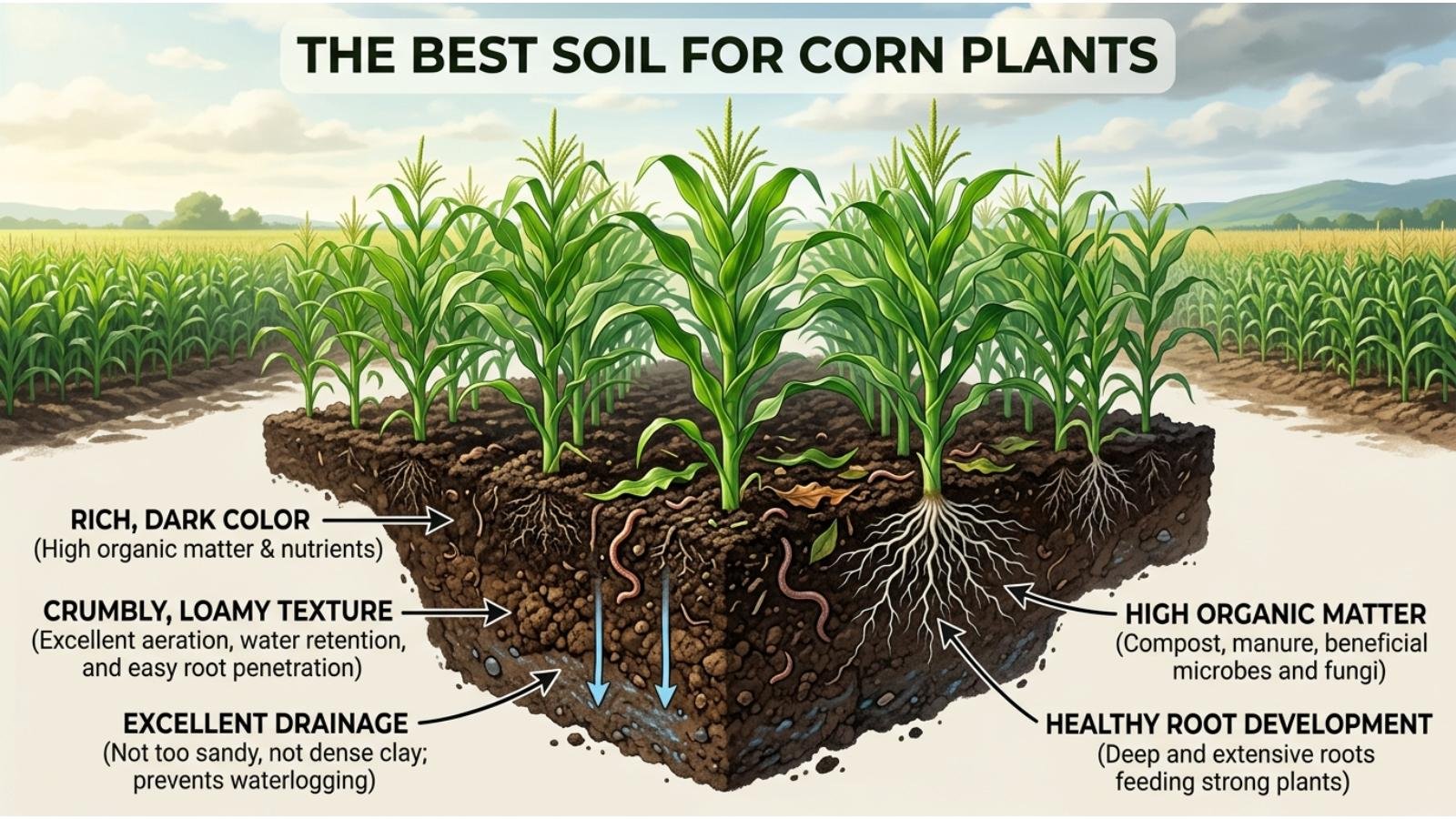
Best Soil for Corn Plants
Corn plants need a potting medium that holds some moisture while allowing excess water to drain.
A heavy, compacted soil can stay wet for too long, particularly in a large container. That creates conditions that are unfavorable for healthy roots.
The RHS recommends a loose, fast-draining but moisture-retentive growing medium for dracaenas. Its growing guide gives an example based on peat-free ericaceous compost, perlite, and orchid bark.
What to look for
A good corn plant potting mix should:
- Drain excess water efficiently
- Retain enough moisture for the roots
- Remain reasonably airy
- Resist becoming compacted
- Work with a container that has drainage holes
Avoid the oversized-pot trap
A common beginner mistake is moving a small corn plant into a dramatically larger pot.
A much larger container can hold excess moisture around a relatively small root system for longer. The RHS recommends moving dracaenas into only a slightly larger container when roots become crowded.
Bigger is not automatically better when it comes to houseplant pots.
Image Suggestion
Corn plant soil comparison: Show healthy airy potting mix beside compacted, waterlogged soil, with a close-up of drainage holes underneath the pot.
Choosing the Right Pot and Drainage
A drainage hole is one of the simplest forms of insurance you can give your corn plant.
Water should have a route out of the container. A decorative outer pot can still be used, but make sure excess water is not left collecting around the nursery pot.
When repotting:
- Choose a container only moderately larger than the current root system.
- Make sure it has adequate drainage.
- Use fresh, well-draining potting mix.
- Position the plant at approximately the same depth.
- Water appropriately after repotting.
- Allow excess water to drain completely.
The RHS recommends repotting dracaenas when roots become overcrowded, generally into a pot one size larger, with repotting commonly carried out in spring.
When should you repot?
Look for signs such as:
- Roots filling the container
- Roots emerging from drainage holes
- Soil drying unusually quickly
- The plant becoming unstable
- Severely compacted or degraded potting mix
Don’t repot simply because a plant has been in the same pot for a particular number of months.
Temperature and Humidity for Corn Plants
Corn plants are tropical and prefer warm, stable indoor conditions.
The RHS recommends approximately 18–30°C (65–86°F) for good growth and advises protecting dracaenas from cold drafts and hot radiators.
Keep your plant away from:
- Cold drafts
- Frequently opened exterior doors during cold weather
- Air-conditioning vents
- Hot radiators
- Strong heating sources
- Sudden temperature changes
Humidity can also influence leaf quality. Corn plants generally appreciate humid air, although increasing humidity should not be used as a substitute for proper watering and drainage. The RHS suggests grouping plants or using a tray with moist gravel to create a more humid local environment.
Practical insight: If the room is comfortable for you and the plant is protected from temperature extremes, it will usually be in a much better environment than one placed beside a heater or drafty window.
How to Fertilize a Corn Plant
Corn plants don’t need constant feeding.
During active growth, a balanced liquid houseplant fertilizer can support continued development. The RHS recommends feeding dracaenas from approximately April through October and warns that excessive fertilizer can harm rather than improve plant health.
A sensible feeding routine
- Feed during active growth.
- Follow the fertilizer label rather than assuming more is better.
- Avoid heavily fertilizing a stressed or severely damaged plant.
- Reduce or stop routine feeding during slower winter growth.
- Water appropriately rather than allowing fertilizer salts to accumulate excessively.
Fertilizer is not a cure for poor light, overwatering, or damaged roots.
If a plant is struggling because its roots are staying wet, adding more fertilizer usually doesn’t solve the underlying problem.
Pruning and Controlling Corn Plant Height
Corn plants can be pruned when they become too tall, sparse, or uneven.
One useful characteristic of dracaenas is their ability to produce new shoots below a pruning cut. This means a tall cane does not necessarily have to remain tall forever. The RHS notes that dracaenas respond well to pruning and can produce new shoots beneath cuts.
How to prune a tall corn plant
- Decide how much height you want to remove.
- Use a clean, sharp cutting tool.
- Make a clean cut through the cane.
- Continue normal care rather than dramatically increasing watering.
- Watch for new shoots developing below the cut.
You can also use suitable stem sections for propagation.
Don’t remove healthy leaves simply because they have a few cosmetic imperfections. Prune primarily to manage structure, remove severely damaged material, or encourage a more attractive form.
Image Suggestion
Corn plant pruning diagram: Show a tall cane before pruning, the correct cut location, and new shoots developing below the cut.
How to Propagate a Corn Plant
Corn plants can be propagated from stem cuttings.
The RHS lists semi-ripe cuttings and leafless stem sections as propagation methods for Dracaena fragrans.
Basic stem-cutting approach
- Select a healthy section of stem.
- Cut it with a clean tool.
- Prepare the cutting appropriately for the propagation method.
- Place it in a suitable propagation medium.
- Keep it warm and provide appropriate moisture.
- Give it suitable indirect light.
- Wait for roots and new growth to develop.
Propagation takes patience. Avoid repeatedly disturbing the cutting to check whether roots have formed.
Advanced tip: Warmth can be particularly useful during propagation because dracaenas are tropical plants and root development is influenced by environmental conditions.
Common Corn Plant Care Mistakes
1. Watering on a fixed schedule
Watering every Sunday may sound convenient, but plant water use changes with light, temperature, season, pot size, and soil.
Better approach: Check the soil first.
2. Keeping the soil constantly wet
Moisture is useful; saturation is not.
Constantly wet compost can create root problems.
3. Putting the plant in harsh direct sun
Corn plants appreciate light, but intense direct sunlight can scorch foliage.
Better approach: Use bright filtered or indirect light.
4. Ignoring water quality
Dracaenas can be sensitive to fluoride, and hard tap water can affect the growing medium. The RHS recommends rainwater or filtered water where possible.
5. Placing the plant beside a radiator
The combination of heat and dry air can contribute to brown foliage.
6. Buying an enormous decorative pot
A huge container can make moisture management harder.
7. Fertilizing a struggling plant excessively
More fertilizer does not compensate for poor roots, bad drainage, or inadequate lighting.
8. Cutting off every brown leaf
Removing damaged tissue may improve appearance, but it does not fix the underlying cause.
Corn Plant Troubleshooting Guide
Why is my corn plant drooping?
Check the soil first.
If it is extremely dry, underwatering may be involved. If it is consistently wet, root stress from excessive moisture may be contributing.
Also check recent environmental changes, including light, temperature, and drafts.
Why are the leaves turning yellow?
Yellow foliage can have several causes, but persistent wet soil should be one of the first things to investigate.
Check:
- Soil moisture
- Drainage
- Pot size
- Root condition
- Light levels
- Recent changes in care
Avoid assuming that yellow leaves automatically mean the plant needs more fertilizer.
Why are the leaf tips turning brown?
Potential causes include inconsistent watering, dry air, fluoride exposure, excessive direct sunlight, cold drafts, or nearby heating.
Look for a pattern rather than treating the symptom alone.
Why is my corn plant not growing?
Possible causes include:
- Low light
- Seasonal slowdown
- Poor root conditions
- Insufficient nutrition
- Temperature stress
- An overly stressed plant
If the plant otherwise looks healthy, slow growth is not necessarily a sign of failure.
Why is my corn plant getting brown spots?
Consider direct sun, watering problems, environmental stress, or pests.
Inspect the leaves carefully and check whether the spots are concentrated on the side receiving the most sunlight.
Corn Plant Pests
Corn plants are generally robust, but pests can occasionally become a problem.
The RHS identifies pests such as scale insects, red spider mites, thrips, and mealybugs as possible problems for dracaenas.
What to inspect
Regularly check:
- Leaf undersides
- Leaf joints
- New growth
- Stems
- Areas where leaves meet the cane
Early detection makes pest management much easier.
If you notice a sudden decline, don’t automatically assume it is a watering problem. Inspect the plant closely before changing multiple aspects of its care at once.
Is the Corn Plant Safe for Cats and Dogs?
No. Corn plants (Dracaena fragrans) are toxic to cats and dogs if eaten.
The ASPCA identifies saponins as the toxic principle and lists symptoms that can include vomiting, depression, loss of appetite, and excessive salivation; cats may also develop dilated pupils.
If you have pets that chew plants, place the corn plant somewhere inaccessible to them.
If a pet has eaten part of the plant and you are concerned about possible poisoning, contact a veterinarian or an appropriate animal poison-control service promptly.
Image Suggestion
Pet-safety graphic: A corn plant placed safely out of reach of a curious cat and dog, with a simple “toxic if eaten” warning.
Seasonal Corn Plant Care
Spring
Spring is a good time to reassess the plant after winter.
- Check whether roots have become crowded.
- Consider repotting if necessary.
- Resume active-growth fertilization.
- Increase watering only as the plant’s actual water needs increase.
- Inspect for pests.
Summer
Summer can increase water use, particularly in bright, warm rooms.
However, don’t automatically water more simply because it is summer. Check the soil.
Protect the plant from intense direct sunlight and hot windows.
Fall
As light levels decrease, water use may decline.
Begin adjusting your watering routine rather than continuing a summer schedule automatically.
Winter
Winter care is often about avoiding environmental stress.
- Keep the plant warm.
- Protect it from cold drafts.
- Keep it away from heating vents and radiators.
- Water according to soil moisture.
- Avoid unnecessary heavy fertilization.
A Simple Corn Plant Care Routine
For beginners, this routine is easier to remember than a complicated calendar:
Every few days:
Look at the plant and notice any sudden changes.
Before watering:
Check the top couple of inches of soil.
When watering:
Water thoroughly when appropriate and allow excess water to drain.
Every few weeks:
Inspect leaves and stems for pests.
Monthly during active growth:
Assess whether the plant needs feeding according to your fertilizer’s instructions.
Seasonally:
Reassess light, watering, temperature, and growth.
When roots become crowded:
Consider repotting into a slightly larger container.
This approach works because it responds to the plant’s condition rather than forcing it into a rigid schedule.
Corn Plant Care at a Glance
| Care Factor | Best Practice |
|---|---|
| Light | Bright, indirect light |
| Water | Water when the top ~2 inches of soil becomes dry |
| Soil | Loose, well-draining, moisture-retentive mix |
| Pot | Container with drainage holes |
| Temperature | Warm, stable conditions; around 18–30°C is suitable for best growth |
| Humidity | Moderate to higher humidity is beneficial |
| Fertilizer | Balanced houseplant fertilizer during active growth |
| Pruning | Prune tall or weak stems as needed |
| Repotting | Move up only when roots become crowded |
| Water quality | Filtered or rainwater can help minimize fluoride-related leaf damage |
| Pets | Toxic if eaten by cats and dogs |
The care recommendations above are consistent with RHS guidance for dracaenas, including light, temperature, watering, soil, feeding, pruning, and repotting.
Frequently Asked Questions
How much sunlight does a corn plant need?
Corn plants generally perform best in bright, indirect light. Protect them from strong direct summer sun, which can scorch leaves.
How often should I water a corn plant?
Don’t rely on a fixed weekly schedule. Check the soil and water when roughly the top 2 inches feels dry. Environmental conditions can change how quickly the soil dries.
Can a corn plant grow in low light?
Some corn plant cultivars tolerate relatively low indoor light, but growth may be slower. Brighter indirect light is generally preferable for healthy growth and attractive foliage.
Should I cut off brown leaves?
You can remove severely damaged leaves or trim unattractive brown portions, but first determine why the browning occurred. Otherwise, the problem may continue.
Can I use tap water for a corn plant?
You can, but water quality matters. Fluoride and hard tap water can contribute to foliage problems in dracaenas. Filtered or rainwater is preferable where practical.
Why does my corn plant have brown tips even though I water it?
Watering alone does not determine leaf health. Fluoride, hard water, dry air, excessive direct sunlight, temperature stress, and inconsistent moisture can also cause brown tips.
How tall can a corn plant become?
Dracaena fragrans can become a substantial indoor plant. The RHS lists a potential height of approximately 1.5–2.5 meters for the species under its growing conditions.
Can I cut a corn plant in half?
Yes. Pruning can be used to reduce height and encourage new shoots below the cut. Dracaenas respond well to pruning.
Is Dracaena fragrans poisonous to cats?
Yes. The ASPCA lists corn plant/Dracaena fragrans as toxic to cats and identifies saponins as the toxic principle.
Does a corn plant need high humidity?
Corn plants appreciate humid conditions, but good watering, drainage, temperature, and light are still fundamental. Increasing humidity cannot compensate for permanently waterlogged soil.
Conclusion
Successful corn plant care is less about following a perfect watering calendar and more about learning to read the plant and its growing environment. Give Dracaena fragrans bright indirect light, well-draining soil, appropriate moisture, warmth, and enough room for its roots to breathe.
When problems appear, diagnose the cause before reaching for fertilizer or watering more frequently. Brown tips, yellow leaves, and slow growth can result from several different conditions, so look at the entire growing environment rather than treating one symptom in isolation.
For most beginners, the most important habit is simple: check the soil before watering, provide good drainage, and keep the plant away from harsh sun and temperature extremes. With those fundamentals in place, a corn plant can become a long-lived, attractive indoor feature.
Suggested Related Internal Links
If these topics are covered elsewhere on your website, useful internal links could include:
- Snake Plant Care
- Spider Plant Care
- Pothos Plant Care
- Jade Plant Care
- Prayer Plant Care
- Bird of Paradise Plant Care
- Monstera Plant Care
- Kalanchoe Plant Care
- Aloe Plant Care
- Elephant Ear Plant Care
Suggested Article Images
- Healthy corn plant in a bright indoor room.
- Corn plant light-placement diagram.
- Correct versus excessive watering illustration.
- Healthy roots versus root-rot comparison.
- Brown corn plant leaf tips with possible causes labeled.
- Corn plant pruning and regrowth diagram.
- Corn plant propagation from stem cuttings.
- Pet-safe placement showing that the plant is toxic if eaten.