Quick Answer
Zebra plant care is easiest when Aphelandra squarrosa receives bright indirect light, consistently moist but well-draining soil, warm temperatures, and high humidity. Avoid both bone-dry soil and waterlogged roots. Keep the plant away from cold drafts and harsh direct sunlight, and feed lightly during active growth. Brown tips, leaf drop, and drooping usually indicate problems with moisture, humidity, temperature, or light.
Introduction
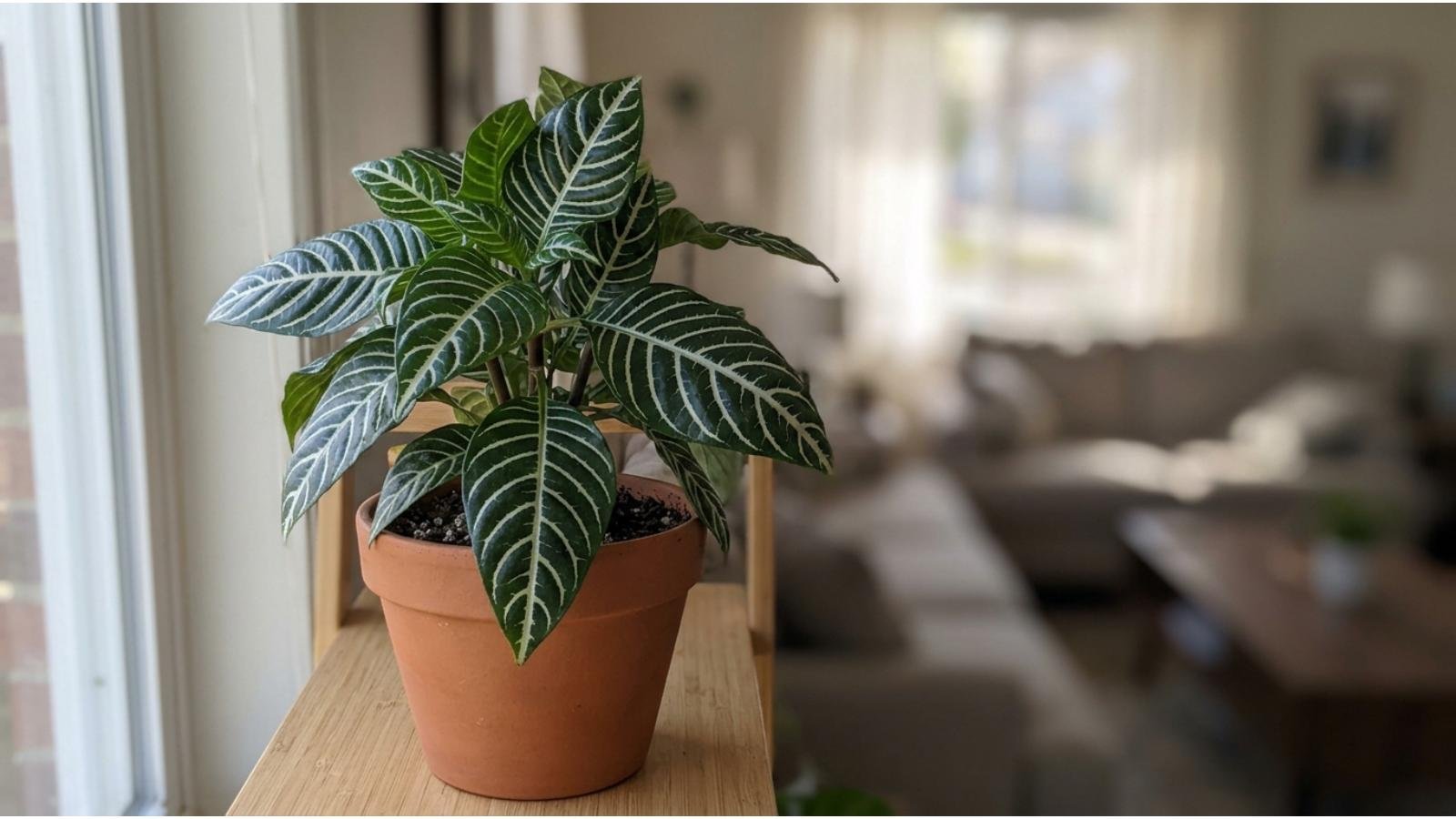
Zebra plant, or Aphelandra squarrosa, is a tropical houseplant prized for its glossy dark-green leaves, striking white veins, and dramatic yellow flower spikes. It comes from Brazil, where it naturally experiences warm temperatures, moisture, and humid conditions. Indoors, recreating those basic conditions is more important than following a rigid watering calendar.
The biggest challenge is balance. Beginners often assume that a tropical plant should stay soaking wet, but zebra plants dislike constantly waterlogged roots. At the other extreme, allowing the potting mix to become completely dry can quickly lead to wilting and leaf drop. Good zebra plant care means keeping moisture available while still giving the roots oxygen and drainage.
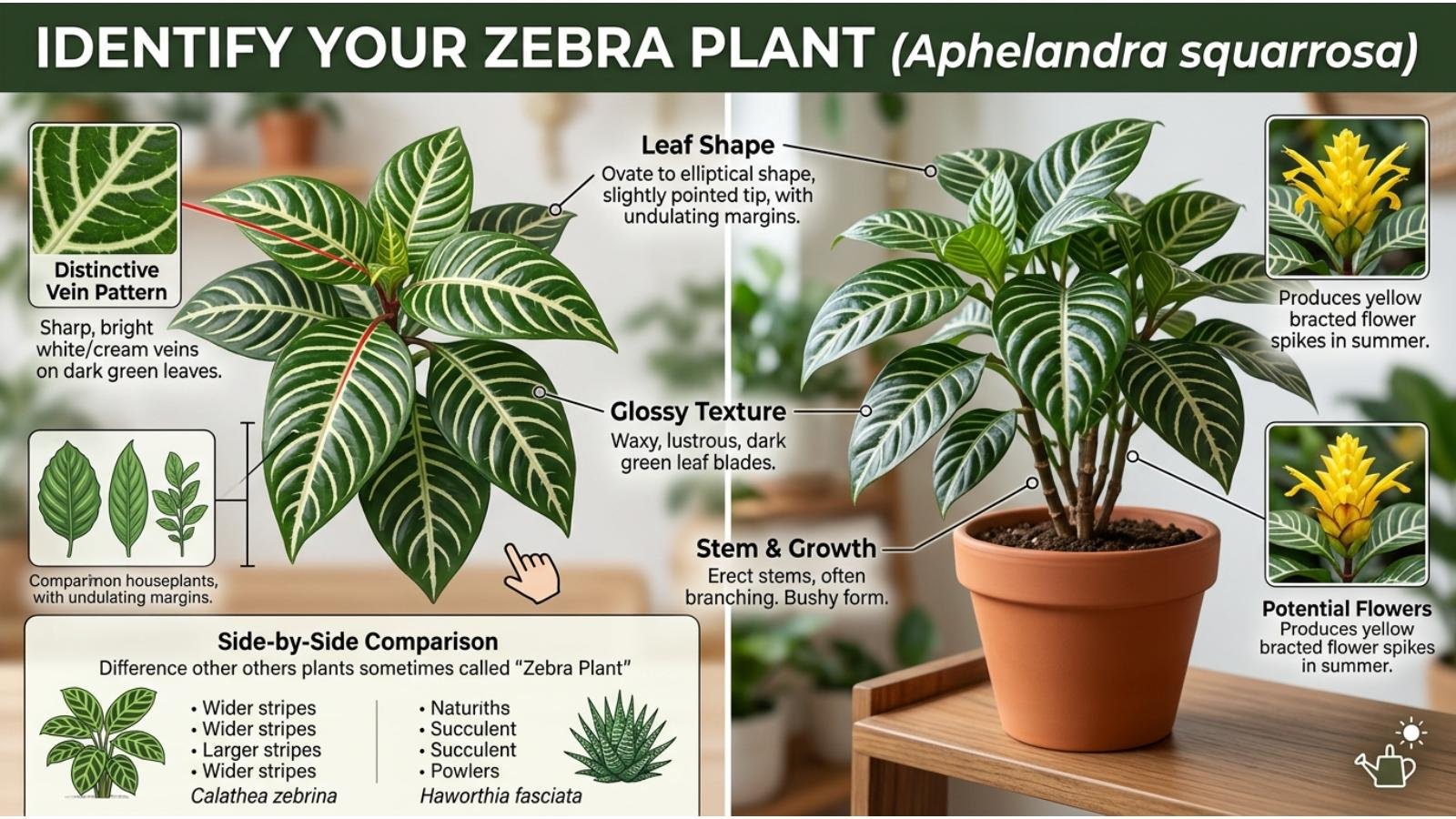
Identify Your Zebra Plant Before You Start
The name zebra plant creates confusion because it can refer to several unrelated plants.
The classic houseplant covered in this guide is Aphelandra squarrosa. It has glossy, broad leaves with prominent pale veins and can produce yellow flower spikes. North Carolina State Extension lists Goeppertia zebrina, Haworthiopsis attenuata, Tradescantia zebrina, and other plants under the same common name.
| Plant | Key Appearance | Basic Care Style |
|---|---|---|
| Aphelandra squarrosa | Glossy green leaves with strong white veins | Warm, humid, bright indirect light, consistently moist soil |
| Goeppertia zebrina | Large velvety striped leaves | Humid, evenly moist, filtered light |
| Haworthiopsis attenuata | Small stiff succulent leaves with white markings | Bright light, much drier soil |
| Tradescantia zebrina | Trailing green, silver, and purple foliage | More adaptable and relatively forgiving |
If your plant has thick succulent-like leaves arranged in a compact rosette, do not automatically follow Aphelandra watering advice. The plant may actually be a zebra haworthia.
Image Suggestion: A visual comparison showing Aphelandra squarrosa, Goeppertia zebrina, and zebra haworthia side by side.
What Makes Zebra Plant Different
Aphelandra squarrosa is a tropical broadleaf evergreen in the Acanthaceae family. In its native Brazilian environment, it grows in warm, humid conditions. As a houseplant, it generally remains much smaller than its potential native size and is grown primarily for its patterned foliage and striking flowers.
Its leaves are the easiest identification feature. They are dark green, glossy, and marked with prominent white veins. When conditions are favorable, yellow flowers emerge in dense upright spikes.
The plant is considered moderately demanding rather than completely carefree. That does not mean it is difficult for an attentive beginner. It simply responds quickly when one of its basic environmental needs is neglected.
How Much Light Does a Zebra Plant Need
Bright indirect light is one of the most important parts of successful zebra plant care.
Place the plant near a bright window where it receives plenty of filtered light without sitting in intense afternoon sun. Illinois Extension lists Aphelandra squarrosa among houseplants requiring high or bright light.
A practical setup is an east-facing window or a bright location near a south or west-facing window with a sheer curtain.
Too little light can result in weak growth and reduce flowering. Too much intense direct sunlight can scorch or bleach the foliage.
Watch the leaves rather than relying only on the clock. If the plant is becoming stretched and growth is weak, increase its light gradually. If leaves develop scorched or bleached areas after exposure to strong sun, filter the light.
Image Suggestion: A zebra plant positioned several feet from a bright window with filtered sunlight.
How to Water a Zebra Plant
Watering is where many zebra plants fail.
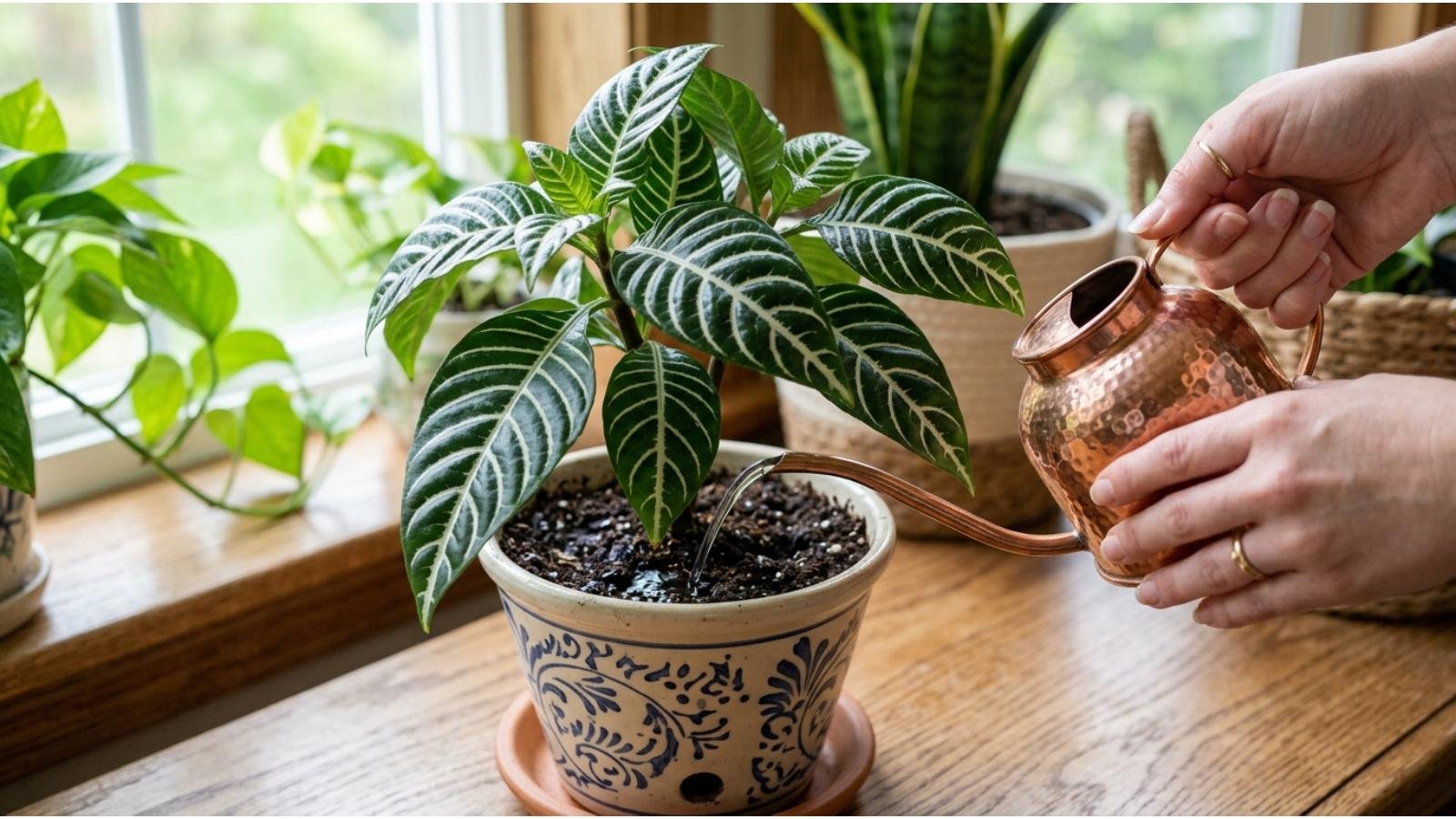
The goal is consistently moist soil without creating stagnant, saturated conditions. North Carolina State Extension recommends not allowing the soil to dry out completely and notes that both excessive water and extremely dry conditions can cause lower leaves to brown and drop.
Instead of watering every Sunday or every fixed number of days, check the potting mix.
Follow these steps.
- Check the upper portion of the potting mix with your finger.
- If it is beginning to dry but the lower mix is still moist, prepare to water.
- Water thoroughly enough to moisten the root zone.
- Allow excess water to drain freely.
- Empty standing water from a saucer or decorative cachepot.
- Check the plant again sooner during hot, bright periods because it may use water faster.
The exact interval will change with pot size, soil composition, temperature, humidity, season, and light.
A plant sitting in a small pot near a bright window may dry much faster than a larger plant in a cool room.
Should You Use Tap Water
Water quality can matter, particularly when your local tap water is hard or contains substantial mineral content.
If you repeatedly notice unexplained brown leaf tips despite appropriate watering and humidity, consider using filtered, distilled, or rainwater if practical. Water quality is not always the cause of browning, however, so do not automatically replace your entire watering routine based on leaf tips alone.
Low humidity, excessive light, temperature stress, and watering problems can also produce brown or damaged foliage.
Best Soil for Zebra Plant Care
Zebra plants need a potting medium that holds some moisture while still allowing excess water to escape.
A quality indoor potting mix amended with material that improves drainage is a practical starting point. The goal is not an extremely dry succulent mix and not dense garden soil.
North Carolina State Extension describes the plant as preferring well-drained, acidic potting soil and lists good drainage and high organic matter among its cultural requirements.
A useful homemade approach is to combine:
- Quality indoor potting mix.
- Fine orchid bark or another organic aeration component.
- Perlite or a similar drainage material.
The exact proportions do not need to be treated as a universal formula. Your watering habits and indoor environment matter just as much as the recipe.
If the soil remains wet for many days after watering, improve drainage rather than simply watering less often.
Choosing the Right Pot
The container should have drainage holes.
This sounds basic, but decorative pots without drainage are a frequent source of houseplant problems. If water accumulates around the roots, reducing the frequency of watering does not solve the underlying drainage problem.
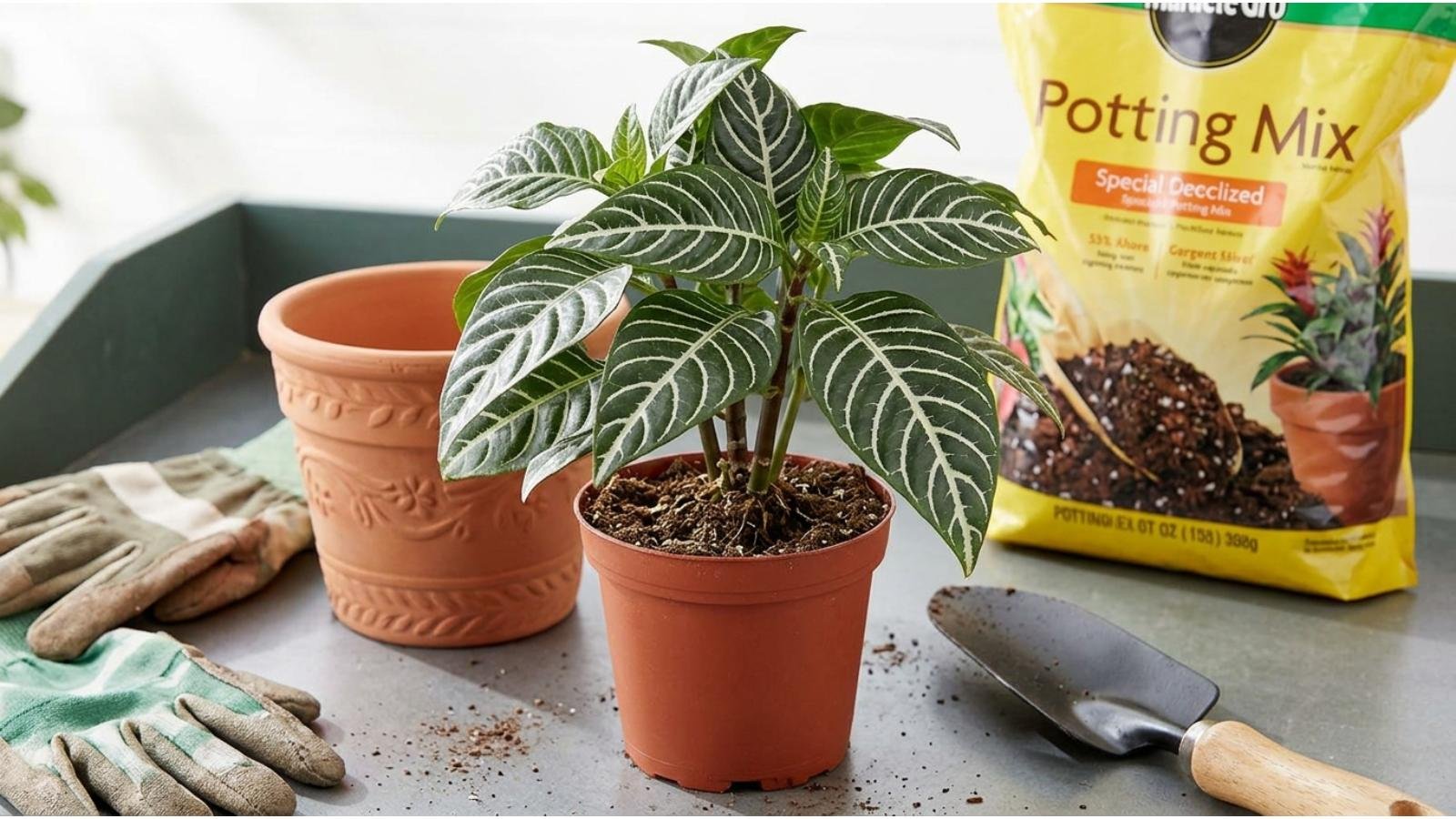
Choose a pot only moderately larger than the existing root ball when repotting. Moving a small root system into a huge container can leave a large volume of wet soil around the roots for an extended period.
A drainage hole gives excess water somewhere to escape.
Image Suggestion: A zebra plant being repotted from a compact nursery pot into a slightly larger container with drainage holes.
Humidity Requirements for Zebra Plants
High humidity is one of the defining requirements of good zebra plant care.
North Carolina State Extension recommends high humidity and suggests using a wet-pebble setup or a naturally humid bathroom to help meet the plant’s needs.
Dry indoor air can cause brown leaf tips and crispy margins. The RHS also identifies low humidity as a common cause of brown leaf tips in houseplants and explains that dry air increases water loss from foliage.
For consistently dry homes, a humidifier is usually more controllable than relying on occasional misting.
Other useful approaches include:
- Grouping compatible plants together.
- Using a humidifier nearby.
- Placing the plant in a naturally humid room with adequate light.
- Using a pebble tray while ensuring the pot itself does not sit directly in standing water.
Do not confuse humid air with constantly wet soil. These are separate conditions.
Ideal Temperature for Zebra Plants
Warmth is essential.
North Carolina State Extension recommends temperatures that do not fall below approximately 65°F for Aphelandra squarrosa.
Keep the plant away from:
- Cold drafts.
- Frequently opened exterior doors.
- Very cold windows during winter.
- Air-conditioning vents.
- Radiators and intense heat sources.
- Sudden temperature changes.
A room that feels comfortable to you is often suitable, but avoid placing the plant directly beside a heat or cooling source.
How to Fertilize Zebra Plants
Fertilizer supports active growth, but more fertilizer does not automatically produce a healthier plant.
During active growth, use a balanced liquid houseplant fertilizer at the label’s recommended dilution or a weaker application when appropriate. North Carolina State Extension recommends weak fertilizer applications every few weeks as new growth resumes toward late winter and during the growing period.
Do not heavily fertilize a stressed plant simply because its leaves look unhealthy.
First determine whether the problem is caused by light, watering, humidity, temperature, pests, or root damage. Feeding a plant with damaged roots will not fix the underlying problem.
Reduce feeding when growth naturally slows during winter.
How to Repot a Zebra Plant
Repot when the plant has outgrown its container or when the potting mix has broken down and no longer drains properly.
A practical repotting process is:
- Choose a container with drainage holes.
- Select a pot only modestly larger than the current one.
- Prepare fresh, well-draining potting mix.
- Remove the plant gently.
- Inspect the roots for obvious damage or decay.
- Place the plant at approximately the same depth as before.
- Fill around the root ball with fresh mix.
- Water appropriately and allow excess water to drain.
North Carolina State Extension recommends annual repotting with an increase of one pot size, although the ideal schedule can vary depending on growth rate, potting mix, and growing conditions.
Do not repot simply because a calendar says you must. Inspect the plant and root system first.
How to Prune a Zebra Plant
Pruning becomes particularly useful after flowering.
The plant can become leggy as older foliage declines. North Carolina State Extension recommends cutting plants back after flowering and leaving two rows of leaves on the remaining stems to maintain a more compact appearance.
Use clean, sharp scissors or pruning shears.
Remove:
- Dead leaves.
- Severely damaged foliage.
- Weak or excessively elongated stems.
- Spent flowering structures.
Avoid removing large amounts of healthy foliage unnecessarily. Leaves are the plant’s energy-producing organs, so aggressive pruning can temporarily slow recovery.
How to Propagate a Zebra Plant
Stem cuttings are a practical way to produce new zebra plants.
Propagation is especially useful after pruning because healthy stem sections can potentially become new plants. North Carolina State Extension identifies stem cuttings as the recommended propagation strategy for Aphelandra squarrosa.
A simple approach is:
- Take a healthy stem cutting using clean tools.
- Remove unnecessary lower foliage.
- Place the cutting into a suitable moist propagation medium.
- Keep it warm and humid.
- Provide bright indirect light.
- Keep the medium lightly moist without making it stagnant.
Propagation is not an instant process. Stable environmental conditions are more important than constantly disturbing the cutting to check for roots.
How to Encourage Zebra Plant Flowers
The yellow flower spike is one of the most attractive features of Aphelandra squarrosa.
Consistent bright indirect light is important for encouraging flowering. North Carolina State Extension specifically notes that prolonged periods of indirect light can help encourage blooming.
If your plant produces healthy leaves but never flowers, evaluate its environment before adding extra fertilizer.
Ask yourself:
- Is the plant receiving enough bright filtered light.
- Is the plant warm enough.
- Is humidity reasonably high.
- Has the plant experienced repeated drought stress.
- Is the plant receiving excessive direct sunlight.
- Is the plant mature and healthy enough to flower.
A flowering plant should not be forced by dramatically changing several conditions at once.
Image Suggestion: Close-up photograph of a mature zebra plant showing its yellow flower spike above the white-veined foliage.
Common Zebra Plant Care Mistakes
The most common problems are usually environmental rather than mysterious diseases.
Overwatering
Constantly saturated soil reduces healthy root conditions and can contribute to root problems.
The solution is not simply to ignore the plant until it becomes completely dry. Improve drainage, use an appropriate pot, and adjust watering according to how quickly the soil is drying.
Letting the Soil Become Bone Dry
Zebra plants are not drought-tolerant houseplants.
Extended dryness can cause wilting, leaf drop, and brown foliage.
Putting It in Harsh Direct Sun
Bright light is useful, but intense direct sunlight through a hot window can damage foliage.
Filtered light is safer than exposing the plant to strong midday sun for long periods.
Keeping It in Dry Air
Low humidity commonly shows up as brown leaf tips and crispy margins.
Using a Pot Without Drainage
A decorative container may look attractive while creating a serious root-zone problem.
Always make sure excess water can escape.
Moving It Constantly
Zebra plants prefer stable conditions. Repeatedly moving a stressed plant from a dark room to a sunny window and then into a bathroom can make diagnosis harder.
Change one major environmental factor at a time and observe the response.
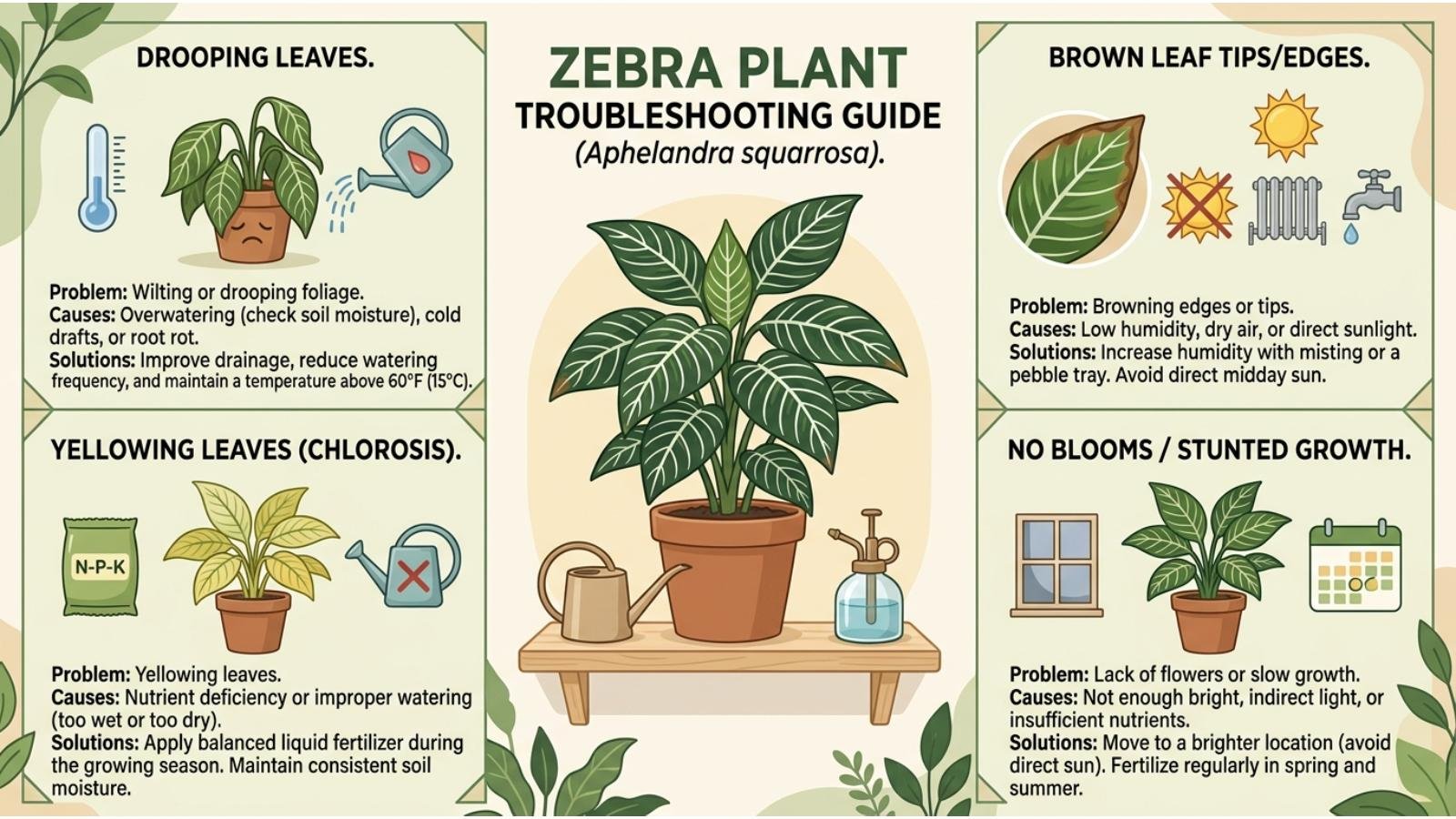
Zebra Plant Troubleshooting Guide
| Symptom | Likely Causes | What to Check |
|---|---|---|
| Brown leaf tips | Low humidity, water stress, mineral buildup | Humidity, watering consistency, water quality |
| Yellowing leaves | Excess moisture, poor roots, stress | Soil moisture and drainage |
| Drooping leaves | Dry soil, excessive water, temperature stress | Root-zone moisture and room temperature |
| Leaf scorch | Excessive direct sunlight or heat | Window exposure and nearby heat |
| Lower leaves dropping | Dryness, excessive water, cool conditions | Watering and temperature |
| Weak or stretched growth | Insufficient light | Move toward brighter filtered light |
| Crispy edges | Dry air or moisture stress | Humidity and watering |
| Pest damage | Spider mites, mealybugs, aphids, scale, or whiteflies | Inspect leaf undersides and stems |
North Carolina State Extension identifies aphids, scales, whiteflies, spider mites, and mealybugs among pests to watch for, while also noting that watering, temperature, humidity, and excessive sunlight can produce several similar symptoms.
The important lesson is that one symptom can have multiple causes. Diagnose the growing conditions before reaching for a treatment.
How to Deal With Zebra Plant Pests
Inspect the plant regularly, especially underneath leaves and around stem joints.
Look for:
- Fine webbing.
- Sticky residue.
- Small insects.
- Cotton-like clusters.
- Scale-like bumps.
- Distorted new growth.
- Pale stippling on leaves.
If pests appear, isolate the affected plant from other houseplants when possible and identify the pest before choosing a treatment.
Spider mites can become particularly troublesome when plants are stressed by dry conditions. Improving the growing environment is therefore part of prevention, not just cosmetic maintenance.
Image Suggestion: Close-up diagram showing common zebra plant pest locations on leaf undersides and stems.
Zebra Plant Care Through the Seasons
Spring
As growth increases, gradually monitor moisture more frequently. This is also a useful period for repotting, pruning, propagation, and restarting a light feeding routine.
Summer
Bright indirect light, warmth, and humidity become especially important. Plants may use water faster during hot weather, so check the potting mix more often rather than automatically increasing watering on a fixed schedule.
Fall
Growth may begin to slow. Gradually reduce feeding as the plant’s activity decreases.
Winter
Avoid cold drafts and keep the plant away from cold windows. Reduce watering frequency if the soil is drying more slowly, but do not allow the plant to remain completely dry for extended periods. North Carolina State Extension describes zebra plants as entering a period of semi-dormancy during winter.
The key seasonal rule is simple: adjust watering to the plant’s drying rate, not the date on the calendar.
An Easy Zebra Plant Care Routine
For beginners, a simple routine is more useful than an elaborate schedule.
Once or twice a week, inspect:
- Soil moisture.
- Leaf condition.
- New growth.
- Undersides of leaves.
- Humidity and temperature.
- Drainage after recent watering.
- Position relative to the window.
Water when the plant needs it rather than because a reminder says it is watering day.
Every few weeks during active growth, inspect for pests and remove damaged foliage.
Every few months, evaluate whether the plant is becoming crowded, stretched, or root-bound.
This approach turns zebra plant care into observation rather than guesswork.
Frequently Asked Questions About Zebra Plant Care
Is a zebra plant easy to care for
Aphelandra squarrosa is moderately demanding because it prefers consistent warmth, humidity, moisture, and bright indirect light. It becomes much easier once these conditions are stable.
How often should I water a zebra plant
There is no universal weekly schedule. Check the potting mix regularly and water when it begins to dry while avoiding prolonged saturation. Environmental conditions can change how quickly the plant uses water.
Why are my zebra plant leaves turning brown
Brown leaves or tips can result from low humidity, dry soil, excessive sunlight, cool conditions, or other stress. Check the entire growing environment before assuming one cause.
Why is my zebra plant dropping leaves
Leaf drop can occur after drought stress, excessive moisture, cool temperatures, or other unfavorable growing conditions. Inspect the roots and review recent changes in watering, temperature, humidity, and light.
Does a zebra plant need direct sunlight
No. Bright indirect or filtered light is the safer choice. Strong direct sunlight, particularly through hot glass, can scorch foliage.
Does a zebra plant need high humidity
Yes. High humidity is an important part of maintaining healthy foliage, particularly in dry indoor environments.
Can zebra plants grow in bathrooms
A bright bathroom can be an excellent location because bathrooms often provide higher humidity. The room still needs sufficient indirect light.
Why is my zebra plant not flowering
Insufficient light, inconsistent growing conditions, or general plant stress can interfere with flowering. Providing prolonged bright indirect light and stable warmth can help encourage blooms.
Should I mist my zebra plant
Misting may temporarily increase moisture around foliage, but it is not a substitute for maintaining appropriate room humidity. A humidifier generally provides more consistent control in very dry rooms.
Can I propagate a zebra plant from a cutting
Yes. Stem cuttings are a recommended propagation method for Aphelandra squarrosa.
Is zebra plant the same as a zebra prayer plant
Not necessarily. Aphelandra squarrosa and Goeppertia zebrina are different plants that can both be sold under the common name zebra plant. Always check the botanical name on the plant label when available.
Final Thoughts on Zebra Plant Care
Successful zebra plant care is less about following a perfect schedule and more about creating stable conditions. Give Aphelandra squarrosa bright filtered light, warm temperatures, high humidity, and evenly moist but well-draining soil. Avoid the two extremes that cause many problems: letting the plant become severely dry or leaving its roots constantly saturated.
Most importantly, learn to read the plant. Brown tips, drooping, leaf drop, and weak growth are signals that something in the environment needs attention. Once you respond to those signals instead of watering or fertilizing automatically, zebra plant care becomes far more predictable and rewarding.