Quick Answer
Bacopa plant care is relatively easy when you provide consistent moisture, plenty of sunlight, and well-draining soil that retains some water.
Bacopa grows well in containers, hanging baskets, and garden beds, particularly in mild weather. Water regularly to prevent the roots from drying out, feed lightly during active growth, and remove damaged stems when needed. Protect the plant from extreme heat and frost to encourage healthy foliage and continuous flowering.
Introduction
Bacopa is a beautiful, low-growing plant valued for its delicate foliage, trailing growth habit, and small, attractive flowers. It is especially popular in hanging baskets, window boxes, container gardens, and flower borders, where its spreading stems can create a soft, cascading appearance.
However, even an easy-growing plant can struggle when its basic needs are misunderstood. Bacopa may wilt when its soil dries out, produce fewer flowers in unsuitable light, or develop root problems when planted in poorly drained soil.
Understanding the right balance of sunlight, moisture, soil, and temperature makes bacopa plant care much simpler.
This guide explains how to grow bacopa successfully, maintain healthy foliage, encourage flowering, troubleshoot common problems, and keep your plant looking attractive throughout its growing season.
1. Understanding Bacopa and Its Growing Habit


The name bacopa can refer to several different plants. For this guide, the focus is ornamental trailing bacopa, commonly sold as Sutera cordata and also known botanically as Chaenostoma cordatum.
It is grown primarily for its small flowers and spreading stems.
What makes ornamental bacopa special?
- Growth habit: Low-growing, spreading, and trailing.
- Flowers: Typically white, pink, lavender, or blue, depending on the variety.
- Foliage: Small green leaves that create a dense background for the flowers.
- Typical uses: Hanging baskets, window boxes, containers, borders, and ground cover.
- Flowering season: Often flowers from late spring into autumn when conditions are suitable.
Bacopa is especially useful as a trailing plant because its stems soften the edges of containers and can spill attractively over the sides of hanging baskets.
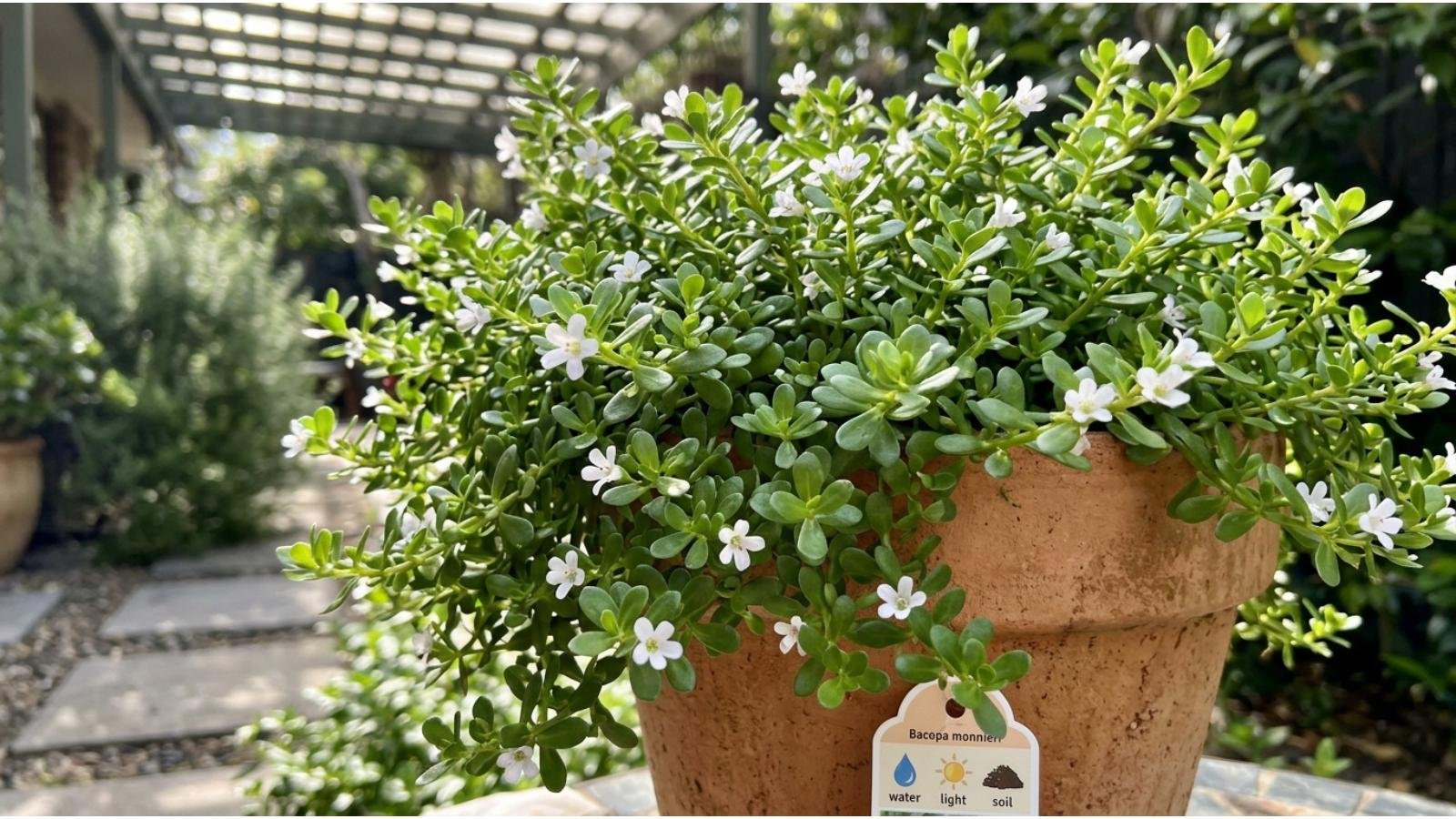
Important distinction: Ornamental bacopa is not the same plant as Bacopa monnieri, commonly called water hyssop or Brahmi, or aquatic bacopa grown in aquariums. Their growing requirements differ, so make sure you identify your plant before following a care routine.
2. Bacopa Plant Care Requirements at a Glance
| Care factor | Recommended conditions |
|---|---|
| Sunlight | Full sun to partial shade, with protection from intense afternoon heat |
| Water | Consistently moist soil without standing water |
| Soil | Fertile, moisture-retentive, well-draining soil |
| Temperature | Mild conditions; protect from frost and excessive heat |
| Fertilizer | Balanced liquid fertilizer during active growth |
| Pruning | Light trimming to control shape and encourage branching |
| Growing location | Hanging baskets, containers, window boxes, and garden beds |
| Maintenance | Regular moisture checks, occasional feeding, and removal of damaged growth |
These recommendations apply to ornamental trailing bacopa. Your watering frequency and sunlight requirements may need adjustment according to your climate, container size, and growing location.
3. How Much Sunlight Does Bacopa Need?
Sunlight plays an important role in bacopa’s flowering performance and overall growth.
Bacopa generally grows well in full sun to partial shade. A bright position with several hours of sunlight can encourage abundant flowers, while some afternoon shade can help protect the plant in particularly hot climates.
Best lighting conditions
For outdoor gardens: Choose a location with morning sunlight and some protection from intense afternoon sun.
For hanging baskets: Place the basket where it receives plenty of natural light but does not become excessively hot and dry.
Partially shaded areas: Bacopa can still grow, but flowering may be reduced when the plant receives too little light.
What happens when sunlight is unsuitable?
| Light condition | Possible effect |
|---|---|
| Adequate sunlight | More compact growth and better flowering |
| Too much shade | Reduced flowering and potentially stretched growth |
| Intense afternoon sun | Heat stress, wilting, or foliage damage |
| Hot, exposed container location | Faster soil drying and increased watering needs |
Practical sunlight tip
If your bacopa receives strong afternoon sunlight and begins looking stressed, try moving its container to a position with morning sun and afternoon shade.
Do not immediately assume that every wilted plant needs more water. Heat stress and root problems can also affect the plant’s appearance.
Image suggestion: Create a comparison image showing bacopa growing in morning sunlight, partial shade, and harsh afternoon sunlight.
4. How to Water Bacopa Correctly


Watering is one of the most important parts of bacopa plant care.
Bacopa prefers consistently moist soil. However, moisture-loving does not mean that its roots should remain submerged in water.
The goal is to maintain an evenly moist root zone while allowing excess water to drain away. Dry soil can interrupt flowering, while waterlogged conditions can damage roots.
How often should you water bacopa?
There is no single watering schedule that works for every bacopa plant.
Your plant may need more frequent watering when:
- Temperatures are high.
- It is growing in a small hanging basket.
- Strong winds increase moisture loss.
- The plant is receiving several hours of direct sunlight.
- Its roots have filled most of the container.
Water less frequently when the weather is cool or rainfall has already kept the soil moist.
Step-by-step watering method
- Check the soil with your finger before watering.
- If the upper layer is beginning to dry, check the moisture deeper in the root zone.
- Water slowly around the base of the plant.
- Continue until excess water begins draining from the container.
- Empty any standing water from the saucer.
- Check the soil again later, particularly during hot weather.
For garden-grown bacopa, check the surrounding soil rather than relying on the surface alone. The surface can dry quickly while the deeper root zone remains moist.
A common watering mistake
Many beginners assume that bacopa needs less water because it is not visibly wilting.
However, bacopa can experience drought stress without showing the dramatic wilting that gardeners expect. Its flower buds may dry up or drop, and flowering can become interrupted. Recovery may take time even after watering is corrected.
Practical tip: During hot weather, check hanging baskets more frequently than plants growing in the ground. Their limited soil volume can dry much faster.
5. Choosing the Right Soil for Bacopa
Bacopa needs soil that holds enough moisture to support its growth but drains freely enough to prevent waterlogging.
A dense, compacted soil can restrict air movement around the roots. At the other extreme, an excessively coarse mix may dry too quickly, especially in exposed containers.
Recommended soil characteristics
Look for a growing medium that is:
- Moisture-retentive.
- Well-draining.
- Rich in organic matter.
- Loose enough for healthy root development.
For containers, a quality all-purpose potting mix that drains well is a practical starting point. For garden beds, improve unsuitable soil with organic matter and address drainage problems before planting.
Can bacopa grow in ordinary garden soil?
Yes, provided the soil is reasonably fertile, retains moisture, and drains adequately.
If your garden soil becomes waterlogged after rain, consider growing bacopa in a raised bed or container instead.
Image suggestion: Show a side-by-side comparison of suitable loose potting mix and compacted, waterlogged soil.
6. Growing Bacopa in Pots and Hanging Baskets


Containers and hanging baskets are particularly suitable for bacopa because its trailing stems can spread over the edges and create a cascading display.
However, container-grown bacopa needs closer moisture monitoring than plants growing in the ground.
Choosing a suitable container
Select a pot or basket that:
- Has drainage holes.
- Provides enough room for the roots to develop.
- Holds sufficient potting mix to maintain moisture.
- Is large enough to support the mature plant and any companion plants.
A very small basket may look attractive initially, but it can dry out quickly during warm weather.
How to plant bacopa in a container
- Choose a container with adequate drainage.
- Fill it with a suitable, well-draining potting mix.
- Remove the plant carefully from its nursery pot.
- Loosen tightly circling roots gently if necessary.
- Position the root ball at approximately the same depth it was growing previously.
- Fill around the roots and lightly firm the mix.
- Water thoroughly and allow excess water to drain.
- Place the container in an appropriate light location.
Can bacopa grow with other plants?
Yes. Bacopa is commonly used as a trailing companion in mixed containers.
It can complement upright or mounding plants by spreading around the edges and adding a softer appearance.
When choosing companion plants, select varieties with reasonably similar requirements for sunlight and soil moisture. Otherwise, one plant may thrive while another struggles.
Image suggestion: Create a labeled container-gardening diagram showing an upright centerpiece, mounding companion plants, and trailing bacopa around the edges.
7. Temperature and Humidity Requirements
Bacopa performs best in relatively mild growing conditions. Although it can tolerate some variation, extreme temperatures may affect flowering and foliage quality.
Ideal temperature conditions
- Mild weather: Generally supports healthy growth and flowering.
- Excessive heat: Can cause stress, reduce flowering, and increase water requirements.
- Cold weather: Slows growth and can damage the plant.
- Frost: Can kill or seriously damage ornamental bacopa.
Ornamental bacopa is generally treated as an annual in colder climates, although it can survive as a perennial in sufficiently mild regions.
Caring for bacopa during hot weather
If temperatures become unusually high:
- Check the soil moisture more frequently.
- Provide some afternoon shade.
- Avoid allowing the root ball to dry out completely.
- Move container-grown plants away from excessively hot surfaces.
- Avoid heavy feeding when the plant is visibly stressed.
What about humidity?
Normal outdoor humidity is generally sufficient when the plant receives suitable light, water, and air circulation.
Rather than trying to create unusually high humidity, focus on maintaining consistent soil moisture and avoiding stagnant, waterlogged conditions.
8. Fertilizing Bacopa for Healthy Growth and Flowers
Bacopa benefits from a steady supply of nutrients during active growth, particularly when it is grown in containers.
Repeated watering can gradually carry nutrients out of potting mix, so container-grown plants may need more regular feeding than plants growing in fertile garden soil.
Which fertilizer should you use?
A balanced, water-soluble fertilizer suitable for flowering plants is a reasonable option.
Follow the product’s label for dilution and frequency. Some growing guides recommend feeding container-grown bacopa every one to two weeks, but the appropriate schedule depends on the fertilizer strength, growing conditions, and whether the potting mix already contains nutrients.
Signs that your feeding routine needs adjustment
| Observation | What to check |
|---|---|
| Slow growth | Light levels, root health, watering, and nutrient availability |
| Pale or yellowing leaves | Nutrient deficiencies, excessive moisture, and root damage |
| Lots of foliage but fewer flowers | Excessive fertilizer, insufficient sunlight, and heat stress |
| Brown leaf edges | Fertilizer concentration, salt buildup, and inconsistent watering |
These symptoms can have several causes, so avoid adding fertilizer automatically whenever the plant looks unhealthy.
Expert tip: If you suspect fertilizer buildup in a container, check the drainage and watering routine first. Where appropriate, thoroughly flush the potting mix with water and allow it to drain before resuming a lighter feeding schedule.
9. Pruning and Maintenance
Bacopa is relatively low-maintenance, and many ornamental varieties are self-cleaning, meaning spent flowers generally do not need to be removed individually.
However, occasional trimming can help maintain an attractive shape and control excessive growth.
When should you prune bacopa?
Consider light pruning when:
- Stems become excessively long.
- The plant begins looking uneven.
- Some growth becomes damaged or unhealthy.
- You want to encourage a neater, more compact appearance.
How to prune bacopa
- Use clean, sharp scissors or pruning shears.
- Identify the stems that are too long or damaged.
- Trim them back moderately rather than cutting away most of the plant.
- Remove dead or unhealthy material.
- Continue providing suitable light, moisture, and nutrition.
Avoid severe pruning when the plant is already struggling with heat, drought, or root damage.
Does bacopa need deadheading?
Usually, no. Many ornamental varieties shed spent flowers naturally.
Removing damaged flowers or stems is still useful when necessary, but routine removal of every faded bloom is generally unnecessary.
10. How to Propagate Bacopa
Bacopa can be propagated through stem cuttings, allowing you to produce additional plants from healthy existing growth.
Stem cuttings are a practical option for gardeners who want to expand a container display or preserve a favorite variety.
Propagating bacopa from stem cuttings


Step 1: Select a healthy stem.
Choose a vigorous stem without obvious signs of pests, disease, or damage.
Step 2: Take a cutting.
Using clean scissors, cut a short section of healthy stem. Include several nodes, where leaves attach to the stem.
Step 3: Prepare the cutting.
Remove the leaves from the lower portion that will be placed in the growing medium.
Step 4: Plant the cutting.
Insert the lower portion into a small container filled with a suitable, lightly moist propagation medium.
Step 5: Provide suitable conditions.
Place the cutting in bright, indirect light and keep the medium lightly moist without making it waterlogged.
Step 6: Monitor root development.
Check periodically for signs of new growth and root establishment. Avoid repeatedly pulling the cutting out to inspect its roots.
Once the cutting has developed a healthy root system, gradually move it into its permanent container or garden location.
Stem cuttings are an established propagation method for ornamental bacopa.
Can you grow bacopa from seeds?
Yes. Some ornamental varieties can be grown from seed, although the process may require more patience and attention than purchasing established plants or using cuttings.
Seed-starting requirements vary by variety, so follow the instructions supplied with the seed.
11. Common Bacopa Plant Problems and How to Fix Them
Even when bacopa receives reasonable care, environmental stress, watering mistakes, and pests can affect its appearance.
The key is to identify the likely cause before making major changes.
Why is my bacopa wilting?
Possible causes:
- The soil has become too dry.
- High temperatures are stressing the plant.
- The roots are damaged.
- The soil is waterlogged and the roots cannot function properly.
What to do:
Check the moisture throughout the root zone.
If the soil is dry, water thoroughly and allow excess water to drain. If the soil is already wet, investigate drainage and root health rather than adding more water.
Why is my bacopa not flowering?
Possible causes include:
- Insufficient sunlight.
- Drought stress.
- Excessive heat.
- Unsuitable nutrition.
- General stress following planting or root disturbance.
What to do:
Check light exposure and watering consistency first. If the plant is receiving very little sunlight, move it to a brighter location gradually.
Avoid trying to force flowering with excessive fertilizer.
Why are my bacopa leaves turning yellow?
Yellow leaves can result from several conditions, including excessive moisture, root problems, nutrient deficiencies, or environmental stress.
What to do:
- Check whether the soil is staying wet for too long.
- Confirm that the container drains freely.
- Inspect the roots if the plant continues deteriorating.
- Review the recent fertilizer routine.
- Remove severely damaged leaves once the underlying problem is addressed.
Why is my bacopa turning brown?
Brown foliage may indicate drought stress, heat damage, fertilizer-related problems, or unhealthy roots.
Check whether the damage is concentrated around the leaf edges, affects the entire plant, or appears mainly on the sun-exposed side.
The pattern can help you narrow down the possible cause.
Why are bacopa flowers or buds falling off?
Dry soil and environmental stress can interrupt flowering and cause buds to dry up or drop.
Bacopa is particularly sensitive to inconsistent moisture, so check the soil before assuming that the plant needs more fertilizer.
Bacopa troubleshooting table
| Problem | Possible cause | Practical solution |
|---|---|---|
| Wilting with dry soil | Underwatering | Water thoroughly and monitor moisture |
| Wilting with wet soil | Poor drainage or root damage | Improve drainage and inspect root health |
| Few flowers | Insufficient light or environmental stress | Improve light and stabilize growing conditions |
| Yellow leaves | Watering problems or nutrient issues | Check soil moisture, roots, and feeding |
| Brown leaf edges | Drought, heat, or fertilizer buildup | Review watering and fertilizer concentration |
| Bud drop | Dry soil or environmental stress | Maintain consistent moisture and reduce heat stress |
| Sparse growth | Insufficient light or poor growing conditions | Improve light, root health, and general care |
These are diagnostic possibilities rather than definitive diagnoses. Several problems can produce similar symptoms, so assess the whole plant and its growing conditions before treating it.
12. Pests and Diseases That Can Affect Bacopa
Bacopa is not generally considered a highly troublesome plant, but it can occasionally experience pest and disease problems.
Potential pests include:
- Aphids.
- Whiteflies.
- Spider mites.
- Thrips.
Root rot can also develop when growing conditions remain excessively wet or drainage is inadequate.
How to inspect your plant
Check the following areas regularly:
- The undersides of leaves.
- Tender new growth.
- The points where stems and leaves meet.
- The soil surface and drainage holes.
- Areas with yellowing, distorted, or damaged foliage.
What to do if you find pests
- Isolate a container-grown plant if nearby plants may be affected.
- Inspect the entire plant to determine how widespread the problem is.
- Remove heavily damaged material when appropriate.
- For a minor infestation, consider washing pests from the foliage with a gentle stream of water.
- If further treatment is necessary, choose a product labeled for the identified pest and ornamental plant, and follow its instructions.
Avoid applying pesticides unnecessarily. Correcting environmental stress and maintaining suitable growing conditions can also help prevent recurring problems.
13. Seasonal Bacopa Plant Care
Bacopa’s needs change with the weather, so adjusting your care routine throughout the growing season can help maintain healthier plants.
Spring
Spring is a useful time to establish new plants once the risk of frost has passed.
- Prepare containers with fresh, suitable potting mix.
- Gradually acclimate plants to outdoor sunlight.
- Begin checking moisture regularly as growth increases.
- Start feeding according to the plant’s growth and fertilizer instructions.
Summer
Summer is often an important flowering period, but intense heat can create challenges.
- Check containers frequently for drying soil.
- Provide afternoon shade during extreme heat.
- Maintain consistent moisture without waterlogging.
- Inspect foliage for pests and environmental damage.
- Avoid heavy feeding when plants are heat-stressed.
Autumn
As temperatures become cooler, growth and flowering may slow.
- Remove damaged stems and foliage.
- Reduce watering when the soil dries more slowly.
- Continue monitoring the plant for pests and disease.
- Protect the plant from frost if you want to extend its growing season.
Winter
In regions where frost occurs, ornamental bacopa is generally grown as a seasonal annual.
In sufficiently mild climates, it may survive as a perennial. Container-grown plants can sometimes be protected by moving them into a suitable sheltered location, provided adequate light and temperature conditions are available.
14. Growing Bacopa Successfully in Hot Climates
Gardeners in hot regions need to pay particular attention to moisture and sunlight.
A plant that grows well during mild spring weather may struggle when exposed to intense summer heat.
Practical recommendations for hot weather
Choose the location carefully. Morning sunlight with afternoon shade can help reduce heat stress.
Monitor hanging baskets closely. Their soil can dry quickly, particularly when exposed to wind.
Avoid waterlogging. Frequent watering should not leave the roots sitting in stagnant water.
Check the root zone. A dry surface does not always mean the entire root ball is dry, and a moist surface does not guarantee that deeper soil is adequately aerated.
Adjust care gradually. If the plant is struggling, avoid combining severe pruning, heavy fertilizing, and sudden changes in sunlight at the same time.
These steps help address two common challenges: bacopa’s need for consistent moisture and its sensitivity to excessive heat.
15. Common Bacopa Plant Care Mistakes to Avoid
Even experienced gardeners can encounter problems when they overlook the plant’s growing conditions.
Here are several mistakes worth avoiding.
1. Letting the soil dry out completely
Bacopa can lose buds and interrupt flowering when moisture becomes inconsistent.
Better approach: Check the root zone regularly, especially during warm weather.
2. Keeping the roots constantly waterlogged
Frequent watering is not a substitute for good drainage.
Better approach: Use suitable soil and containers with drainage holes.
3. Planting in excessive shade
Bacopa may survive in lower light, but flowering can suffer.
Better approach: Provide sufficient natural light while protecting the plant from excessive afternoon heat.
4. Using too much fertilizer
Excessive feeding can contribute to fertilizer buildup and may encourage unwanted leafy growth.
Better approach: Follow fertilizer instructions and adjust feeding to the plant’s condition.
5. Ignoring extreme temperatures
Bacopa may struggle when conditions become excessively hot or cold.
Better approach: Provide seasonal protection and adjust its location when necessary.
6. Pruning a severely stressed plant
Heavy trimming can add further stress to a plant already struggling with drought, heat, or root damage.
Better approach: Correct the underlying problem first, then prune gradually if needed.
16. Frequently Asked Questions About Bacopa Plant Care
Is bacopa easy to grow?
Yes. Ornamental bacopa is generally considered a relatively easy flowering plant to grow when its basic requirements are met. Consistent moisture, suitable sunlight, and well-draining soil are particularly important.
Does bacopa need full sun?
Bacopa can grow in full sun to partial shade. It generally flowers well with adequate sunlight, but afternoon shade may be beneficial in areas with intense summer heat.
How often should I water bacopa?
Water when the soil begins drying, adjusting the frequency according to temperature, rainfall, container size, and sunlight. Avoid allowing the soil to become completely dry or remain waterlogged.
Can bacopa grow in hanging baskets?
Yes. Its spreading, trailing growth makes it well suited to hanging baskets, window boxes, and containers.
Does bacopa flower all summer?
Bacopa can flower over a long season, often from late spring into autumn when conditions are favorable. However, flowering may decline during excessive heat or drought stress.
Should I remove dead flowers from bacopa?
Usually, regular deadheading is unnecessary because many ornamental varieties are self-cleaning. You can still remove damaged flowers and unhealthy stems when needed.
Can bacopa tolerate afternoon sun?
It can tolerate sunny conditions, but intense afternoon sunlight may cause stress in hot climates. Morning sun followed by light afternoon shade can be helpful during particularly hot weather.
Is bacopa an annual or a perennial?
Ornamental bacopa is commonly grown as an annual in colder climates. It may survive as a perennial in sufficiently mild regions, depending on the local climate and variety.
Can I grow bacopa indoors?
Bacopa is primarily used as an outdoor flowering plant. It may be possible to maintain it indoors with sufficient bright light and suitable temperatures, but flowering and growth can be less satisfactory when indoor conditions are inadequate.
Why is my bacopa dying even though I water it?
Excessive watering, poor drainage, root damage, heat stress, and inconsistent moisture can all contribute to decline. Check the soil and roots before increasing watering further.
Can bacopa grow with other flowering plants?
Yes. It can be used as a trailing companion in mixed containers. Choose plants with compatible sunlight and moisture requirements.
Can bacopa survive winter?
It may survive winter in sufficiently mild climates, but frost can damage or kill it. In colder regions, it is generally treated as an annual.
How do I make bacopa bushier?
Provide adequate light and suitable growing conditions. Lightly trimming excessively long stems may help maintain a fuller appearance, although the response depends on the plant’s condition and variety.
Can bacopa grow from cuttings?
Yes. Healthy stem cuttings can be used to propagate ornamental bacopa. Place them in a suitable propagation medium and maintain appropriate moisture and light while roots develop.
Is ornamental bacopa the same as Brahmi?
No. Ornamental trailing bacopa, commonly sold as Sutera cordata or Chaenostoma cordatum, is different from Bacopa monnieri, the plant commonly called Brahmi or water hyssop. Their growing requirements and uses are not interchangeable.
17. Conclusion
Successful bacopa plant care comes down to maintaining the right balance of sunlight, moisture, soil drainage, and nutrition.
For healthy growth and abundant flowers:
- Provide full sun to partial shade, adjusting for extreme heat.
- Keep the soil consistently moist without allowing water to become stagnant.
- Use fertile, well-draining soil.
- Feed moderately during active growth.
- Trim damaged or excessively long stems when necessary.
- Monitor the plant for pests, root problems, and environmental stress.
The most important practical lesson is to avoid letting bacopa dry out completely while also protecting its roots from waterlogging. Once you establish a consistent watering routine and provide suitable light, this trailing flowering plant can become a beautiful addition to hanging baskets, window boxes, and garden containers.
Start by checking your plant’s current growing conditions, correct any watering or drainage problems, and adjust its location if necessary. Small, consistent improvements can make a significant difference to its appearance and flowering performance.