Quick Answer
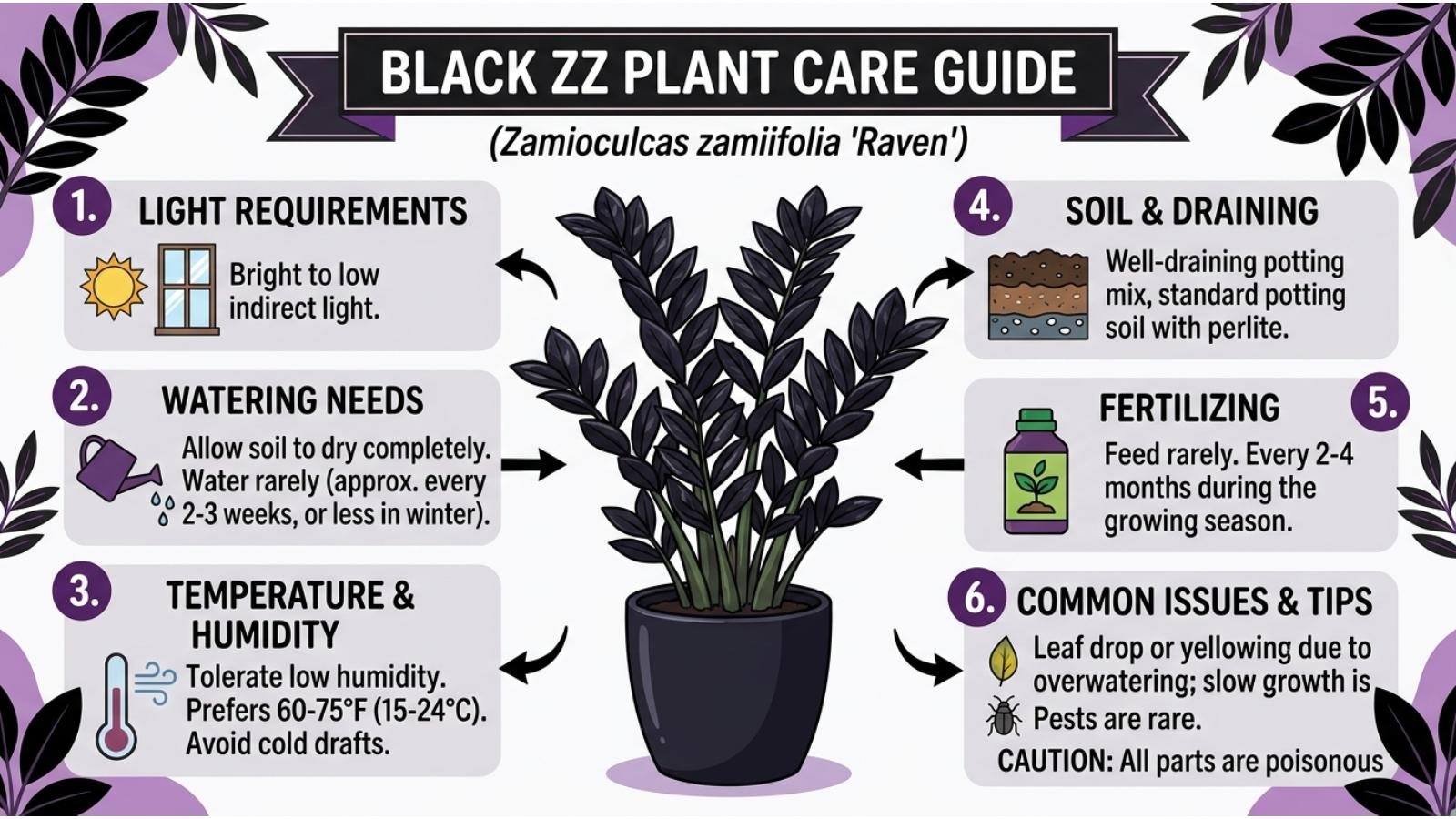
Black ZZ plant care is easy because the plant stores water in thick underground rhizomes. Give it bright, indirect light, well-draining soil, and water only when the soil has dried thoroughly.
Avoid keeping the roots constantly wet or exposing the foliage to intense direct sunlight. Feed lightly during active growth, keep the plant in a pot with drainage holes, and repot only when it becomes root– or rhizome-bound.
Introduction
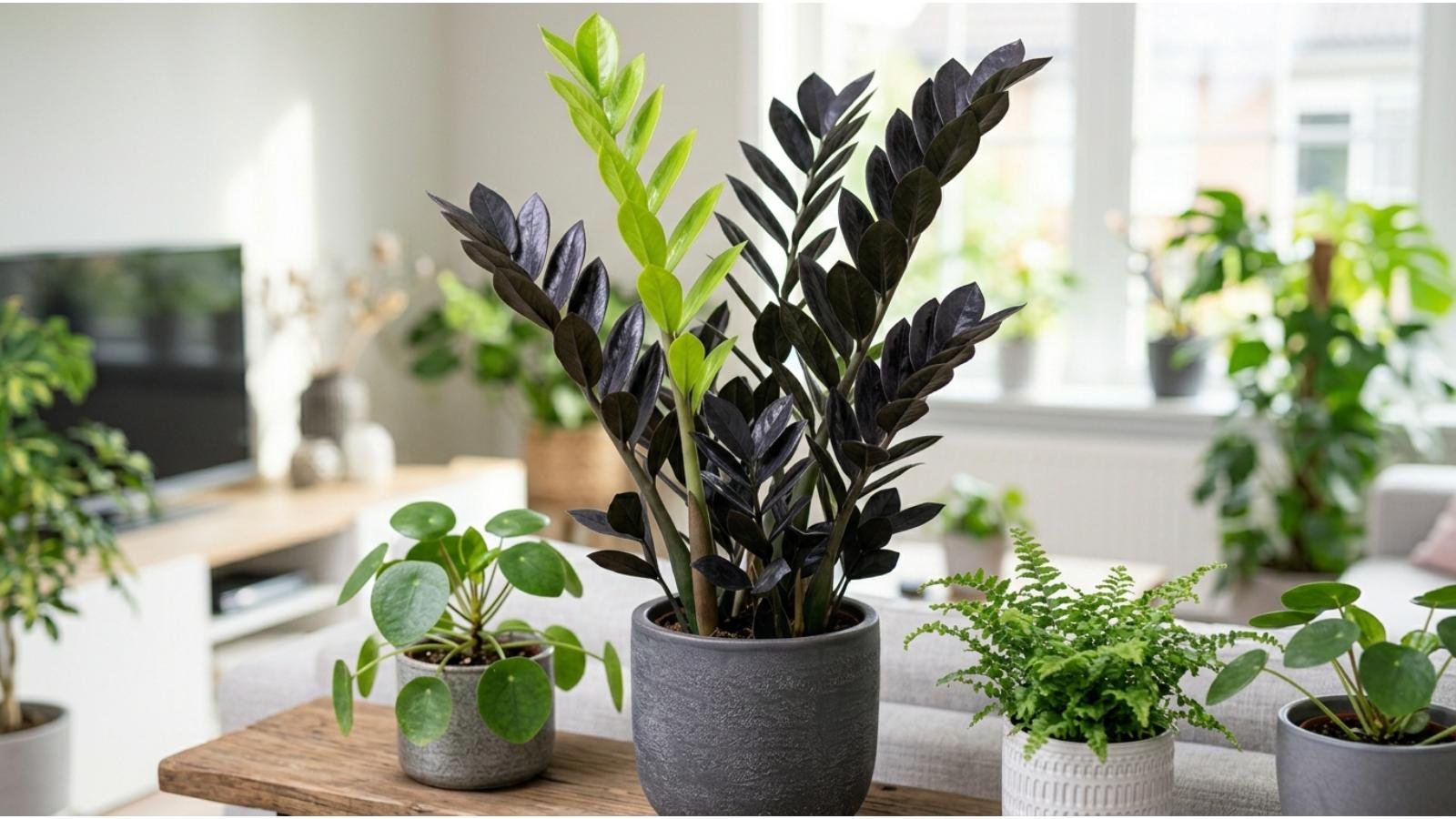
The Black ZZ plant, commonly called the Raven ZZ, is one of the most striking low-maintenance houseplants you can grow indoors. Its new leaves usually emerge bright green and gradually mature into deep purple-black foliage.
Despite its dramatic appearance, this plant does not require complicated care. In fact, one of the biggest challenges is knowing when not to water it.
Because Black ZZ plants store moisture in underground rhizomes, they can tolerate periods of dry soil. Constantly wet soil, however, can create serious problems for the roots and rhizomes.
The best Black ZZ plant care routine focuses on four things: proper light, excellent drainage, careful watering, and patience.
What Is a Black ZZ Plant?
The Black ZZ plant is a dark-leaved cultivar of Zamioculcas zamiifolia, often known as the Raven ZZ.
It has thick upright stems covered with glossy leaflets. The plant develops underground rhizomes that store water, which explains why it can tolerate occasional neglect better than many other houseplants.
Its most recognizable feature is its changing foliage color.
- New leaves are often bright lime green.
- Young foliage gradually becomes darker.
- Mature leaves can appear deep purple or almost black.
- The leaves have a naturally glossy appearance.
- Growth is usually relatively slow indoors.
- Thick underground rhizomes help the plant survive dry periods.
Why are new Black ZZ leaves green?
This is completely normal.
Raven ZZ leaves do not necessarily emerge black. Fresh growth commonly appears green and becomes darker as the leaf matures.
If your plant suddenly produces a green shoot, there is usually no reason to remove it or assume something is wrong.
Black ZZ Plant Light Requirements
Black ZZ plants are highly adaptable to indoor lighting, but bright, indirect light is generally ideal.
A plant can survive in lower light, but its growth may become slower. Brighter indirect light can encourage stronger, more consistent growth.
Best locations for a Black ZZ plant
Good indoor locations include:
- Near a bright east-facing window.
- A few feet away from a sunny window.
- In a bright room with filtered sunlight.
- Near a window protected by a sheer curtain.
- In an office with adequate natural or artificial light.
Can Black ZZ grow in low light?
Yes.
One of its biggest advantages is its ability to tolerate lower-light conditions. However, surviving in low light and actively growing in low light are two different things.
If your Black ZZ has remained healthy but has produced little new growth for months, inadequate light may be part of the reason.
Move it gradually toward a brighter location with indirect light rather than immediately placing it in intense sunlight.
Can Black ZZ tolerate direct sunlight?
It can tolerate some gentle sunlight, particularly in the morning, but prolonged intense direct sunlight can scorch the foliage.
Watch for:
- Brown patches.
- Bleached-looking leaves.
- Curling foliage.
- Dry leaf edges.
- Sudden yellowing after exposure to strong sun.
Practical tip: If your plant is currently in a dark corner, increase light gradually. A sudden change from low light to strong afternoon sun can stress the foliage.
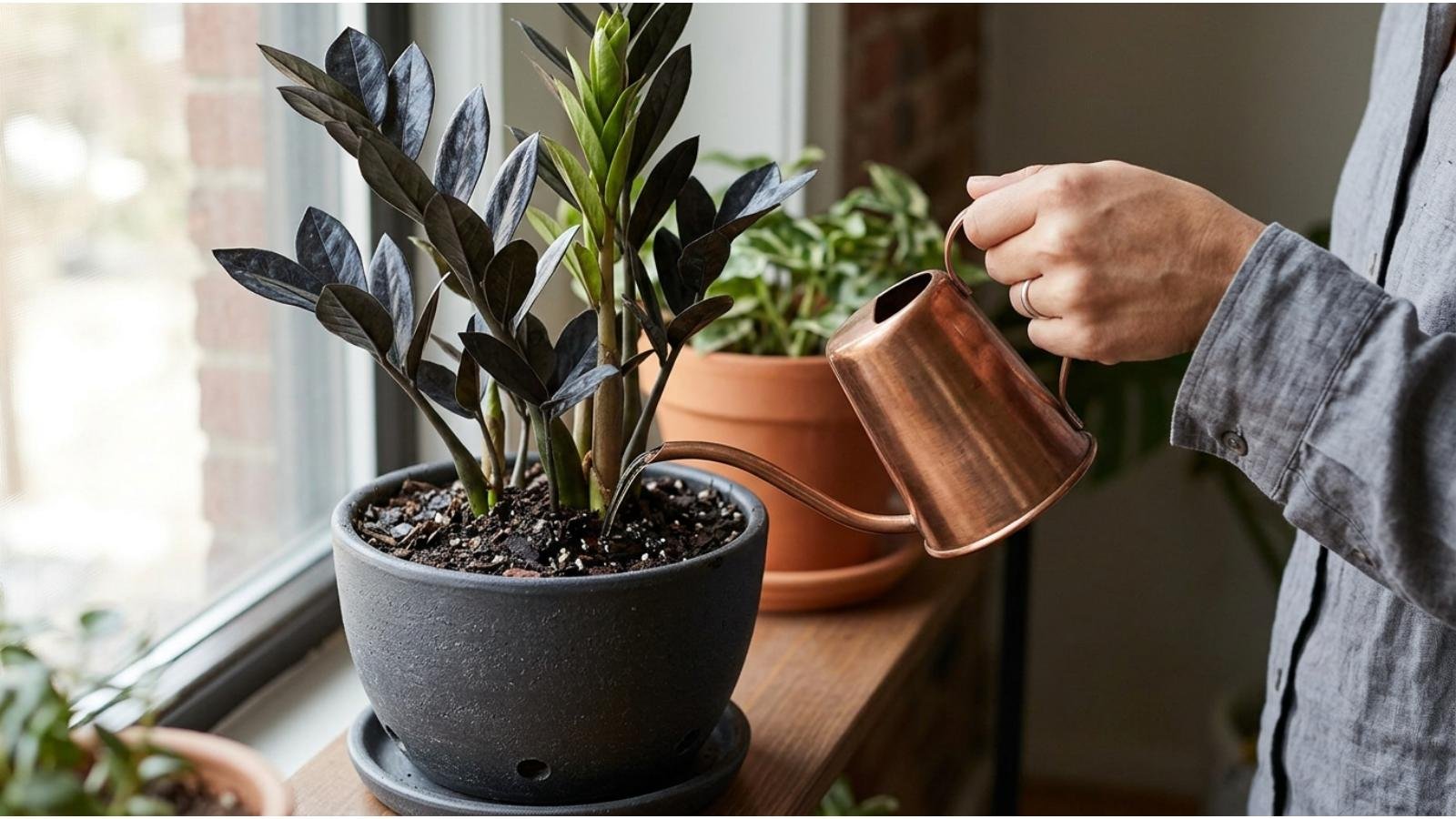
How Often Should You Water a Black ZZ Plant?
Watering is probably the most important part of Black ZZ plant care.
The plant prefers to dry out between waterings. Instead of watering according to a fixed weekly schedule, check the soil.
When the soil has dried thoroughly, water the plant deeply and allow excess water to drain from the bottom of the container.
Then empty any water sitting in the saucer.
Why does Black ZZ need less water?
Its underground rhizomes act as storage structures. They hold moisture that the plant can use during drier periods.
This means the plant does not need constantly moist soil.
Beginners sometimes assume that frequent watering encourages faster growth. With Black ZZ, the opposite approach is usually safer. Repeatedly watering soil that is still wet can deprive the roots of the air they need and increase the risk of root or rhizome problems.
A simple watering test
Before watering:
- Push your finger several inches into the soil.
- Check whether the mix is still damp.
- Consider how quickly the pot has been drying recently.
- Check whether the container has drainage holes.
- Water only when the soil has dried sufficiently.
The exact watering interval can vary significantly depending on the season, pot size, soil, temperature, humidity, and light.
Should you water Black ZZ on a schedule?
Not necessarily.
A calendar can be useful as a reminder to check the plant, but it should not decide whether the plant actually receives water.
A Black ZZ in a bright, warm room may dry faster than one sitting in a cool, low-light room.
Signs of Overwatering
Overwatering is one of the most common Black ZZ plant care problems.
Possible warning signs include:
- Yellow leaves.
- Soft stems.
- Persistently wet soil.
- A musty or unpleasant soil smell.
- Weak or declining growth.
- Soft or damaged rhizomes.
- Multiple leaves deteriorating at once.
If the soil remains wet for an unusually long time, investigate the drainage and pot size rather than simply waiting and continuing your normal watering routine.
Image Suggestion: Create a comparison graphic showing healthy Black ZZ foliage versus an overwatered plant with yellow leaves and wet soil.
Signs of Underwatering
Black ZZ plants tolerate dry conditions, so occasional dryness is usually not an emergency.
However, prolonged severe dryness can eventually cause:
- Drooping stems.
- Dry or crispy leaflets.
- Leaf drop.
- Very slow growth.
- Extremely lightweight potting soil.
If the soil has become completely dry and pulls away from the sides of the container, water thoroughly and allow excess moisture to drain.
Do not compensate for a long dry period by keeping the soil permanently saturated afterward.
Best Soil for Black ZZ Plant Care
Black ZZ plants need soil that drains efficiently.
A heavy soil mix that remains wet for a long time can create an unfavorable environment for the roots and rhizomes.
A practical potting mix can contain:
- Quality indoor potting soil.
- Perlite.
- Pumice or another coarse drainage material.
The exact recipe is less important than the final result.
You want a mix that holds enough moisture for the plant but allows excess water to escape quickly.
Why drainage matters
Imagine watering two identical plants.
One is planted in a loose, well-draining mix. The other is planted in dense soil that stays wet for days.
Even if both plants receive exactly the same amount of water, the second plant may face greater root stress because its root zone remains saturated longer.
That is why drainage is just as important as watering technique.
Choosing the Right Pot
Always choose a container with drainage holes.
A decorative container without drainage can trap excess water around the roots.
The pot should also be appropriately sized.
Avoid putting a small Black ZZ into a dramatically oversized container simply because you want it to grow faster.
A very large pot contains more soil, and more soil can retain moisture for longer.
When should you move to a larger pot?
Consider repotting when:
- The plant has significantly filled its container.
- Rhizomes are pressing against the pot.
- Roots are heavily crowded.
- Water is draining unusually poorly.
- The plant has become unstable.
- The existing potting mix has deteriorated.
Choose a new pot only slightly larger than the current container.
Temperature Requirements
Black ZZ plants prefer comfortable indoor temperatures.
Keep them away from:
- Cold drafts.
- Extremely cold windows.
- Air-conditioning vents blowing directly onto the plant.
- Heating vents producing intense hot air.
- Sudden temperature changes.
Stable indoor conditions are generally more useful than trying to create a highly tropical environment.
Does Black ZZ Need High Humidity?
No.
Black ZZ plants generally adapt well to ordinary household humidity.
You do not need to mist the plant constantly or purchase a humidifier simply to keep it alive.
If the surrounding air is extremely dry, you may notice faster moisture loss from the soil, but watering should still be based on soil conditions rather than humidity alone.
Fertilizing Black ZZ Plants
Black ZZ plants are relatively light feeders.
During active growth, a balanced houseplant fertilizer can be applied according to the product’s instructions.
Avoid the temptation to fertilize heavily because the plant appears slow-growing.
A sensible feeding routine
- Feed lightly during active growth.
- Follow the recommended dilution.
- Avoid repeated heavy applications.
- Reduce feeding when growth naturally slows.
- Never use fertilizer as a substitute for adequate light.
Can fertilizer make Black ZZ leaves blacker?
Not directly.
The characteristic dark foliage comes from the Raven cultivar and the natural maturation of its leaves. Fertilizer is primarily intended to provide nutrients for healthy growth, not to artificially create black foliage.
How to Repot a Black ZZ Plant
Black ZZ plants do not need frequent repotting.
When repotting becomes necessary, choose a container only moderately larger than the existing one.
Step-by-step repotting
- Select a pot with drainage holes.
- Prepare a well-draining potting mix.
- Carefully remove the plant from its container.
- Examine the roots and underground rhizomes.
- Remove damaged material with clean tools if necessary.
- Place the plant into the new container.
- Add fresh soil around the root system.
- Avoid burying the rhizomes excessively deep.
- Water appropriately and allow excess moisture to drain.
After repotting, give the plant time to settle rather than immediately increasing fertilizer or watering.
Black ZZ Plant Pruning
Pruning is usually simple.
Remove stems that are:
- Dead.
- Severely damaged.
- Yellowing and declining.
- Diseased.
- Growing in an undesirable direction.
Use clean, sharp pruning shears and cut unwanted stems near their base.
Avoid repeatedly trimming individual leaflets simply to control the shape. Removing an entire unwanted stem is usually cleaner.
Why Is My Black ZZ Plant Not Growing?
Slow growth is normal.
The Raven ZZ is not the type of houseplant that produces dramatic new leaves every few weeks.
Slow growth can become even more noticeable when:
- Light is too low.
- Temperatures are cool.
- The plant has recently been repotted.
- The season has changed.
- The plant is still establishing its root system.
How to encourage more growth
If you want stronger growth:
- Provide brighter indirect light.
- Keep the soil well drained.
- Water only after adequate drying.
- Feed lightly during active growth.
- Avoid constantly moving the plant.
- Give it time.
Increasing watering is not the first solution to slow growth.
Why Is My Black ZZ Plant Turning Yellow?
Yellow leaves can have several causes, but excessive moisture should be investigated first.
Ask yourself:
- Is the soil still wet?
- Have I been watering too frequently?
- Does the pot have drainage holes?
- Is the pot much larger than necessary?
- Is the plant receiving very little light?
- Are multiple leaves yellowing at the same time?
If the soil is consistently wet, improve the drainage situation before increasing fertilizer.
A single older yellow leaf is different from widespread yellowing throughout the plant.
Why Are Black ZZ Leaves Turning Brown?
Brown leaves or leaf edges can result from several forms of stress.
Possible causes include:
- Strong direct sunlight.
- Severe dryness.
- Root problems.
- Physical damage.
- Environmental stress.
Look at the pattern.
If the entire plant has been extremely dry for an extended period, dehydration becomes more likely.
If the soil remains wet and the plant is declining at the same time, investigate the roots and drainage.
Why Are the Leaves Curling?
Curling leaves can indicate stress rather than one specific problem.
Check:
- Soil moisture.
- Light intensity.
- Temperature.
- Recent environmental changes.
- Root condition.
Do not automatically assume curled leaves mean the plant needs more water.
Check the soil first.
Black ZZ Plant Propagation
Black ZZ plants can be propagated through division or leaf cuttings.
Propagation by division
Division is practical when a mature plant has multiple stems and established rhizomes.
Carefully separate portions of the plant while preserving viable rhizomes and roots.
Each division should have enough underground growth to support the stems attached to it.
Propagation from leaf cuttings
Leaf propagation is possible but slow.
A leaf or leaflet can eventually develop underground structures before producing new shoots.
This method requires patience because the visible progress can be extremely slow.
Image Suggestion: Create a four-stage Black ZZ propagation illustration showing leaf cutting, rooting, rhizome formation, and new shoot development.
Common Black ZZ Plant Care Mistakes
Watering every week automatically
A fixed schedule can lead to unnecessary watering.
Better approach: Check the soil before watering.
Using a pot without drainage
Excess water has nowhere to go.
Better approach: Choose a container with functional drainage holes.
Keeping the plant in harsh sunlight
A plant that tolerates low light does not necessarily tolerate intense direct sunlight.
Better approach: Use bright, filtered or indirect light.
Using an oversized pot
Extra soil can remain wet for too long.
Better approach: Increase pot size gradually.
Fertilizing too much
More fertilizer does not guarantee faster growth.
Better approach: Feed lightly during active growth.
Panicking over green new leaves
Green new foliage is part of the Raven ZZ’s normal development.
Better approach: Wait for the foliage to mature and darken.
Repotting too frequently
Frequent repotting is unnecessary for a slow-growing plant.
Better approach: Repot when the root and rhizome system actually needs additional space.
Black ZZ Plant Care by Season
Spring and Summer
During active growth:
- Provide bright indirect light.
- Check soil moisture regularly.
- Water thoroughly after the soil dries.
- Fertilize lightly when appropriate.
- Monitor new growth for pests or damage.
Fall and Winter
Growth may slow as light levels decrease.
- Allow the soil to dry more slowly and completely.
- Reduce watering frequency when necessary.
- Avoid unnecessary fertilizer.
- Protect the plant from cold drafts.
- Keep it in a suitable light location.
The most important seasonal adjustment is usually watering frequency. If the soil takes longer to dry in winter, your plant should not continue receiving the same amount of water on the same summer schedule.
Black ZZ Plant Care Checklist
Use this quick checklist when caring for your Raven ZZ:
- Bright indirect light.
- Well-draining soil.
- Pot with drainage holes.
- Allow soil to dry thoroughly between waterings.
- Avoid standing water.
- Fertilize lightly during active growth.
- Keep temperatures reasonably stable.
- Repot only when necessary.
- Remove damaged stems.
- Expect slow growth.
- Remember that new leaves may begin green.
- Keep the plant away from pets and children who may chew it.
Is Black ZZ Plant Toxic to Pets?
Yes. ZZ plants contain calcium oxalate crystals that can irritate the mouth and digestive system when chewed or swallowed.
Possible symptoms after ingestion can include:
- Drooling.
- Mouth irritation.
- Vomiting.
- Difficulty swallowing.
- Oral discomfort.
Keep the plant out of reach of cats, dogs, and young children who may chew leaves or stems.
If a pet has eaten part of the plant and develops symptoms, contact a veterinarian for appropriate guidance.
Frequently Asked Questions
How often should I water a Black ZZ plant?
Water when the soil has dried thoroughly rather than watering according to a strict weekly schedule. The actual interval depends on light, temperature, pot size, soil, and season.
Does Black ZZ need direct sunlight?
No. Bright indirect light is generally preferable. Strong prolonged direct sunlight can damage the foliage.
Can Black ZZ grow in low light?
Yes. It tolerates low-light conditions, although growth may be significantly slower.
Why is my Black ZZ growing green leaves?
New Raven ZZ foliage commonly emerges green and gradually becomes darker as it matures.
How do I make my Black ZZ plant black?
You cannot simply force mature leaves to become black through fertilizer or excessive sunlight. Raven ZZ naturally develops dark foliage as its leaves mature. Provide appropriate light and healthy growing conditions.
Why is my Black ZZ plant turning yellow?
Overwatering is an important possibility. Check soil moisture, drainage, pot size, and watering frequency before making other changes.
Does Black ZZ need high humidity?
No. It generally performs well under ordinary indoor humidity.
What type of soil is best for Black ZZ?
Use a loose, well-draining potting mix that allows excess water to escape efficiently.
How often should I fertilize Black ZZ?
Feed lightly during active growth according to the fertilizer’s instructions. Avoid heavy or excessive feeding.
Can I propagate Black ZZ from a leaf?
Yes, but leaf propagation can be very slow. Division is another option for mature plants with multiple rhizomes.
Why is my Black ZZ growing so slowly?
Slow growth is normal. Low light, cool temperatures, seasonal changes, and limited nutrition during active growth can make it even slower.
Should I mist my Black ZZ plant?
Misting is generally unnecessary. Proper watering, drainage, and suitable light are much more important.
Is Black ZZ safe for cats and dogs?
No. ZZ plants can cause irritation if chewed or swallowed, so they should be kept away from pets.
Conclusion
Successful black ZZ plant care is surprisingly simple when you understand how the plant stores water. The biggest mistake is usually treating it like a thirsty tropical plant and watering before the soil has dried.
Give your Raven ZZ bright indirect light, excellent drainage, appropriately sized containers, and enough time to dry between waterings. Feed lightly during active growth and avoid unnecessary repotting.
Most importantly, learn to recognize what is normal. Green new leaves, slow growth, and occasional long periods without visible change can all be part of owning a Black ZZ. With the right conditions and a little patience, this striking dark-leaved plant can remain healthy and attractive for years.