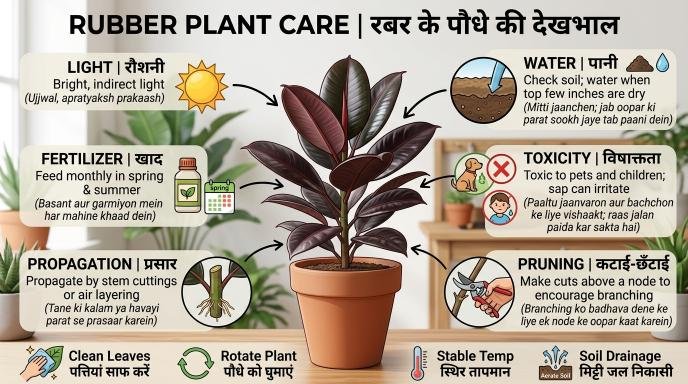
Quick Answer
Rubber plant care is mainly about providing bright, indirect light, well-draining soil, moderate watering, warmth, and reasonable humidity.
Let the top 1–2 inches of soil dry before watering again, and avoid leaving the roots in standing water. Clean the broad leaves regularly, fertilize during active growth, and repot when roots become crowded. Consistent conditions are more important than constant attention.
Introduction
The rubber plant (Ficus elastica) is a popular indoor plant because of its large, glossy leaves and relatively straightforward care requirements. However, even a hardy rubber plant can develop yellow leaves, drooping foliage, brown edges, or slow growth when its basic needs are misunderstood.
The biggest mistake in rubber plant care is usually treating the plant according to a rigid watering schedule rather than observing the soil, light, temperature, and condition of the leaves. A rubber plant sitting in bright light may need water much sooner than one growing in a dim room.
The goal is simple: give the plant enough light to grow strongly, enough water to stay hydrated, and enough drainage to keep its roots healthy.
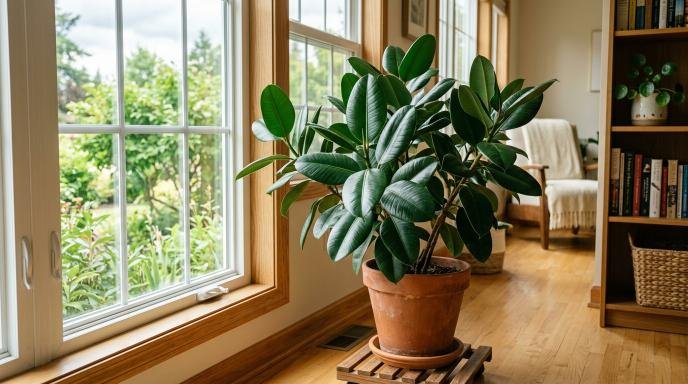
Understanding Your Rubber Plant’s Basic Needs
Before changing your care routine, understand what the plant is actually responding to.
| Care factor | What rubber plants generally prefer | Why it matters |
|---|---|---|
| Light | Bright, mostly indirect light | Supports healthy growth and leaf color |
| Water | Moderate, adjusted to soil dryness | Prevents both dehydration and root problems |
| Soil | Airy and well-draining | Protects roots from prolonged saturation |
| Temperature | Warm, stable conditions | Supports active growth |
| Humidity | Moderate to moderately high | Helps foliage remain healthy |
| Fertilizer | Regular feeding during active growth | Supports new leaves and development |
| Pot | Drainage holes essential | Prevents water accumulation around roots |
The important point is that these factors work together. For example, moving a rubber plant into stronger light can increase water use, while a plant kept in a darker room may stay wet for much longer.
How Much Light Does a Rubber Plant Need?
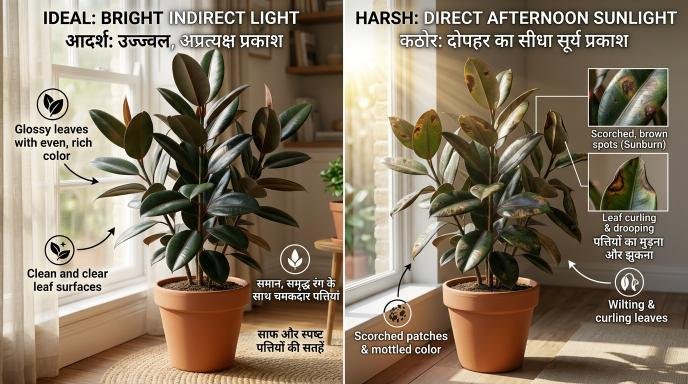
Rubber plants generally perform best in bright, indirect light.
A location near a bright window can work well, particularly when the plant receives plenty of daylight without being exposed to intense, scorching afternoon sun for long periods.
Signs of insufficient light
A rubber plant receiving too little light may show:
- Slow or weak growth.
- Larger gaps between leaves.
- Smaller new leaves.
- A tendency to lean toward a window.
- Soil that stays wet for an unusually long time.
Low light does not always kill a rubber plant immediately. The more common problem is that growth gradually becomes weaker.
What about direct sunlight?
Rubber plants can tolerate some direct sunlight, especially when gradually acclimated. Problems often occur when a plant that has been growing in low light is suddenly placed in intense sunlight.
This can cause leaf scorching.
Practical tip: If you move your plant to a much brighter location, increase exposure gradually rather than changing its environment overnight.
How Often Should You Water a Rubber Plant?
There is no universally correct watering schedule for every rubber plant.
Instead, check the soil.
When the upper layer of soil has dried, water thoroughly until excess water flows through the drainage holes. Then allow the plant to drain completely.
For many indoor conditions, this may mean watering roughly every 1–2 weeks, but the interval can vary considerably depending on light, temperature, pot size, soil composition, and season.
A simple watering test
Push your finger about 1–2 inches into the soil.
- If it feels noticeably moist, wait.
- If the upper layer feels dry, check slightly deeper.
- If the soil has dried sufficiently, water thoroughly.
- Empty excess water from a decorative outer container or saucer.
The plant should not sit in a pool of water.
Why overwatering is dangerous
Overwatering does not simply mean giving a plant “too much water” once. More often, the problem is soil remaining wet for too long.
Constantly saturated soil reduces the air available around the roots. Over time, stressed roots can lead to yellowing leaves, wilting, poor growth, and other symptoms.
This is why drainage and soil structure matter as much as watering frequency.
How to Tell If Your Rubber Plant Is Overwatered
Common warning signs include:
- Yellowing leaves.
- Persistent wet soil.
- Drooping despite moist soil.
- Unpleasant-smelling soil.
- Leaf drop.
- Slow growth.
- Dark or deteriorating roots in severe cases.
However, yellow leaves alone do not prove overwatering. Low light, natural aging, environmental stress, and other problems can produce similar symptoms.
What to do
If you suspect excessive moisture:
- Check how wet the soil remains.
- Confirm that the pot has drainage holes.
- Make sure water is not collecting in an outer container.
- Move the plant to an appropriately bright location.
- Allow excess moisture to drain before watering again.
- If the roots show signs of serious deterioration, inspect the root system and replace severely damaged material.
Avoid automatically watering a drooping rubber plant. Drooping does not always mean thirst.
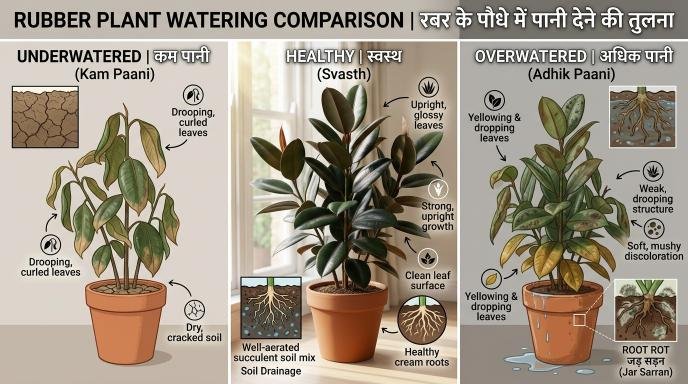
How to Recognize an Underwatered Rubber Plant
A rubber plant that has become too dry may develop:
- Drooping leaves.
- Dry or crispy leaf edges.
- Soil pulling away from the container.
- Leaves that feel less firm than usual.
- Premature leaf drop in severe cases.
If the soil is extremely dry and water runs immediately down the sides of the pot, the root ball may have become difficult to rehydrate evenly.
Water slowly and thoroughly, allowing moisture to penetrate the soil rather than giving only a small splash.
Choosing the Right Soil for a Rubber Plant
Rubber plants need soil that holds enough moisture for the roots but still drains efficiently.
A practical mix can include:
- Quality indoor potting mix.
- Perlite or another drainage-improving material.
- Organic material that supports moisture retention without making the mix excessively dense.
The exact recipe is less important than the final structure.
What good soil should do
Good rubber plant soil should:
- Drain excess water.
- Retain some moisture.
- Allow air around the roots.
- Resist becoming permanently compacted.
Heavy, poorly draining soil can stay wet for too long, especially in a low-light room.
Choosing the Right Pot
A drainage hole is one of the most important features of a rubber plant’s container.
When repotting, avoid moving the plant into a dramatically oversized pot simply because you want it to grow faster.
A very large container holds more soil around the roots, which can increase the time required for the soil to dry.
Choose a pot only moderately larger than the current root system.
When and How to Repot a Rubber Plant
Rubber plants generally benefit from repotting when their root system has substantially filled the container or when the soil has become degraded.
Possible signs include:
- Roots emerging from drainage holes.
- Water moving through the pot unusually quickly.
- Very slow growth despite suitable conditions.
- The root ball becoming tightly packed.
- The plant repeatedly drying out much faster than expected.
Repotting steps
- Choose a container with drainage holes.
- Select fresh, well-draining potting mix.
- Remove the plant carefully.
- Inspect the roots.
- Loosen severely circling roots gently.
- Place the plant at approximately its previous soil depth.
- Fill around the root ball with fresh mix.
- Water thoroughly and allow excess water to drain.
Avoid aggressively disturbing healthy roots unnecessarily.
How to Fertilize a Rubber Plant
Fertilizer provides nutrients that the plant uses for continued growth, particularly when it is actively producing new foliage.
A balanced, water-soluble houseplant fertilizer can be used according to its label directions during active growth.
Avoid excessive fertilizer
More fertilizer does not automatically mean faster or healthier growth.
Excess fertilizer can contribute to salt accumulation in the soil and may damage roots.
If your rubber plant is barely growing because it receives insufficient light, adding more fertilizer will not solve the underlying problem.
Light first, fertilizer second is a useful rule.
Temperature and Humidity for Rubber Plants
Rubber plants prefer warm, stable indoor conditions.
Protect them from:
- Cold drafts.
- Sudden temperature changes.
- Direct blasts from heating equipment.
- Strong air-conditioning currents.
- Prolonged exposure to cold temperatures.
Average household humidity is often adequate, but very dry indoor air can contribute to crispy leaf margins.
If your home is particularly dry, improving ambient humidity may help. However, increasing humidity cannot compensate for poor watering, inadequate light, or waterlogged soil.
Why Cleaning Rubber Plant Leaves Matters
Rubber plant leaves are broad and naturally collect dust.
A layer of dust can make the foliage look dull and can interfere with the plant’s ability to use available light efficiently.
Gently wipe leaves with a clean, damp cloth when necessary.
Avoid relying on oily leaf-shine products. They can leave residues on foliage and are unnecessary for healthy growth.
A useful maintenance routine
While cleaning the leaves, check for:
- Spider mites.
- Scale insects.
- Mealybugs.
- Unusual spots.
- Discoloration.
- New growth abnormalities.
Leaf cleaning is therefore also an easy opportunity for early pest detection.
Common Rubber Plant Problems and What They Mean
Yellow Leaves
Yellowing can have several causes, including excessive moisture, insufficient light, environmental stress, or normal aging of older leaves.
First check: soil moisture and drainage.
Do not immediately increase watering simply because a yellow leaf looks unhealthy.
Brown Leaf Edges
Brown edges can be associated with inconsistent moisture, very dry air, excessive fertilizer salts, or environmental stress.
Look at the entire growing environment instead of treating the leaf symptom alone.
Drooping Leaves
Drooping can occur because the plant is too dry, but it can also happen when roots are stressed by excessive moisture.
Check the soil before watering.
Leaf Drop
Sudden environmental changes can trigger leaf drop. Common triggers include relocation, temperature fluctuations, watering problems, and insufficient light.
If the plant has recently been moved, avoid making several additional changes at once.
Slow Growth
Slow growth is often linked to insufficient light, seasonal dormancy, limited nutrients, root restriction, or unsuitable temperatures.
Give the plant adequate light before assuming fertilizer is the solution.
How to Prevent Pests on Rubber Plants
Rubber plants can experience common houseplant pests such as scale, mealybugs, spider mites, and aphids.
Inspect new plants carefully before placing them beside your existing collection.
Pay particular attention to:
- Leaf undersides.
- Leaf joints.
- New growth.
- Stems.
- Areas where leaves attach to branches.
Early detection makes pest management considerably easier.
If pests appear, isolate the affected plant from other houseplants and identify the pest before choosing a treatment.
Rubber Plant Care Through the Seasons
Spring and Summer
Growth is often more active during brighter, warmer periods.
You may need to:
- Monitor soil more frequently.
- Fertilize according to plant needs.
- Rotate the pot for more even growth.
- Watch for pests.
- Provide sufficient bright light.
Autumn and Winter
Growth may slow as light levels decrease.
This often means the plant uses water more slowly.
Avoid continuing a summer watering schedule automatically.
A useful seasonal rule is:
When growth and light decrease, check the soil more carefully before watering.
Should You Rotate a Rubber Plant?
Yes, occasional rotation can encourage more even growth.
Plants naturally respond to light, so a rubber plant positioned beside a window may gradually lean toward the brighter side.
Rotating the container periodically can help distribute light more evenly across the plant.
Do not rotate it constantly. A consistent environment is generally preferable to repeatedly moving the plant.
How to Encourage a Bushier Rubber Plant
Rubber plants can become tall and sparse when growing toward a light source.
For fuller growth:
- Provide adequate light.
- Rotate the plant periodically.
- Prune strategically when appropriate.
- Maintain stable growing conditions.
Pruning can encourage branching, but the response varies with the plant and growing conditions.
Always use clean, sharp tools when pruning.
Common Rubber Plant Care Mistakes
Watering on a Fixed Calendar
A calendar cannot account for changing light, temperature, humidity, and soil conditions.
Better approach: check the soil.
Keeping the Plant in Low Light
A rubber plant may survive in low light but often grows less vigorously.
Better approach: provide brighter indirect light whenever possible.
Using a Pot Without Drainage
Water has nowhere to escape.
Better approach: use a container with drainage holes.
Repotting Too Frequently
Constant repotting can disturb the root system unnecessarily.
Better approach: repot when the plant or root system actually needs it.
Fertilizing a Stressed Plant Heavily
Fertilizer cannot correct poor drainage, inadequate light, or root damage.
Better approach: identify the underlying problem first.
Ignoring the Leaves
Dust, pests, and early signs of stress can remain unnoticed when foliage is never inspected.
Better approach: examine the plant regularly while watering or cleaning it.
A Simple Rubber Plant Care Routine
You do not need to spend hours caring for a rubber plant.
Weekly
- Inspect leaves and stems.
- Check for pests.
- Look at the soil moisture.
- Check whether the plant is receiving suitable light.
Every Few Weeks
- Clean dusty leaves.
- Rotate the plant if needed.
- Reassess its location and growing conditions.
During Active Growth
- Monitor watering needs more closely.
- Fertilize appropriately.
- Watch for new growth and signs of nutrient or environmental stress.
The most effective routine is based on observation rather than a rigid calendar.
Frequently Asked Questions
How often should I water a rubber plant?
Water when the upper portion of the soil has dried rather than following a fixed schedule. Environmental conditions determine how quickly the soil dries.
Does a rubber plant need direct sunlight?
Rubber plants generally do well in bright indirect light and can tolerate some direct sun when gradually acclimated. Sudden exposure to intense sunlight can scorch leaves.
Why are my rubber plant leaves turning yellow?
Yellow leaves can result from excessive moisture, insufficient light, environmental stress, or normal aging. Check the soil and growing conditions before changing your watering routine.
Why is my rubber plant dropping leaves?
Leaf drop can follow watering problems, low light, temperature changes, relocation, or other environmental stress. Look for recent changes in the plant’s conditions.
Can rubber plants grow in low light?
They can tolerate lower light, but growth is usually stronger when the plant receives bright, indirect light.
Should I mist my rubber plant?
Misting is not essential for healthy growth. Maintaining appropriate soil moisture, light, drainage, and overall humidity is more important.
How do I make my rubber plant grow faster?
Provide adequate bright light, appropriate watering, well-draining soil, suitable warmth, and nutrients during active growth. Avoid excessive fertilizer or water in an attempt to accelerate growth.
When should I repot my rubber plant?
Repot when the roots have substantially filled the container, drainage has become problematic, or the existing potting mix has deteriorated. Choose a container only moderately larger than the current one.
Can I keep a rubber plant in a bedroom?
Yes, provided the room offers suitable light, temperature, and watering conditions.
How do I keep rubber plant leaves shiny?
Keep leaves clean by gently wiping them with a damp cloth. Healthy leaves naturally develop their own attractive sheen, so commercial leaf-shine products are unnecessary.
Conclusion
Successful rubber plant care is less about following a perfect schedule and more about learning to read the plant. Give it bright indirect light, well-draining soil, a container with drainage, and water only when the soil has dried sufficiently.
The most important habit is to investigate symptoms before reacting. A drooping plant is not automatically thirsty, and a yellow leaf does not automatically mean it needs more water. Check the soil, light, roots, temperature, and recent environmental changes first.
With consistent conditions and occasional maintenance, a rubber plant can develop strong stems, healthy foliage, and attractive long-term growth.
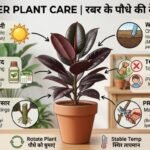
Image Suggestion: Healthy mature rubber plant in a bright indoor setting with labeled care requirements.