Quick Answer
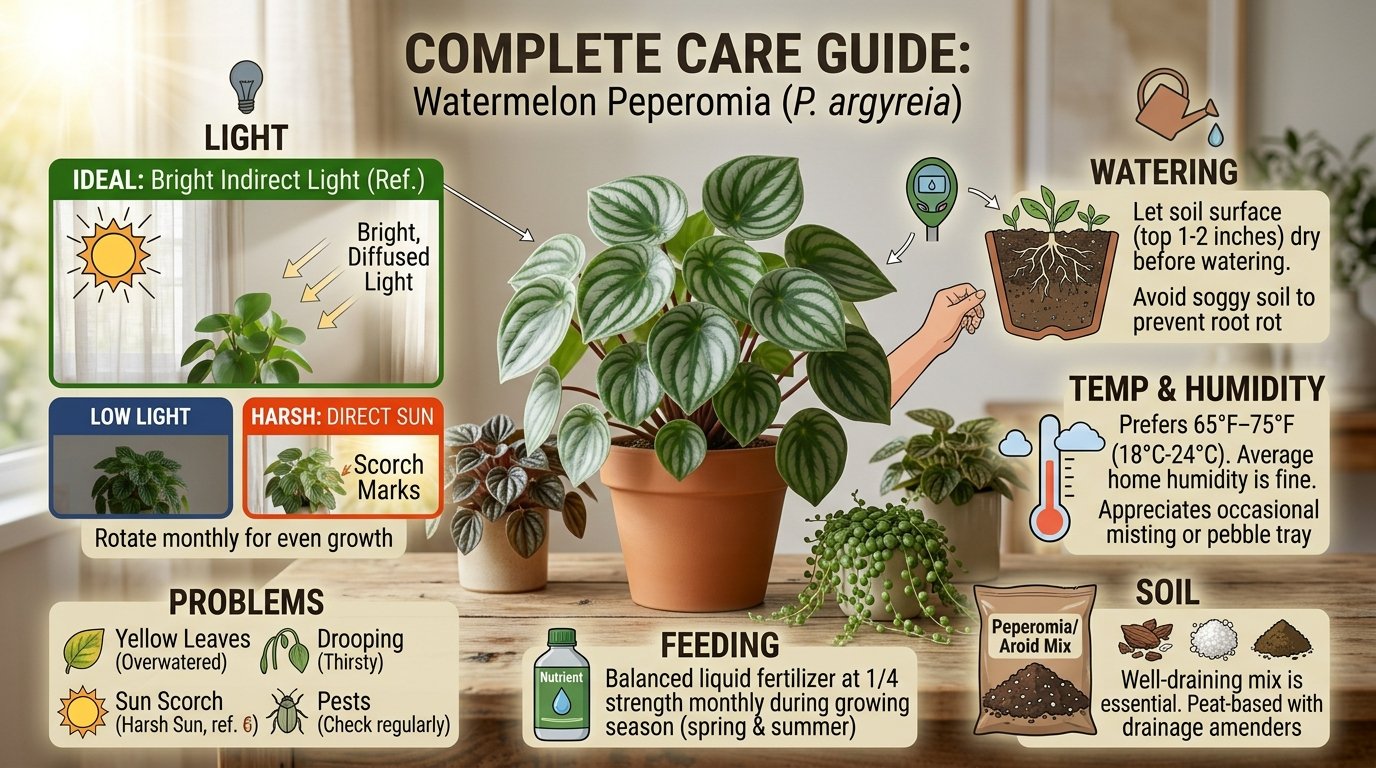
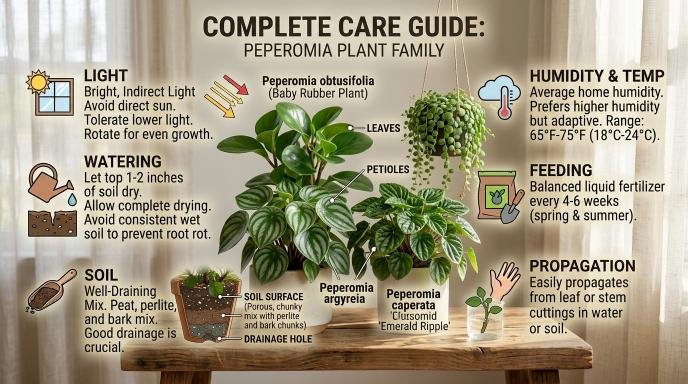
Peperomia plant care is simple when you provide bright, indirect light, well-draining soil, moderate watering, and warm temperatures.
Let the top portion of the soil dry before watering again because peperomia stores moisture in its thick leaves and can suffer from root rot when kept too wet. Moderate humidity, occasional feeding, and light pruning will help maintain healthy, compact growth.
Introduction
Peperomia is one of the easiest houseplant groups to grow when its basic needs are understood. Its attractive foliage, compact growth, and wide range of leaf shapes make it a popular choice for bedrooms, offices, shelves, and small indoor spaces.
However, one mistake causes more peperomia problems than almost anything else: overwatering.
Because many peperomia varieties have thick, fleshy leaves, they can store moisture. This means the plant usually does not need constantly wet soil. In fact, allowing the soil to dry partially between waterings is one of the most important parts of successful peperomia plant care.
Whether you grow watermelon peperomia, baby rubber plant, ripple peperomia, raindrop peperomia, or string of turtles, understanding light, watering, soil, temperature, and drainage will give you a much healthier plant.
Peperomia Plant Care Requirements at a Glance
| Care Requirement | Best Condition |
|---|---|
| Light | Bright, indirect light |
| Water | When soil partially dries |
| Soil | Loose and well-draining |
| Humidity | Moderate household humidity |
| Temperature | Warm and stable |
| Fertilizer | Light feeding during active growth |
| Pot | Container with drainage holes |
| Repotting | Only when necessary |
| Pruning | Light pruning as needed |
| Propagation | Stem, leaf, or division depending on variety |
The exact requirements can vary between peperomia species, but these conditions work well for most commonly grown indoor varieties.
What Is a Peperomia Plant?
Peperomia is a large group of tropical and subtropical plants known primarily for their decorative foliage.
Different varieties can have:
- Thick rounded leaves.
- Heart-shaped leaves.
- Rippled foliage.
- Silver markings.
- Striped patterns.
- Red or purple undersides.
- Trailing stems.
- Upright growth.
Some varieties remain compact and bushy, while others develop trailing stems that work particularly well in hanging containers.
One reason peperomia makes a good houseplant is its ability to tolerate occasional drying. Its fleshy leaves can retain moisture, making it more forgiving when watering is delayed.
How Much Light Does Peperomia Need?
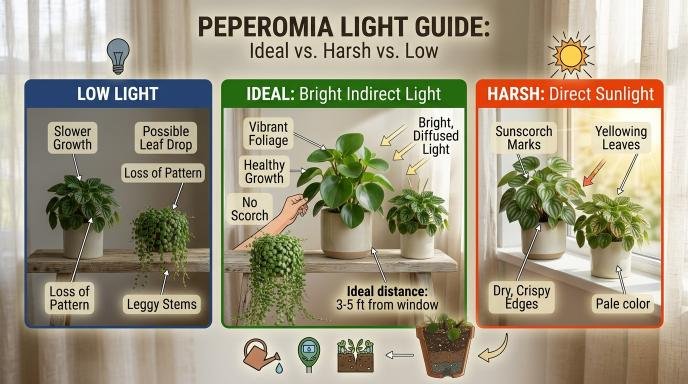
Peperomia generally grows best in bright, indirect light.
Place it near a bright window where the plant receives plenty of natural light without being exposed to strong, prolonged direct sunlight.
An east-facing window can be particularly useful because it often provides gentle morning sunlight. A bright west- or south-facing window can also work if intense sunlight is filtered with a sheer curtain or the plant is positioned farther from the glass.
Signs of insufficient light
Your peperomia may receive too little light if you notice:
- Slow growth.
- Long, stretched stems.
- Large gaps between leaves.
- Weak or floppy growth.
- Reduced coloration.
- Loss of attractive variegation in some varieties.
Signs of excessive light
Too much intense sunlight can cause:
- Brown patches.
- Bleached leaves.
- Crispy edges.
- Scorched foliage.
The goal is bright but filtered light, rather than either deep shade or harsh afternoon sun.
How Often Should You Water Peperomia?
Do not water peperomia according to a fixed calendar.
Instead, check the soil.
Allow the upper portion of the potting mix to dry before watering again. The exact drying time depends on the pot size, soil, temperature, humidity, and amount of light.
A simple watering routine
- Check the soil with your finger.
- If the soil still feels noticeably moist, wait.
- Once the upper layer has dried, water thoroughly.
- Allow excess water to escape through the drainage holes.
- Empty water collected in the saucer.
The most important principle is water thoroughly, then allow the soil to dry partially.
Why overwatering is dangerous
When soil remains saturated for long periods, roots have less access to oxygen. Continued wet conditions can weaken the roots and eventually cause root or stem rot.
Overwatering can produce symptoms such as:
- Yellow leaves.
- Soft leaves.
- Leaf drop.
- Brown or black roots.
- Mushy stems.
- Unpleasant-smelling soil.
- Sudden plant collapse.
What about underwatering?
A severely dry peperomia may develop:
- Wrinkled leaves.
- Drooping foliage.
- Dry leaf edges.
- Slow growth.
- Leaves that feel unusually thin.
The solution is not to keep the soil permanently wet. Instead, establish a consistent pattern of checking the soil and watering when necessary.
Expert Tip: If you are unsure whether your peperomia needs water, checking the soil is more reliable than counting the days since the last watering.
Best Soil for Peperomia
Peperomia needs soil that provides both moisture and excellent drainage.
A heavy garden soil or dense indoor mix can stay wet for too long, particularly in a large container.
A useful peperomia potting mix can contain:
- Quality indoor potting soil.
- Perlite for improved drainage.
- A small amount of orchid bark or another chunky material.
The exact recipe is less important than the final texture.
When you squeeze slightly moist soil in your hand, it should not remain as a dense, muddy mass. The roots need access to air as well as moisture.
Why drainage matters
Good drainage helps prevent water from accumulating around the roots.
If your peperomia frequently develops yellow leaves despite receiving adequate light, examine the soil before assuming it needs fertilizer.
Choosing the Right Pot for Peperomia
Always choose a pot with drainage holes.
A decorative container without drainage can trap excess water around the roots.
Peperomia also does not need an enormous pot.
A pot that is much larger than the root system can hold excess moisture for a long time. This increases the risk of overwatering problems.
When repotting, choose a container only slightly larger than the existing root ball.
Terracotta vs. plastic pots
Both can work.
Terracotta:
- Breathes well.
- Dries faster.
- Useful for people who frequently overwater.
Plastic:
- Holds moisture longer.
- Can be useful in dry indoor environments.
- Requires more attention to watering.
The best choice depends on how quickly your plant’s soil dries.
Ideal Temperature for Peperomia
Peperomia prefers warm, stable indoor conditions.
A comfortable range is generally around 18–30°C (65–86°F).
Protect the plant from:
- Cold drafts.
- Air-conditioning vents.
- Very cold windows.
- Sudden temperature changes.
- Extremely hot locations.
Cold stress can cause growth to slow and leaves to deteriorate.
If your peperomia is sitting directly beside a drafty window during winter, moving it slightly farther into the room can make a noticeable difference.
Does Peperomia Need High Humidity?
Peperomia appreciates moderate humidity but generally does not require extremely humid conditions.
Normal indoor humidity can be sufficient for many varieties.
If the air is extremely dry, especially during periods of indoor heating or cooling, you may notice:
- Crispy leaf edges.
- Dry leaf tips.
- Slower growth.
- Increased stress.
A humidifier can help when indoor air is consistently dry.
However, increasing humidity should not be used as a substitute for proper watering.
Important: High humidity does not make waterlogged soil safe. Root health still depends on proper drainage and appropriate watering.
How to Fertilize Peperomia
Peperomia is not a heavy feeder.
During active growth, you can use a balanced liquid houseplant fertilizer diluted according to the product instructions.
Light feeding is usually better than aggressive fertilization.
Avoid fertilizing when:
- The plant is severely stressed.
- The roots may be rotting.
- The soil is constantly wet.
- The plant has recently been repotted into fresh, nutrient-rich soil.
- The plant is dormant or barely growing.
Too much fertilizer can cause salt buildup in the soil and damage the roots.
Remember that fertilizer supports healthy growth—it does not fix poor lighting, overwatering, or root problems.
How to Prune Peperomia
Peperomia generally needs only light pruning.
Remove:
- Dead leaves.
- Damaged leaves.
- Diseased-looking growth.
- Weak stems.
- Excessively long stems.
If your plant has become leggy, trimming healthy stems above a leaf node can encourage a more compact appearance.
Always use clean, sharp scissors or pruning shears.
Should you remove yellow leaves?
Yes, but first determine why they became yellow.
If only an old leaf is naturally aging, removing it is harmless.
If several leaves are turning yellow at once, investigate:
- Watering.
- Drainage.
- Light.
- Root health.
- Temperature.
Removing yellow leaves without addressing the underlying problem will not solve the issue.
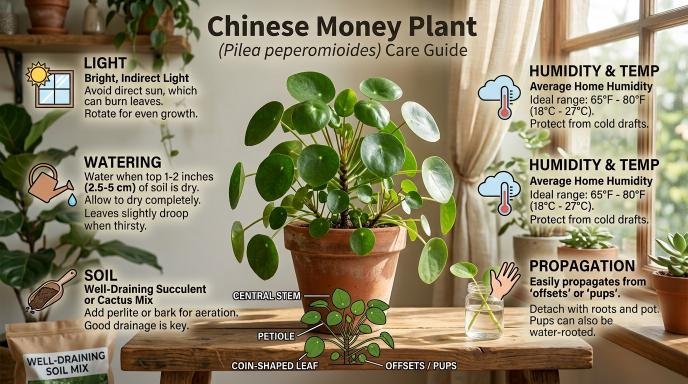
How to Propagate Peperomia
Peperomia can be propagated in several ways depending on the variety.
Stem Cutting Propagation
This is one of the easiest methods for many peperomias.
Steps
- Select a healthy stem.
- Cut below a suitable leaf node.
- Remove unnecessary lower leaves.
- Place the cutting in water or a suitable propagation medium.
- Keep it in bright, indirect light.
- Maintain moderate moisture without creating soggy conditions.
- Once roots develop sufficiently, transfer the cutting to a suitable potting mix.
Not every cutting roots at the same speed, so patience is important.
Leaf Propagation
Some peperomia varieties can be propagated from individual leaves.
Choose a healthy leaf with an appropriate section of the petiole and place it into a suitable propagation medium.
This method can be slower than stem propagation and does not work equally well for every species.
Propagation by Division
If your peperomia has multiple rooted sections, division can sometimes be performed during repotting.
Gently separate sections that already have their own roots and plant them individually.
How to Repot Peperomia
Peperomia usually does not need frequent repotting.
Repot when:
- Roots are tightly crowded.
- Water passes through the pot unusually quickly.
- The soil has broken down.
- Drainage has become poor.
- The plant has clearly outgrown its container.
Choose a pot only slightly larger than the current one.
Repotting steps
- Water lightly if the soil is extremely dry.
- Carefully remove the plant from its container.
- Examine the roots.
- Remove obviously damaged or rotten roots.
- Place fresh, well-draining soil into the new pot.
- Position the plant at approximately the same depth.
- Fill around the roots.
- Water appropriately.
- Return the plant to bright indirect light.
Avoid immediately placing a freshly repotted plant into intense sunlight.
Common Peperomia Problems
Peperomia Leaves Turning Yellow
Yellow leaves are often associated with excess moisture, particularly when several leaves turn yellow together.
Check:
- Soil moisture.
- Drainage holes.
- Pot size.
- Watering frequency.
- Root condition.
If the soil is consistently wet, allowing it to dry more between waterings may help.
Peperomia Leaves Falling Off
Leaf drop can happen because of:
- Overwatering.
- Underwatering.
- Temperature stress.
- Sudden environmental changes.
- Root problems.
- Insufficient light.
Look at the entire plant rather than treating leaf drop as a single symptom with one guaranteed cause.
Peperomia Leaves Curling
Curling leaves can indicate environmental stress.
Possible causes include:
- Excessive dryness.
- Root problems.
- Too much direct sunlight.
- Sudden temperature changes.
- Inconsistent watering.
Check the soil first.
If the soil is completely dry, watering may be appropriate. If it is wet and the leaves are curling, adding more water could make the problem worse.
Brown Leaf Tips
Brown tips may result from:
- Very dry air.
- Irregular watering.
- Excessive fertilizer.
- Water quality.
- Root stress.
- Excessive sunlight.
Instead of immediately cutting the damaged portion, investigate what caused it.
Peperomia Has Soft or Mushy Stems
Soft stems are a serious warning sign.
The plant may be suffering from excessive moisture or rot.
Remove the plant from the pot and inspect the roots and lower stems.
Healthy roots should generally feel firm rather than mushy.
If rot is present, remove affected tissue with clean tools and propagate healthy sections when possible.
Why Is My Peperomia Not Growing?
Peperomia naturally grows relatively slowly, so patience is important.
However, extremely slow growth can indicate a problem.
Check the following:
Light
Insufficient light can dramatically reduce growth.
Temperature
Cold conditions can slow or stop active growth.
Roots
Damaged roots cannot efficiently support new foliage.
Soil
Poorly draining or exhausted soil can contribute to weak growth.
Nutrition
A plant that has been growing actively for a long time without nutrients may eventually benefit from light fertilization.
Do not automatically add fertilizer whenever growth slows. Check light, temperature, soil, and roots first.
How to Make Peperomia Bushier
If your peperomia looks thin or stretched, focus on light and pruning.
Move it to a brighter location with indirect light.
Then trim excessively long stems above appropriate nodes.
Good light encourages stronger growth, while pruning helps maintain a compact shape.
Avoid cutting away too much healthy foliage at one time because peperomia is not a rapid-growing plant.
Can Peperomia Grow in Low Light?
Peperomia can tolerate lower-light conditions better than many houseplants, but tolerance is not the same as preference.
In low light, growth may become:
- Slower.
- More stretched.
- Less compact.
- Less colorful in variegated varieties.
For the healthiest appearance, provide bright indirect light whenever possible.
Can Peperomia Grow Outdoors?
Peperomia can grow outdoors in suitable warm conditions, but outdoor environments are significantly more intense than indoor environments.
Protect outdoor peperomia from:
- Harsh afternoon sunlight.
- Cold temperatures.
- Strong wind.
- Heavy rainfall.
- Waterlogged soil.
If moving a plant from indoors to outdoors, acclimate it gradually.
Do not take a plant accustomed to filtered indoor light and immediately place it in full outdoor sun.
The sudden increase in light can cause severe leaf scorch.
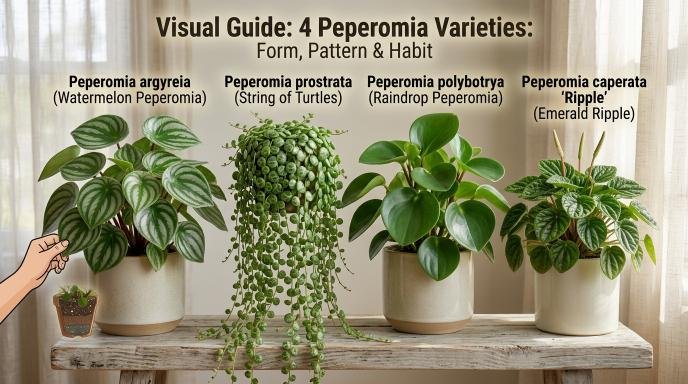
Popular Peperomia Varieties
Watermelon Peperomia
Watermelon peperomia is famous for its rounded leaves with markings resembling the rind of a watermelon.
Its compact growth makes it particularly attractive for tables, shelves, and small plant collections.
Baby Rubber Plant
Baby rubber plant has thick, glossy foliage and a compact upright growth habit.
It is one of the most forgiving peperomias for indoor growing.
String of Turtles
String of turtles is a trailing variety with small, patterned leaves.
Its cascading growth makes it particularly attractive in hanging containers or elevated shelves.
Raindrop Peperomia
Raindrop peperomia has thick, teardrop-shaped leaves and an upright growth habit.
Its fleshy foliage is another reason careful watering is important.
Ripple Peperomia
Ripple peperomia has highly textured, corrugated foliage and comes in several attractive color variations.
Its compact form makes it suitable for smaller indoor spaces.
Image Suggestion: Comparison chart showing the leaf shape, growth habit, and ideal placement of five popular peperomia varieties.
Peperomia Care by Season
Spring
Spring is often a period of renewed growth.
Check:
- Light levels.
- Root health.
- Potting mix.
- Need for pruning.
- Fertilization requirements.
This can be a good time for propagation and repotting if the plant genuinely needs it.
Summer
Higher temperatures and stronger light may cause the soil to dry faster.
Check the plant more frequently, but do not automatically increase watering without checking the soil.
Fall
Growth may begin slowing.
Reduce fertilizer as the plant becomes less active and continue monitoring soil moisture.
Winter
Indoor temperatures and light levels often change.
Avoid placing peperomia near cold windows or heating vents.
Because growth may slow, the plant may use water more slowly. This means the soil can remain wet longer than it did during summer.
10 Peperomia Care Mistakes to Avoid
- Watering on a strict schedule.
- Using a pot without drainage holes.
- Keeping the soil constantly wet.
- Using dense, poorly draining soil.
- Placing the plant in harsh afternoon sunlight.
- Using an oversized pot.
- Overfertilizing.
- Ignoring yellow leaves.
- Moving the plant suddenly into intense outdoor light.
- Assuming slow growth automatically means the plant needs fertilizer.
The most important lesson is simple: observe the plant and its growing environment before changing anything.
A Simple Peperomia Care Routine
You do not need to inspect your peperomia constantly.
Once a week, check five things:
1. Soil
Is it still wet or has it partially dried?
2. Leaves
Look for yellowing, brown spots, pests, or unusual softness.
3. Light
Is the plant still receiving adequate bright indirect light?
4. Pot
Is water draining correctly?
5. Growth
Is the plant producing healthy new foliage?
This simple routine can catch problems before they become serious.
Frequently Asked Questions
How often should I water peperomia?
Water when the soil has partially dried rather than following a fixed schedule. The frequency can vary significantly depending on light, temperature, pot size, and soil.
Does peperomia need direct sunlight?
No. Bright indirect light is generally better. Strong direct sunlight can scorch the foliage.
Why are my peperomia leaves turning yellow?
Overwatering is one of the most common causes. Check whether the soil stays wet for extended periods and make sure the pot drains properly.
Can peperomia survive low light?
Yes, many varieties tolerate lower light, but growth is usually better and more compact in bright indirect light.
Does peperomia like humidity?
Peperomia generally appreciates moderate humidity but can often grow successfully in ordinary household conditions.
Why is my peperomia dropping leaves?
Check watering first, followed by temperature, light, and root health. Both excessive moisture and severe dryness can cause leaf problems.
How do I make my peperomia bushier?
Provide brighter indirect light and prune excessively long stems above suitable nodes. Avoid aggressive pruning.
How often should I fertilize peperomia?
Feed lightly during active growth using a diluted balanced fertilizer. Avoid heavy feeding.
Does peperomia need a large pot?
No. Peperomia generally performs better in a reasonably sized container with good drainage than in a very large pot.
Can I grow peperomia in a bathroom?
Yes, provided there is sufficient natural or artificial light. Bathroom humidity can be beneficial, but drainage remains essential.
Why are my peperomia leaves soft?
Soft leaves can indicate excessive moisture, root problems, or severe dehydration. Check the soil and roots before deciding how to respond.
How fast does peperomia grow?
Most peperomias are relatively slow to moderate growers. Growth depends heavily on light, temperature, nutrition, variety, and root health.
Final Thoughts
Successful peperomia plant care does not require complicated equipment or constant attention. The key is creating a stable environment where the roots receive oxygen, the foliage receives adequate indirect light, and the plant is watered according to the condition of its soil.
Remember these four priorities:
- Bright indirect light
- Well-draining soil
- Moderate watering
- Good drainage
Most peperomia problems become easier to diagnose when you start with those basics.
If your peperomia is struggling, resist the temptation to immediately add more water or fertilizer. First look at the soil, roots, light, pot, and temperature. In many cases, correcting one underlying environmental problem is all the plant needs to begin producing healthier growth again.