Quick Answer
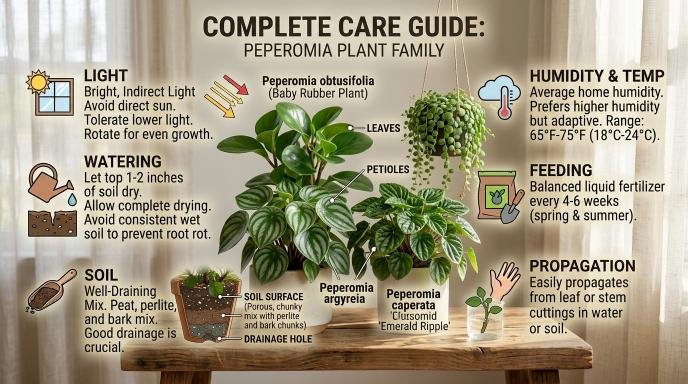
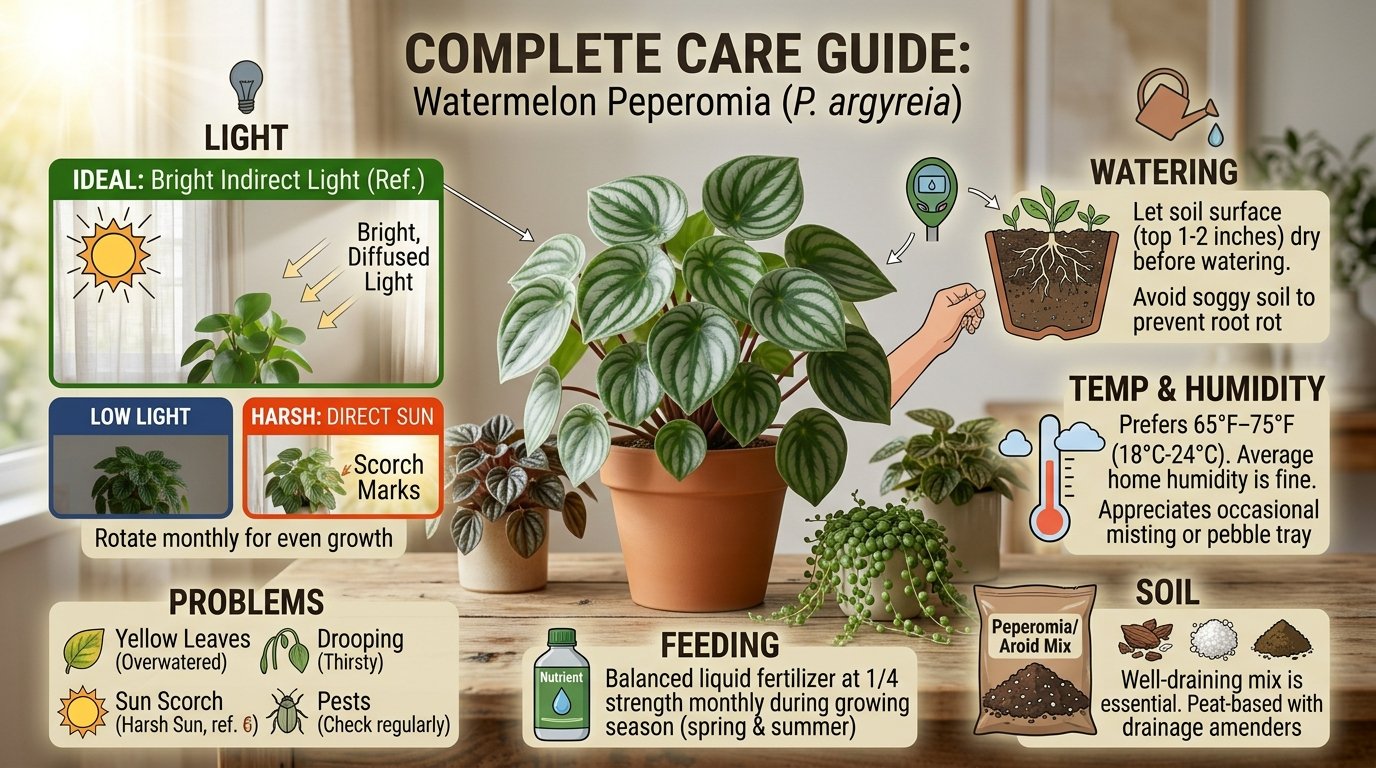
Watermelon peperomia care is mainly about bright indirect light, careful watering, well-draining soil, moderate humidity, and warm temperatures.
Peperomia argyreia prefers its soil to dry slightly between waterings and is more likely to suffer from overwatering than occasional dryness. Keep it away from harsh direct sun, cold drafts, and constantly wet soil, and it can produce healthy, beautifully striped leaves indoors.
Introduction
Few houseplants are as recognizable as watermelon peperomia. Its round leaves have silver and green striping that resembles the rind of a watermelon, while its compact growth makes it particularly useful for desks, shelves, windowsills, and small indoor spaces.
The challenge is that its attractive appearance can make beginners assume it needs frequent watering and constant attention. In reality, watermelon peperomia care is mostly about balance. Too much water, poor drainage, intense sunlight, or a cold location can quickly cause problems.
The good news is that watermelon peperomia is relatively manageable once you understand what its leaves, soil, and growth pattern are telling you. Instead of following a rigid watering schedule, focus on light, soil moisture, temperature, and the condition of the plant.
What Is a Watermelon Peperomia?
Watermelon peperomia is the common name for Peperomia argyreia, a compact tropical plant grown primarily for its attractive foliage.
Its rounded leaves feature alternating green and silvery markings that resemble a watermelon rind. The plant generally maintains a relatively compact form rather than becoming a large floor plant.
Why the leaves matter
The thick, somewhat succulent-like leaves allow the plant to store some moisture. This is one reason constantly wet soil can become a problem.
When the soil remains saturated for too long, roots may struggle to receive enough oxygen. The result can be yellowing leaves, soft stems, leaf drop, or root problems.
Practical insight: Treat watermelon peperomia more like a plant that appreciates controlled moisture than one that wants to sit in damp soil all the time.
Watermelon Peperomia Care Requirements at a Glance
| Care factor | Ideal approach |
|---|---|
| Light | Bright, indirect light |
| Direct sun | Limited, especially harsh afternoon sun |
| Watering | Water when the upper soil has dried somewhat |
| Soil | Loose, airy, fast-draining mix |
| Humidity | Moderate household humidity is usually sufficient |
| Temperature | Warm, stable indoor temperatures |
| Fertilizer | Light feeding during active growth |
| Pot | Container with drainage holes |
| Repotting | Only when the plant becomes root-bound or the soil breaks down |
| Growth habit | Compact and clumping |
| Main risk | Overwatering and poor drainage |
The exact frequency of care depends on light, temperature, pot size, soil composition, and season.
How Much Light Does Watermelon Peperomia Need?
Bright, indirect light is usually the sweet spot for watermelon peperomia.
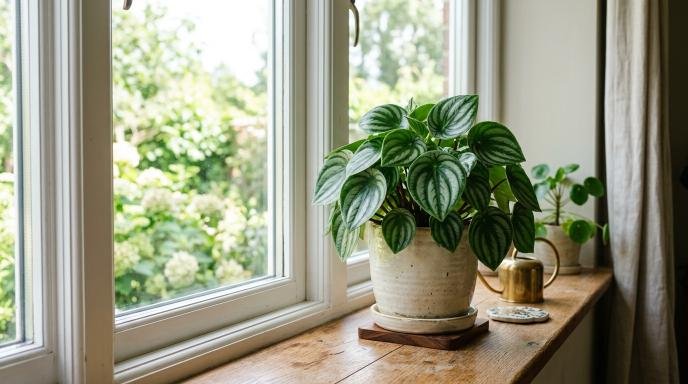
Place the plant near a bright window where it receives plenty of filtered daylight without being exposed to intense direct sunlight for long periods.
Why light matters
Light influences both growth and leaf appearance.
Insufficient light can cause:
- Slow growth.
- Smaller new leaves.
- Longer spaces between leaves.
- Less vigorous development.
- Soil that stays wet for longer because the plant uses water more slowly.
Too much intense direct sunlight can cause:
- Pale or bleached-looking foliage.
- Brown or crispy patches.
- Scorched leaves.
- Stress during hot weather.
A useful placement trick
An east-facing window often provides gentle morning light. A bright location near a south- or west-facing window can also work if the plant is protected from strong direct rays with a sheer curtain or by placing it farther from the glass.
Can Watermelon Peperomia Grow in Low Light?
It can tolerate lower light than many tropical foliage plants, but tolerance is not the same as ideal growth.
In a dim room, the plant may survive while growing slowly. The soil may also remain wet for longer, increasing the risk of watering-related problems.
If your peperomia is healthy but barely producing new growth, consider light before automatically adding fertilizer.
Signs it needs more light
Look for:
- Very slow growth.
- Small new leaves.
- Long gaps between leaves.
- Weak or stretched growth.
- Soil remaining wet for unusually long periods.
Move it gradually toward brighter indirect light rather than immediately placing it in intense direct sun.
How to Water Watermelon Peperomia
Watering is one of the most important parts of watermelon peperomia care.
The best approach is to check the soil rather than watering according to a fixed calendar.
Allow the upper portion of the potting mix to dry before watering again. When it is time to water, moisten the soil thoroughly until excess water drains from the bottom of the pot.
Then empty any water sitting in a saucer or decorative outer container.
Why overwatering is dangerous
Waterlogged soil reduces the air available around the roots. If this condition continues, roots can become damaged and the plant may begin showing symptoms above the soil.
A common beginner mistake is interpreting drooping leaves as a guaranteed sign of thirst. Drooping can occur from both underwatering and root stress caused by excessive moisture.
The soil should be your first clue, not the leaves alone.
A practical watering test
Before watering:
- Push your finger into the upper layer of soil.
- Feel whether the mix is still noticeably damp.
- Check the weight of the pot if you are familiar with how it feels after watering.
- Look for drainage from the bottom after watering.
- Recheck the plant after several days rather than automatically watering again.
How Often Should You Water Watermelon Peperomia?
There is no universal weekly schedule.
A watermelon peperomia growing in bright light during a warm season may need water considerably sooner than one growing in a cool, dim room.
Factors that affect watering frequency include:
- Light intensity.
- Indoor temperature.
- Humidity.
- Pot size.
- Pot material.
- Soil composition.
- Plant size.
- Season.
During active growth, the plant may use water more quickly. During cooler or darker periods, the soil can remain moist for longer.
Expert tip: If you find yourself watering because “it has been seven days,” stop and check the soil first. The plant’s growing conditions matter more than the calendar.
The Best Soil for Watermelon Peperomia
Watermelon peperomia needs a potting mix that drains efficiently while retaining enough moisture for the roots to absorb.
A suitable mix can include:
- Quality indoor potting soil.
- Perlite or another drainage-enhancing material.
- Fine orchid bark or another airy component.
The goal is a loose, breathable growing medium rather than dense soil that stays saturated.
Why drainage matters
Good drainage does not mean the soil should become bone dry immediately after watering.
Instead, the mix should hold some moisture while allowing excess water and air to move through the root zone.
If your soil remains wet for many days after watering, consider whether the pot is too large, the soil is too dense, the drainage holes are inadequate, or the plant is receiving too little light.
Choosing the Right Pot
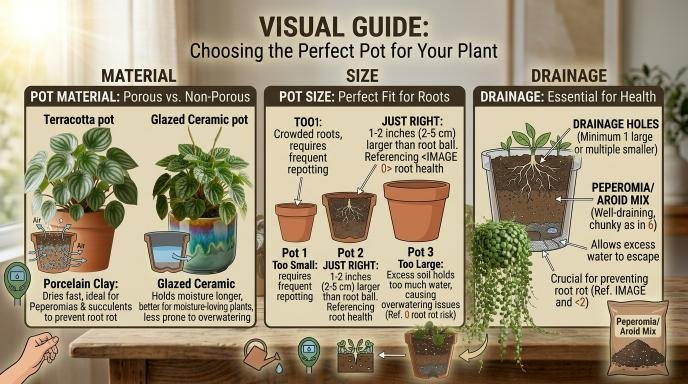
A drainage hole is more important than the decorative appearance of the container.
A pot without drainage can allow water to accumulate around the roots, even when the surface appears dry.
Choose a pot that:
- Has one or more drainage holes.
- Is appropriately sized for the root system.
- Is not dramatically larger than the current root ball.
- Allows excess water to escape easily.
An oversized container can hold a large volume of wet soil around a relatively small root system. This can make moisture management more difficult.
Practical tip: If you use a decorative cachepot without drainage, keep the peperomia in a separate nursery pot with drainage holes inside it.
Watermelon Peperomia Humidity Requirements
Watermelon peperomia appreciates moderate humidity, but you do not necessarily need to turn your home into a greenhouse.
Normal indoor humidity can be adequate when the plant receives appropriate light and watering.
Humidity becomes more important when indoor air is extremely dry, particularly during periods when heating or air conditioning runs frequently.
Signs of excessively dry conditions
You may notice:
- Dry or crispy leaf edges.
- Slower growth.
- Increased sensitivity to environmental changes.
If humidity is consistently very low, a humidifier can provide a more reliable improvement than occasional misting.
Does misting increase humidity?
Misting may temporarily wet the leaf surface, but it does not reliably maintain higher room humidity for long periods.
For consistent humidity, controlling the surrounding environment is generally more useful.
Best Temperature for Watermelon Peperomia
Warm, stable indoor conditions are ideal.
Avoid placing watermelon peperomia:
- Directly beside cold drafts.
- Against very cold windows during winter.
- Immediately beside heating vents.
- Directly in the path of strong air conditioning.
- In locations with frequent temperature swings.
Sudden environmental changes can cause stress even when the plant otherwise receives good care.
For most homes, a comfortable indoor environment is preferable to trying to create extreme tropical conditions.
Should You Fertilize Watermelon Peperomia?
Watermelon peperomia does not require heavy feeding.
During active growth, a balanced houseplant fertilizer diluted according to its label can provide nutrients when the existing potting mix has become depleted.
Avoid the temptation to fertilize every time the plant looks weak.
Why fertilizer is not always the answer
Poor growth can result from:
- Insufficient light.
- Root problems.
- Incorrect watering.
- Poor soil.
- Temperature stress.
- Natural seasonal slowdown.
Adding fertilizer to a stressed or damaged root system can make the situation worse.
Better approach: Fix environmental problems first, then use light feeding to support healthy growth.
When and How to Repot Watermelon Peperomia
Watermelon peperomia generally does not need frequent repotting.
Consider repotting when:
- Roots are becoming crowded.
- Water passes through the pot unusually quickly because the root mass has filled the container.
- The potting mix has broken down and drains poorly.
- The plant has outgrown its current container.
- There are clear signs of root-related problems.
Choose a pot only modestly larger than the existing one.
Repotting mistake to avoid
Moving a small peperomia into a very large pot may seem helpful, but the extra soil can remain wet for longer than the plant can use it.
A slightly larger container is usually easier to manage than a dramatically oversized one.
Image Suggestion: Watermelon peperomia root ball showing healthy roots and an appropriately sized pot.
How to Propagate Watermelon Peperomia
Watermelon peperomia can be propagated from healthy plant material, with leaf and stem propagation being common approaches.
Stem cutting method
- Select a healthy stem with a suitable leaf.
- Make a clean cut using a sanitized tool.
- Place the cutting in an appropriate propagation medium.
- Keep the medium lightly moist rather than saturated.
- Provide bright indirect light.
- Maintain warm, stable conditions.
- Wait for roots and new growth to develop before treating the young plant as established.
Patience matters because propagation speed varies with temperature, light, cutting quality, and growing medium.
Leaf propagation considerations
Leaf-based propagation can work with peperomia, but success depends on using the correct leaf material and technique. A leaf that is already damaged, severely stressed, or diseased is a poor candidate.
Practical insight: Healthy propagation material matters more than taking a large number of cuttings.
Image Suggestion: Step-by-step watermelon peperomia propagation from cutting to rooted plant.
Common Watermelon Peperomia Problems
Yellow Leaves
Yellow leaves can have several causes, but excessive moisture is one of the first things to investigate.
Check:
- Soil moisture.
- Drainage.
- Pot size.
- Light level.
- Recent watering frequency.
If the soil remains wet for an extended period, increasing watering is likely to make the problem worse.
Older leaves can also naturally yellow and decline, so examine the pattern rather than reacting to a single aging leaf.
Brown or Crispy Leaf Edges
Brown edges may occur because of:
- Very dry conditions.
- Inconsistent watering.
- Excessive direct sunlight.
- Environmental stress.
- Root problems.
Look at the location of the damage. A bleached brown patch facing a bright window suggests a different problem from dry edges on a plant sitting beside a heating vent.
Drooping Leaves
Drooping does not automatically mean the plant needs water.
Check the soil before doing anything.
If it is dry, watering may solve the problem. If the soil is already wet, investigate drainage and root health instead.
This distinction prevents one of the most common houseplant mistakes: adding more water to a plant that is already suffering from excessive moisture.
Curling Leaves
Curling can occur when the plant is experiencing environmental stress.
Possible causes include:
- Excessive sunlight.
- Low humidity.
- Watering problems.
- Temperature stress.
- Root damage.
Look at recent changes. If the plant was recently moved, repotted, placed near a heater, or exposed to stronger sunlight, that change may provide the clue.
Leaves Falling Off
A few older leaves dropping can be normal, but sudden or widespread leaf loss deserves investigation.
Check for:
- Overwatering.
- Poor drainage.
- Cold exposure.
- Major changes in light.
- Root problems.
- Physical damage.
Avoid immediately cutting everything back or adding fertilizer. First identify the environmental problem.
Why Are Watermelon Peperomia Leaves Losing Their Color?
The attractive striped pattern can become less pronounced when growing conditions are not ideal.
Insufficient light may contribute to weaker growth and less visually striking foliage.
However, increasing light does not mean exposing the plant to intense afternoon sun. Bright filtered light is generally a better target.
If the plant has suddenly changed after being moved, compare its current location with its previous environment.
Watermelon Peperomia Leaves Turning Soft
Soft leaves can indicate excessive moisture or root stress, particularly when the soil is consistently wet.
Inspect the plant carefully.
If the soil is saturated:
- Stop watering temporarily.
- Confirm that the drainage holes are open.
- Check whether the potting mix is excessively dense.
- Inspect the roots if symptoms are severe.
- Remove damaged roots if necessary and repot into an appropriate airy mix.
Do not confuse a soft leaf with ordinary temporary drooping. Texture changes can provide important clues about the plant’s condition.
Pests That Can Affect Watermelon Peperomia
Indoor peperomias can occasionally experience pests such as:
- Mealybugs.
- Spider mites.
- Aphids.
- Scale insects.
Inspect leaf undersides, stems, and areas where leaves meet the plant.
Early detection makes treatment much easier.
If you see pests, isolate the affected plant from nearby houseplants when practical. Remove visible pests and use an appropriate indoor-plant pest treatment according to its label directions.
Avoid applying excessive products simply because a single insect was found.
Watermelon Peperomia Care by Season
Spring
Spring often brings increasing light and renewed growth.
Check whether your watering routine needs to increase gradually as the plant begins using moisture more quickly.
This can also be a suitable period for repotting or propagation when the plant is actively growing.
Summer
Summer conditions can increase water use, particularly near bright windows.
However, higher temperatures do not automatically mean daily watering is necessary.
Check the soil before watering and protect the plant from harsh direct sunlight.
Fall
As daylight decreases, growth may slow.
Reduce watering according to actual soil moisture rather than maintaining a summer schedule.
Winter
Indoor heating can create dry air while reduced daylight slows water consumption.
Keep the plant away from cold windows and heating vents, and be especially careful not to overwater when the soil is drying more slowly.
Common Watermelon Peperomia Care Mistakes
Watering on a fixed schedule
A calendar cannot account for changes in light, temperature, humidity, and soil.
Better approach: Check the plant and soil before watering.
Using a pot without drainage
Decorative containers can look attractive but create serious moisture-management problems.
Better approach: Use a nursery pot with drainage holes.
Giving too much direct sunlight
More light is not always better.
Better approach: Aim for bright, indirect light and introduce stronger light gradually.
Repotting into a huge container
Extra soil can remain wet around a small root system.
Better approach: Increase pot size gradually.
Fertilizing a stressed plant
Nutrients cannot correct poor drainage or root damage.
Better approach: Correct environmental conditions first.
Constantly moving the plant
Changing locations every few days makes it difficult to determine what is actually helping.
Better approach: Give the plant a suitable location and observe it over time.
How to Build the Ideal Watermelon Peperomia Setup
For a simple, low-maintenance setup, aim for:
- A bright room with indirect light.
- A pot with reliable drainage.
- A loose, well-draining potting mix.
- Moderate indoor humidity.
- Stable warm temperatures.
- Watering based on soil moisture.
- Light fertilizer during active growth.
- Regular inspection for pests and leaf changes.
You do not need complicated equipment to grow a healthy watermelon peperomia.
The most important improvement for many struggling plants is simply getting the combination of light, drainage, and watering right.
A Simple Weekly Watermelon Peperomia Care Check
Instead of following a strict watering schedule, spend a few minutes inspecting the plant.
Check the soil
Is the upper layer still damp?
Check the leaves
Look for yellowing, browning, curling, spots, or unusual softness.
Check the stems
Look for discoloration, softness, or visible pests.
Check the light
Has seasonal sunlight changed, or has the plant been moved?
Check for pests
Inspect both sides of the leaves and the stems.
This small routine can catch problems before they become severe.
How to Make Watermelon Peperomia Grow Faster
There is no need to force rapid growth.
Instead, optimize the conditions that support healthy growth:
- Provide bright indirect light.
- Use an airy, well-draining growing medium.
- Water thoroughly when the soil has dried sufficiently.
- Avoid leaving the plant in standing water.
- Maintain warm, stable conditions.
- Feed lightly during active growth.
- Repot only when necessary.
If all of these conditions are good and growth is still slow, remember that watermelon peperomia is naturally a compact plant. Slow growth is not automatically a sign that something is wrong.
Frequently Asked Questions
Is watermelon peperomia easy to care for?
Yes, it can be relatively easy to grow indoors when its basic needs are met. The biggest challenge for beginners is usually avoiding excessive watering and poorly draining soil.
How much sunlight does watermelon peperomia need?
It prefers bright, indirect light. Gentle morning light can work well, while strong direct afternoon sunlight may scorch the leaves.
How often should I water watermelon peperomia?
Water when the upper portion of the soil has dried rather than following a fixed weekly schedule. The exact interval depends on light, temperature, humidity, pot size, and soil.
Should I mist my watermelon peperomia?
Misting is not necessary for routine care. If indoor humidity is consistently very low, maintaining room humidity with a humidifier is generally more reliable.
Why is my watermelon peperomia drooping?
Check the soil first. Dry soil can indicate underwatering, while wet soil combined with drooping may point toward excessive moisture or root stress.
Why are my watermelon peperomia leaves turning yellow?
Overwatering is a common possibility, but yellow leaves can have several causes. Check soil moisture, drainage, light, and the age of the affected leaves before changing your care routine.
Can watermelon peperomia grow in a bathroom?
It can grow well in a bright bathroom if there is sufficient indirect light and good air circulation. A dark bathroom is unlikely to provide enough light for vigorous growth.
Can watermelon peperomia tolerate direct sunlight?
It may tolerate some gentle direct morning sunlight, but strong prolonged sunlight can damage the leaves. Filter intense light when necessary.
Does watermelon peperomia need fertilizer?
It can benefit from light feeding during active growth, particularly when growing in an older or nutrient-depleted potting mix. Avoid heavy fertilization.
Can I propagate watermelon peperomia from a leaf?
Peperomia can be propagated using leaf material, although the success of leaf propagation depends on the technique and condition of the cutting. Stem propagation is another practical option.
Why are my watermelon peperomia leaves curling?
Curling may result from watering problems, excessive light, low humidity, temperature stress, or root issues. Check the growing conditions rather than assuming one cause.
Does watermelon peperomia need high humidity?
It appreciates moderate humidity but does not necessarily require extremely high humidity. Stable indoor conditions are usually sufficient when watering and lighting are appropriate.
Final Takeaways
Successful watermelon peperomia care does not require a complicated routine. Give the plant bright indirect light, an airy potting mix, reliable drainage, and water only when the soil has dried sufficiently.
Pay particular attention to what the plant is telling you. Yellow leaves combined with persistently wet soil, soft foliage, or slow drying are reasons to investigate moisture and drainage before adding more water or fertilizer.