Monstera Thai Constellation is a striking tropical houseplant known for its large, heart-shaped leaves decorated with creamy white and yellow-green splashes. Its distinctive variegation makes it a popular choice among indoor plant collectors, but growing a healthy plant requires the right balance of light, watering, humidity, and nutrition.
Learning proper Monstera Thai Constellation care helps prevent common problems such as yellowing leaves, brown edges, root rot, and slow growth. Although this plant can thrive indoors, its variegated foliage needs particular attention because the cream-colored areas contain less chlorophyll than the green portions.
Whether you are growing your first Thai Constellation or improving the health of an established specimen, this guide explains how to create suitable conditions and maintain attractive, healthy leaves throughout the year.
Quick Answer
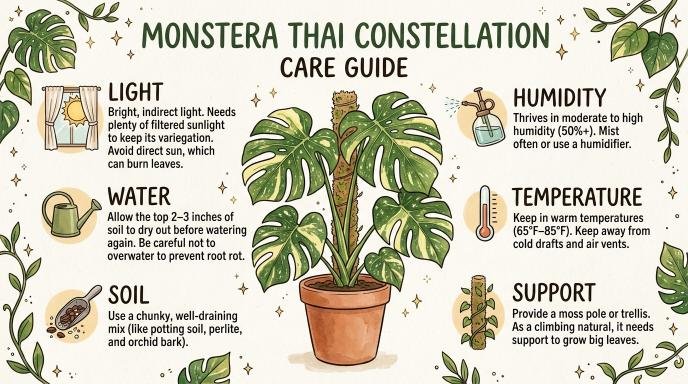
Monstera Thai Constellation grows best in bright, indirect light, a chunky, well-draining potting mix, and temperatures between 65°F and 85°F. Water when the upper 1–2 inches of soil feel dry, maintain moderate to high humidity, and fertilize lightly during active growth. Use a pot with drainage holes to reduce the risk of root rot.
What Is Monstera Thai Constellation?
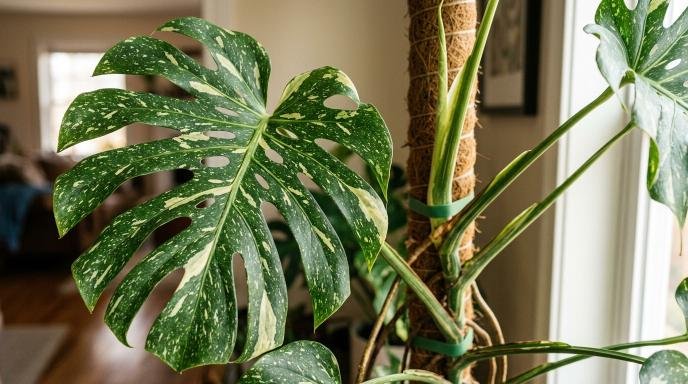
Monstera Thai Constellation is a variegated form of Monstera deliciosa, a tropical climbing plant native to Central America. Its leaves feature irregular cream-colored flecks, speckles, and larger patches that resemble stars scattered across a night sky.
Unlike some variegated plants whose patterns can change significantly from one leaf to another, Thai Constellation is generally valued for its relatively stable variegation. However, individual leaves can still vary in the amount and distribution of cream-colored tissue.
Key Characteristics
- Scientific name: Monstera deliciosa ‘Thai Constellation’
- Plant type: Tropical evergreen climbing aroid
- Leaf appearance: Large, green leaves with cream or pale yellow variegation
- Mature leaf shape: Broad, heart-shaped leaves that develop characteristic splits and holes
- Growth habit: Climbing, with aerial roots that help it attach to supports
- Light preference: Bright, indirect light
- Watering preference: Evenly moist soil with sufficient drying between waterings
- Humidity preference: Moderate to high humidity
- Toxicity: Toxic to cats, dogs, and people if chewed or ingested
Best Growing Conditions for Monstera Thai Constellation
The secret to growing this plant successfully is providing stable conditions rather than constantly changing its environment. Sudden changes in light, temperature, or watering can stress the plant and damage its attractive foliage.
| Growing factor | Recommended conditions |
|---|---|
| Light | Bright, indirect light |
| Temperature | 65–85°F (18–29°C) |
| Humidity | Ideally 50–70% |
| Watering | When the upper 1–2 inches of soil dry |
| Soil pH | Slightly acidic to neutral |
| Soil texture | Chunky, airy, and well-draining |
| Fertilizer | Balanced houseplant fertilizer during active growth |
| Pot | Container with drainage holes |
| Support | Moss pole, coir pole, or sturdy plant stake |
These recommendations provide a useful starting point, but your plant’s actual needs will depend on pot size, room temperature, light intensity, and how quickly its growing medium dries.
1. Provide Bright, Indirect Light
Light is one of the most important factors in Monstera Thai Constellation care. Because the cream-colored portions of its leaves have reduced chlorophyll, the plant benefits from adequate light to support photosynthesis.
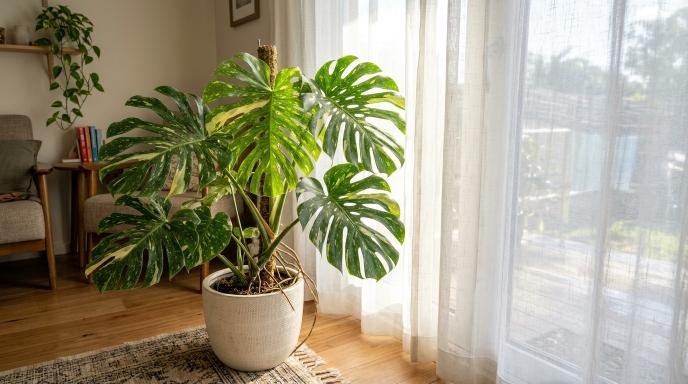
Place your plant near an east-facing window or a short distance from a bright south- or west-facing window where harsh direct sunlight is filtered.
How Much Light Does It Need?
Aim for a bright location where the plant receives plenty of ambient daylight without prolonged exposure to intense midday or afternoon sun.
A few gentle morning sun rays may be tolerated, especially after gradual acclimation. However, sudden exposure to strong sunlight can scorch the foliage, leaving dry, brown patches that will not turn green again.
Signs Your Plant Needs More Light
Watch for these changes:
- New leaves emerge smaller than expected.
- Stems become stretched, with longer spaces between leaves.
- Growth slows despite suitable watering and temperatures.
- The plant consistently leans toward the nearest window.
If these symptoms appear, gradually move the plant to a brighter location.
Can Thai Constellation Grow in Low Light?
It may survive in a lower-light room, but growth will usually be slower. Prolonged insufficient light can produce smaller leaves and reduce the plant’s ability to support healthy new growth.
A full-spectrum grow light can help when natural daylight is limited. Position it according to the manufacturer’s instructions and adjust the schedule based on the plant’s response.
Expert tip: Do not put a plant directly against a hot window simply because it needs more light. Bright indirect light is generally safer than intense sunlight concentrated on its leaves.
2. Water Only When the Soil Needs It
Overwatering is one of the most common reasons Monstera Thai Constellation develops yellow leaves and unhealthy roots. However, allowing the root ball to become completely dry for extended periods can also cause stress.
The goal is to water thoroughly and then allow excess moisture to drain away.
How Often Should You Water?
There is no universal watering schedule. Indoor plants may need water every several days in warm, bright conditions or much less frequently in cool, low-light rooms.
Instead of watering every Sunday, check the soil before each watering.
Follow these steps:
- Insert your finger approximately 1–2 inches into the potting mix.
- If the upper layer feels dry, check whether deeper soil remains wet.
- If the upper layer is dry and the root zone is no longer saturated, water thoroughly.
- Allow excess water to escape through the drainage holes.
- Empty the saucer or decorative outer pot so the roots are not left standing in water.
Smaller pots and plants growing in warm rooms generally dry faster than large pots in cool spaces.
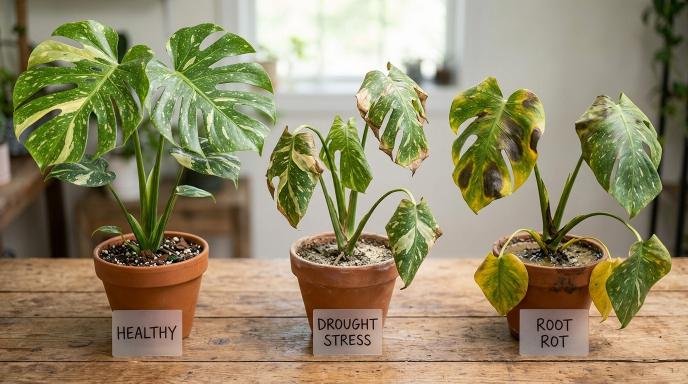
Signs of Overwatering
- Several leaves turn yellow.
- Soil remains wet for many days.
- Stems or petioles become unusually soft.
- The plant develops a musty smell.
- Roots become brown, mushy, or unpleasant-smelling.
Yellow leaves alone do not prove overwatering. Check the soil moisture and root condition before changing your routine.
Signs of Underwatering
- Leaves droop or curl.
- The pot feels unusually light.
- The soil pulls away from the pot’s edges.
- Leaf edges become dry and crispy.
If the soil has become extremely dry, water slowly and thoroughly. Very dry potting mix may initially repel water, so several gradual passes can help rehydrate the root ball.
Expert tip: A moisture meter can help with large pots, but it should not replace checking the plant, soil texture, and drainage. Different potting mixes can produce different readings.
3. Use a Chunky, Well-Draining Potting Mix
Monstera Thai Constellation has roots that need both moisture and oxygen. Dense soil that stays saturated can restrict airflow and increase the risk of root rot.
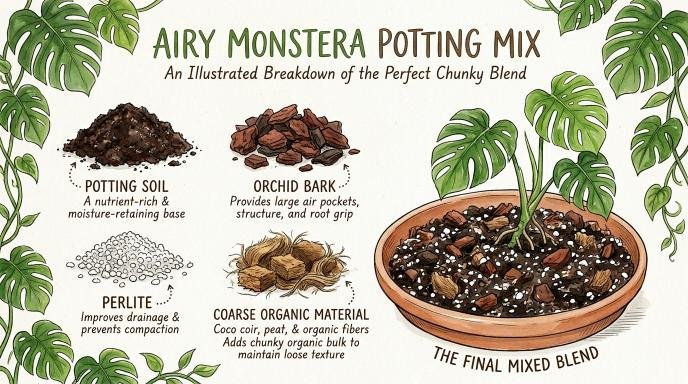
A chunky aroid mix provides spaces for air and allows excess water to drain while retaining enough moisture for the plant to absorb.
Recommended Soil Mix
A practical starting recipe is:
- 40% high-quality potting mix or coco-based growing medium
- 25% orchid bark
- 20% perlite or pumice
- 15% coco chips or another suitable coarse component
These proportions are flexible rather than mandatory. Adjust the mixture according to how quickly it dries in your home.
For example, a plant in a hot, dry room may benefit from slightly greater moisture retention, while a plant in a humid room may need a more open mix.
Avoid soil that becomes compacted or remains waterlogged after watering.
Can You Use Regular Potting Soil?
Yes, but ordinary potting soil may retain too much moisture when used alone. Mixing it with coarse materials can improve drainage and aeration.
Do not confuse a well-draining mix with one that dries out almost immediately. Thai Constellation needs a balance of moisture retention and airflow.
4. Maintain Suitable Temperature and Humidity
As a tropical plant, Monstera Thai Constellation prefers warm conditions and benefits from moderate to high humidity.
Ideal Temperature
A comfortable range is approximately 65–85°F (18–29°C).
Protect the plant from:
- Cold drafts near frequently opened doors.
- Air-conditioning vents blowing directly onto leaves.
- Hot air from heaters.
- Sudden temperature changes.
- Prolonged exposure to temperatures below approximately 55°F (13°C).
Cold stress can cause drooping, damaged foliage, and slowed growth. A plant near a cold window may experience lower temperatures than the rest of the room, particularly during winter nights.
What Humidity Does It Need?
Humidity around 50–70% is a useful target for indoor growing. The plant can tolerate lower humidity in many homes, but very dry air may contribute to crispy leaf edges, especially when combined with irregular watering or heat.
To improve humidity:
- Use a room humidifier.
- Group compatible tropical plants together.
- Keep the plant away from heating and cooling vents.
- Monitor room conditions with a small digital hygrometer.
Misting the leaves provides only a temporary increase in surface moisture and is not a reliable way to maintain consistent room humidity.
Expert tip: If brown leaf edges appear, investigate several factors before blaming humidity. Damaged roots, fertilizer buildup, underwatering, and direct sunlight can cause similar symptoms.
5. Fertilize for Healthy Growth
Monstera Thai Constellation needs nutrients to produce roots, stems, and new leaves. However, excessive fertilizer can damage roots and contribute to brown leaf tips.
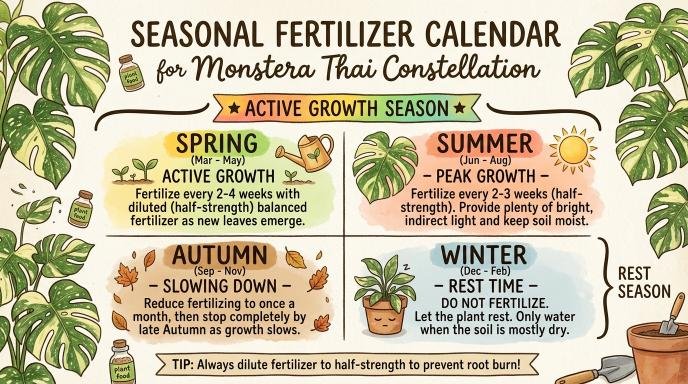
Use a balanced, water-soluble houseplant fertilizer during active growth, generally in spring and summer.
Fertilizing Schedule
- Spring: Begin light feeding as growth resumes.
- Summer: Continue according to the fertilizer label and the plant’s growth rate.
- Autumn: Reduce feeding as growth slows.
- Winter: Fertilize sparingly or pause if growth has stopped because of low light or cool conditions.
A diluted application is often safer than repeatedly applying a strong concentration. Follow the product label and avoid combining several fertilizers without a clear reason.
Signs of Fertilizer Problems
Excess fertilizer may cause brown tips, leaf-edge damage, or a crust of mineral salts on the soil surface. Severe accumulation can injure roots and interfere with water uptake.
If you suspect salt buildup, flush the growing medium with clean water if the pot drains freely. Allow it to drain completely, and reconsider the fertilizer concentration and frequency.
Do not fertilize a severely stressed plant simply to encourage recovery. Correct the underlying problem first.
6. Choose the Right Pot and Repot Carefully
The correct pot size helps maintain a healthy balance between moisture retention and root growth.
A pot that is too large may hold excess moisture around a relatively small root system. A container that is too small may dry rapidly and restrict further growth.
When Should You Repot?
Consider repotting when:
- Roots emerge from several drainage holes.
- The root ball becomes densely packed.
- Water passes through the pot unusually quickly because the mix is root-bound.
- Growth slows despite suitable light, nutrition, and watering.
- The potting mix has broken down and no longer drains properly.
A few roots appearing through drainage holes do not automatically mean repotting is urgent.
How to Repot Monstera Thai Constellation
- Select a pot with drainage holes, usually only 1–2 inches wider than the existing container.
- Prepare fresh, airy potting mix.
- Gently remove the plant and inspect the roots.
- Trim only roots that are dead, mushy, or clearly rotting, using clean tools.
- Place the plant at the same approximate soil depth as before.
- Fill around the roots without tightly compressing the mix.
- Water thoroughly and allow excess water to drain.
After repotting, place the plant in bright indirect light and avoid unnecessary disturbance while it adjusts.
Important: Do not bury the stem deeply or pack the growing medium tightly around the roots. Both practices can interfere with airflow and increase moisture-related problems.
Image suggestion: A step-by-step repotting illustration showing root inspection, pot selection, and the correct soil level.
7. Support Climbing Growth With a Moss Pole
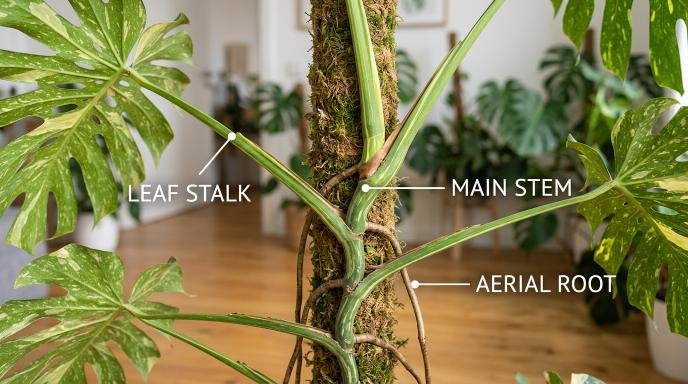
Monstera Thai Constellation is a climbing plant. In nature, its aerial roots help it attach to supporting surfaces as it grows upward.
Indoors, a moss pole, coir pole, or sturdy trellis can help the plant develop a more upright form.
Why Use a Support?
A climbing support can:
- Keep stems from sprawling across furniture.
- Help organize the plant’s growth.
- Provide a surface for aerial roots to attach to.
- Support larger leaves as the plant matures.
A moss pole that holds some moisture may encourage aerial roots to attach, although results depend on the pole design and growing conditions.
How to Attach the Plant
Position the support close to the climbing stem and use soft plant ties to secure the stem without squeezing it.
Avoid tying leaf stalks tightly. Petioles need room to move and orient their leaves toward light.
Direct aerial roots toward the support where practical, but do not force them into a position that risks breaking them.
If the plant becomes top-heavy, stabilize the pot or choose a stronger support rather than repeatedly tightening the ties.
Expert tip: Mature leaf development depends on several factors, including plant maturity, adequate light, nutrition, and climbing support. A moss pole alone cannot guarantee large, fenestrated leaves.
8. Understand Variegation and New Leaf Development
The cream-colored patterns are the main attraction of Monstera Thai Constellation, but variegation can influence how the plant grows.
Cream-colored tissue contains less chlorophyll than green tissue. As a result, heavily variegated leaves contribute less photosynthetic area than similarly sized green leaves.
Why Does Variegation Matter?
A plant with substantial cream-colored tissue may grow more slowly than a mostly green Monstera deliciosa under otherwise similar conditions.
The pale sections can also be more vulnerable to visible browning from harsh sunlight, dehydration, or other stress.
However, brown patches do not automatically mean the variegation is disappearing. They may indicate physical damage, sun scorch, root problems, or inconsistent moisture.
Will New Leaves Have More White or More Green?
The exact pattern of each new leaf cannot be predicted reliably.
Thai Constellation is generally considered a relatively stable variegated cultivar, but individual leaves still vary. Some may be more green, while others have more extensive cream-colored areas.
Do not try to force greater variegation by exposing the plant to intense direct sunlight or starving it of nutrients.
The goal is to support balanced growth and preserve the health of the existing foliage.
What If a Leaf Is Almost Completely Cream-Colored?
A highly cream-colored leaf has limited photosynthetic capacity. If the plant produces several leaves with very little green tissue, its overall growth may become weaker.
Maintain suitable light and inspect the pattern of growth over several leaves before making major changes.
If new growth repeatedly becomes almost entirely cream-colored and the plant weakens, consider whether pruning is appropriate. Removing a leaf alone will not guarantee a different pattern; the location of a cut and the growth point that develops afterward matter.
9. How to Propagate Monstera Thai Constellation
Propagation allows you to grow a new plant from a healthy piece of the parent plant. Stem cuttings are the most practical option for many home growers.
Unlike plants that can be propagated from an ordinary leaf alone, Monstera needs a viable stem node for conventional stem-cutting propagation.
What Is a Node?
A node is the point on a stem where a leaf, bud, or aerial root emerges. It contains the growth structures needed for a new shoot to develop.
A cutting with a leaf but no viable node may survive temporarily, but it generally cannot produce a new growing stem.
Propagation Steps
- Choose a healthy stem section with at least one viable node.
- Use a clean, sharp cutting tool.
- Make the cut so the node is included in the cutting.
- Place the node in water or an appropriate propagation medium, keeping the leaf above the water or substrate where possible.
- Provide warmth and bright indirect light.
- Check regularly for root development and remove any rotting material.
- Transfer water-rooted cuttings into an airy potting mix when the roots are sufficiently developed.
Avoid transferring a cutting with only tiny, fragile roots directly into a large pot that stays wet for long periods.
Can You Propagate Thai Constellation in Water?
Yes. Water propagation can work if the cutting includes a healthy node and receives suitable care.
Keep the water clean, monitor the node for decay, and transfer the cutting once a functional root system develops.
Alternatively, a suitable moist propagation medium may provide a smoother transition to soil-based growing conditions.
Important: Variegation in a cutting depends on the stem section and its growth point. A cutting from a green-only section may produce predominantly green growth, while a cutting from a heavily variegated section may have limited photosynthetic tissue.
10. Common Monstera Thai Constellation Problems and Solutions
Troubleshooting should begin with observation rather than immediately adding fertilizer, increasing humidity, or watering more frequently.
Look at the pattern of damage, soil moisture, recent environmental changes, and the condition of the roots.
| Problem | Possible causes | What to do |
|---|---|---|
| Yellow leaves | Overwatering, root stress, natural aging, or poor light | Check soil moisture and roots before changing care |
| Brown leaf tips | Dry air, inconsistent watering, fertilizer salts, or root damage | Review humidity, watering consistency, and fertilizer use |
| Brown, bleached patches | Sun scorch or physical damage | Move away from harsh direct sun and avoid further stress |
| Drooping leaves | Underwatering, overwatering, root damage, or temperature stress | Check the root zone and room conditions |
| Small new leaves | Insufficient light, immaturity, inadequate nutrition, or lack of support | Improve growing conditions and support climbing growth |
| Slow growth | Seasonal dormancy, low light, root problems, or nutrient limitations | Evaluate light, temperature, and root health |
| Black or soft stems | Potential rot or severe tissue damage | Isolate if necessary and inspect affected tissue and roots |
| Brown spots spreading across leaves | Possible fungal or bacterial disease, pests, or environmental injury | Isolate the plant, inspect closely, and avoid wetting foliage unnecessarily |
| Fine webbing or stippled leaves | Possible spider mites | Inspect leaf undersides and treat confirmed pests appropriately |
| Sticky residue or cottony clusters | Possible scale insects or mealybugs | Isolate the plant and inspect stems, nodes, and leaf joints |
Why Are the Cream-Colored Parts Turning Brown?
The pale portions of Thai Constellation leaves may brown more visibly than green tissue because they contain less chlorophyll and can be vulnerable to stress.
Potential causes include:
- Excessive direct sunlight.
- Prolonged underwatering.
- Root damage that reduces water uptake.
- Fertilizer or mineral salt accumulation.
- Very dry air combined with other environmental stress.
First check the soil and roots. If the plant is otherwise healthy, consider whether recent sunlight exposure or dry conditions explain the damage.
Existing brown tissue will not become green again. Focus on preventing additional damage rather than trying to reverse the affected area.
What Should You Do About Root Rot?
If the soil stays wet and the plant continues to deteriorate, inspect the roots.
Healthy roots are generally firm, while rotten roots are often soft, dark, and may smell unpleasant.
Remove the plant from its pot, trim clearly rotten roots with clean tools, and repot it into fresh, well-draining medium. Use a suitably sized pot with drainage holes.
Afterward, correct the conditions that caused the problem. Repotting alone will not prevent root rot if the new medium remains saturated.
11. Seasonal Monstera Thai Constellation Care
The same watering and fertilizer schedule may not work throughout the year because light levels, room temperatures, and growth rates change.
Spring
Spring often brings renewed growth as daylight increases.
- Check whether the plant needs repotting.
- Resume light fertilization if growth is active.
- Inspect new leaves and roots.
- Gradually improve light exposure if the plant has been in a dim winter location.
Summer
Warm conditions may encourage faster growth and quicker soil drying.
- Check moisture more frequently.
- Protect leaves from intense afternoon sun.
- Monitor for spider mites, mealybugs, and scale.
- Secure new growth to its climbing support.
Do not automatically increase watering simply because it is summer. The root zone still needs sufficient aeration.
Autumn
As daylight decreases, growth may slow.
- Reduce fertilizer if the plant is no longer growing actively.
- Reassess the watering frequency.
- Move the plant away from cooling drafts.
- Clean dusty leaves carefully.
Winter
Indoor plants often use less water during periods of reduced light and cooler temperatures.
- Water according to soil moisture rather than a fixed schedule.
- Avoid placing the plant against cold glass.
- Keep it away from heating vents.
- Pause or reduce feeding if growth has stopped.
12. How to Clean and Maintain the Leaves
Dust can accumulate on broad Monstera leaves, reducing their clean appearance and making it harder to inspect for pests.
Wipe the leaves gently with a soft, damp cloth. Support the leaf from underneath so it does not bend or tear.
Avoid abrasive cleaners, household detergents, and unnecessary leaf-shine products. These can leave residues or damage the leaf surface.
While cleaning, inspect both sides of each leaf, the petiole joints, and the main stem. Early detection makes pest management easier.
Remove completely dead leaves using clean scissors, but avoid cutting healthy leaves merely because they have minor cosmetic imperfections.
Practical tip: Newly unfurled Monstera leaves are delicate. Avoid repeatedly touching or trying to open them by hand because they can tear or develop permanent damage.
13. Is Monstera Thai Constellation Toxic to Pets?
Yes. Monstera deliciosa, including Thai Constellation, contains insoluble calcium oxalate crystals that can irritate the mouth and digestive tract when plant tissue is chewed or swallowed.
Possible symptoms include:
- Oral pain or irritation.
- Drooling.
- Pawing at the mouth.
- Difficulty swallowing.
- Vomiting or reduced appetite.
Keep the plant out of reach of cats, dogs, and children who might chew its leaves or stems.
If a pet chews the plant and develops symptoms, contact a veterinarian promptly. If a person ingests part of the plant or develops significant symptoms, seek appropriate medical or poison-control advice.
Wearing gloves while pruning is sensible, particularly if you have sensitive skin. Wash your hands after handling damaged plant tissue and keep cuttings away from pets.
14. Essential Supplies for Growing Thai Constellation
You do not need an expensive collection of equipment to grow this plant successfully. Prioritize the supplies that address real growing needs.
| Supply | Why it helps | What to look for |
|---|---|---|
| Pot with drainage holes | Reduces standing water around roots | Correct size and unobstructed drainage |
| Chunky aroid mix | Improves aeration and drainage | Bark, perlite, and suitable moisture-retaining material |
| Watering can | Allows controlled, thorough watering | A narrow spout for directing water toward the soil |
| Digital hygrometer | Helps monitor humidity | Easy-to-read temperature and humidity display |
| Grow light | Supplements inadequate natural light | Full-spectrum light suitable for indoor plants |
| Climbing support | Stabilizes upright growth | Strong pole or trellis that fits the plant’s size |
| Soft plant ties | Secures stems without constriction | Flexible ties that can be adjusted as the plant grows |
| Clean pruning shears | Supports hygienic pruning and propagation | Sharp blades that can be cleaned between cuts |
Start with the essentials. A suitable pot, healthy roots, appropriate light, and well-managed watering generally matter more than specialized accessories.
Frequently Asked Questions About Monstera Thai Constellation Care
Is Monstera Thai Constellation difficult to care for?
It is manageable for beginners who can provide bright indirect light, a well-draining growing medium, and consistent moisture management. Its main challenge is preventing root problems while supplying enough light for healthy growth.
How fast does Monstera Thai Constellation grow?
Growth depends on light, temperature, plant maturity, root health, and the growing season. It generally grows more slowly than a comparable green Monstera deliciosa because its cream-colored tissue contributes less to photosynthesis.
How often should I water Monstera Thai Constellation?
Water when the upper 1–2 inches of soil feel dry and the root zone is no longer saturated. The exact interval varies with pot size, room conditions, and the potting mix.
Can Monstera Thai Constellation tolerate direct sunlight?
It may tolerate gentle morning sunlight after gradual acclimation, but intense direct sun can scorch its leaves. Bright indirect light is a safer default.
Why is my Thai Constellation producing small leaves?
Possible reasons include inadequate light, an immature plant, root problems, insufficient nutrition, or lack of climbing support. Check these conditions before increasing fertilizer.
Why are my Thai Constellation leaves turning yellow?
Overwatering is one possible cause, but natural aging, underwatering, root damage, and insufficient light can also contribute. Check soil moisture and inspect the roots if several leaves yellow or the plant declines rapidly.
Does Monstera Thai Constellation need a moss pole?
No, but a sturdy climbing support can help organize growth and provide a surface for aerial roots. It does not guarantee larger leaves by itself.
Can I grow Monstera Thai Constellation in water permanently?
It can be maintained in water under suitable conditions, but long-term water culture requires careful management of nutrients, water quality, oxygen, and root health. A well-aerated potting mix is a practical choice for most home growers.
How do I encourage more variegation?
You cannot reliably control the exact pattern of each new leaf. Provide sufficient bright indirect light and maintain healthy growing conditions. Do not use harsh sunlight or nutrient deprivation to try to increase variegation.
When should I repot my Thai Constellation?
Repot when the roots are crowded, the potting mix has deteriorated, or water management becomes difficult because the root system fills the container. Choose a pot only modestly larger than the existing root ball.
Can Monstera Thai Constellation grow outdoors?
It can grow outdoors in suitable warm, humid climates with filtered light and protection from harsh afternoon sun. In cooler climates, grow it indoors or bring it inside before temperatures become too low.
Should I cut off brown leaf tips?
You can trim dead brown tissue for appearance, using clean scissors and following the natural leaf shape. Leave healthy green and cream-colored tissue intact, and investigate the underlying cause to prevent further damage.
Conclusion
Successful Monstera Thai Constellation care comes down to maintaining a healthy root system, providing bright indirect light, using an airy potting mix, and watering according to actual soil moisture.
Pay particular attention to the cream-colored foliage, which may show stress more visibly than green tissue. Protect the plant from harsh sunlight, avoid excessive fertilizer, and give climbing stems appropriate support as they mature.
Most importantly, observe your plant before making changes. Yellow leaves, brown tips, and slow growth can have several causes, so checking the soil, roots, light, and recent environmental conditions is more effective than following a rigid care schedule.
With stable growing conditions and careful attention to its needs, Monstera Thai Constellation can develop into a healthy, impressive indoor plant with distinctive variegated foliage.