Monstera Albo is a striking tropical houseplant prized for its large, split green leaves decorated with creamy-white variegation. However, its beautiful appearance comes with a few extra care requirements.
White leaf sections contain little or no chlorophyll, so the plant needs the right balance of light, watering, humidity, and nutrition to grow successfully.
With proper Monstera Albo care, you can encourage healthy new leaves, protect delicate white sections from browning, and maintain attractive variegation without risking root rot. Whether you are caring for your first cutting or maintaining a mature climbing plant, understanding its growing habits will make a noticeable difference.
Quick Answer
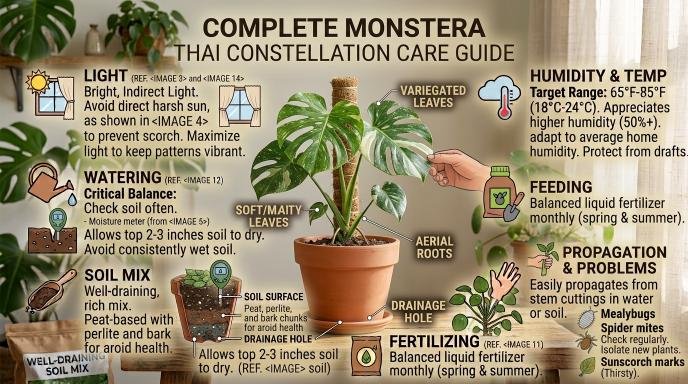
Monstera Albo grows best in bright, indirect light, a chunky well-draining potting mix, and temperatures between 65–85°F (18–29°C). Water when the top 1–2 inches of soil feel dry, maintain moderate to high humidity, and provide a moss pole for support. Avoid harsh sunlight, soggy soil, and excessive fertilizer.
What Is a Monstera Albo?


Monstera Albo is a variegated form of Monstera deliciosa known for its dramatic green-and-white foliage. Its botanical name is commonly written as Monstera deliciosa ‘Albo Variegata’.
Unlike an ordinary green Monstera, this plant develops white or cream-colored patches, streaks, and large sectors across its leaves. The pattern varies from leaf to leaf, making every plant visually unique.
The white areas contain less chlorophyll than green areas. As a result, Monstera Albo generally grows more slowly than fully green Monstera deliciosa and can be more sensitive to unsuitable growing conditions.
Why variegation affects plant care
- Slower growth: Less chlorophyll means the plant has less capacity to produce energy through photosynthesis.
- Greater light sensitivity: White sections can scorch in strong direct sunlight.
- Potential for brown patches: White tissue may brown when exposed to excessive heat, inconsistent moisture, root problems, or other stress.
- Variable leaf patterns: A new leaf may contain more green or more white than the previous one.
A common beginner mistake is assuming that more white means a healthier plant. In reality, a leaf with balanced green and white areas often supports growth more effectively than one that is almost entirely white.
Best Growing Conditions for Monstera Albo
The goal is to recreate the warm, humid, filtered-light conditions of a tropical climbing plant while allowing its roots to breathe.
| Growing factor | Ideal conditions |
|---|---|
| Light | Bright, indirect light |
| Temperature | 65–85°F (18–29°C) |
| Humidity | Approximately 50–70% |
| Soil | Chunky, airy, well-draining mix |
| Watering | When the upper 1–2 inches dry |
| Fertilizer | Balanced, diluted fertilizer during active growth |
| Pot | Drainage holes are essential |
| Support | Moss pole or sturdy climbing support |
These are practical starting points rather than rigid rules. Your plant’s pot size, root health, season, and indoor climate will influence how quickly the soil dries and how frequently new leaves develop.
Provide the Right Amount of Light

Light is one of the most important factors in successful Monstera Albo care. The plant needs enough light to support growth, but its white leaf sections can be damaged by intense direct sun.
Where should you place Monstera Albo?
A bright room near an east-facing window is often a good starting point. A south- or west-facing window may also work if you diffuse the sunlight with a sheer curtain or place the plant farther from the glass.
Look for a location where:
- The leaves receive plenty of ambient daylight.
- Strong midday or afternoon sun does not fall directly on the foliage.
- The plant is not pressed against hot window glass.
- New growth remains firm and develops without excessive stretching.
If natural light is limited, a full-spectrum grow light can help. Position it according to the manufacturer’s instructions, and adjust the distance if the leaves become unusually warm or stressed.
Signs your Monstera Albo needs more light
- New leaves emerge smaller than expected.
- Stems become long and stretched between leaves.
- Growth slows considerably during the growing season.
- The plant consistently leans toward a window.
Insufficient light can also reduce the plant’s ability to support highly variegated growth.
Signs of excessive light
- White areas develop dry, tan, or brown patches.
- Leaf surfaces look bleached or scorched.
- Damage appears on the side facing the window.
Expert tip: Increase light gradually when moving a plant from a dim room to a brighter location. A sudden change can scorch leaves even if the new location would otherwise be suitable.
Image suggestion: Show a healthy Monstera Albo beside a window, with indirect light and a sheer curtain.
Water Only When the Soil Needs It

Add to Favorites
Watering mistakes are among the most common causes of declining Monstera Albo plants. Both underwatering and overwatering can produce brown leaf edges, but consistently wet soil is particularly dangerous because it deprives roots of oxygen and encourages root rot.
How often should you water Monstera Albo?
There is no reliable universal watering schedule. Depending on light, temperature, pot size, and soil composition, your plant may need water every several days or only every couple of weeks.
Instead of watering on a fixed weekday, follow these steps:
- Insert your finger about 1–2 inches into the soil.
- Check whether the upper layer has dried.
- If it is still wet, wait and check again later.
- If the upper layer is dry and the pot feels lighter, water thoroughly.
- Let excess water drain completely before returning the pot to its decorative cover or saucer.
For a mature plant in a large pot, check the soil more deeply if necessary. The surface can be dry while the lower root zone remains wet.
How to water correctly
Water slowly over the soil until water flows through the drainage holes. Allow the excess to escape rather than letting the pot sit in standing water.
Avoid giving the plant repeated tiny amounts of water. Light surface watering can leave parts of the root ball dry while keeping other areas unevenly moist.
Underwatering versus overwatering
| Symptom | Possible cause | What to do |
|---|---|---|
| Drooping leaves and dry soil | Underwatering | Water thoroughly and allow drainage |
| Yellowing leaves and wet soil | Overwatering or root stress | Check moisture and inspect roots if symptoms persist |
| Brown, crispy margins | Low humidity, underwatering, or root issues | Assess soil, room conditions, and root health |
| Soft stems or a sour soil smell | Possible root rot | Inspect roots and correct drainage |
One yellow leaf does not automatically mean root rot. Older leaves naturally age, so look at the soil condition and the overall pattern of symptoms before changing your care routine.
Use a Chunky, Well-Draining Soil Mix

Monstera Albo grows best in a growing medium that holds some moisture but does not stay compacted and waterlogged. Its roots need both water and air to function properly.
Ordinary dense garden soil is usually unsuitable for indoor pots because it can compact, drain poorly, and remain wet for too long.
A practical Monstera Albo soil recipe
Try this starting mix:
- 40% quality indoor potting mix or coco-based potting medium.
- 30% orchid bark.
- 20% perlite or pumice.
- 10% horticultural charcoal, if desired.
The exact proportions are flexible. The important result is a loose, stable mix with enough moisture retention for the roots and plenty of air spaces.
If your room is hot and dry, you may need a slightly more moisture-retentive mix. In a cool, humid room, a chunkier mix may help prevent prolonged wetness.
How to tell if your soil needs changing
Consider repotting if:
- Water sits on the surface for a long time.
- The mix stays wet for many days despite suitable warmth and light.
- The soil has become compacted or broken down.
- Roots are brown, mushy, or unpleasant-smelling.
- The plant dries out unusually quickly because the roots have filled the pot.
Do not repot simply because a particular number of months has passed. Healthy roots and a stable growing medium matter more than following an arbitrary schedule.
Maintain Suitable Temperature and Humidity
Monstera Albo is a tropical plant that prefers warmth and moderate to high humidity. Stable conditions usually produce better growth than repeated fluctuations.
Ideal temperature
Aim for 65–85°F (18–29°C). Protect the plant from cold drafts, sudden temperature drops, and direct blasts from air conditioners or heaters.
Cold conditions can slow root activity and water uptake. When this happens, soil may remain wet longer than expected, increasing the risk of root problems.
Ideal humidity
A relative humidity of around 50–70% is a useful target for many indoor environments. The plant can often adapt to lower humidity, but dry air may contribute to crispy leaf edges, especially when watering or root health is also inconsistent.
Ways to improve humidity include:
- Using a room humidifier.
- Grouping plants while allowing sufficient airflow.
- Keeping the plant away from heating vents.
- Monitoring humidity with a small digital hygrometer.
Misting leaves is not a reliable way to maintain humidity because its effect is brief. Constantly wet foliage without good airflow can also encourage leaf problems.
Practical tip: If the room is comfortable for people and the plant is growing well, avoid making drastic environmental changes just to achieve a perfect humidity number. Stable conditions are often more useful than chasing an exact percentage.
Choose the Right Pot and Repot Carefully

Add to Favorites
A suitable pot helps control moisture and gives roots enough space to develop. The biggest pot is not necessarily the best pot.
What size pot does Monstera Albo need?
Choose a container that comfortably accommodates the root ball, usually only about 1–2 inches wider than the existing root mass. Make sure it has drainage holes.
A pot that is too large holds more unused wet soil around the roots. This can slow drying and increase the risk of root rot, especially when light and temperatures are low.
When should you repot?
Repot when you notice several signs of root crowding or declining soil quality, such as:
- Roots densely circling the bottom of the pot.
- Roots emerging from drainage holes.
- Water passing through very quickly because the root mass has filled the container.
- Growth slowing despite appropriate light, watering, and nutrition.
Roots emerging from drainage holes alone do not always require immediate repotting.
Step-by-step repotting
- Select a pot with drainage holes and an airy soil mix.
- Gently remove the plant and inspect its roots.
- Trim only clearly dead, mushy, or rotten roots with clean tools.
- Position the root ball at approximately its previous depth.
- Fill around the roots without packing the mix tightly.
- Water as appropriate for the fresh mix and allow excess water to drain.
- Keep the plant in stable, indirect light while it adjusts.
Repotting can temporarily slow growth. Avoid combining repotting with unnecessary pruning, major location changes, and heavy fertilization.
Fertilize for Healthy Growth
Monstera Albo needs nutrients to produce roots, stems, and leaves. However, extra fertilizer cannot compensate for insufficient light or unhealthy roots.
Use a balanced liquid houseplant fertilizer during active growth, following the product label. If the label allows dilution, beginning with a weaker concentration is a sensible precaution for a plant that grows slowly.
When should you fertilize?
- Spring and summer: Feed periodically when the plant is actively growing.
- Autumn: Reduce feeding as growth slows.
- Winter: Feed less often or pause if growth has largely stopped, particularly in low light.
The exact frequency depends on the fertilizer, growing medium, water quality, and growing conditions.
Signs of fertilizer problems
Excess fertilizer can cause brown leaf tips, damaged roots, or a crust of mineral salts on the soil surface. Nutrient deficiencies may cause pale foliage or weak growth, but those symptoms can also result from poor lighting, root damage, or incorrect watering.
If you suspect fertilizer buildup, pause feeding and assess the roots and soil. If drainage is good, flushing the pot with clean water can help remove accumulated soluble salts.
Do not fertilize a plant with severely damaged roots until it begins recovering.
Support Your Monstera Albo With a Moss Pole

Add to Favorites
Monstera deliciosa is a climbing plant. As it matures, it benefits from support that helps the stem grow upright and keeps larger leaves positioned attractively.
A moss pole, coir pole, or sturdy trellis can provide support. A moss pole may also encourage aerial roots to attach when its surface is suitably moist, although the plant can grow well on other supports too.
How to train Monstera Albo
- Place the support near the main stem without damaging the root ball.
- Loosely secure the stem with soft plant ties.
- Keep the ties away from leaf stalks and growing tips.
- Guide new growth toward the support as the plant develops.
- Check ties regularly so they do not cut into the stem.
Never force a mature stem into a sharp bend. Gradual adjustments are safer and less likely to cause damage.
Important: A support pole will not automatically increase variegation. Its primary role is to provide climbing structure and help the plant develop a more natural growth habit.
How to Maintain Strong Green-and-White Variegation

Variegation is one of the main reasons people grow Monstera Albo, but the pattern is not completely controllable. The amount and placement of white tissue depend largely on the plant’s genetic makeup and the growth point producing each leaf.
Good care supports healthy growth, but it cannot guarantee that every new leaf will have the same pattern.
Why is your Monstera Albo producing mostly green leaves?
A plant may produce greener leaves when its growth point shifts toward less-variegated growth. Other factors, including insufficient light, can affect how successfully it supports new foliage, but low light does not reliably explain every change in pattern.
Try these steps:
- Provide consistent bright, indirect light.
- Maintain healthy roots and an appropriate watering routine.
- Avoid excessive nitrogen fertilizer intended to force rapid growth.
- Observe several new leaves before deciding the pattern has permanently changed.
What if the plant produces an almost completely white leaf?
An almost entirely white leaf contributes little to photosynthesis and may be more prone to browning. One such leaf does not mean the plant is doomed, but repeated nearly all-white growth can weaken the plant over time.
If a stem repeatedly produces nearly all-white leaves, inspect the location of the active growth point. Pruning may be appropriate if you understand the stem’s nodes and can cut back to a viable node with healthier green-and-white growth.
Do not cut randomly through the stem or remove healthy leaves simply because they have a lot of white.
Can you make Monstera Albo more white?
Not reliably. Increasing light within a safe range can support healthy growth, but it does not guarantee more white variegation. Excessive sunlight can burn the leaves, and excessive fertilizer can damage the roots.
The best strategy is to maintain the plant’s health and allow its natural pattern to develop.
Image suggestion: Compare a balanced green-and-white leaf, a mostly green leaf, and a mostly white leaf, with brief explanations of their growth implications.
Pruning and Cleaning Monstera Albo Leaves
Pruning helps remove damaged tissue, control size, and manage growth. It should not be used as a routine way to remove every imperfect leaf.
When should you prune?
Remove a leaf if it is completely dead, severely damaged, or affected by a problem that requires removal. Slightly brown tips can usually remain if the rest of the leaf is healthy.
Use clean, sharp pruning shears. If you are correcting unwanted growth, identify the stem nodes first because new shoots develop from viable growth points rather than from a leaf blade alone.
How to clean the leaves
Dust can accumulate on broad Monstera leaves and reduce their appearance. Wipe the foliage gently with a soft cloth dampened with clean water.
Avoid abrasive cleaners, leaf-shine products that leave residue, and unnecessary handling of fragile white sections.
If you trim damaged white tissue, remember that the cut edge will not turn green again. Focus on preventing additional damage rather than repeatedly cutting back small brown areas.
Propagating Monstera Albo Successfully

Monstera Albo is commonly propagated from stem cuttings. A leaf without a viable node may stay attractive for a while in water, but it cannot normally produce a new climbing shoot on its own.
What does a viable cutting need?
A suitable cutting should have:
- At least one healthy node.
- A viable growth point or the potential to produce a new shoot.
- A healthy section of stem.
- Preferably, an aerial root or existing root system.
A leaf and its petiole alone are not enough for reliable long-term propagation.
Step-by-step propagation
- Identify a healthy stem section containing a node.
- Use clean pruning shears to make the cut.
- Allow the cut surface to dry briefly if appropriate for your chosen propagation method.
- Place the node in water, a suitable propagation medium, or moist sphagnum moss while keeping the leaf above the medium.
- Provide warmth and bright, indirect light.
- Monitor moisture and inspect for soft, dark, or foul-smelling tissue.
- Pot the cutting into an airy aroid mix once its roots are sufficiently developed for the chosen method.
Propagation speed varies. Avoid moving the cutting repeatedly between different media simply because roots have not appeared after a few days.
Water propagation versus moss propagation
| Method | Advantages | Things to watch |
|---|---|---|
| Water | Easy to inspect roots | Water needs regular replacement; submerged stem tissue can rot |
| Sphagnum moss | Holds moisture around the node | Can become too wet or compacted |
| Perlite-based medium | Offers air around developing roots | Moisture needs careful monitoring |
| Direct potting | Avoids a later transition from water | Root development is harder to inspect |
Propagation tip: A cutting with a balanced green-and-white pattern is often a more practical choice than one with an almost completely white leaf. Healthy stem tissue and a viable node matter more than the appearance of a single leaf.
Common Monstera Albo Problems and How to Fix Them
The most effective troubleshooting approach is to identify the pattern of damage, inspect the growing conditions, and correct the likely cause. Similar symptoms can have different explanations, so avoid treating every brown or yellow leaf with the same solution.

Brown tips or crispy white sections
Possible causes include dry air, inconsistent watering, fertilizer salts, root stress, or sunburn. Check the soil, review recent light changes, and assess the roots if the damage continues. White tissue is especially noticeable when it browns.

Yellowing leaves
One older leaf yellowing gradually may be normal. Several yellow leaves appearing together can indicate excessive moisture, poor drainage, root damage, or environmental stress. Check the moisture level before adding water.

Small leaves or stretched stems
Insufficient light is a common possibility. Move the plant gradually to a brighter location, check root health, and provide climbing support. Do not expect fertilizer alone to correct weak growth.

Scorched or bleached patches
Strong direct sunlight or excessive heat may be responsible. Filter the light and prevent the leaves from touching hot glass. Damaged areas generally will not regain their original appearance.

Soft roots, persistent wilting, or foul-smelling soil
Root rot is a concern, especially when the pot stays wet. Inspect the roots, remove rotten tissue with clean tools, and repot into a suitable airy mix if necessary. Do not simply add more water to a wilted plant without checking its soil.
What to do when a new leaf will not unfurl
A new Monstera Albo leaf may take time to unfurl, particularly in cooler conditions or when growth is slow. Low humidity, insufficient water uptake, and inconsistent environmental conditions can contribute to difficulty.
- Keep temperature and watering reasonably stable.
- Check that the root system is healthy.
- Avoid pulling the leaf open by hand.
- Do not repeatedly spray or soak the leaf in an attempt to force it open.
If the emerging leaf remains stuck for an extended period, inspect for pests and review the growing conditions before making changes.
How to recognize pests
Check the undersides of leaves, leaf joints, and new growth for spider mites, thrips, mealybugs, and scale insects. Look for fine webbing, silvery scarring, tiny moving insects, cottony clusters, or unusual sticky residue.
Isolate an affected plant from other houseplants. Identify the pest before choosing a treatment, and follow the product’s instructions carefully.
Seasonal Monstera Albo Care
Your plant’s water and fertilizer needs change with its environment. Seasonal adjustments are more useful than following the same routine all year.
| Season | Care priorities |
|---|---|
| Spring | Resume feeding as active growth returns; check whether repotting is needed |
| Summer | Monitor soil more frequently; protect leaves from intense direct sunlight |
| Autumn | Reduce fertilizer as growth slows; watch for cooler drafts |
| Winter | Water less often when drying slows; maintain suitable warmth and adequate light |
These are general guidelines for indoor plants in temperate seasonal conditions. In a warm climate, such as many parts of Pakistan, Monstera Albo may continue growing for much of the year if light, temperature, and root conditions remain suitable.
During very hot weather, protect the plant from harsh afternoon sun and hot window glass. In air-conditioned rooms, avoid placing it directly in the path of cold, dry air.
During cooler months, do not continue watering at the summer frequency if the soil takes much longer to dry.
How to Encourage Healthy New Leaves
A new leaf is a useful indicator of how well your plant is adapting. However, one leaf cannot tell you everything about its health.
For more consistent growth:
- Prioritize light: Keep the plant in a bright location without prolonged harsh direct sun.
- Protect the roots: Use an airy mix and avoid keeping the root zone constantly wet.
- Maintain stable warmth: Protect the plant from sudden temperature changes.
- Feed appropriately: Fertilize during active growth rather than forcing growth with excess nutrients.
- Provide support: Let the climbing stem attach to a suitable structure.
- Monitor new growth: Look for firm stems, healthy roots, and leaves that unfurl normally.
A healthy Monstera Albo may still grow slowly. Growth rate depends on the plant’s maturity, genetics, growing season, root system, and available light.
Do not compare your plant’s growth directly with a fully green Monstera deliciosa. The latter generally has a greater photosynthetic capacity and may produce foliage more quickly.
Frequently Asked Questions About Monstera Albo Care
Is Monstera Albo difficult to care for?
Monstera Albo is manageable for beginners who understand basic watering and lighting. Its slower growth, sensitive white tissue, and susceptibility to root problems make it less forgiving of inconsistent care than many fully green houseplants.
How much sunlight does Monstera Albo need?
It prefers bright, indirect light for much of the day. Gentle morning sun may be tolerated after gradual acclimation, but strong direct afternoon sunlight can scorch the white portions of its leaves.
Why are the white leaves on my Monstera Albo turning brown?
White tissue contains little or no chlorophyll and can be vulnerable to environmental stress. Brown areas may result from direct sunlight, dry conditions, inconsistent watering, fertilizer buildup, or root damage. Check the plant’s overall growing conditions rather than assuming humidity is always the cause.
How often should I water Monstera Albo?
Water when the upper 1–2 inches of the potting mix feel dry, then water thoroughly and let excess drain away. Check the soil more frequently in warm weather and less frequently when growth slows or the room becomes cooler.
Does Monstera Albo need a moss pole?
A moss pole is not essential, but it is helpful because Monstera deliciosa naturally climbs. A sturdy trellis or another suitable support can also work.
Can Monstera Albo survive in low light?
It may survive for some time in lower light, but prolonged insufficient light can lead to slow growth, smaller leaves, and stretched stems. A brighter position with indirect light is generally better.
How fast does Monstera Albo grow?
Growth varies with maturity, season, light, temperature, root health, and genetics. Under suitable conditions, it can produce new leaves during the growing season, but its growth is generally slower than that of a fully green Monstera deliciosa.
Should I cut off brown parts of Monstera Albo leaves?
You can trim completely dead or unsightly brown edges with clean scissors, but small patches do not always need removal. Trimming improves appearance rather than reversing the underlying damage. Correct the cause to reduce further browning.
Can I grow Monstera Albo in water permanently?
A stem cutting can root in water, but long-term water culture requires appropriate oxygenation, nutrient management, and water quality. For most home growers, a well-aerated potting mix is a practical option for sustained growth.
Why is my Monstera Albo producing all-green leaves?
The growth point may be producing less-variegated growth. Provide adequate indirect light and maintain healthy roots, but remember that lighting cannot guarantee a particular variegation pattern. If repeated new leaves are entirely green, consider whether selective pruning back to a suitable node is appropriate.
Is Monstera Albo toxic to pets?
Yes. Monstera deliciosa contains insoluble calcium oxalate crystals that can irritate the mouth and digestive tract if chewed or eaten. Keep the plant out of reach of cats, dogs, and young children. Seek veterinary advice if a pet eats part of the plant and develops symptoms.
Conclusion
Successful Monstera Albo care comes down to maintaining healthy roots, providing bright indirect light, watering according to soil moisture, and keeping growing conditions stable. An airy potting mix and suitable climbing support can also help the plant develop strong stems and attractive foliage.
Remember that white variegation is naturally variable. Brown tips or an unusually green leaf do not automatically mean your plant is unhealthy, and more fertilizer or stronger sunlight will not necessarily improve its appearance.
Start with the basics, observe how quickly your soil dries, and make changes gradually. With consistent care and attention to new growth, your Monstera Albo can remain a beautiful feature of your indoor plant collection.