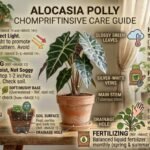
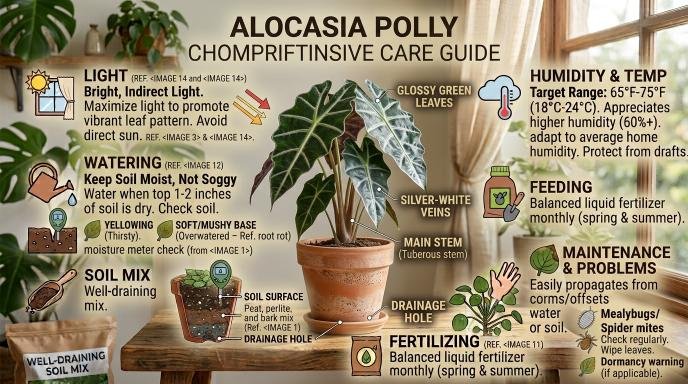
Alocasia Polly is a striking tropical houseplant known for its dark green, arrow-shaped leaves, dramatic silvery-white veins, and attractive wavy edges. Although its bold appearance makes it a favorite among indoor plant lovers, it can be sensitive to improper watering, low humidity, and sudden environmental changes. Understanding alocasia polly care helps you maintain healthy foliage, encourage steady growth, and prevent common problems such as yellow leaves and root rot.
Whether you are growing your first Alocasia Polly or trying to revive a struggling plant, the key is to provide bright indirect light, consistent warmth, suitable humidity, and a well-draining potting mix. With the right routine, this tropical beauty can thrive indoors throughout the growing season.
Quick Answer
Alocasia Polly grows best in bright, indirect light, warm temperatures between 65–85°F (18–29°C), and moderate to high humidity. Water when the upper 1–2 inches of soil feel dry, use a well-draining aroid potting mix, and choose a pot with drainage holes. Feed lightly during active growth and inspect leaves regularly for pests.
Alocasia Polly Plant Overview


Alocasia Polly, commonly called the African mask plant, is a compact ornamental aroid grown primarily for its distinctive foliage. It is commonly sold as a cultivated Alocasia hybrid and is associated with the Alocasia × amazonica group.
Unlike plants grown mainly for flowers, Alocasia Polly attracts attention through the shape, color, and texture of its leaves. Its relatively compact growth makes it suitable for shelves, plant stands, desks, and bright indoor corners.
| Plant characteristic | Details |
|---|---|
| Common name | African mask plant |
| Botanical name | Alocasia × amazonica ‘Polly’ |
| Plant family | Araceae |
| Plant type | Tropical perennial |
| Mature size | Commonly around 1–2 feet tall indoors, depending on conditions |
| Light requirement | Bright, indirect light |
| Water requirement | Moderate; soil should partially dry between waterings |
| Humidity preference | Moderate to high |
| Growth season | Primarily spring and summer |
| Difficulty level | Moderate to challenging |
| Toxicity | Toxic if chewed or ingested by people and pets |
Best Light for Alocasia Polly
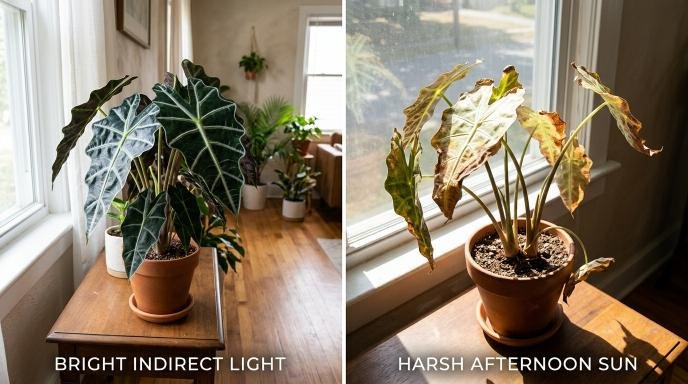
Light strongly influences leaf size, color, and the overall growth of Alocasia Polly. The plant needs enough brightness to support healthy foliage, but direct afternoon sunlight can scorch its leaves.
Where should you place Alocasia Polly?
Choose a location that receives bright, filtered daylight for several hours. An east-facing window often works well, while a south- or west-facing window may require a sheer curtain or a position farther from the glass.
Good placement options include:
- Near an east-facing window with gentle morning sunlight.
- A few feet from a bright south-facing window, depending on its intensity.
- In a bright room where sunlight does not fall directly on the leaves.
- Under a full-spectrum grow light when natural daylight is insufficient.
If you use a grow light, begin with a moderate distance and follow the manufacturer’s recommended duration and intensity.
Signs of incorrect lighting
| Symptom | Possible explanation | What to do |
|---|---|---|
| Long, weak petioles | Insufficient light | Move the plant to a brighter location gradually |
| Small new leaves | Low light or other growth stress | Check light, roots, watering, and feeding |
| Bleached or brown patches | Excessive direct sunlight | Filter the light or move the plant back |
| Slow growth | Low light or seasonal dormancy | Assess the overall growing conditions |
One important detail is that older leaves may naturally decline even when the lighting is correct. Always look at the plant’s overall condition and new growth rather than diagnosing a problem from one leaf.
How to Water Alocasia Polly Correctly

Watering is one of the most important parts of Alocasia Polly care because its roots need moisture but also require oxygen. Constantly wet soil can suffocate the roots and encourage rot, while prolonged dryness can cause wilting and crispy leaf edges.
When should you water Alocasia Polly?
Check the soil rather than following a fixed calendar. Water when the upper 1–2 inches of the potting mix feel dry, adjusting for pot size, temperature, humidity, and the plant’s growth rate.
During warm, bright weather, the plant may need water more frequently. In winter or during dormancy, the soil usually dries more slowly.
Step-by-step watering method
- Check the soil with your finger or a wooden stick.
- If the upper layer is still damp, wait and check again later.
- When the soil has partially dried, water slowly and evenly across the surface.
- Continue until excess water drains through the bottom holes.
- Empty the saucer or decorative outer pot so the roots are not sitting in water.
Avoid giving tiny amounts of water repeatedly. Thorough watering followed by appropriate drying helps wet the root zone evenly and prevents some areas from remaining dry while others stay saturated.
How to recognize watering problems
- Yellowing leaves with wet soil: Overwatering, poor drainage, or root damage may be responsible.
- Drooping leaves with dry soil: The plant may need water.
- Brown, crispy edges: Dry air, inconsistent watering, mineral buildup, or root problems can contribute.
- Soft stems or a foul-smelling mix: Root or crown rot is possible and requires prompt inspection.
Do not assume every yellow leaf means overwatering. Check soil moisture, drainage, roots, and the age of the affected leaf before changing your routine.
3. Best Soil Mix for Alocasia Polly
Alocasia Polly needs a potting mix that retains some moisture while allowing excess water and air to move through the root zone. Ordinary dense garden soil can remain wet for too long in an indoor container.
A loose aroid mix is usually a better choice.
Recommended potting mix

Orchid bark
Creates air spaces and improves structure.

Perlite or pumice
Improves aeration and drainage.

Coco coir or quality potting mix
Provides moisture retention and a base for roots.
A practical starting recipe is:
- 2 parts quality indoor potting mix or coco-based mix.
- 1 part perlite or pumice.
- 1 part fine to medium orchid bark.
Adjust the proportions according to your environment. If the mix remains wet for many days, increase the coarse components or reassess the pot size and watering routine. If it dries extremely quickly, a little more moisture-retentive material may help.
Why pot size matters
A pot that is much larger than the root ball holds more unused soil, which can stay wet for too long. Choose a container only slightly larger than the root system and make sure it has unobstructed drainage holes.
Ideal Temperature and Humidity
As a tropical plant, Alocasia Polly prefers warmth and dislikes cold drafts and sudden temperature changes.
Temperature requirements
Aim for approximately 65–85°F (18–29°C). Protect the plant from cold windows, air-conditioning vents, heating equipment, and sudden nighttime temperature drops.
Cold conditions combined with wet soil are particularly stressful because the roots use water more slowly and the risk of root problems increases.
How much humidity does Alocasia Polly need?
Moderate to high humidity helps the leaves remain attractive. Around 50–70% relative humidity is a useful target, although the plant’s response also depends on temperature, airflow, watering, and root health.
If your indoor air is dry, consider these measures:
- Use a humidifier near the plant.
- Group compatible tropical plants together while maintaining good airflow.
- Monitor humidity with a simple digital hygrometer.
- Keep the plant away from hot, dry air from heaters.
Misting is not a reliable long-term solution because it raises humidity only briefly. Repeatedly wetting the foliage without adequate airflow can also encourage leaf spotting.
In warm climates, indoor humidity may already be adequate. Measure it before purchasing equipment.
Fertilizing Alocasia Polly for Healthy Growth
Alocasia Polly uses nutrients to produce new leaves and maintain healthy roots. However, applying too much fertilizer can damage roots and create salt buildup in the potting mix.
Best fertilizer and feeding schedule
Use a balanced liquid houseplant fertilizer diluted according to its label. During active spring and summer growth, feeding approximately every 2–4 weeks may work well if the plant is healthy and growing in suitable conditions.
Follow these guidelines:
- Start with a conservative concentration rather than applying extra fertilizer.
- Apply fertilizer to an appropriately moist root zone.
- Reduce or stop feeding when growth slows significantly.
- Avoid fertilizing a plant with severe root damage until it begins recovering.
- Periodically flush the potting mix with water if mineral salts accumulate and drainage is good.
Yellow leaves do not automatically indicate a nutrient deficiency. Overwatering, inadequate light, damaged roots, and natural leaf aging can produce similar symptoms.
Expert tip: If your Alocasia Polly is not producing new growth, correct the light, temperature, and root conditions before increasing fertilizer.
How to Maintain Healthy Leaves

The patterned leaves are the main attraction of Alocasia Polly, so routine inspection is worthwhile.
Cleaning the foliage
Dust blocks some light from reaching the leaf surface. Gently wipe each leaf with a soft, damp cloth and support it from underneath to avoid tearing it.
Avoid household leaf-shine products, which can leave unwanted residue.
Pruning damaged leaves
Remove leaves that are completely yellow, dead, or severely damaged using clean, sharp scissors. Cut the leaf stalk near its base without damaging the central growing point.
Do not remove every imperfect leaf. Partly green leaves still contribute energy to the plant, and excessive pruning can slow recovery.
Why are the leaves losing their appearance?
Brown tips may result from dry air, inconsistent watering, fertilizer salts, or root stress. Pale patches can indicate sunburn, while tiny speckles and webbing may suggest pests.
Check the undersides of leaves and the petiole joints regularly. Early detection is much easier to manage than a widespread infestation.
How to Repot Alocasia Polly
Repot when the plant has become crowded, roots are emerging from drainage holes, the potting mix has broken down, or water movement through the mix has become poor.
Repotting is not necessary every year if the roots still have adequate room and the mix remains healthy.
Repotting steps
- Choose a pot with drainage holes that is only modestly larger than the root ball.
- Prepare a fresh, airy potting mix.
- Slide the plant out carefully, supporting the base rather than pulling on the leaves.
- Inspect the roots for soft, dark, or foul-smelling sections.
- Trim clearly rotten roots with clean tools if necessary.
- Position the plant at approximately its previous planting depth.
- Fill around the roots without compressing the mix excessively.
- Water appropriately and let excess water drain completely.
After repotting, keep the plant in warm, bright indirect light. Avoid immediate heavy fertilization, especially if the roots were disturbed.
Common mistake: Moving a small plant into a very large pot because you want it to grow faster. More soil does not necessarily mean faster growth and can increase the risk of prolonged wetness.
Alocasia Polly Propagation
Alocasia Polly is generally propagated by dividing suitable offsets or separating its underground structures, often called corms. It is not reliably propagated from an ordinary leaf cutting.


Propagating through offsets
If your plant has developed a separate rooted offset, you can divide it during repotting.
- Remove the plant carefully from its pot.
- Identify a distinct offset with its own growing point and, ideally, established roots.
- Separate it gently, using a clean tool only if necessary.
- Plant it in a small container with an airy, lightly moist potting mix.
- Maintain warmth, bright indirect light, and suitable humidity while it establishes.
Growing Alocasia Polly from corms
Corms are small underground structures that can develop into new plants.
- Inspect the root system during repotting for viable corms.
- Separate suitable corms without unnecessarily damaging the parent plant.
- Place them in a warm propagation environment with an appropriate moist, airy medium.
- Maintain humidity while providing enough ventilation to reduce rot.
- Transfer established seedlings to individual pots when they have developed roots and leaves.
Not every corm will sprout, and development speed varies with maturity and environmental conditions.
Why Is My Alocasia Polly Dying?
When Alocasia Polly declines, the most useful approach is to identify the pattern of symptoms and check the growing conditions before making multiple changes.
| Problem | Likely causes | Recommended action |
|---|---|---|
| Yellow leaves | Overwatering, root stress, low light, or natural aging | Check soil moisture and inspect roots if several leaves decline |
| Drooping foliage | Dry soil, damaged roots, temperature stress | Check moisture and root health before watering |
| Brown, crispy edges | Low humidity, inconsistent moisture, salt buildup | Stabilize care and review water and fertilizer practices |
| Brown or bleached patches | Excess direct sunlight or leaf damage | Move to filtered light and monitor new growth |
| No new leaves | Seasonal slowdown, insufficient light, root crowding, or stress | Review light, warmth, roots, and growing-season care |
| Soft or rotting stems | Crown rot or prolonged wetness | Inspect the base and roots promptly |
| Small spots and fine webbing | Possible spider mites or other pests | Isolate the plant and inspect both sides of the leaves |
How to check for root rot
Gently remove the plant from its pot if several symptoms suggest root damage. Healthy roots are generally firm, while rotten roots may be mushy, dark, and unpleasant-smelling.
If rot is present, remove the damaged roots with clean scissors and repot into fresh, well-draining medium. Correct the cause, such as excessive watering, compacted soil, or poor drainage. Severe damage may limit the plant’s chances of recovery.
What if Alocasia Polly loses all its leaves?
Leaf loss does not always mean the plant is dead. Alocasia can enter dormancy or experience substantial foliage decline after environmental stress.
Check whether the underground structure and remaining roots are firm rather than mushy. If they remain viable, keep the plant warm, provide suitable indirect light, and maintain lightly moist rather than waterlogged soil. Reduce watering as growth slows and avoid forcing new growth with heavy fertilizer.
Recovery can take time. Do not repeatedly dig up the plant to check for new shoots, because disturbing the roots may add further stress.
Alocasia Polly Dormancy and Seasonal Care
Alocasia Polly often grows most actively during spring and summer. Shorter days and cooler indoor conditions can slow growth, and some plants may shed leaves or enter dormancy.
Spring and summer
- Provide bright indirect light.
- Check soil moisture more frequently as temperatures rise.
- Feed lightly while new growth is developing.
- Inspect for spider mites and other pests.
Autumn and winter
- Water less frequently when the soil dries more slowly.
- Maintain warmth and avoid cold drafts.
- Reduce fertilizer if growth has slowed.
- Provide supplemental lighting if the room becomes unusually dim.
Do not automatically assume every leaf drop is dormancy. Sudden yellowing, soft stems, and persistently wet soil may indicate a problem that needs attention.
Common Alocasia Polly Care Mistakes to Avoid
Several well-intentioned habits can make this plant harder to maintain.
Watering on a fixed schedule. Indoor conditions change throughout the year. Check the soil instead of watering every few days regardless of moisture.
Using dense soil. A compact mix can remain saturated and limit oxygen around the roots. Use an airy medium and a pot with drainage.
Exposing the plant to harsh sunlight. Bright light is beneficial, but intense direct sun can damage the foliage. Increase light gradually.
Ignoring pests. Spider mites and other sap-feeding pests can spread before damage becomes obvious. Inspect new growth and leaf undersides.
Fertilizing a stressed plant heavily. Extra nutrients cannot repair damaged roots and may make matters worse.
Changing several conditions at once. If you move the plant, increase watering, add fertilizer, and repot on the same day, it becomes difficult to identify what helped or harmed it. Make necessary corrections methodically and monitor new growth.
Is Alocasia Polly Safe for Pets and Children?
Alocasia Polly contains insoluble calcium oxalate crystals, which can irritate the mouth and digestive tract if chewed or ingested. Possible symptoms include oral pain, drooling, swelling, and difficulty swallowing.
Keep the plant out of reach of children and pets. Wear gloves if you have sensitive skin or are handling damaged plant tissue, and wash your hands afterward.
If a person or pet chews or swallows the plant, seek appropriate medical or veterinary guidance, especially if swelling or difficulty swallowing occurs.
Frequently Asked Questions About Alocasia Polly Care
How often should I water Alocasia Polly?
Water when the top 1–2 inches of soil feel dry, then allow excess water to drain. The interval depends on temperature, light, pot size, humidity, and the potting mix, so there is no universal weekly schedule.
Does Alocasia Polly need direct sunlight?
No. Bright indirect light is generally best. Gentle morning sun may be tolerated in some settings, but strong afternoon sunlight can scorch the leaves.
Why are my Alocasia Polly leaves turning yellow?
Common causes include overwatering, poor drainage, root damage, insufficient light, and natural aging of older leaves. Check soil moisture and the plant’s overall condition before deciding on a solution.
Is Alocasia Polly difficult to grow indoors?
It can be more demanding than many common houseplants because it responds poorly to prolonged waterlogging, cold conditions, and severe humidity fluctuations. Consistent warmth, bright indirect light, and an airy potting mix make care easier.
Can Alocasia Polly grow in low light?
It may survive in moderate indoor light, but growth can slow and the plant may produce smaller leaves or weaker stems. A brighter position with filtered light is usually better.
Should I mist my Alocasia Polly?
Misting is not a dependable way to maintain humidity. A humidifier and appropriate room conditions provide more consistent results.
Why is my Alocasia Polly drooping after watering?
Drooping after watering can indicate root stress, especially if the soil remains wet for a long time. Check the drainage holes, soil structure, and root condition rather than adding more water automatically.
Does Alocasia Polly go dormant in winter?
Growth often slows during winter, and some plants may lose foliage. Keep the underground structure warm, reduce watering as moisture use decreases, and avoid heavy feeding during dormancy.
How do I make Alocasia Polly grow bigger leaves?
Provide suitable indirect light, warmth, healthy roots, consistent moisture, and moderate feeding during active growth. Leaf size also depends on the plant’s maturity and genetics, so larger leaves cannot be guaranteed by fertilizer alone.
Can Alocasia Polly grow outdoors?
It can grow outdoors in warm, sheltered conditions with filtered light and good drainage. Protect it from harsh direct sun, cold temperatures, and strong winds. In cooler climates, growing it in a container that can be brought indoors is often more practical.
Conclusion
Successful Alocasia Polly care comes down to maintaining a balance between moisture, oxygen, warmth, and light. Give your plant bright indirect light, use an airy potting mix, water when the upper soil layer dries, and maintain a comfortably warm environment with suitable humidity.
Pay attention to patterns rather than reacting to every imperfect leaf. Yellowing, drooping, and slow growth can have several causes, so checking the soil and roots will usually provide better answers than adding more water or fertilizer.
With consistent care, regular pest inspections, and thoughtful seasonal adjustments, Alocasia Polly can reward you with striking, beautifully veined foliage and healthy new growth.