Quick Answer
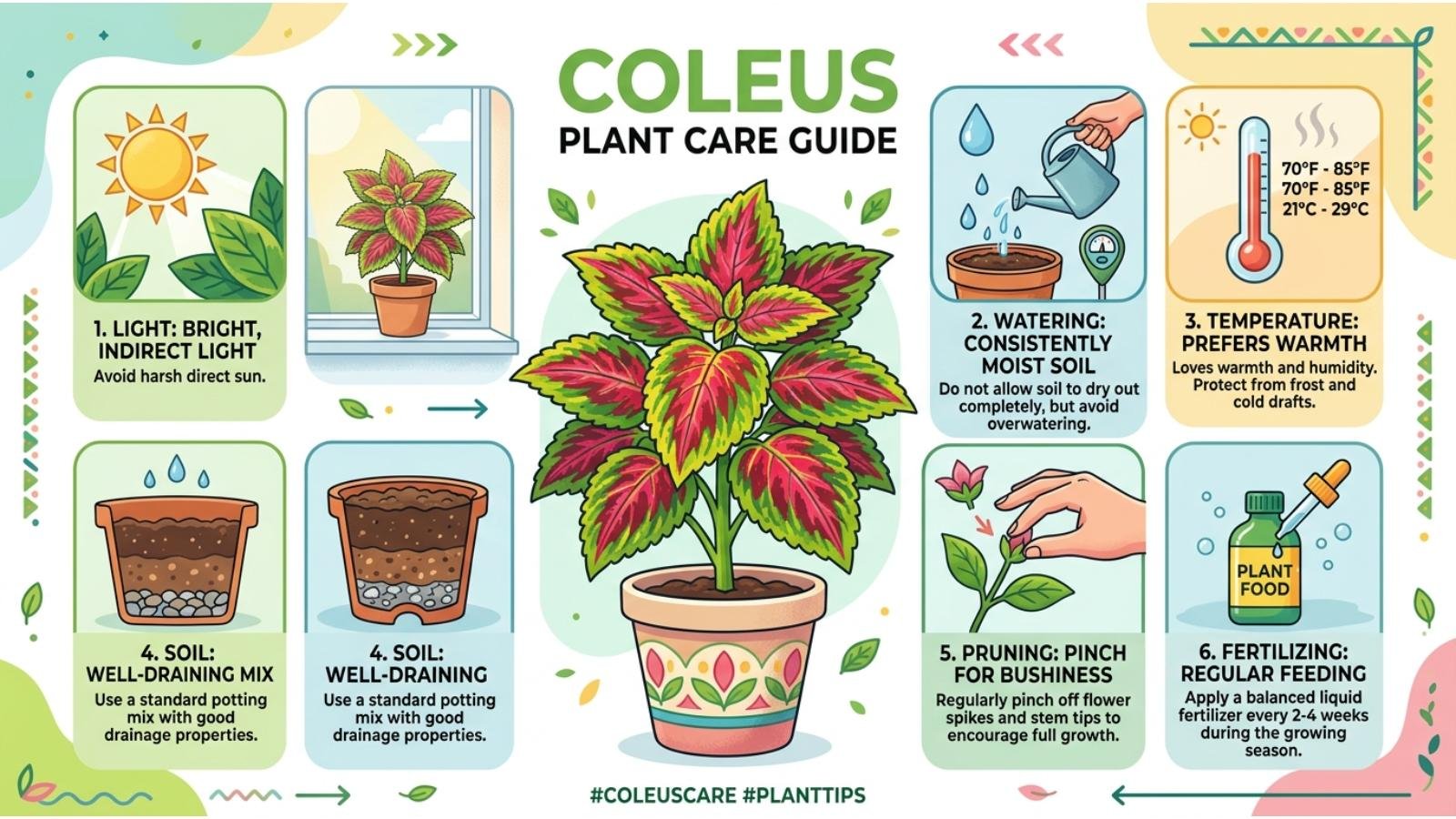
Coleus plant care is mainly about providing bright light, consistent moisture, warm temperatures, and well-draining, organic-rich soil. Most coleus varieties perform best in bright filtered light or partial shade, although many modern cultivars tolerate full sun. Keep the soil evenly moist without leaving the roots waterlogged, pinch growing tips to encourage bushiness, and protect coleus from frost and prolonged cold.
Introduction
Coleus is one of the easiest ways to add dramatic color to a home, patio, balcony, or garden without relying on flowers. Its foliage can appear in combinations of green, burgundy, red, pink, purple, orange, yellow, and cream, and different cultivars can have very different light and growth preferences.
The challenge is that coleus can look perfect one week and suddenly become leggy, wilted, faded, or yellow the next. Fortunately, most problems come down to a small number of correctable issues: unsuitable light, inconsistent watering, poor drainage, cold temperatures, or failure to pinch the plant regularly.
What Is Coleus?
Coleus is the common name generally used for colorful foliage plants now classified primarily as Coleus scutellarioides. Older gardening references may use names such as Solenostemon scutellarioides or Coleus blumei. It belongs to the mint family, Lamiaceae.
Unlike plants grown mainly for their flowers, coleus is prized for its leaves. Modern cultivars range from compact mounds to spreading and trailing forms, making them useful in containers, hanging baskets, borders, and indoor displays.
Why coleus is so popular
- Exceptional foliage color
- Fast growth during warm weather
- Easy propagation from stem cuttings
- Works in containers and garden beds
- Many varieties tolerate partial shade
- Some newer cultivars tolerate considerably more sun
- Can be grown indoors with sufficiently bright light
Image Suggestion: A labeled collage showing several coleus cultivars with different leaf colors, shapes, and growth habits.
Coleus Plant Care Requirements at a Glance
| Care factor | What coleus generally needs |
|---|---|
| Light | Bright filtered light to partial shade; some cultivars tolerate full sun |
| Water | Consistent moisture without waterlogged soil |
| Soil | Organic-rich, moisture-retentive but well-drained |
| Temperature | Warm conditions; protect from cold and frost |
| Humidity | Average household humidity is usually workable |
| Fertilizer | Light, regular feeding during active growth |
| Pruning | Pinch growing tips to encourage branching |
| Propagation | Stem cuttings or seed |
| Container | Drainage holes are essential |
| Main risk | Overwatering combined with poor drainage |
These requirements vary somewhat by cultivar, particularly when it comes to sunlight.
1. How Much Light Does Coleus Need?
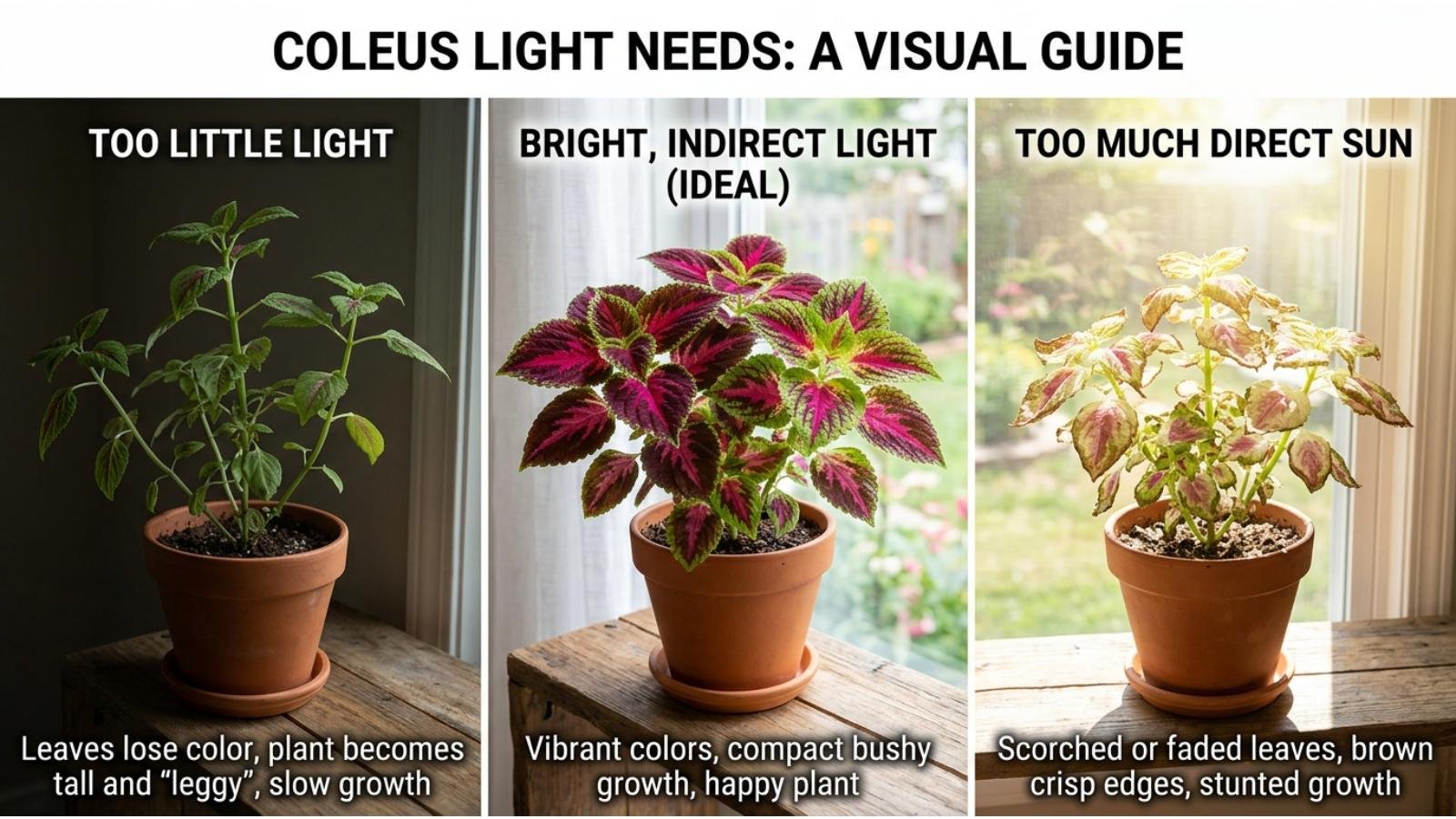
Light is one of the most important factors in successful coleus care because it affects both growth and foliage color.
Traditional coleus types are often associated with shade, while many newer cultivars can tolerate substantially more sun. Illinois Extension notes that coleus selections exist for both full sun and shade, while Wisconsin Extension reports that many varieties perform especially well with morning sun and afternoon shade.
Best indoor location
For an indoor coleus, choose a position with:
- Bright indirect light
- Several hours of strong ambient daylight
- Protection from harsh, scorching afternoon sun if the cultivar is shade-oriented
- Enough light to prevent stretched growth
A bright east-facing window can be an excellent starting point. A very bright south- or west-facing window may work too, but the plant may need protection from intense direct sunlight.
Signs of insufficient light
Your coleus may become:
- Tall and thin
- Widely spaced between leaves
- Less colorful
- Weak-stemmed
- Bent toward the window
Signs of excessive sun
Watch for:
- Bleached patches
- Brown, crispy areas
- Faded foliage
- Sudden leaf damage after moving the plant outdoors
University of Minnesota Extension specifically identifies sunscald as a coleus problem, particularly when hot, dry conditions intensify leaf damage.
Expert tip: Don’t judge a coleus cultivar’s sun tolerance solely by its label. If a plant becomes washed out or scorched after moving into stronger light, reduce the intensity gradually rather than assuming it needs more water.
Image Suggestion: Three coleus plants showing healthy light exposure, low-light legginess, and excessive-sun leaf damage.
2. How Often Should You Water Coleus?
Coleus likes moisture, but moist does not mean constantly saturated.
A common beginner mistake is watering on a rigid schedule. A plant in a small pot beside a sunny window can dry much faster than a larger coleus growing in a shaded container.
Instead, check the soil.
The practical watering method
- Touch the top layer of potting mix.
- If it has begun to dry, check slightly deeper.
- Water thoroughly when the plant actually needs it.
- Allow excess water to drain completely.
- Empty standing water from a saucer or cachepot.
The goal is consistently moist growing media with sufficient drainage. recommendations for coleus similarly emphasize moist but well-drained conditions.
What happens when coleus gets too little water?
You may notice:
- Drooping leaves
- Soft stems
- Dry potting mix
- Temporary wilting during hot weather
- Leaf edges becoming dry or crispy
What happens when coleus gets too much water?
The symptoms can look surprisingly similar at first.
Overly wet conditions can cause:
- Yellowing leaves
- Wilting despite wet soil
- Stunted growth
- Root damage
- Stem discoloration
University of Minnesota Extension identifies root rot as a coleus problem associated with cool, wet, poorly drained soil.
The important distinction: If a wilted coleus is sitting in wet soil, adding more water is usually the wrong response.
3. Choose the Right Soil and Pot
The ideal coleus soil balances two seemingly opposite requirements:
It must hold enough moisture for the plant while allowing excess water to escape.
Illinois Extension recommends soils high in organic matter that retain moisture while remaining well drained.
A good container mix
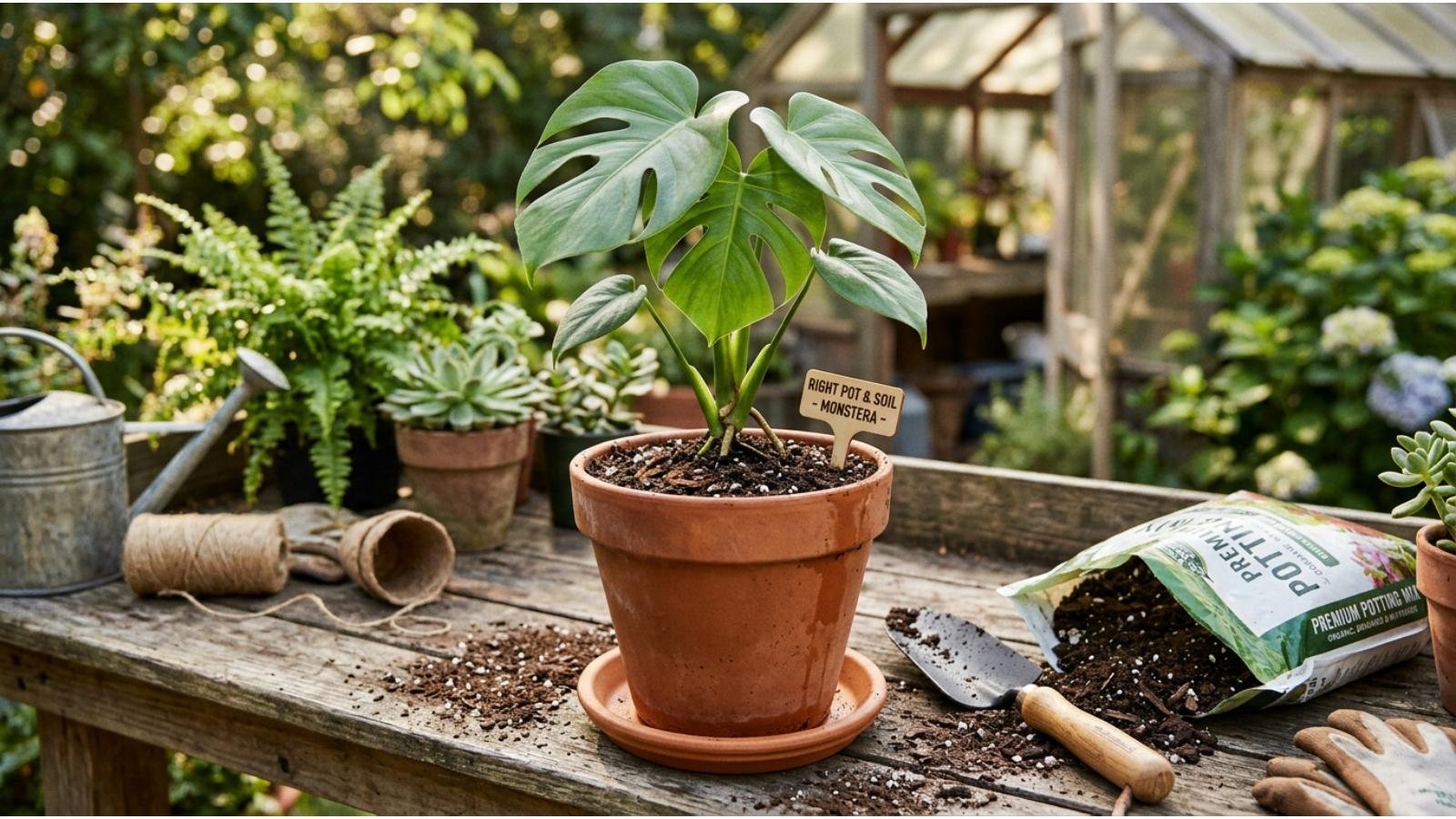
A quality commercial potting mix designed for containers is a sensible starting point. The container should also have drainage holes.
Avoid using heavy garden soil alone in an indoor container because it can compact and restrict drainage.
Why drainage matters
Roots need oxygen as well as water. When the growing medium remains saturated for long periods, oxygen availability around the roots can decline and root diseases become more likely.
This is particularly important because coleus can wilt from root problems even while its potting mix is visibly wet.
Choosing a container
Look for:
- Drainage holes
- A size appropriate for the root system
- A stable base for top-heavy growth
- A pot that isn’t dramatically oversized
A huge container isn’t automatically better. More unused wet soil around a small root system can make moisture management harder.
Image Suggestion: Diagram showing a coleus pot with drainage holes, well-drained soil, healthy roots, and a comparison with waterlogged soil.
4. Temperature and Humidity for Healthy Coleus
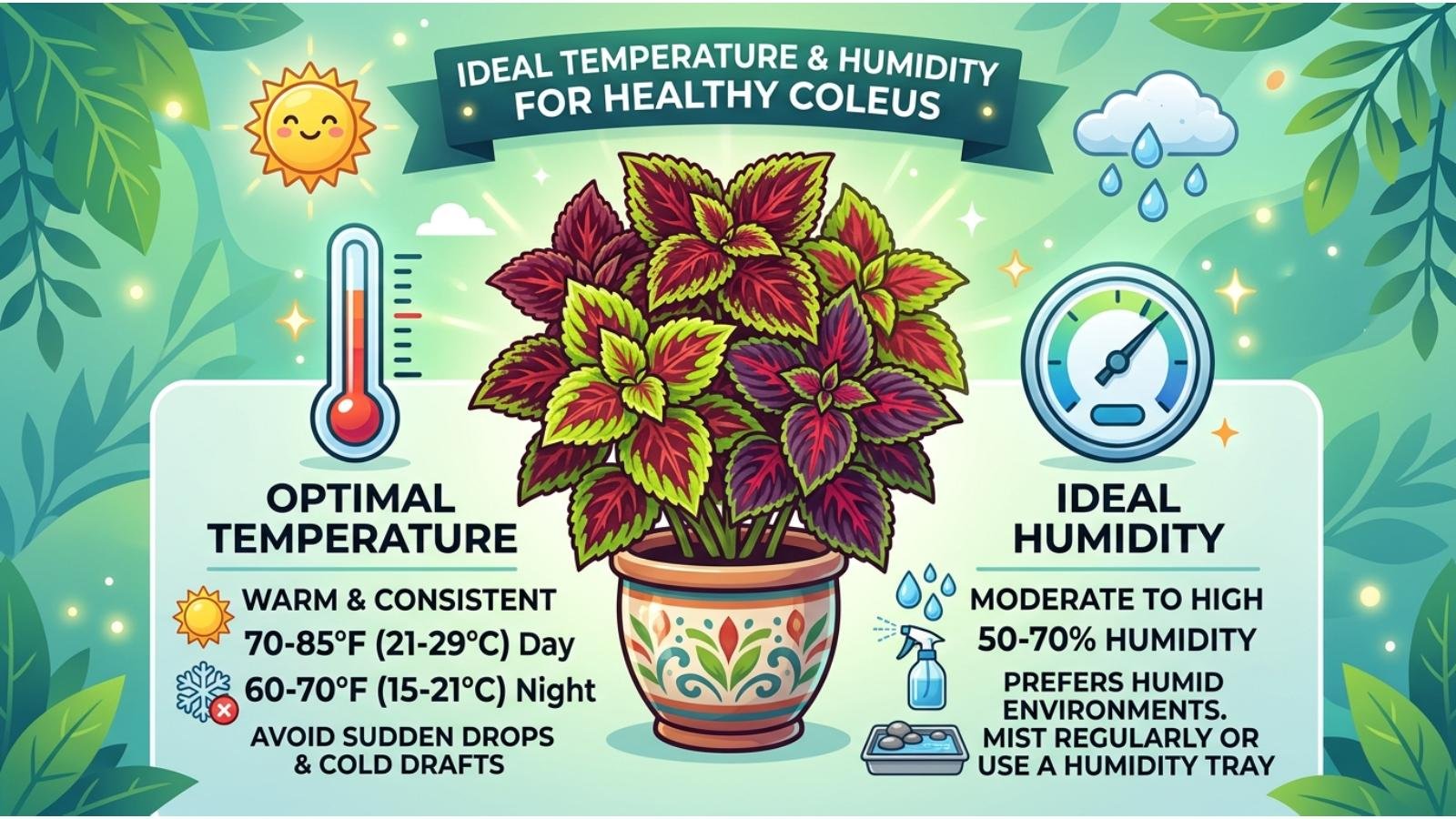
Coleus is a warm-weather plant and does poorly when exposed to prolonged cold.
Wisconsin Extension notes that coleus thrives in warmth and can languish below about 55°F (13°C), while also warning that extreme heat above roughly 95°F (35°C) can be undesirable.
That doesn’t mean every plant will suddenly fail at a particular temperature. Rather, these figures provide useful warning points for gardeners.
Keep coleus away from:
- Frost
- Cold drafts
- Very cold windows
- Sudden temperature changes
- Prolonged exposure to cold, wet soil
Outdoor coleus should generally be planted after frost danger has passed. RHS guidance likewise recommends a warm, sheltered, frost-free environment.
Does coleus need high humidity?
Coleus appreciates comfortable growing conditions, but extremely complicated humidity routines aren’t normally necessary for a healthy houseplant.
Prioritize:
- Correct light
- Proper watering
- Warm temperatures
- Good drainage
These usually matter more than obsessively measuring household humidity.
5. How to Fertilize Coleus
Coleus grows rapidly during favorable conditions, so nutrients can become depleted, particularly in containers.
A light feeding program during active growth can support healthy foliage. RHS guidance for some coleus cultivars recommends feeding during growth, including high-nitrogen fertilizer at regular intervals.
A sensible approach
Use a balanced or foliage-oriented fertilizer according to the product’s label directions.
Avoid assuming that more fertilizer means more colorful leaves.
Excessive fertilizer can create problems such as:
- Salt buildup
- Root stress
- Weak or excessively soft growth
- Leaf-edge damage
If your plant is already growing strongly in nutrient-rich potting mix, aggressive fertilizing may be unnecessary.
Practical rule: Feed to support growth, not to compensate for poor light, bad drainage, or improper watering.
6. Why You Should Pinch Coleus Regularly
If your goal is a full, bushy coleus, pruning is one of the highest-value maintenance tasks.
Coleus naturally produces vertical shoots. Without intervention, some plants become tall and sparse rather than compact and dense.
RHS specifically recommends pinching growing tips on coleus to promote bushier growth.
How to pinch coleus
- Identify a growing tip above a pair of leaves.
- Pinch or cut the tip just above the leaf pair.
- Repeat as new shoots become long.
- Encourage multiple branches rather than one dominant stem.
Each pruning session can redirect growth toward branching.
What about flowers?
Coleus is primarily grown for foliage, so many gardeners remove emerging flower spikes to keep the plant focused on a compact foliage display. RHS recommends pinching young shoots and flower spikes on certain cultivars. (RHS)
However, flowering isn’t automatically a sign that something is wrong. It is part of the plant’s normal reproductive cycle.
Expert tip: Don’t wait until your coleus is extremely leggy before pruning. Light, regular pinching is easier on the plant and produces a more attractive shape.
7. How to Propagate Coleus From Cuttings
Coleus is particularly rewarding for propagation because healthy stem cuttings can root readily.
Penn State Extension recommends taking healthy stem tips, removing lower leaves, placing the cuttings into moist growing media, and keeping them warm and adequately moist while roots develop.
Step-by-step propagation
Step 1: Choose a healthy stem
Select a vigorous, non-diseased shoot.
Step 2: Take the cutting
A cutting of around 4–6 inches is practical for many situations.
Step 3: Remove lower leaves
Leave several leaves toward the top and remove foliage that would otherwise sit below the growing medium or in water.
Step 4: Root it
You can root coleus cuttings in suitable moist growing media. Some gardeners also use water propagation.
Step 5: Provide warmth and light
Keep the cutting in a warm location with bright but appropriate light.
Step 6: Wait for roots
Penn State notes that coleus cuttings can form roots in roughly three to four weeks under suitable conditions.
Why propagation by cutting is useful
A cutting gives you a genetic copy of the parent plant. This matters because seed-grown plants may not reliably reproduce the exact characteristics of a named cultivar. RHS specifically notes that cultivars may not come true from seed.
Image Suggestion: Step-by-step visual showing a coleus stem cutting, removed lower leaves, rooting stage, and newly potted plant.
8. Growing Coleus Indoors During Winter
In colder climates, outdoor coleus is often treated as a seasonal plant. But you don’t necessarily have to let a favorite specimen disappear when temperatures fall.
Penn State Extension specifically recommends overwintering coleus through stem cuttings.
Option 1: Bring the plant indoors
Before moving an outdoor plant inside:
- Inspect leaves and stems for pests.
- Clean the foliage.
- Remove damaged material.
- Check the pot and soil.
- Gradually acclimate the plant to indoor conditions.
University of Minnesota Extension recommends checking plants carefully for pests and acclimating them gradually when bringing outdoor plants indoors.
Option 2: Take cuttings
For many gardeners, cuttings are easier than moving a large outdoor plant indoors.
Take healthy tips, root them, and maintain them as small indoor plants during winter.
This has an additional advantage: you start the next growing season with fresh young plants.
9. Common Coleus Problems and How to Fix Them
Coleus Leaves Are Wilting
First check the soil.
If the soil is dry:
Water thoroughly and reassess the plant after it has had time to recover.
If the soil is wet:
Don’t automatically water again. Inspect drainage and roots.
Root rot can cause yellowing and wilting even though the plant has plenty of water available.
Coleus Is Turning Yellow
Possible causes include:
- Overwatering
- Poor drainage
- Root problems
- Cold, wet soil
- Natural aging of individual leaves
- Pest or disease problems
If several leaves yellow at once and the soil remains wet, investigate the roots and drainage before adding fertilizer.
Coleus Is Leggy
The most common suspects are:
- Insufficient light
- Lack of pinching
- Excessively vigorous vertical growth
Move the plant to a brighter suitable location and prune the long stems to encourage branching.
Coleus Leaves Are Faded
Faded color can result from environmental conditions, including light and temperature. Coleus foliage coloration can change depending on cultivar and growing conditions.
Don’t immediately assume the plant needs fertilizer.
First evaluate:
Light → watering → temperature → cultivar characteristics → nutrition.
Brown or Bleached Leaves
Sunscald is one possibility, particularly after moving a plant suddenly into intense sunlight. University of Minnesota Extension reports that exposed coleus leaves can bleach yellow or white and later become brown and brittle.
If the damage appeared shortly after moving the plant into stronger light, gradually reduce exposure and remove severely damaged leaves.
Coleus Has Brown Roots or a Damaged Stem Base
This can indicate root disease.
Cool, wet, poorly drained conditions favor root rot, and symptoms can include yellowing, wilting, stunted growth, and damaged roots.
If the roots are severely compromised, simply changing the watering schedule may not be enough. Remove affected material and reassess whether the plant can be successfully propagated from healthy tissue.
10. Coleus Pests and Diseases
Coleus is generally straightforward to grow, but it isn’t immune to pests and diseases.
RHS lists pests including mealybugs, scale insects, whitefly, and, depending on cultivar, other garden pests.
Common pests
Check regularly for:
- Aphids
- Mealybugs
- Scale insects
- Whiteflies
- Spider mites in suitable conditions
- Slugs outdoors
Disease problems
University of Minnesota Extension identifies several possible coleus disorders, including:
- Root rot
- Downy mildew
- Impatiens necrotic spot virus
- Sunscald
Downy mildew is particularly associated with cool, wet conditions and can produce leaf discoloration, curling, and growth on leaf undersides.
Prevention is easier than treatment
Good habits include:
- Avoiding chronically wet soil
- Providing adequate air movement
- Inspecting new plants before placing them with established plants
- Removing badly diseased foliage
- Avoiding unnecessary overhead watering
- Keeping tools clean when taking cuttings
11. Indoor vs. Outdoor Coleus Care
| Feature | Indoor Coleus | Outdoor Coleus |
|---|---|---|
| Light | Bright indoor light | Partial shade to sun depending on cultivar |
| Watering | Check soil regularly | Frequency changes with weather |
| Temperature | Protect from cold windows/drafts | Protect from frost |
| Soil | Quality container mix | Rich, well-drained garden soil |
| Pruning | Useful for compact growth | Useful throughout growing season |
| Pests | Inspect closely | Inspect leaves and stems |
| Winter | Can remain indoors | Often seasonal in cold climates |
The biggest difference isn’t simply location. Outdoor plants experience changing sunlight, rainfall, wind, and temperature, while indoor plants often experience lower light and slower evaporation.
12. Seasonal Coleus Care Guide
Spring
- Start new plants indoors if necessary.
- Propagate cuttings.
- Increase growth-season feeding gradually.
- Move plants outdoors only after cold conditions have passed.
- Acclimate plants to stronger outdoor light.
Summer
- Monitor soil moisture closely.
- Pinch growing tips.
- Remove unwanted flower spikes if you want maximum foliage emphasis.
- Watch for pests.
- Protect shade-oriented cultivars from harsh afternoon sun.
Fall
- Take healthy cuttings before temperatures become unfavorable.
- Inspect plants before bringing them indoors.
- Reduce watering if indoor conditions become cooler and growth slows.
Winter
- Provide the brightest suitable indoor location.
- Avoid cold drafts.
- Don’t keep watering on the same schedule used outdoors.
- Trim weak or leggy growth.
- Maintain healthy propagated cuttings for spring.
RHS and extension guidance consistently emphasize warm, frost-free conditions and the usefulness of cuttings for maintaining coleus from one season to the next.
13. Five Mistakes That Make Coleus Look Worse
1. Watering by calendar
A fixed “water every two days” routine ignores changes in temperature, light, pot size, and humidity.
Better: Check the growing medium first.
2. Assuming every coleus is a shade plant
Many modern cultivars tolerate more sun than traditional types.
Better: Identify the cultivar and watch how the plant responds.
3. Putting a small plant into an enormous pot
More soil can mean more retained moisture around a small root system.
Better: Increase pot size progressively.
4. Never pruning
A plant allowed to grow vertically can become sparse and unattractive.
Better: Pinch young growing tips regularly.
5. Treating every wilt as thirst
A wilted plant in saturated soil may have a root problem rather than a water shortage.
Better: Check the soil before watering.
14. A Simple Coleus Care Routine for Beginners
If you want a straightforward routine, use this checklist.
Once or twice a week
- Check the soil moisture.
- Inspect leaves for insects.
- Look for yellowing or damaged foliage.
- Rotate indoor plants if growth is leaning toward the light.
Every few weeks during active growth
- Pinch long shoots.
- Check whether the plant needs feeding.
- Examine the pot for drainage problems.
- Remove badly damaged leaves.
Before seasonal changes
- Take cuttings.
- Inspect for pests.
- Adjust watering according to temperature and light.
- Move plants gradually rather than exposing them suddenly to a completely different environment.
This approach is more reliable than following an inflexible watering or fertilizing calendar.
Frequently Asked Questions About Coleus Plant Care
Does coleus need full sun or shade?
It depends on the cultivar. Traditional types often prefer partial or filtered shade, while many modern cultivars tolerate full sun. Morning sun with afternoon protection is a useful starting point when you’re unsure.
How often should I water coleus?
Water when the growing medium begins to dry rather than following a strict calendar. Keep the soil consistently moist but ensure excess water can drain away.
Why is my coleus losing its color?
Light, temperature, cultivar genetics, and growing conditions can all influence foliage coloration. Evaluate light and general plant health before assuming fertilizer is the problem.
Can coleus grow indoors?
Yes. Coleus can be grown indoors when given sufficiently bright light, appropriate watering, warmth, and regular pruning. Illinois Extension describes coleus as suitable for houseplant use when provided high light.
Can coleus grow in water?
Stem cuttings can root in water, although rooting them in a suitable growing medium is another effective method. Coleus has a reputation for easy propagation from cuttings.
Should I remove coleus flowers?
If your priority is a compact, foliage-focused plant, removing emerging flower spikes can help maintain the desired shape. Some cultivars are grown primarily for their leaves, so gardeners commonly pinch flower spikes.
Why is my coleus wilting even though the soil is wet?
Overly wet soil can damage roots and produce wilting symptoms. Root rot is associated with wet, poorly drained conditions, so inspect drainage and roots rather than automatically adding more water.
Can I keep coleus alive over winter?
Yes. You can bring a healthy plant indoors or, often more conveniently, propagate healthy stem cuttings and grow them indoors through winter.
When should I take coleus cuttings?
Take cuttings while the plant is actively growing and healthy. This is especially useful before cold weather arrives if you want to preserve a favorite cultivar.
Is coleus toxic to pets?
Be careful with plant identification because several plants use “coleus” in their common names. ASPCA lists Coleus amboinicus as toxic to dogs, cats, and horses, while its database lists prostrate coleus (Plectranthus oertendahlii) as non-toxic. If pets may chew a particular plant, identify the exact species or cultivar rather than relying only on the common name.
Related Plant-Care Topics to Explore
If you’re building a broader indoor-plant care guide, useful related topics include:
- Snake plant care
- Pothos plant care
- Spider plant care
- Jade plant care
- Prayer plant care
- Monstera plant care
- Bird of paradise plant care
- Kalanchoe plant care
- Aloe plant care
These topics complement coleus because they cover different approaches to light, watering, propagation, and indoor growing.
Final Thoughts: The Key to Successful Coleus Plant Care
The best coleus plant care routine isn’t complicated. Give the plant enough appropriate light, keep its soil consistently moist without creating waterlogged conditions, provide warmth, and pinch the growing tips regularly.
The most useful habit is learning to read the plant rather than follow a rigid schedule. A wilted coleus in dry soil needs a different response from a wilted coleus sitting in saturated soil. Likewise, a faded plant may need different light rather than more fertilizer.
For beginners, start with bright filtered light, a well-draining container, careful moisture checks, and regular pinching. Once you understand how your particular cultivar responds, you can fine-tune its light exposure, feeding, pruning, and seasonal routine for fuller growth and stronger foliage color.
Editorial/EEAT note
The care recommendations above are grounded primarily in horticultural guidance from university extension services and the Royal Horticultural Society, including Illinois Extension, Penn State Extension, University of Minnesota Extension, and RHS plant profiles. Cultivar-specific behavior can differ, particularly regarding sun tolerance and growth habit, so recommendations should be adjusted to the actual plant rather than treating every coleus as identical.