Quick Answer
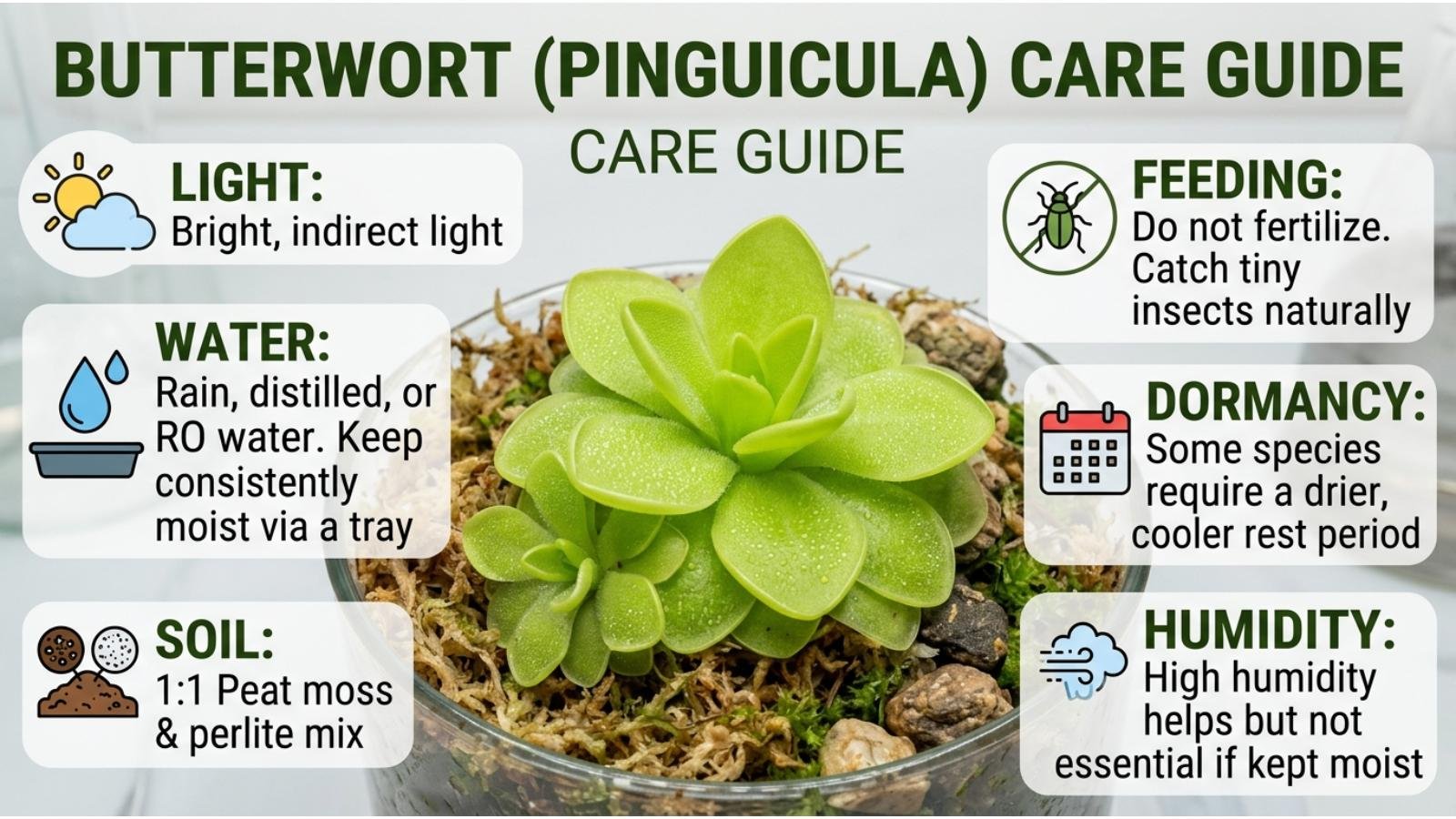
Butterwort plant care starts with the right balance of light, moisture, and mineral-free water. Most butterworts, or Pinguicula, prefer bright filtered light, consistently moist but well-drained carnivorous-plant soil, and rainwater, distilled water, or reverse-osmosis water.
Avoid ordinary potting soil and tap water with high mineral content. Care varies considerably between Mexican, tropical, and temperate species, so identify your butterwort before changing its watering routine or providing dormancy.
Introduction
Butterworts are small carnivorous plants best known for their attractive rosettes and sticky leaves that trap tiny insects. Unlike plants with obvious snap traps or pitchers, a butterwort can look like an ordinary succulent or flowering houseplant until you notice the glistening digestive surface on its leaves.
The biggest challenge with butterwort plant care is that not every Pinguicula has identical requirements. Mexican species can develop a compact, succulent-like winter rosette and may need a drier winter period, while some warm-growing species remain wet throughout the year. Treating every butterwort exactly the same is one of the easiest ways to create watering and root problems.
The safest approach is to understand your species or hybrid first, then adjust moisture, light, and seasonal care accordingly.
What Is a Butterwort?
Butterwort is the common name for plants in the genus Pinguicula, a group of carnivorous plants in the family Lentibulariaceae.
Their leaves are covered with tiny glands that produce a sticky substance. Small insects that land on the leaves can become trapped, after which the plant releases digestive enzymes and absorbs nutrients from the prey.
This adaptation is particularly useful because many butterworts naturally grow in habitats where soils provide limited nutrients.
A healthy butterwort typically forms a low-growing rosette. Depending on the species, leaves can range from soft green to pink, purple, reddish, or highly textured forms.
Why Are Butterwort Leaves Sticky?
The sticky surface is part of the plant’s natural carnivorous system.
Small insects may mistake the leaf for a safe landing surface. Once they become stuck, the plant’s digestive glands help break down the prey.
You should not try to remove every insect from the leaves. Catching small insects is normal and beneficial for a butterwort.
Butterwort Plant Care Requirements at a Glance
| Care Factor | General Recommendation |
|---|---|
| Light | Bright filtered or indirect light |
| Water | Rainwater, distilled, or reverse-osmosis water |
| Soil | Low-nutrient carnivorous-plant mix |
| Humidity | Moderate humidity is usually sufficient |
| Temperature | Depends heavily on species |
| Feeding | Small insects when naturally available |
| Fertilizer | Avoid conventional fertilizer in the soil |
| Repotting | Only when necessary |
| Dormancy | Required by some species but not others |
| Pot | Small pot with suitable drainage |
The important point is that these are general guidelines rather than universal rules. Species-specific requirements can differ substantially.
How Much Light Does a Butterwort Need?
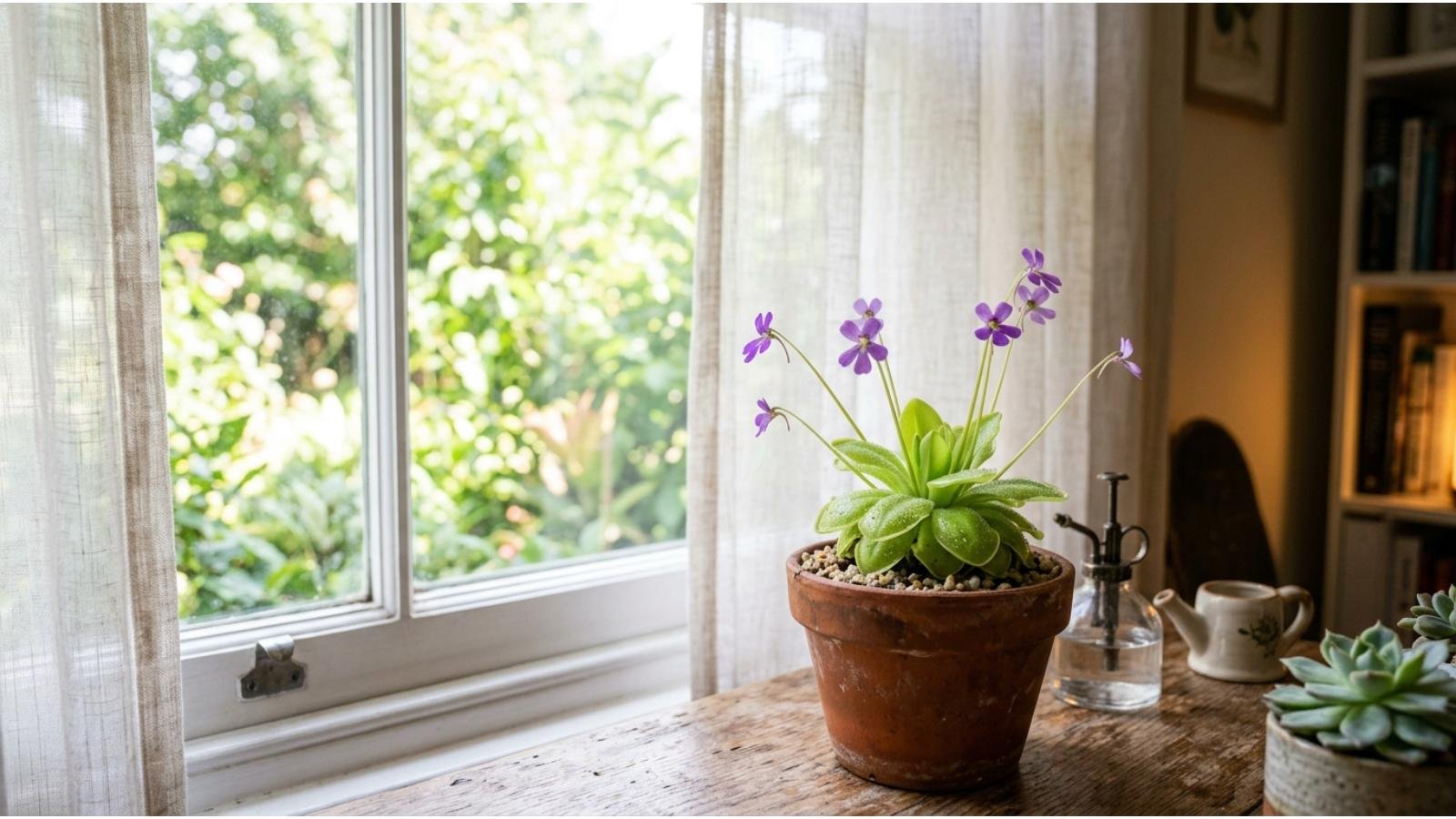
Butterworts generally grow best in bright light, but intense direct afternoon sun can be too harsh for some plants, especially when grown behind glass.
A bright windowsill with filtered sunlight can work well. Artificial grow lights are another practical option for indoor growers.
Signs Your Butterwort Needs More Light
Watch the plant rather than relying only on a fixed number of hours.
Possible signs of insufficient light include:
- Pale or unusually stretched growth.
- A loose, open rosette.
- Weak-looking leaves.
- Poor flowering.
- Reduced coloration in varieties that normally develop strong colors.
On the other hand, excessive intense sunlight can cause leaf scorching, overheating, or stress.
Practical Light Tip
If your butterwort is sitting in a sunny window, check the temperature around the plant during the hottest part of the day. A location that provides excellent morning light can become excessively hot in the afternoon.
How to Water a Butterwort
Watering is one of the most important parts of butterwort plant care, but the correct method depends on the species.
Use rainwater, distilled water, or reverse-osmosis water whenever possible. Carnivorous plants adapted to nutrient-poor environments generally do not respond well to accumulating minerals from ordinary tap water.
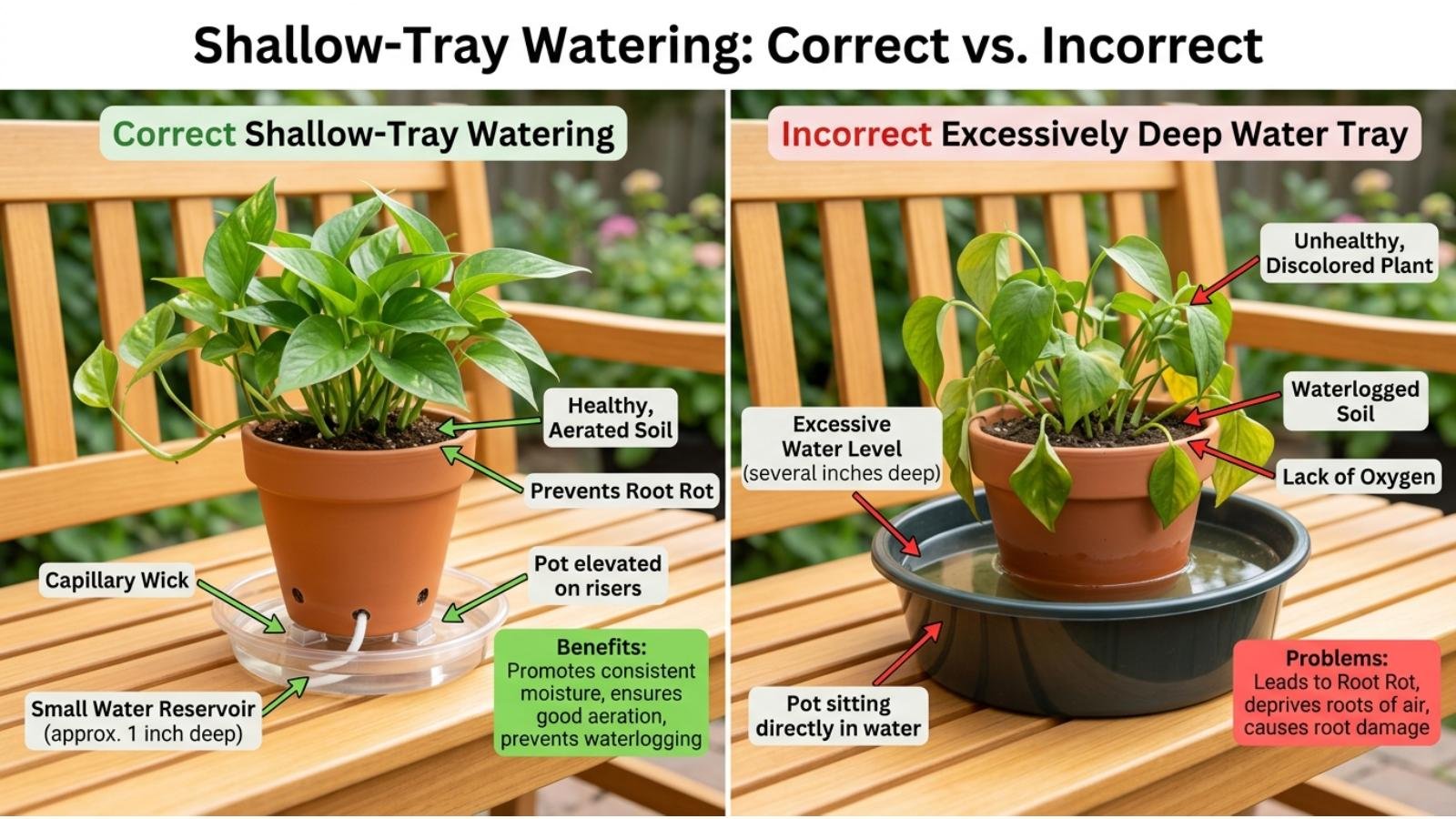
For many butterworts, the growing medium should remain appropriately moist during active growth. Some species can be grown using a shallow water tray, while others—particularly certain Mexican species—should be kept less wet during their winter growth phase.
Why Tap Water Can Be a Problem
Tap water can contain dissolved minerals that gradually accumulate in the growing medium.
A plant may appear healthy immediately after switching to tap water, but repeated exposure can eventually create unfavorable conditions around the roots.
If you do not know the mineral content of your water, using distilled or reverse-osmosis water is the safer option.
Should You Use the Tray Method?
A shallow tray can be useful for species that naturally prefer consistently wet conditions.
However, do not automatically keep every butterwort sitting in water all year.
Some Mexican butterworts transition into a drier winter rosette. Keeping these plants constantly saturated when they are naturally adapted to a seasonal reduction in moisture can increase the risk of problems.
What Soil Is Best for Butterworts?
Butterworts require a low-nutrient growing medium designed for carnivorous plants.
Ordinary houseplant potting soil is usually unsuitable because it contains nutrients and materials that can damage sensitive carnivorous-plant roots.
Common components used for butterwort cultivation include:
- Sphagnum peat.
- Long-fiber sphagnum moss.
- Silica sand.
- Other low-nutrient, mineral-safe materials suitable for carnivorous plants.
The exact mix should depend on the species.
For example, some Mexican butterworts are commonly grown in more open, mineral-based or mineral-amended mixes, while several North American species have different moisture and substrate preferences.
Avoid These Soil Ingredients
Do not casually add:
- Standard garden soil.
- Compost.
- Manure.
- Rich houseplant fertilizer.
- Ordinary garden fertilizer.
- Mineral-rich decorative soil amendments.
Butterwort roots are adapted to nutrient-poor conditions, so giving the plant “better” soil can actually make its environment worse.
Do Butterworts Need Humidity?
Butterworts generally appreciate reasonable humidity, but extremely high humidity is not automatically better.
Good airflow is important, particularly when the plant is kept in an enclosed terrarium.
A common beginner mistake is to assume that a carnivorous plant must be kept in a sealed, constantly wet environment. In reality, stagnant air combined with excessive moisture can create conditions for fungal or rot problems.
Aim for a balance of:
adequate moisture + suitable humidity + good airflow.
Temperature Requirements
Temperature requirements depend on the butterwort species.
Mexican butterworts are popular indoor plants because many can perform well under typical household conditions. Temperate and North American species may have very different seasonal requirements.
If your plant changes dramatically during the year—such as producing smaller, thicker, or more succulent-looking leaves—do not automatically assume it is dying.
That seasonal change may be a normal part of its growth cycle.
Understanding Butterwort Dormancy
Dormancy is one of the areas where generic care advice can cause problems.
Some butterworts have a seasonal dormancy or winter growth phase, while others do not require a traditional dormancy period.
For example, Pinguicula primuliflora can be grown without a dormancy period, although growth may slow during cooler weather.
Many Mexican butterworts can produce a different winter rosette with smaller, thicker leaves. During this phase, watering requirements may be reduced compared with the active growing season.
How to Tell When a Butterwort Is Entering a Winter Phase
Look for:
- Smaller leaves.
- More compact growth.
- Thicker-looking foliage.
- Reduced production of large carnivorous leaves.
- Slower growth.
Do not remove healthy seasonal leaves simply because they look different from summer foliage.
Do Butterworts Need to Eat Insects?
Butterworts are carnivorous, but you usually do not need to manually feed them every day.
Small flying insects, fungus gnats, fruit flies, and other tiny prey can provide nutrients naturally.
If the plant is grown indoors in a location with very few insects, occasional feeding may be useful.
The important word is small.
Do not place large insects, pieces of meat, or large quantities of food on the leaves.
The plant’s leaves are designed to capture relatively small prey.
What If My Butterwort Never Catches Bugs?
A butterwort does not need to be constantly covered with insects to remain alive.
If it receives appropriate light, water, and growing conditions, lack of visible prey does not necessarily mean something is wrong.
If feeding is necessary, use tiny prey rather than trying to force large food items onto the leaves.
Should You Fertilize a Butterwort?
For most home growers, conventional fertilizer is unnecessary and can be risky.
Butterworts obtain nutrients from prey and are adapted to nutrient-poor growing media.
Fertilizing the soil as you would for a tomato, pothos, or flowering houseplant can create excessive nutrient concentrations around the roots.
If you are growing a particular species with specialized feeding requirements, follow species-specific carnivorous-plant guidance rather than applying ordinary houseplant fertilizer.
Repotting a Butterwort
Butterworts generally do not need frequent repotting.
Repot when:
- The growing medium has broken down.
- The plant has outgrown its container.
- Drainage has become poor.
- You need to correct an unsuitable substrate.
- The existing pot has developed mineral buildup or other problems.
Choose a relatively small container rather than an unnecessarily large pot.
A huge pot can retain moisture for longer than expected and makes it harder to manage the plant’s moisture requirements.
How to Repot a Butterwort
- Prepare a clean pot and suitable low-nutrient growing medium.
- Moisten the new medium with appropriate water.
- Carefully remove the butterwort from its old container.
- Handle the plant gently and avoid damaging the roots.
- Place it into the new medium at an appropriate depth.
- Do not bury the central crown.
- Water according to the plant’s species and current growth phase.
- Keep it in suitable light while it settles.
Avoid repeatedly disturbing the roots just to inspect them.
Common Butterwort Plant Care Mistakes
1. Using Regular Potting Soil
This is one of the most serious beginner mistakes.
Regular potting soil is formulated for plants that need access to nutrients. Butterworts have evolved for very different conditions.
2. Using Mineral-Rich Water
Even if the plant looks fine initially, minerals can accumulate over time.
Use low-mineral water whenever possible.
3. Keeping Every Species Constantly Wet
Some butterworts enjoy very wet conditions, while others require a seasonal reduction in moisture.
Species identification matters.
4. Giving Too Much Direct Afternoon Sun
More sunlight is not automatically better.
A plant can receive plenty of light while still being protected from extreme heat and intense afternoon exposure.
5. Feeding Large Insects
Butterwort leaves are delicate.
Tiny prey are much more appropriate than large insects or chunks of food.
6. Adding Fertilizer to the Soil
Butterworts are not ordinary houseplants.
Their carnivorous adaptation is part of how they obtain nutrients in naturally poor environments.
7. Treating Seasonal Leaves as Dead Leaves
A winter rosette can look dramatically different from the summer plant.
Before removing leaves or changing conditions drastically, determine whether the change is part of the species’ normal seasonal cycle.
Butterwort Leaves Turning Green
Green leaves are not automatically a sign of poor health.
Leaf color can change with:
- Light intensity.
- Temperature.
- Season.
- Species or hybrid.
- Plant age.
- Growing conditions.
Instead of judging the plant by color alone, look at the entire rosette.
Healthy new growth, appropriate leaf formation, and stable development are generally more useful indicators.
Butterwort Leaves Turning Brown
Brown leaves can have several causes.
Possible reasons include:
- Excessive direct sunlight.
- Dehydration.
- Poor water quality.
- Natural aging.
- Sudden environmental changes.
- Root or crown problems.
Do not immediately increase watering just because one or two older leaves turn brown.
Check the whole plant first.
If the center of the rosette remains healthy and new growth is developing, occasional older-leaf loss may simply be part of the plant’s normal cycle.
Why Is My Butterwort Not Sticky?
A healthy butterwort usually has visibly glandular leaves, but the appearance of stickiness can vary.
Possible causes of reduced visible stickiness include:
- Insufficient light.
- New leaves that have not fully developed.
- Species-specific differences.
- Environmental stress.
- Unsuitable growing conditions.
Rather than trying to make the leaves sticky directly, correct the underlying growing conditions.
Never wipe the leaves to increase their appearance.
Why Is My Butterwort Losing Leaves?
Leaf loss can be completely normal during seasonal transitions, particularly when a species changes from an active carnivorous rosette into a winter rosette.
However, rapid widespread leaf loss can indicate stress.
Check:
- Water quality.
- Moisture level.
- Light.
- Temperature.
- Growing medium.
- Crown condition.
- Recent changes in care.
A sudden change is often more informative than the appearance of one individual leaf.
Butterwort Pests
Although butterworts capture insects, they can still experience pest problems.
Aphids and other small pests can occasionally affect plants.
Inspect the plant regularly, particularly around new growth and flowers.
Avoid automatically applying strong chemical treatments to a delicate carnivorous plant. If treatment is necessary, choose a method known to be compatible with the particular Pinguicula species and follow the product directions carefully.
How to Encourage Butterwort Flowers
Butterworts can produce attractive flowers on tall stalks above the rosette.
Good flowering depends on species, maturity, seasonal conditions, and general plant health.
To encourage flowering:
- Provide appropriate light.
- Avoid constantly disturbing the plant.
- Maintain suitable moisture.
- Follow the species’ seasonal requirements.
- Avoid excessive fertilizer.
- Allow the plant to complete its natural growth cycle.
A plant that is struggling with poor roots or unsuitable water should not be pushed to flower.
Butterwort Care for Beginners
If you are growing your first butterwort, keep the routine simple.
Your basic checklist
Light: Give bright filtered light or suitable artificial light.
Water: Use rainwater, distilled water, or reverse-osmosis water.
Soil: Use a low-nutrient carnivorous-plant medium.
Moisture: Keep the plant appropriately moist for its species.
Food: Allow it to catch small insects naturally or provide suitable tiny prey occasionally.
Fertilizer: Do not treat it like a conventional houseplant.
Season: Find out whether your particular butterwort has a winter dormancy or seasonal rosette.
Observation: Watch new growth rather than reacting to every old leaf.
A Simple Butterwort Care Routine
For a typical indoor butterwort, a practical routine can look like this:
Every few days
Check the moisture level and inspect the plant for obvious stress.
Weekly
Look for new growth, pests, dead leaves, and changes in leaf shape or color.
Monthly
Check whether mineral deposits are developing around the container and review whether the plant is receiving appropriate light.
Seasonally
Determine whether your species is entering an active growing phase or a winter rosette.
The goal is not to interfere constantly. Carnivorous plants often do better when their basic requirements are correct and their roots are left undisturbed.
Butterwort Care by Growth Type
| Type | Typical Consideration |
|---|---|
| Mexican butterworts | Often appreciate bright light and a seasonal change in growth and moisture |
| Tropical butterworts | Usually need warm conditions and may remain actively growing for much of the year |
| Temperate butterworts | May have stronger seasonal requirements |
| Aquatic or semi-aquatic-adapted species | Can have significantly different water requirements |
This is why a care guide written for one Pinguicula species should not automatically be applied to another.
The Most Important Butterwort Care Rule
Identify the species before making major changes to its care.
Two butterworts can look similar while having different requirements for winter moisture, temperature, and light.
If the plant came with a label, keep it.
If it is a named hybrid, record the cultivar name as well.
Species-specific information can turn a confusing care problem into a straightforward one.
Frequently Asked Questions
Is butterwort easy to care for?
Many butterworts can be manageable for beginners when grown in appropriate water, low-nutrient soil, and suitable light. The main difficulty is understanding that different species can have different seasonal requirements.
How often should I water my butterwort?
There is no universal schedule. Many butterworts prefer consistently moist conditions during active growth, while some species require drier conditions during a winter rosette. Water according to the species and growth phase.
Can butterwort grow indoors?
Yes. Several butterwort species and hybrids can grow successfully indoors when provided with adequate light, appropriate water, and a suitable low-nutrient medium.
Can I use tap water for butterwort?
It is safer to use low-mineral water such as rainwater, distilled water, or reverse-osmosis water. Regular tap water can contain minerals that accumulate in the growing medium.
Does butterwort need direct sunlight?
Butterworts need sufficient light, but intense direct sunlight is not appropriate for every species or growing environment. Bright filtered light is a useful starting point for many indoor plants.
Why are my butterwort leaves not sticky?
Reduced visible stickiness can result from insufficient light, immature leaves, environmental stress, or species differences. Evaluate the plant’s overall growing conditions instead of focusing only on the leaf surface.
Should I feed my butterwort?
A butterwort can obtain nutrients from small insects it catches naturally. Indoor plants with little access to prey may benefit from occasional suitable tiny prey, but large insects and excessive feeding should be avoided.
Does butterwort need fertilizer?
Generally, conventional fertilizer is not necessary. Butterworts are adapted to nutrient-poor environments and obtain nutrients through carnivory.
Does every butterwort need winter dormancy?
No. Dormancy requirements vary among species. Some butterworts remain capable of year-round growth, while others undergo distinct seasonal changes.
Why is my butterwort making small leaves?
Small leaves can be a normal seasonal response, particularly when certain species enter a winter rosette. They can also indicate stress if the change occurs unexpectedly during active growth.
Can butterwort live in a terrarium?
Some species can grow well in terrarium conditions, but the setup must provide appropriate light, moisture, temperature, and airflow. A sealed, permanently saturated environment is not automatically suitable for every Pinguicula.
Final Thoughts
Successful butterwort plant care is less about following a rigid watering calendar and more about understanding what kind of Pinguicula you are growing.
Start with low-mineral water, an appropriate carnivorous-plant medium, bright but suitable light, and moisture levels matched to the species. Then pay attention to seasonal changes instead of treating every change in leaf size or shape as a problem.
The most useful habit is simple: learn your butterwort’s natural growth cycle before changing its care routine. Once you understand whether your plant prefers continuously moist conditions or a seasonal shift toward drier growth, caring for it becomes much more predictable.