Quick Answer
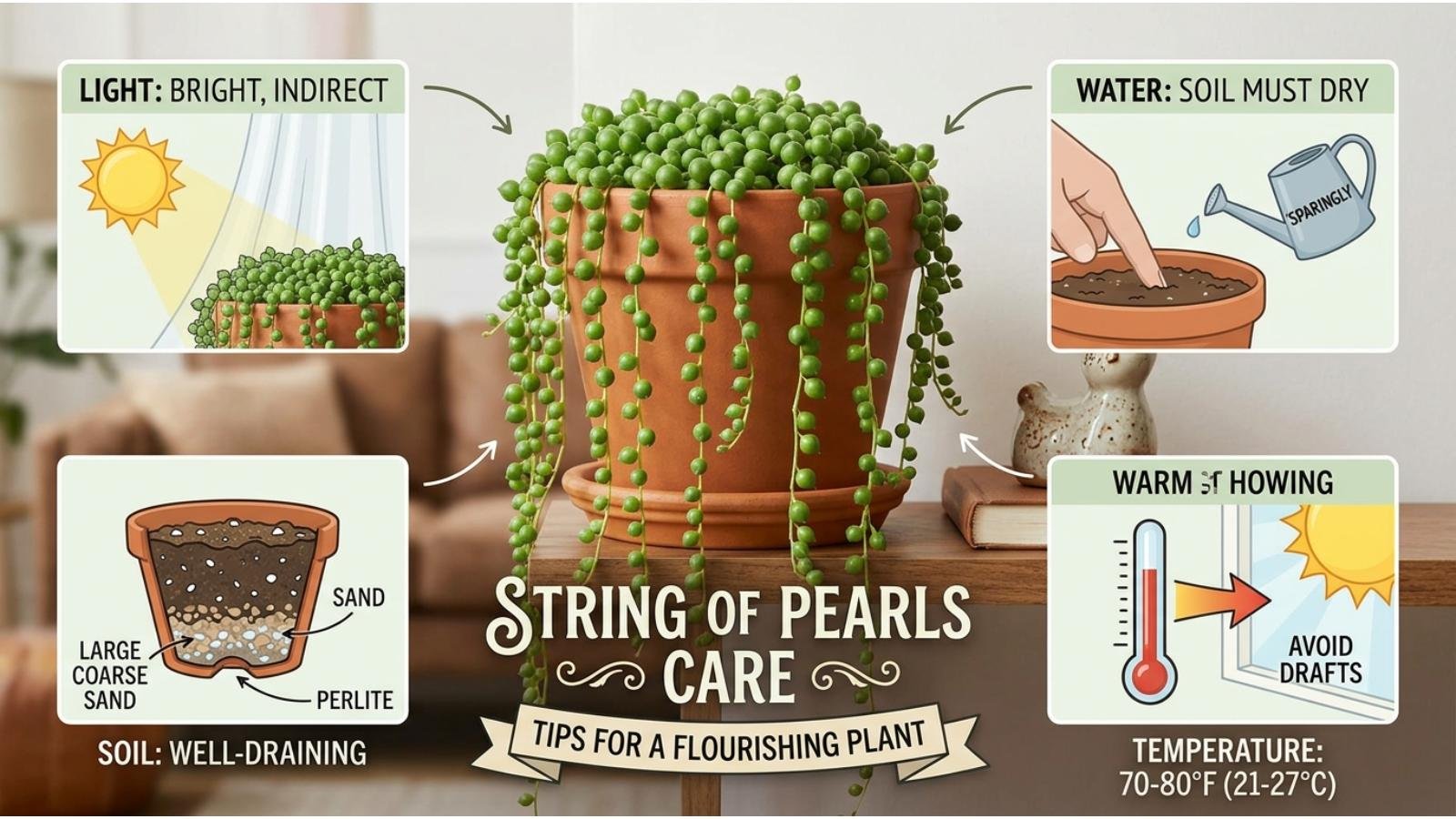
String of pearls plant care is mainly about giving this trailing succulent bright light, fast-draining soil, and careful watering. Let the potting mix dry thoroughly before watering again, and use a container with drainage holes. Keep it warm, avoid high humidity and soggy soil, and reduce watering in winter. If the pearls become flat, shriveled, yellow, or widely spaced, adjust light and watering rather than automatically adding more water.
Introduction
String of pearls is one of those houseplants that looks complicated but becomes surprisingly manageable once you understand what its unusual leaves are designed to do. Each small, bead-like leaf stores water, allowing the plant to tolerate dry periods. The real challenge is not keeping it constantly hydrated—it is preventing the roots and stems from staying wet for too long.
The plant is especially attractive in hanging baskets, on high shelves, or anywhere its long stems can cascade downward. But many beginners make the same mistake: they treat it like a tropical houseplant and water it frequently. With string of pearls plant care, good drainage and the right watering routine matter far more than constant moisture.
Image Suggestion: Close-up illustration showing healthy, plump string of pearls compared with a shriveled, dehydrated plant.
What Is a String of Pearls Plant?
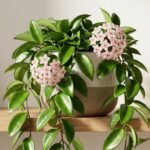
String of pearls, Curio rowleyanus, is a trailing succulent native to arid regions of southwestern Africa. Its thin stems carry spherical green leaves that resemble tiny pearls. Mature stems can trail around 90 cm (3 feet) or more, making the plant particularly effective in hanging containers.
Unlike many leafy houseplants, it is adapted to periods of dryness. The rounded leaves act as water-storage structures, which explains why constantly wet soil is particularly problematic.
Under suitable conditions, mature plants may also produce small white to cream-colored, fragrant flowers.
Why the leaves are shaped like pearls
The unusual spherical leaves are more than decoration. They help the plant store water while reducing exposed surface area. Some string-of plants also have translucent areas in their leaves that allow light to penetrate deeper into the tissue.
This adaptation tells you something important about care:
The plant is better prepared for occasional dryness than continuously wet roots.
String of Pearls Care at a Glance
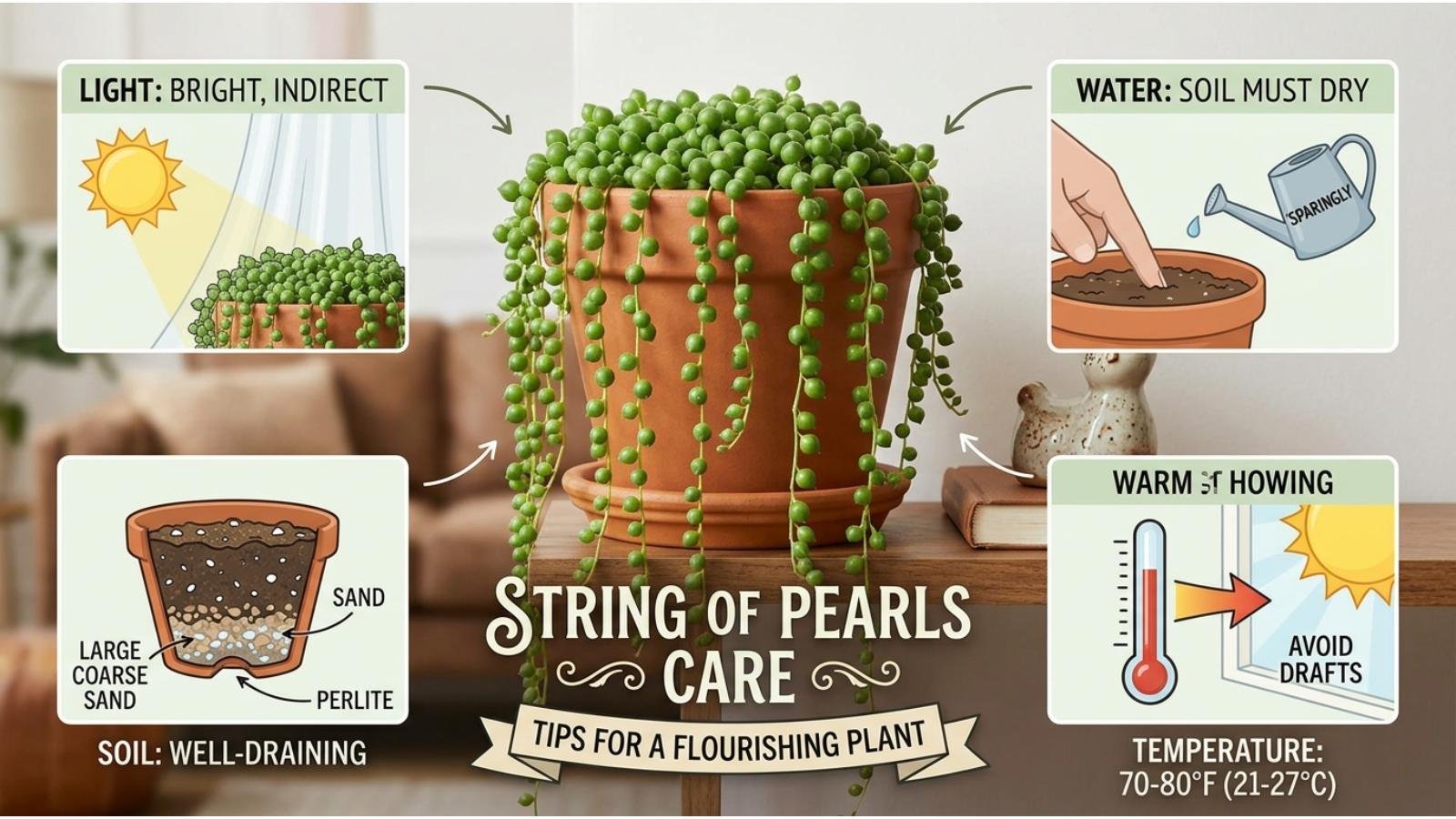
| Care requirement | What works best |
|---|---|
| Light | Bright light with some gentle direct sun |
| Soil | Fast-draining succulent or cactus mix |
| Water | Water thoroughly, then allow soil to dry |
| Humidity | Average to low household humidity |
| Temperature | About 10–25°C (50–75°F) |
| Pot | Container with drainage holes |
| Fertilizer | Light feeding during active growth |
| Repotting | When needed, usually every year or two |
| Propagation | Stem cuttings |
| Growth habit | Trailing succulent |
| Winter care | Less water and cooler, stable conditions |
How Much Light Does String of Pearls Need?
String of pearls grows best in bright light, but intense midday or afternoon sunlight through glass can scorch the plant.
An east- or west-facing window is often a practical choice. Bright indirect light can support healthy growth, while some gentle direct sunlight can help maintain compact growth.
Signs your plant needs more light
Look at the spacing between the pearls rather than simply asking whether the plant is green.
Insufficient light can cause:
- Long, weak stems.
- Large gaps between leaves.
- Smaller or less abundant pearls.
- Sparse growth.
- A plant that stretches toward the window.
This stretched growth is called etiolation. Once a stem has stretched significantly, moving it into better light will not magically shorten the existing section. New growth is where you will see improvement.
Can string of pearls tolerate direct sunlight?
Yes, but introduce stronger sunlight gradually.
A plant that has been growing indoors in filtered light can suffer leaf damage if suddenly placed in intense direct sun. Morning sun is generally easier to manage than harsh afternoon exposure.
Practical tip: If the window receives powerful afternoon sun, place the plant slightly back from the glass or use a sheer curtain.
Image Suggestion: Diagram showing ideal east-, west-, and south-facing window positions for string of pearls.
The Right Soil for String of Pearls
Fast drainage is one of the most important parts of successful string of pearls plant care.
Use a cactus or succulent potting mix that drains quickly. The University of Wisconsin Extension recommends a very well-draining medium and notes that inorganic materials such as pumice, coarse sand, or small gravel can improve drainage.
The goal is not simply to make the soil dry quickly on top. Water should be able to move through the entire root zone instead of creating a persistently wet pocket around the roots.
A simple soil approach
You can use:
- Commercial cactus/succulent mix.
- Cactus mix amended with pumice or perlite.
- Another coarse, well-draining succulent medium.
Avoid heavy garden soil or dense mixes that remain wet for extended periods.
Why ordinary potting soil can cause problems
A dense mix may hold more water than this succulent needs. When roots remain wet and oxygen-starved, root and stem problems become much more likely.
The mistake is not watering itself. The mistake is creating conditions where the roots cannot dry afterward.
How to Water String of Pearls Correctly
Watering is probably the most important—and most frequently misunderstood—part of string of pearls care.
Instead of watering according to a fixed calendar, check the plant and its soil.
The basic method
- Check whether the potting mix has dried thoroughly.
- If it is still damp, wait.
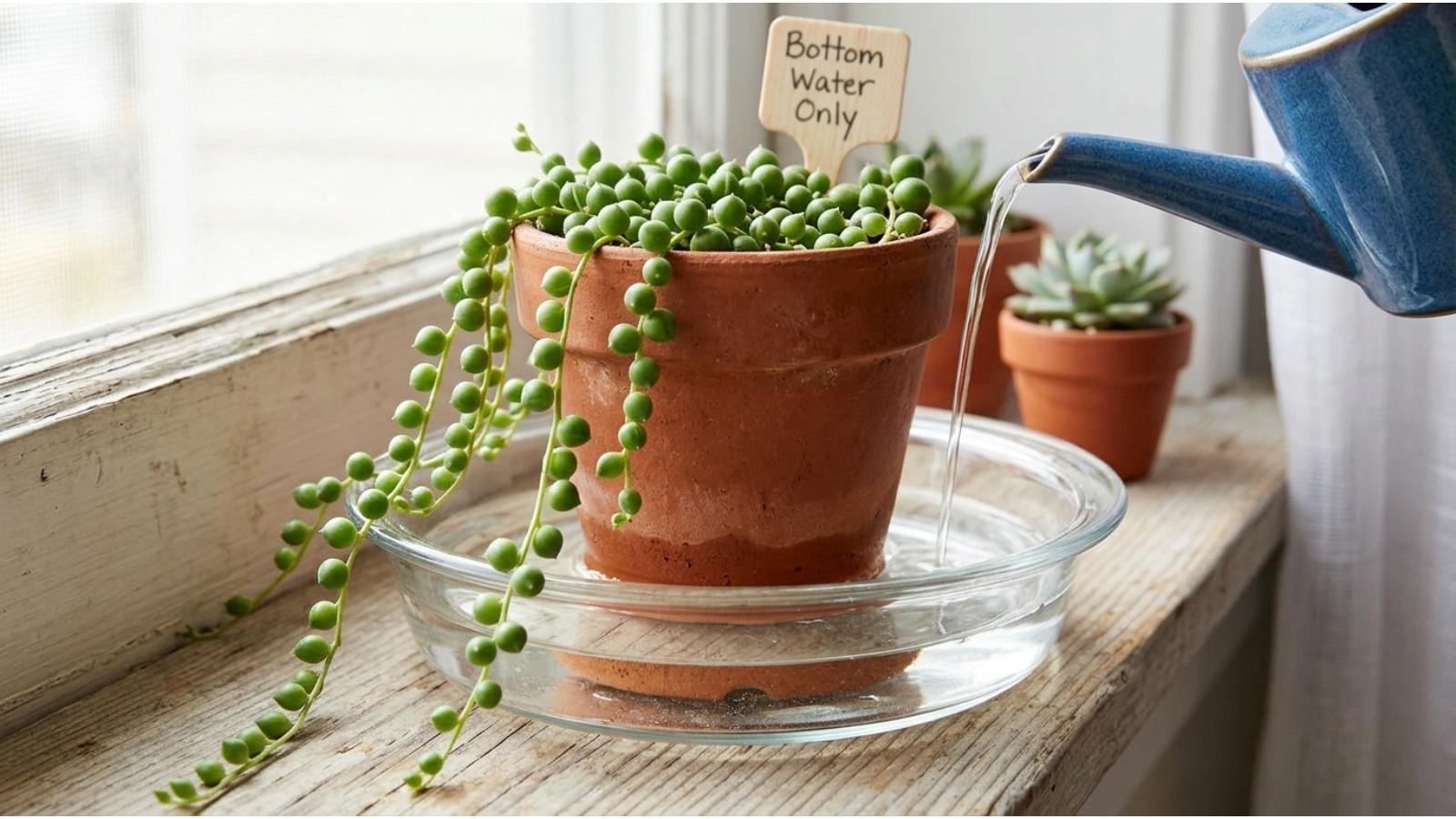
- When the soil has dried, water thoroughly.
- Allow excess water to drain from the bottom.
- Empty any water collected in a saucer or outer pot.
- Wait until the mix dries again before watering.
The allowing the compost to dry between waterings and watering much more sparingly during winter.
How often should you water?
There is no universal number of days.
Your watering frequency changes with:
- Light intensity.
- Temperature.
- Pot size.
- Soil composition.
- Pot material.
- Season.
- Plant size.
- Air circulation.
A plant in bright light and warm conditions may use water much faster than the same plant in a dim, cool room.
What do healthy pearls feel like?
Healthy leaves should look plump and firm.
If the pearls begin to become noticeably flattened or shriveled, the plant may be getting too dry. The University of Wisconsin Extension also notes that slightly shriveled leaves can indicate it is time to water.
Image Suggestion: Three-stage visual showing plump, mildly dehydrated, and severely dehydrated pearls.
How to Avoid Overwatering
Overwatering is one of the biggest risks for string of pearls.
A common beginner reaction to shriveled leaves is to immediately add more water. But shriveling can sometimes occur when damaged roots are unable to absorb water effectively. In that situation, watering even more can make the underlying problem worse.
Warning signs of excess moisture
Watch for:
- Yellowing leaves.
- Mushy or collapsing pearls.
- Soft stems.
- Darkened stems.
- Persistent wet soil.
- A foul or stagnant smell from the pot.
- Sudden stem loss.
Root rot can be especially difficult to reverse because the visible symptoms may appear after the roots have already been damaged.
What to do if you suspect overwatering
Remove the plant from its container and inspect the roots if symptoms are serious.
Healthy roots should not be mushy and decaying. Remove clearly damaged material with clean tools, allow appropriate cut surfaces to dry when necessary, and repot into fresh, well-draining medium.
Do not immediately return a damaged plant to the same saturated soil.
Choosing the Best Pot
A good pot can make watering much easier.
Look for these features
- Drainage holes.
- A relatively small container.
- Good airflow around the root zone.
- A size appropriate for the root system.
Terracotta vs. plastic
Terracotta can be useful because its porous material allows moisture to evaporate through the sides.
Plastic pots retain moisture longer, which is not necessarily bad, but it means you may need to wait longer before watering again.
The most important feature is still drainage—not the color or style of the pot.
Temperature and Humidity
String of pearls prefers warm, stable indoor conditions and does not need tropical humidity.
The approximately 10–25°C (50–75°F) for its string-of-beads growing guide and warns against cold drafts.
Avoid placing it:
- Against a cold window during winter.
- Directly beside an air conditioner.
- Immediately over a heating vent.
- In a constantly damp bathroom.
- Where temperatures fluctuate dramatically.
Does string of pearls need high humidity?
This is an important distinction from tropical plants such as many calatheas and ferns.
Do not mist string of pearls simply because you see another houseplant being misted.
Fertilizing String of Pearls
String of pearls is not a heavy feeder.
During active growth, you can use a diluted general-purpose liquid fertilizer occasionally. The feeding once a month or less during the growing season at half strength.
Avoid excessive fertilizer
Too much fertilizer can cause unnecessary salt buildup and encourage weak or unbalanced growth.
A simple approach is:
- Feed lightly during active growth.
- Do not fertilize a stressed or severely damaged plant.
- Reduce or stop feeding during winter.
- Follow the dilution instructions for the fertilizer you use.
More fertilizer does not automatically mean more pearls.
When and How to Repot String of Pearls
String of pearls does not need an oversized container to thrive.
Repot when:
- Roots are becoming crowded.
- The soil has broken down or drains poorly.
- The plant repeatedly stays wet for too long.
- The container is damaged.
- You need to replace problematic soil.
The newly purchased plants can often remain in their existing container for at least a year, while the University of Wisconsin Extension suggests repotting every year or two when appropriate.
Repotting steps
- Choose a container only slightly larger if an increase in size is necessary.
- Make sure it has drainage holes.
- Prepare fresh succulent soil.
- Carefully remove the plant.
- Inspect the roots.
- Remove obviously damaged roots if necessary.
- Place the plant at an appropriate depth.
- Fill around the roots without compacting the mix excessively.
- Allow the plant to settle before resuming your normal watering routine.
Image Suggestion: Step-by-step repotting infographic showing pot size, drainage holes, soil texture, and root inspection.
How to Propagate String of Pearls
Propagation is one of the easiest ways to create new plants from a healthy parent plant.
The most practical method is stem cutting propagation.
Propagation with stem cuttings
- Select a healthy stem.
- Cut a section several inches long using a clean tool.
- Remove a few pearls from the lower portion.
- Place the exposed nodes against or lightly into a well-draining propagation medium.
- Keep the medium only lightly moist rather than saturated.
- Provide bright, indirect light.
- Wait for roots to develop before treating the cutting like an established plant.
A useful propagation trick
You do not need to bury a long section of stem.
The nodes are the important areas for rooting. Getting several nodes in contact with the propagation medium can help produce multiple rooting points.
How to Make String of Pearls Fuller
A sparse plant is often a light and growth-management problem rather than simply an age problem.
Improve fullness by combining several strategies
Provide adequate light.
Better light helps prevent weak, stretched growth.
Trim excessively long or bare stems.
The cutting weak or straggly stems back to the base to encourage new growth.
Propagate healthy cuttings back into the pot.
Rooted cuttings can eventually help create a fuller container.
Avoid excessive water.
More water does not create faster, healthier growth when the roots are struggling.
Give the plant time.
A fuller hanging basket usually develops through repeated growth and propagation rather than overnight.
Why Is My String of Pearls Turning Yellow?
Yellow pearls can have several causes, so do not diagnose the problem from color alone.
Common possibilities
Too much water:
Persistently wet soil can damage roots and lead to yellowing.
Poor drainage:
Even moderate watering becomes risky when water cannot escape.
Insufficient light:
Low light can weaken growth and alter the appearance of foliage.
Normal leaf loss:
An occasional old leaf may naturally decline.
Start by checking the soil moisture and roots rather than immediately adding fertilizer or water.
Why Are My String of Pearls Shriveling?
Shriveled pearls usually suggest that the plant is experiencing a water-balance problem.
Possible causes include:
- Soil has stayed dry too long.
- The plant is using water rapidly in hot, bright conditions.
- Roots have been damaged by excessive moisture.
- The plant is stressed after repotting.
- Seasonal watering needs have changed.
The key is to check the soil and root condition before deciding what action to take.
If the soil is bone dry and the roots are healthy, watering may be appropriate. If the soil is wet and the plant is still shriveling, adding more water is unlikely to solve the problem.
Why Is My String of Pearls Losing Leaves?
Leaf loss can happen because of environmental stress, watering problems, physical damage, or root issues.
Check:
- Is the soil staying wet?
- Is the plant receiving enough light?
- Has its location recently changed?
- Are the stems soft or discolored?
- Is the pot draining properly?
- Has the plant experienced extreme heat or cold?
String of pearls has delicate trailing stems, so constantly moving or handling the plant can also cause mechanical damage.
Why Is My String of Pearls Growing Long and Sparse?
This is usually a light problem.
When light is insufficient, the plant may produce longer sections of stem with greater gaps between leaves. The RHS specifically identifies low light as a cause of weak, straggly growth and smaller, sparser leaves.
Move it gradually toward a brighter location rather than exposing a shade-grown plant suddenly to intense sun.
Once new growth becomes compact, you can prune older stretched sections and use healthy cuttings for propagation.
Common String of Pearls Care Mistakes
1. Watering on a fixed schedule
“Water every Sunday” sounds simple, but plants do not use water at the same rate every week.
Better approach: Check soil and plant condition first.
2. Using a large decorative pot without drainage
A beautiful container can become a problem if water has nowhere to escape.
Better approach: Use a drainage pot inside the decorative container.
3. Keeping the soil constantly moist
This is one of the fastest ways to create root problems.
Better approach: Let the growing medium dry between waterings.
4. Putting it in a dark corner
The plant may survive, but growth can become thin and stretched.
Better approach: Give it a bright location.
5. Misting the plant
String of pearls does not need high humidity.
Better approach: Focus on airflow and good drainage.
6. Using too much fertilizer
Succulents are not improved by excessive feeding.
Better approach: Fertilize lightly during active growth.
7. Repotting into a huge container
More soil means more moisture retention.
Better approach: Increase pot size only when necessary.
Seasonal String of Pearls Care
Spring
As light and growth increase:
- Gradually resume regular watering.
- Check whether the plant needs repotting.
- Begin light fertilization if the plant is actively growing.
- Prune weak or damaged stems.
Summer
Summer can bring strong light and faster water use.
- Watch for intense afternoon sun.
- Check soil more frequently.
- Maintain good airflow.
- Avoid leaving water standing in the pot or saucer.
Autumn
Growth may begin slowing.
- Reduce feeding.
- Monitor drying time.
- Avoid continuing a summer watering routine automatically.
Winter
String of pearls generally needs less water during its cooler resting period. The watering sparingly in winter and keeping the plant away from cold drafts.
Do not compensate for reduced winter light by watering more frequently.
Image Suggestion: Seasonal care calendar showing watering, feeding, light, and temperature adjustments from spring through winter.
Can String of Pearls Grow Outdoors?
Yes, it can be grown outdoors in suitable warm conditions, particularly in a sheltered position with bright light and protection from extreme weather.
However, it is not a frost-hardy plant.
If moving an indoor plant outdoors, acclimate it gradually to stronger light.
In hot climates, protect it from extreme midday or afternoon exposure if the foliage begins showing signs of sun stress.
Does String of Pearls Flower?
Yes.
Mature plants can produce small white or cream flowers with fragrance, typically during summer under suitable conditions.
Flowering is not guaranteed indoors, however.
Good overall health, sufficient light, mature growth, and an appropriate seasonal cycle can help create better flowering conditions.
Do not stress the plant severely just to force flowers.
Is String of Pearls Toxic?
This is an important consideration if you have children or pets.
The RHS lists string of pearls as potentially harmful, noting that its sap may irritate skin and that ingestion can cause stomach upset.The growing guide also recommends keeping these plants away from children and pets.
Wear gloves if your skin is sensitive when pruning or propagating, and position the plant somewhere inaccessible to animals that chew plants.
If a pet has eaten the plant, contact a veterinarian or an appropriate animal poison service rather than relying on online diagnosis.
String of Pearls vs. String of Tears
These plants are closely related, but they are not the same species.
| Feature | String of Pearls | String of Tears |
|---|---|---|
| Botanical name | Curio rowleyanus | Curio citriformis |
| Leaf shape | Round or pearl-like | Teardrop-shaped |
| Growth habit | Trailing | Trailing |
| Care style | Succulent care | Similar succulent care |
| Light | Bright | Bright |
| Soil | Fast draining | Fast draining |
Expert Care Checklist
Before deciding that your string of pearls is unhealthy, run through this checklist:
- Light: Is it receiving bright enough light?
- Soil: Does water drain quickly?
- Pot: Does the container have drainage holes?
- Water: Is the soil allowed to dry between waterings?
- Roots: Are they firm rather than mushy?
- Temperature: Is the plant protected from cold drafts?
- Humidity: Is the surrounding air reasonably dry and well ventilated?
- Growth: Are new stems compact rather than excessively stretched?
- Pests: Are there signs of aphids, mealybugs, or spider mites?
- Season: Have you adjusted watering for winter?
Frequently Asked Questions
How often should I water string of pearls?
Water when the growing medium has dried thoroughly, then water adequately and allow the excess to drain. Frequency depends on light, temperature, pot size, soil, and season, so a fixed weekly schedule is unreliable.
Does string of pearls need direct sunlight?
It benefits from bright light and can tolerate some direct sun, but intense sunlight—especially through a hot window—can scorch the foliage. Introduce stronger light gradually.
Why is my string of pearls turning brown?
Brown or damaged pearls can result from dehydration, excessive sunlight, physical damage, or root problems. Check both the plant’s light exposure and the moisture condition of its roots and soil.
Why are my pearls flat?
Flat or shriveled leaves can indicate that the plant needs water, but they can also occur when damaged roots cannot absorb moisture properly. Check the soil before watering.
Can string of pearls grow in low light?
It may survive, but low light commonly produces weak, stretched growth and sparse foliage. Bright light is a much better choice for attractive, compact growth.
Should I mist string of pearls?
No. This succulent does not need misting, and the avoiding high humidity and frequent misting
What type of soil is best for string of pearls?
Use a fast-draining cactus or succulent mix. Adding an appropriate amount of coarse inorganic material such as pumice or perlite can further improve drainage.
Can I propagate string of pearls from cuttings?
Yes. Stem cuttings are a straightforward propagation method. Healthy sections can be placed against or lightly into a suitable propagation medium so that nodes can develop roots.
How do I make string of pearls fuller?
Provide sufficient light, prune weak or bare stems, and root healthy cuttings back into the container. Fuller growth usually develops gradually rather than from heavy watering or fertilizing.
Is string of pearls a succulent?
Yes. Its fleshy leaves store water, and it should generally be cared for like a trailing succulent rather than a moisture-loving tropical houseplant.
Final Thoughts
Successful string of pearls plant care comes down to understanding what the plant is adapted to do. Its rounded leaves store water, so constantly wet soil is unnecessary and potentially dangerous. Give it bright light, a fast-draining growing medium, a pot with drainage, and enough time for the soil to dry between waterings.
The most useful habit is to inspect before you water. Look at the soil, feel the pearls, consider recent light and temperature, and check the roots if the plant continues to decline. That simple routine is far more reliable than following a rigid watering calendar.
With the right balance of light, dryness, drainage, and occasional feeding, string of pearls can develop long, attractive trailing stems and become one of the most distinctive plants in a houseplant collection.