Quick Answer
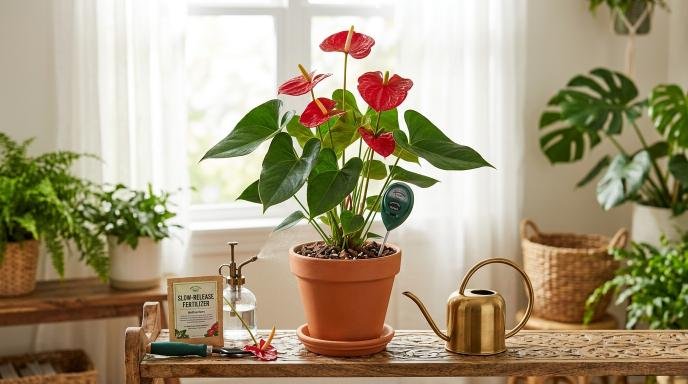
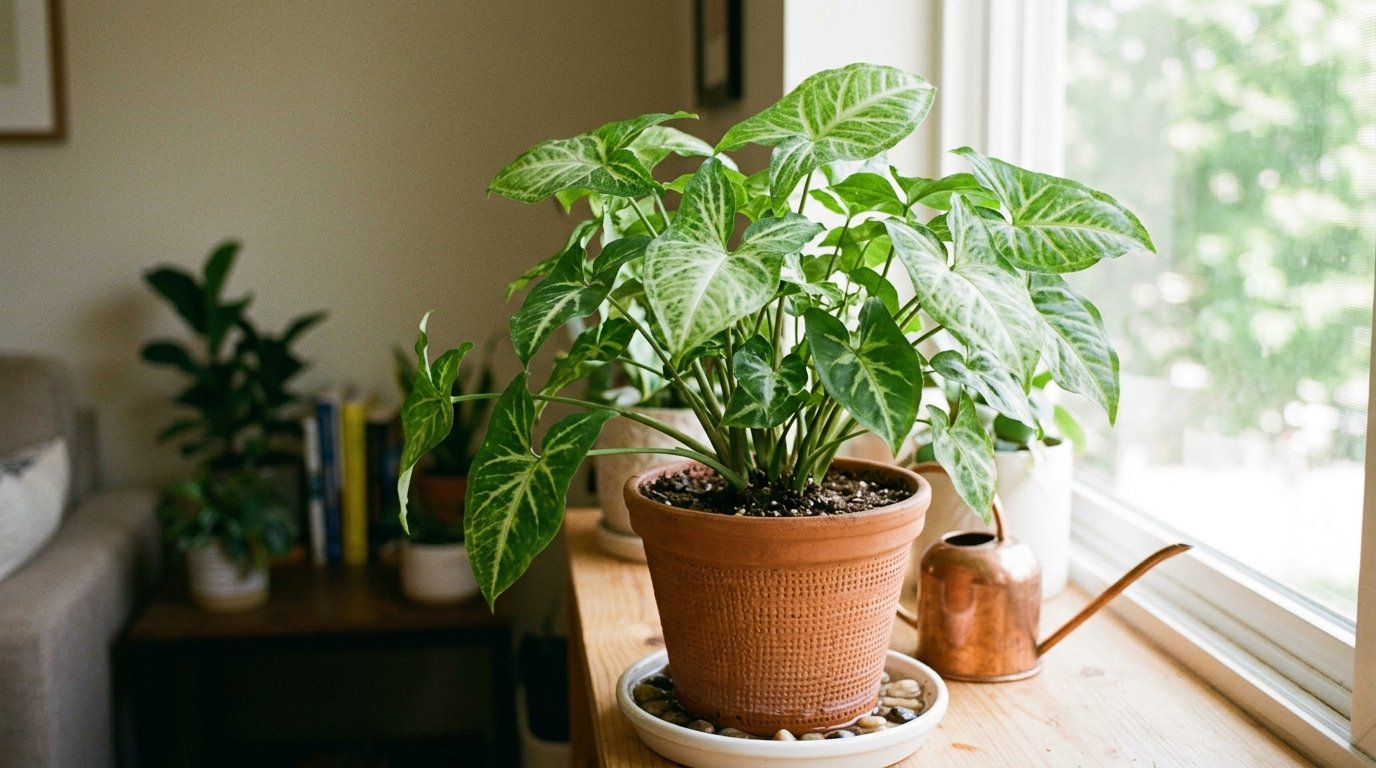
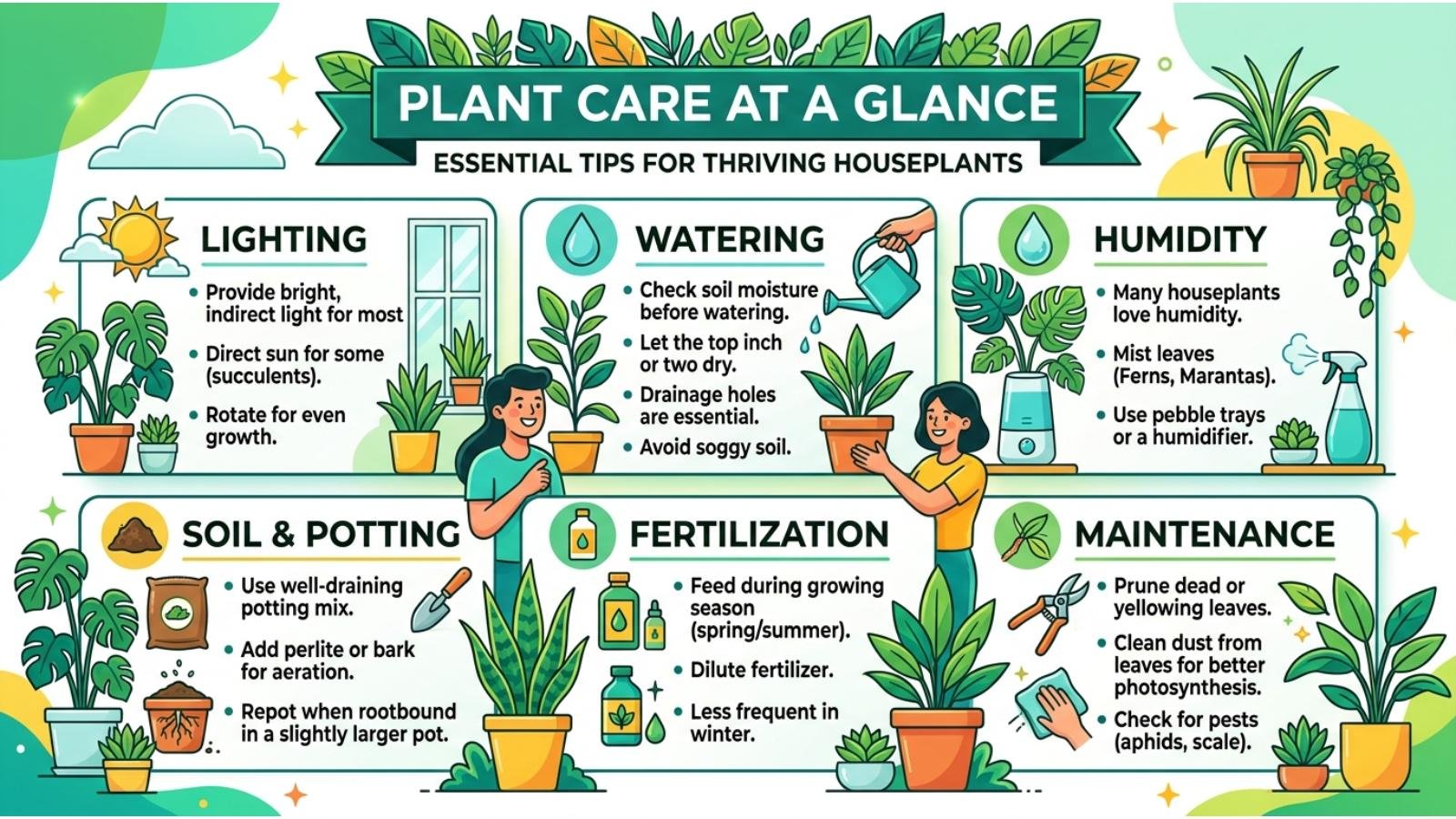
Arrowhead plant care is mainly about providing bright, indirect light, well-draining soil, moderate humidity, and consistent but controlled watering. Water when the top inch or two of soil feels dry, and avoid keeping the roots constantly wet. Prune regularly to encourage bushier growth, rotate the pot for even development, and repot when roots become crowded. Arrowhead plants can tolerate lower light, but stronger indirect light generally produces healthier, more compact growth.
Introduction
Arrowhead plant care is relatively easy once you understand how the plant responds to light, moisture, and pruning. The arrowhead plant, commonly known as Syngonium podophyllum, is popular as a houseplant because it grows quickly, adapts to indoor conditions, and produces attractive arrow-shaped leaves.
The biggest mistake beginners make is treating an adaptable plant as an indestructible one. An arrowhead plant can survive less-than-perfect conditions, but poor watering habits, insufficient light, compacted soil, or prolonged exposure to dry air can gradually lead to yellow leaves, weak growth, root problems, or leggy stems.
The good news is that most problems are preventable. With the right combination of light, watering, soil, humidity, pruning, and occasional feeding, an arrowhead plant can remain vigorous and attractive for years.
Arrowhead Plant Care at a Glance
| Care requirement | Best practice |
|---|---|
| Light | Bright, indirect light |
| Water | Water when the upper soil begins to dry |
| Soil | Loose, well-draining potting mix |
| Humidity | Moderate to high humidity is beneficial |
| Temperature | Warm, stable indoor conditions |
| Fertilizer | Balanced houseplant fertilizer during active growth |
| Pruning | Regularly pinch or trim stems for fuller growth |
| Repotting | When roots become crowded or soil drains poorly |
| Propagation | Stem cuttings in water or soil |
| Growth habit | Bushy when young, climbing or trailing with maturity |
What Is an Arrowhead Plant?
The arrowhead plant is a tropical aroid belonging to the genus Syngonium. Its common name comes from the arrow-like shape of its leaves, although leaf shape can change considerably as the plant matures.
Young plants typically have compact growth and relatively simple arrow-shaped leaves. Mature plants can develop larger and more deeply divided foliage, particularly when allowed to climb.
This growth behavior is important when planning arrowhead plant care. A plant that becomes long and vine-like is not necessarily unhealthy. It may simply be reaching a more mature growth stage or responding to its environment.
Image Suggestion: Photograph showing a young compact arrowhead plant beside a mature climbing plant to illustrate how foliage changes with age.
How Much Light Does an Arrowhead Plant Need?
Bright, indirect light is usually the best choice for an arrowhead plant.
Place it near a bright window where it receives plenty of filtered daylight without being exposed to intense direct afternoon sun for long periods.
Light affects more than just growth speed. It also influences:
- Leaf size.
- Stem strength.
- Distance between leaves.
- Variegation on colored cultivars.
- Overall plant density.
- Water consumption.
A plant growing in very low light may survive, but its stems can become stretched and sparse as it searchs for more light.
What About Direct Sunlight?
Gentle morning sunlight can be tolerated by many arrowhead plants, but strong direct sunlight can scorch foliage, especially when the plant has been grown indoors under filtered light.
If leaves develop pale, bleached, brown, or crispy patches after being moved closer to a sunny window, increase the distance from the glass or filter the light with a sheer curtain.
Can Arrowhead Plants Grow in Low Light?
They can tolerate lower-light conditions, but tolerance is different from preference.
In low light, growth is generally slower and stems may become elongated. Variegated plants can also struggle to maintain strong coloration when light levels are inadequate.
A practical approach is to give the plant the brightest indirect location available while watching the leaves for signs of excessive direct sun.
Image Suggestion: Diagram showing ideal placement near an east-facing, west-facing, and south-facing window.
How to Water an Arrowhead Plant Correctly
Watering is one of the most important parts of arrowhead plant care.
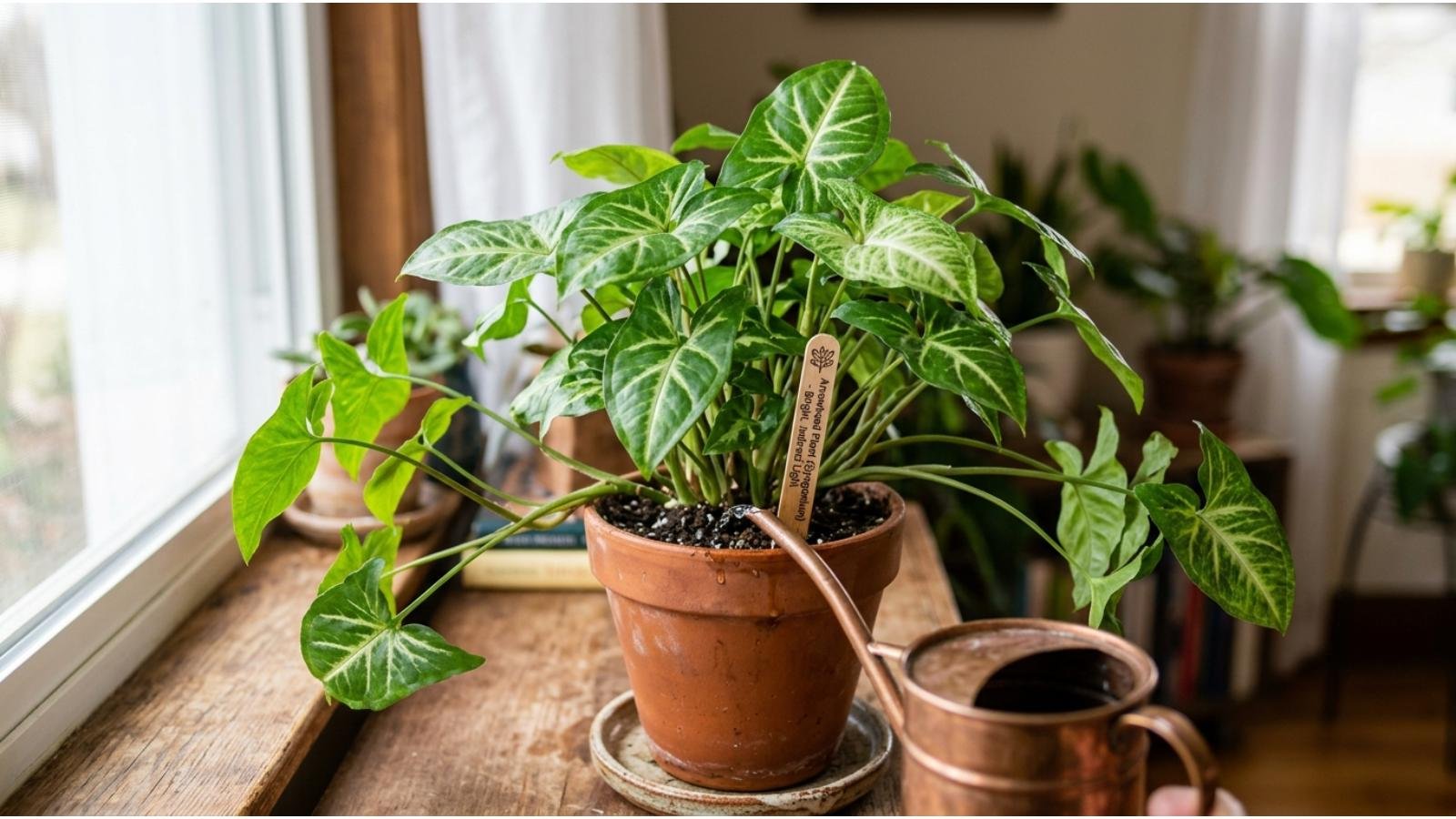
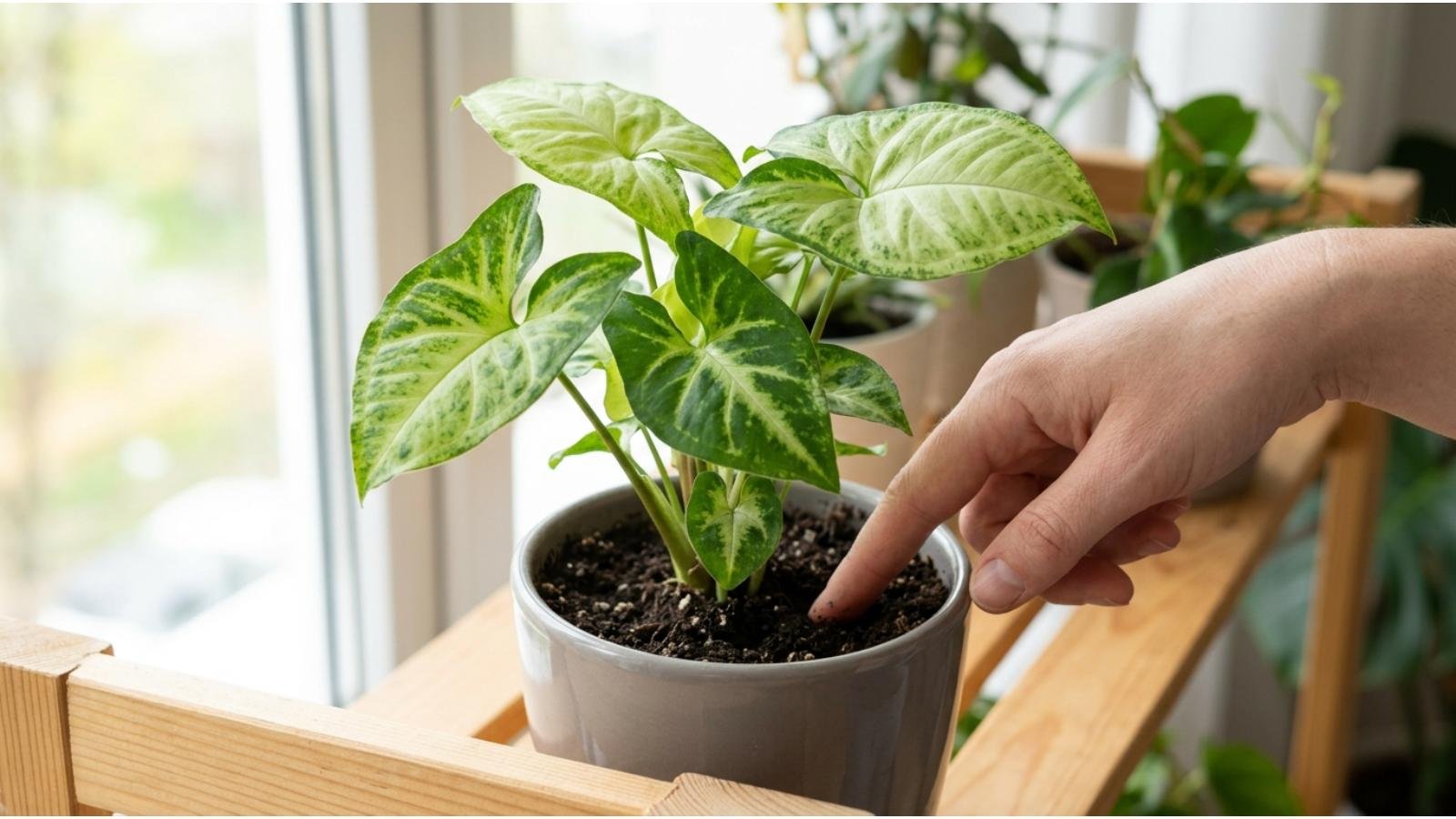
Instead of following a rigid calendar, check the soil. When the upper portion of the potting mix has started to dry, water thoroughly until excess moisture drains from the bottom of the container.
Then empty any standing water from the saucer or decorative cachepot.
The exact watering frequency varies because indoor conditions change. A plant in bright light during summer may need water considerably more often than the same plant in a cool, dim room during winter.
Signs Your Arrowhead Plant Needs Water
Look for a combination of clues:
- The upper soil feels dry.
- The pot feels noticeably lighter.
- Leaves begin to droop slightly.
- Growth slows during an otherwise active growing period.
Don’t rely on drooping alone. Plants can droop from both insufficient water and serious root problems caused by excessive moisture.
Why Overwatering Is Dangerous
Overwatering does not simply mean giving a plant too much water during one watering session. The more common problem is watering again before the soil has had enough time to dry, especially when the container or soil drains poorly.
Constantly wet soil reduces the air available around roots and creates conditions that can contribute to root deterioration.
A common beginner mistake is adding small amounts of water every few days. This can keep the upper and middle portions of the soil perpetually damp without properly flushing the root zone.
A better method is to check the soil first and then water thoroughly when the plant actually needs it.
Choosing the Right Soil for an Arrowhead Plant
Arrowhead plants perform best in a loose, moisture-retentive but well-draining growing medium.
A practical houseplant mix can contain:
- Quality indoor potting mix.
- Perlite or pumice for additional drainage.
- Orchid bark or another chunky material for improved aeration.
The goal is not to make the soil dry out instantly. The roots need access to moisture, but they also need air.
If water sits on the soil surface for a long time or drains extremely slowly, the growing medium may be too dense.
Why Drainage Matters More Than a Fancy Soil Recipe
There is no single perfect soil recipe for every home.
What matters most is that the mix holds enough moisture to support the plant while allowing excess water and air to move through the root zone.
Your container, indoor temperature, humidity, watering habits, and light level all influence how quickly the soil dries.
Best Pot for an Arrowhead Plant
Choose a container with drainage holes.
A decorative pot without drainage can be used as a cachepot, but the plant should remain in a nursery pot or inner container that allows excess water to escape.
When selecting a new pot, avoid dramatically increasing the container size. An oversized pot holds a larger volume of wet soil, which can take longer to dry.
A pot only slightly larger than the existing root system is often a more practical choice.
Humidity and Arrowhead Plants
Because arrowhead plants originate from tropical environments, they generally appreciate moderate to higher humidity.
However, you do not necessarily need to turn your entire home into a greenhouse.
If indoor air is particularly dry, especially during periods when heating or air conditioning is running, you may notice:
- Brown leaf edges.
- Crispy new growth.
- Slower development.
- Increased stress after watering becomes inconsistent.
A humidifier is often more effective than repeatedly misting the leaves because it can raise the surrounding humidity for a longer period.
Good airflow is also important. High humidity combined with stagnant air can create other problems.
Ideal Temperature for Arrowhead Plants
Arrowhead plants prefer warm, stable indoor conditions.
Protect them from:
- Cold drafts.
- Sudden temperature changes.
- Direct blasts from heating vents.
- Strong air-conditioning airflow.
- Very cold windows during winter.
You do not need to maintain tropical temperatures around the clock. The more important principle is avoiding prolonged cold exposure and abrupt environmental changes.
Fertilizing an Arrowhead Plant
An actively growing arrowhead plant benefits from regular feeding.
Use a balanced houseplant fertilizer according to the manufacturer’s dilution and frequency instructions. Fertilizing more frequently or using a stronger concentration does not automatically produce faster or healthier growth.
During periods of strong active growth, nutrients can support new leaves and stems. When growth slows considerably because of lower light or cooler conditions, reduce or pause feeding rather than maintaining a heavy fertilizing schedule.
A Common Fertilizer Mistake
Brown leaf edges are not automatically proof that a plant needs fertilizer.
Excess fertilizer can contribute to salt accumulation in the growing medium and damage roots. Before feeding a struggling plant, investigate light, watering, drainage, pests, and root health first.
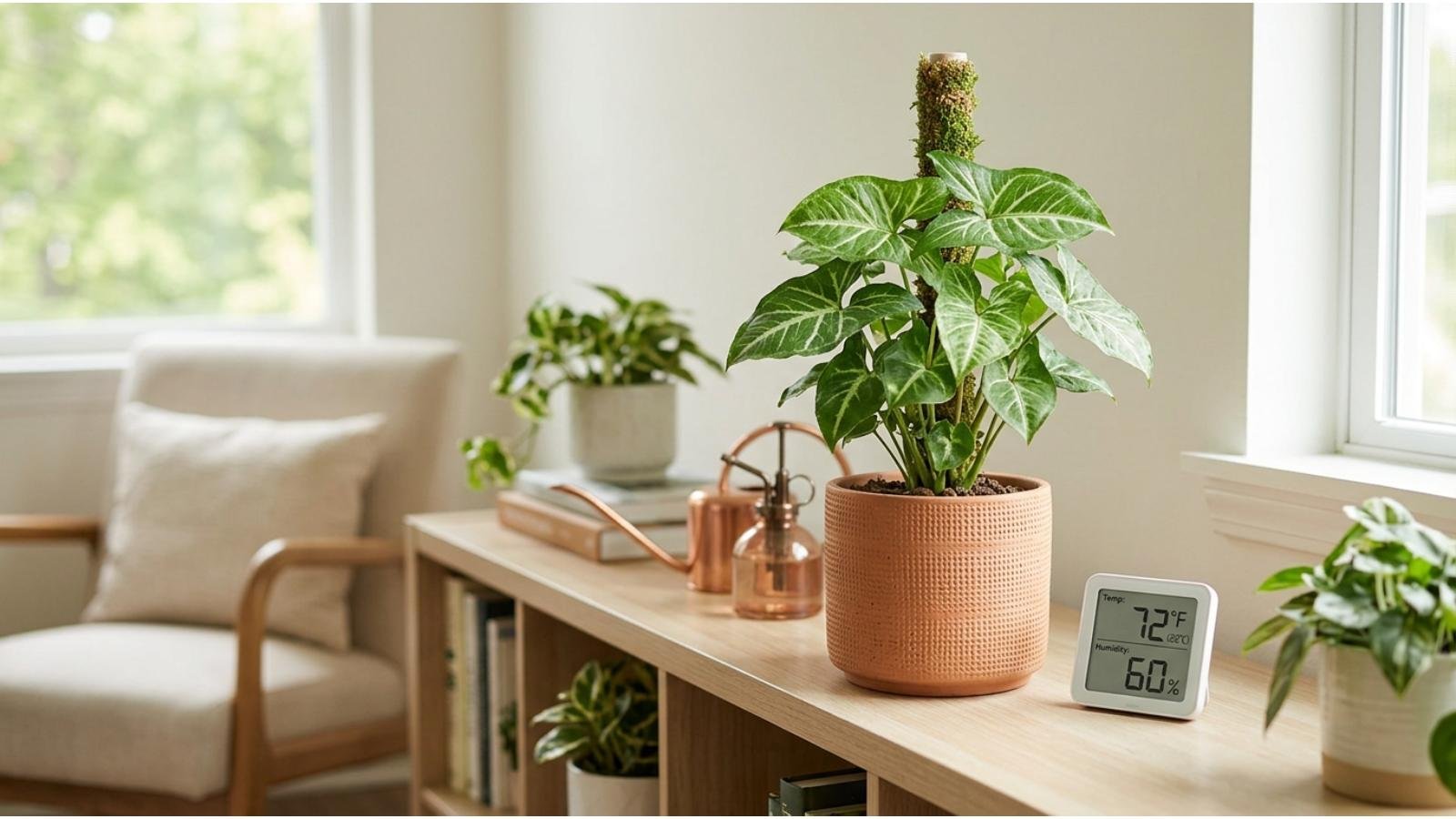
How to Prune an Arrowhead Plant
Pruning is one of the easiest ways to keep an arrowhead plant compact and attractive.
Use clean, sharp scissors or pruning shears and cut just above a healthy node.
Regular pruning can:
- Encourage branching.
- Reduce excessive legginess.
- Keep a young plant compact.
- Remove damaged foliage.
- Provide cuttings for propagation.
If the plant has become extremely long, you can shorten several stems rather than making one severe cut.
Should You Remove Yellow Leaves?
Yes, if a leaf is completely yellow, dead, or badly damaged, removing it can improve the plant’s appearance and allow you to inspect the remaining growth.
However, don’t automatically remove every yellowing leaf without investigating the cause.
Repeated yellowing may indicate a problem with watering, roots, light, nutrition, pests, or natural aging.
Image Suggestion: Close-up diagram showing where to make a pruning cut above a node.
How to Make an Arrowhead Plant Bushier
If your plant looks thin or has long bare sections of stem, pruning is usually more useful than simply adding fertilizer.
Try this approach:
- Move the plant to a brighter indirect-light location if light is inadequate.
- Identify long or sparse stems.
- Cut stems just above healthy nodes.
- Keep the healthiest cuttings for propagation.
- Rotate the pot periodically so growth develops more evenly.
- Continue trimming new growth as needed.
Light and pruning work together. A plant kept in very low light may continue producing elongated stems even after pruning.
Arrowhead Plant Propagation
Arrowhead plants are commonly propagated from stem cuttings.
Propagation in Water
Choose a healthy stem with at least one viable node.
- Cut below the node with clean scissors.
- Remove lower leaves that would sit underwater.
- Place the node in clean water.
- Keep the cutting in bright, indirect light.
- Change the water regularly.
- Wait for a healthy root system to develop.
- Transfer the rooted cutting into a suitable potting mix.
The important part is the node. A leaf without the appropriate stem tissue will not normally produce a new plant simply because it is placed in water.
Propagation in Soil
You can also place a suitable node-containing cutting directly into a moist, airy growing medium.
Keep the medium lightly moist while roots establish, but avoid keeping it saturated.
Image Suggestion: Step-by-step infographic showing an arrowhead stem cutting, node placement, root development, and potting.
When Should You Repot an Arrowhead Plant?
Repot when the plant has clearly outgrown its container or when the existing growing medium has deteriorated.
Possible signs include:
- Roots emerging from drainage holes.
- The root ball becoming extremely crowded.
- Water running through unusually quickly because the soil has become compacted or depleted.
- The plant drying out unusually fast.
- Growth slowing despite otherwise suitable conditions.
Spring and active-growth periods are generally convenient times for repotting, although a severely compromised plant may need attention regardless of season.
Do not automatically repot every year. The plant’s root system and condition should determine the timing.
Why Is My Arrowhead Plant Getting Leggy?
Leggy growth is often associated with insufficient light.
When a plant is trying to reach a stronger light source, the spaces between leaves can become longer, creating a sparse appearance.
Other contributing factors can include:
- Lack of pruning.
- Naturally climbing growth.
- Uneven light from one side.
- Environmental stress.
Move the plant gradually toward brighter indirect light rather than suddenly placing a low-light plant in intense direct sunlight.
Then prune excessively long stems to encourage a more compact shape.
Why Are Arrowhead Plant Leaves Turning Yellow?
Yellow leaves can have several causes, so the pattern matters.
If Several Leaves Turn Yellow
Check:
- Soil moisture.
- Drainage.
- Root condition.
- Recent changes in light.
- Fertilizer use.
- Pest activity.
If the soil remains wet for a long time, investigate the roots and drainage before watering again.
If Only an Older Leaf Turns Yellow
One aging leaf turning yellow occasionally may simply be part of the plant’s natural replacement of older foliage.
The concern is when yellowing becomes frequent or affects multiple leaves.
Why Are the Leaves Turning Brown?
Brown leaf edges or patches may result from several environmental problems.
Common possibilities include:
- Very dry indoor air.
- Inconsistent watering.
- Excessive direct sunlight.
- Fertilizer buildup.
- Root damage.
- Physical damage.
Instead of treating the brown tissue itself, look for the underlying pattern.
If brown areas consistently appear on the side exposed to strong sunlight, lighting may be the issue. If the edges are crispy while the soil repeatedly becomes extremely dry, watering or humidity may deserve attention.
Arrowhead Plant Leaves Curling
Curling leaves can occur when the plant is under environmental stress.
Check the plant’s:
- Soil moisture.
- Light exposure.
- Temperature.
- Humidity.
- Root condition.
- Pest activity.
Do not automatically water a curling plant without checking the soil. If the roots are already sitting in saturated soil, adding more water can make the underlying problem worse.
Common Arrowhead Plant Pests
Arrowhead plants can experience common houseplant pests such as:
- Spider mites.
- Mealybugs.
- Scale insects.
- Aphids.
- Thrips.
Inspect both the upper and lower surfaces of leaves, particularly around new growth and leaf joints.
Early detection makes pest management considerably easier. Isolating an affected plant from nearby houseplants can also help prevent pests from spreading.
Image Suggestion: Macro photograph identifying common pest signs on arrowhead plant leaves and stems.
How to Clean Arrowhead Plant Leaves
Dust can accumulate on broad leaves and make them look dull.
For a routine cleaning:
- Support the leaf gently.
- Wipe it with a clean, damp, soft cloth.
- Remove visible dust without aggressively rubbing the surface.
- Allow the leaves to dry naturally.
Avoid relying on oily leaf-shine products. Clean leaves generally look better without leaving a coating on the foliage.
Seasonal Arrowhead Plant Care
Spring
As light levels increase, watch for faster growth and increased water consumption.
This is a useful period for:
- Pruning.
- Repotting when necessary.
- Propagation.
- Resuming regular fertilization.
Summer
Higher temperatures and brighter light can increase water demand.
Check the soil more frequently, but do not water automatically every day.
Fall
As daylight decreases, growth may slow. Adjust watering according to the soil rather than continuing a summer watering schedule.
Winter
Indoor heating can create dry air while lower light can slow growth.
Avoid overwatering a plant simply because the soil appears dry on the surface. Check moisture deeper in the pot before deciding.
Reduce fertilizer when growth has slowed substantially.
Arrowhead Plant Care Mistakes to Avoid
Watering on a Fixed Schedule
A calendar cannot account for changing light, temperature, humidity, and soil conditions.
Check the plant instead.
Keeping the Soil Permanently Wet
Arrowhead plants like moisture, but constantly saturated soil can deprive roots of oxygen and contribute to root problems.
Putting the Plant in Harsh Sun
More light is not always better. Strong direct sunlight can damage foliage.
Using a Pot Without Drainage
Excess water needs somewhere to go.
Overfertilizing
More fertilizer does not equal more growth. Excess nutrients can create additional problems.
Ignoring Leggy Growth
Long, stretched stems can be an early indication that the plant needs better light or more intentional pruning.
Repotting Into an Oversized Container
A much larger pot can stay wet longer, increasing the difficulty of managing moisture.
How to Build a Simple Arrowhead Plant Care Routine
You do not need to constantly monitor your plant.
A simple routine works well:
Weekly:
Check the leaves for pests, inspect the soil moisture, and rotate the plant if growth is becoming uneven.
Every few weeks:
Look at new growth, inspect stems and leaf undersides, and assess whether the plant needs pruning.
During active growth:
Adjust watering and fertilizer according to environmental conditions.
When necessary:
Repot only when the root system or growing medium indicates that the plant needs it.
This approach is more reliable than following a rigid watering or fertilizing calendar.
Advanced Tip: Train an Arrowhead Plant to Climb
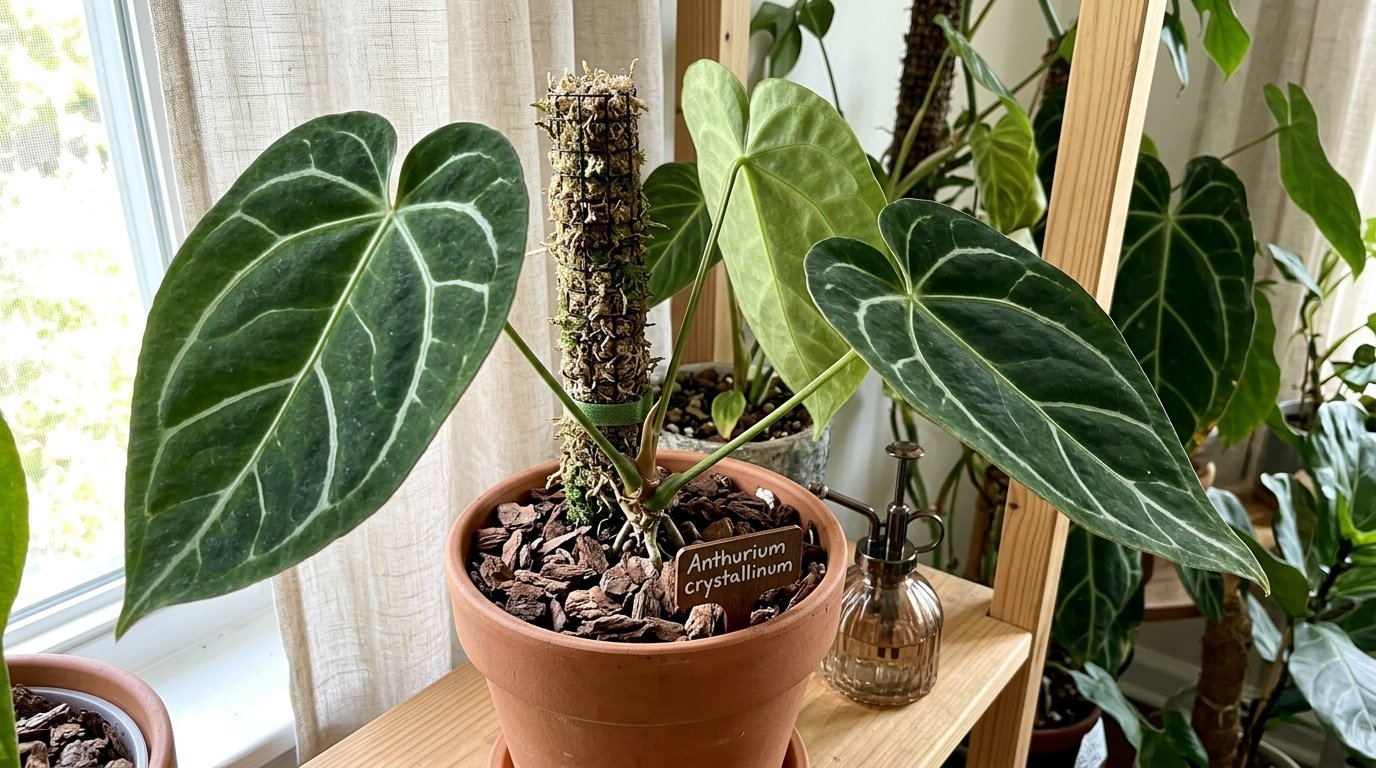
If you want a mature arrowhead plant to develop a more vertical appearance, provide a suitable support such as a moss pole or other plant support.
As the plant matures, supporting its climbing habit can create a very different appearance from a regularly pruned tabletop plant.
Choose the style you want before pruning heavily:
- Bushy: Regularly pinch or prune stems.
- Trailing: Allow stems to extend naturally.
- Climbing: Provide structural support and guide suitable growth.
This is one reason two healthy arrowhead plants can look completely different.
Arrowhead Plant Care for Variegated Plants
Variegated arrowhead plants generally require the same fundamental care as green forms, but their lighter leaf areas contain less chlorophyll.
As a result, maintaining suitable light is particularly important.
Avoid assuming that a heavily variegated plant should be placed in harsh direct sunlight simply because it needs more light. Bright, indirect light is usually a safer starting point.
If variegation begins changing noticeably, evaluate the plant’s light and overall health before making major changes.
Is an Arrowhead Plant Safe Around Pets?
Arrowhead plants contain insoluble calcium oxalate crystals and are considered toxic if chewed or ingested by cats, dogs, and people.
Keep the plant out of reach of pets and young children. If ingestion occurs, contact a veterinarian, poison-control service, or medical professional for appropriate guidance.
Frequently Asked Questions
How often should I water an arrowhead plant?
Water when the upper portion of the potting mix has begun to dry rather than watering according to a fixed schedule. Environmental conditions determine how quickly the soil dries.
Does an arrowhead plant need direct sunlight?
No. Bright, indirect light is generally preferable. Gentle morning sun may be tolerated, but intense direct sunlight can scorch the foliage.
Why is my arrowhead plant drooping?
Check the soil first. Both underwatering and root problems caused by excessive moisture can produce drooping, so watering should not be the automatic solution.
How do I make my arrowhead plant bushier?
Provide adequate indirect light and prune long stems above healthy nodes. Regular pruning encourages branching and helps maintain a compact shape.
Can I grow an arrowhead plant in water?
Stem cuttings containing suitable nodes can be rooted in water. Once roots are established, the cutting can be transferred to an appropriate growing medium.
Why is my arrowhead plant growing slowly?
Insufficient light, cool conditions, poor root health, nutrient limitations, or seasonal changes can slow growth. Check the overall growing environment before adding fertilizer.
Should I mist my arrowhead plant?
Misting may temporarily increase moisture around the leaves but is not a reliable substitute for maintaining suitable ambient humidity. A humidifier can provide more consistent humidity when indoor air is very dry.
Does an arrowhead plant like to be root bound?
It can tolerate a somewhat crowded root system, but severe root crowding can eventually restrict growth and make watering difficult. Repot when the plant clearly outgrows its container.
Can I prune an arrowhead plant heavily?
Healthy arrowhead plants can tolerate pruning, but avoid removing excessive foliage at once. Gradual pruning is generally easier for the plant and allows you to shape its growth deliberately.
Why are my arrowhead plant leaves turning brown?
Brown leaves can result from dry conditions, inconsistent watering, excessive sunlight, fertilizer buildup, root problems, or pests. Examine the pattern and growing conditions before deciding on a treatment.
Conclusion
Successful arrowhead plant care comes down to maintaining a sensible balance rather than following a complicated schedule. Give the plant bright indirect light, well-draining soil, appropriate watering, adequate humidity, and regular pruning, and it can produce vigorous, attractive growth indoors.
The most useful habit is to inspect the plant before taking action. Check the soil before watering, examine leaves before assuming nutrient deficiencies, and look at light conditions when growth becomes thin or stretched.
Once you learn to respond to what the plant is actually showing you, arrowhead plant care becomes much easier—and you can choose whether to maintain a compact bushy plant, let it trail, or train it into a climbing specimen.