Quick Answer
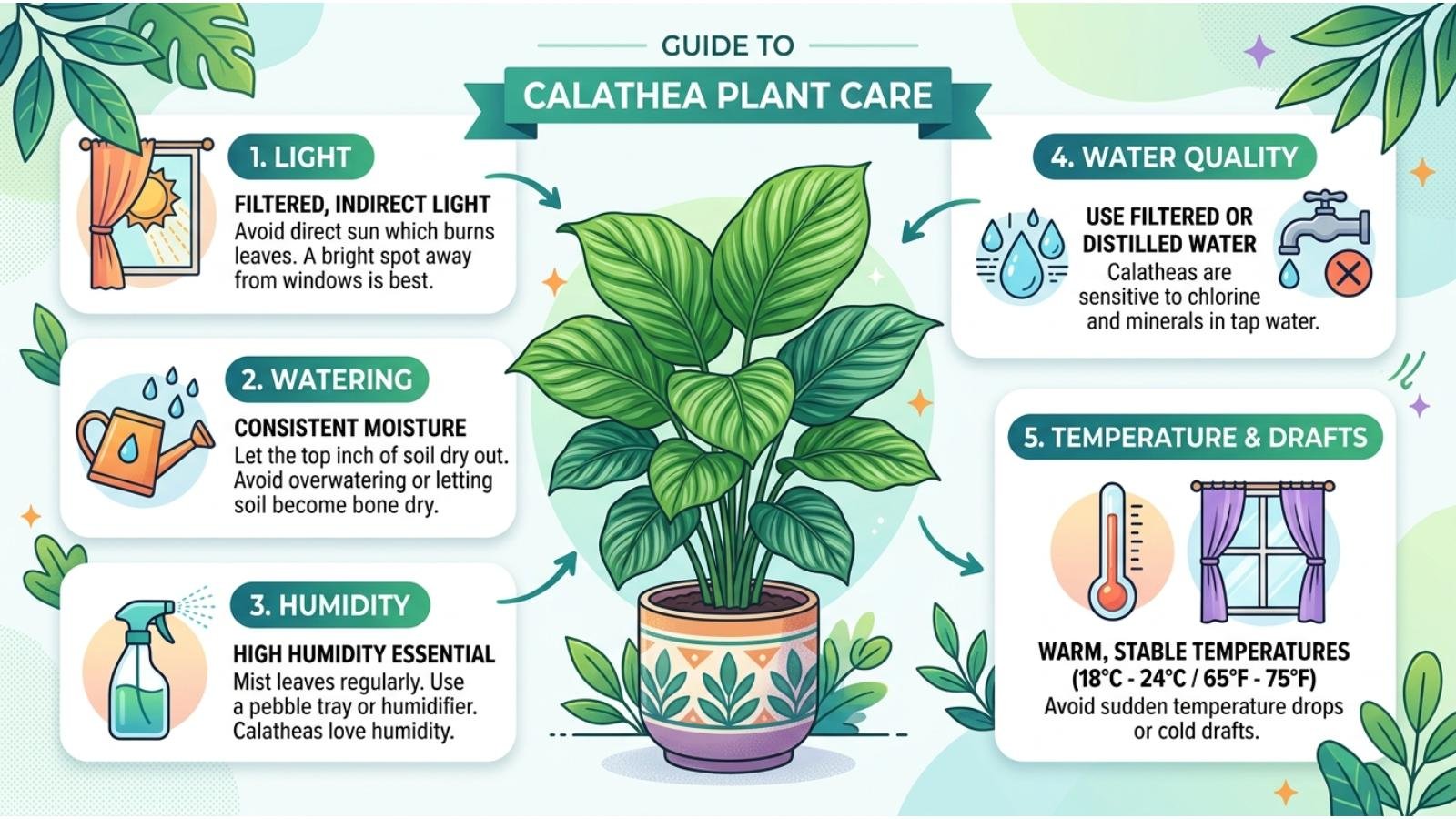
Calathea plant care mainly involves bright indirect light, consistently moist but well-draining soil, moderate to high humidity, warm temperatures, and protection from drafts. Water when the upper layer of soil begins to dry rather than following a rigid schedule. Calatheas are especially sensitive to dry air, excessive fertilizer, and mineral-heavy water, which can cause brown leaf edges and curling. Consistent conditions are usually more important than frequent adjustments.
Introduction
Calatheas are prized for their beautifully patterned foliage, but their reputation for being demanding can make new plant owners nervous. The good news is that most Calathea problems become much easier to prevent once you understand what the plant is actually responding to.
Successful calathea plant care is less about following a perfect watering calendar and more about maintaining a stable environment. A plant sitting beside a hot window may need completely different care from one growing in a humid bathroom or shaded bedroom.
Brown edges, curled leaves, faded patterns, drooping foliage, and slow growth are some of the most common complaints. These symptoms can have several causes, so treating every problem with more water is a mistake.
The goal is simple: give your Calathea stable warmth, suitable indirect light, evenly moist soil, good drainage, and adequate humidity.
Understanding Calatheas Before You Start
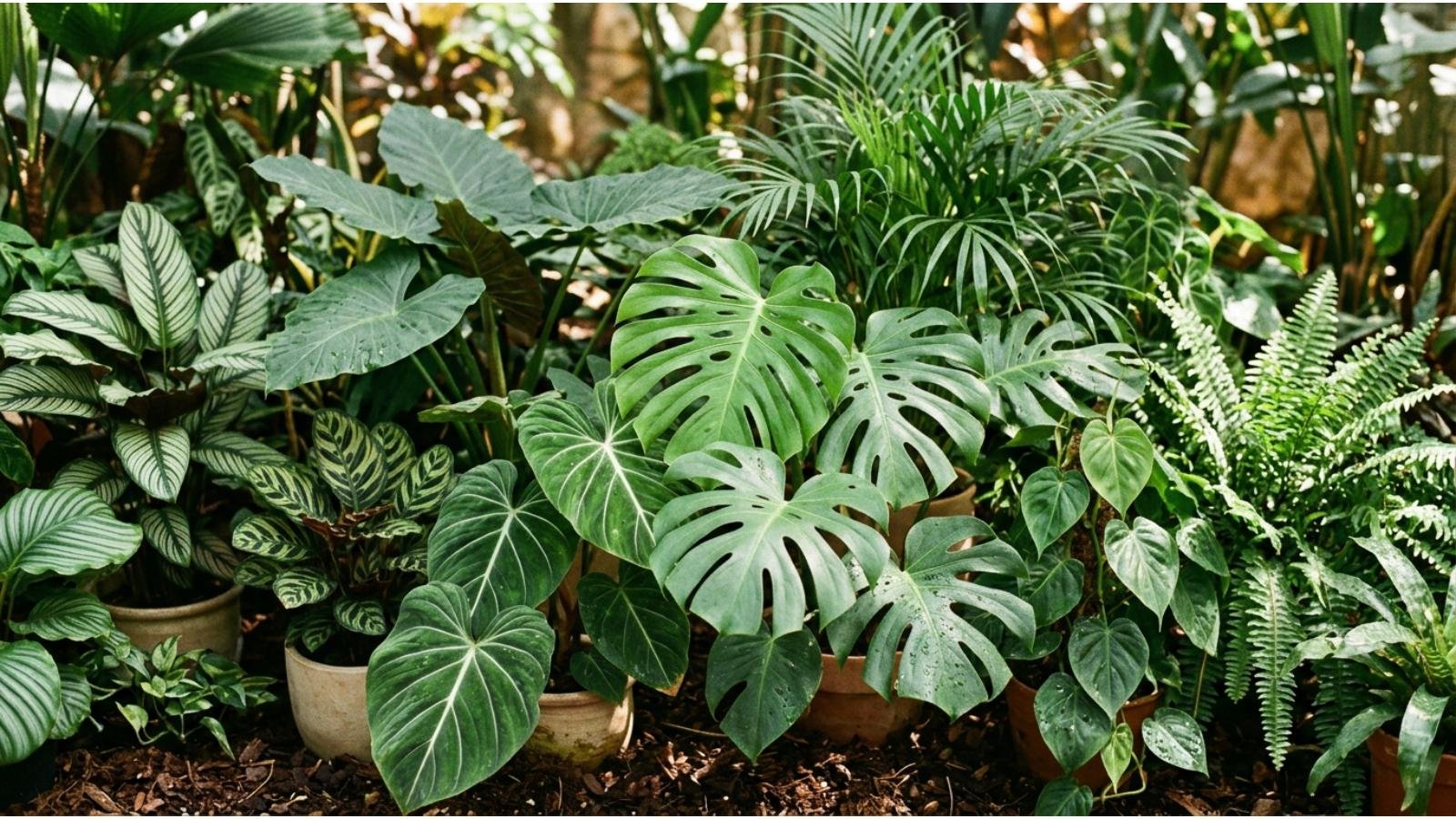
Calathea is the common name used for a group of tropical foliage plants known for decorative leaves with stripes, spots, contrasting undersides, or feather-like patterns.
Many plants sold as Calatheas are now classified botanically under the genus Goeppertia, although the name Calathea remains extremely common in horticulture and everyday plant care.
Popular types include:
- Calathea orbifolia.
- Calathea lancifolia, commonly called the rattlesnake plant.
- Calathea makoyana, commonly called the peacock plant.
- Calathea roseopicta.
- Calathea ornata.
- Calathea warscewiczii.
Different varieties can have different tolerances, but their basic care requirements are broadly similar.
Image Suggestion: Collage showing several Calathea varieties with their distinctive leaf patterns.
Calathea Light Requirements
Calatheas generally perform best in bright, indirect light.
Their natural tropical environment provides filtered light rather than intense, direct midday sun. Strong sunlight through a window can scorch delicate leaves and cause faded or washed-out patterns.
A good location is:
- Near a bright window with filtered light.
- A few feet away from a sunny south- or west-facing window.
- Behind a sheer curtain.
- In a naturally bright room without harsh direct sunlight.
Low light can also cause problems. A Calathea may survive in dim conditions, but growth can become slow and new leaves may be smaller.
How to Tell if the Light Is Wrong
Too much light may cause:
- Faded leaf markings.
- Bleached-looking patches.
- Brown or crispy areas.
- Scorched sections on exposed leaves.
Too little light may cause:
- Slow growth.
- Smaller new leaves.
- Long gaps between leaves.
- Soil staying wet for an unusually long time.
A useful practical test is to observe the soil as well as the leaves. If the plant receives very little light and the soil remains wet for many days, watering less frequently may not solve the underlying problem. Improving the light can help the plant use moisture more effectively.
Image Suggestion: Diagram showing ideal bright indirect light versus harsh direct sunlight for Calatheas.
How Often Should You Water a Calathea?
Calatheas prefer evenly moist soil, but they do not want to sit in permanently saturated soil.
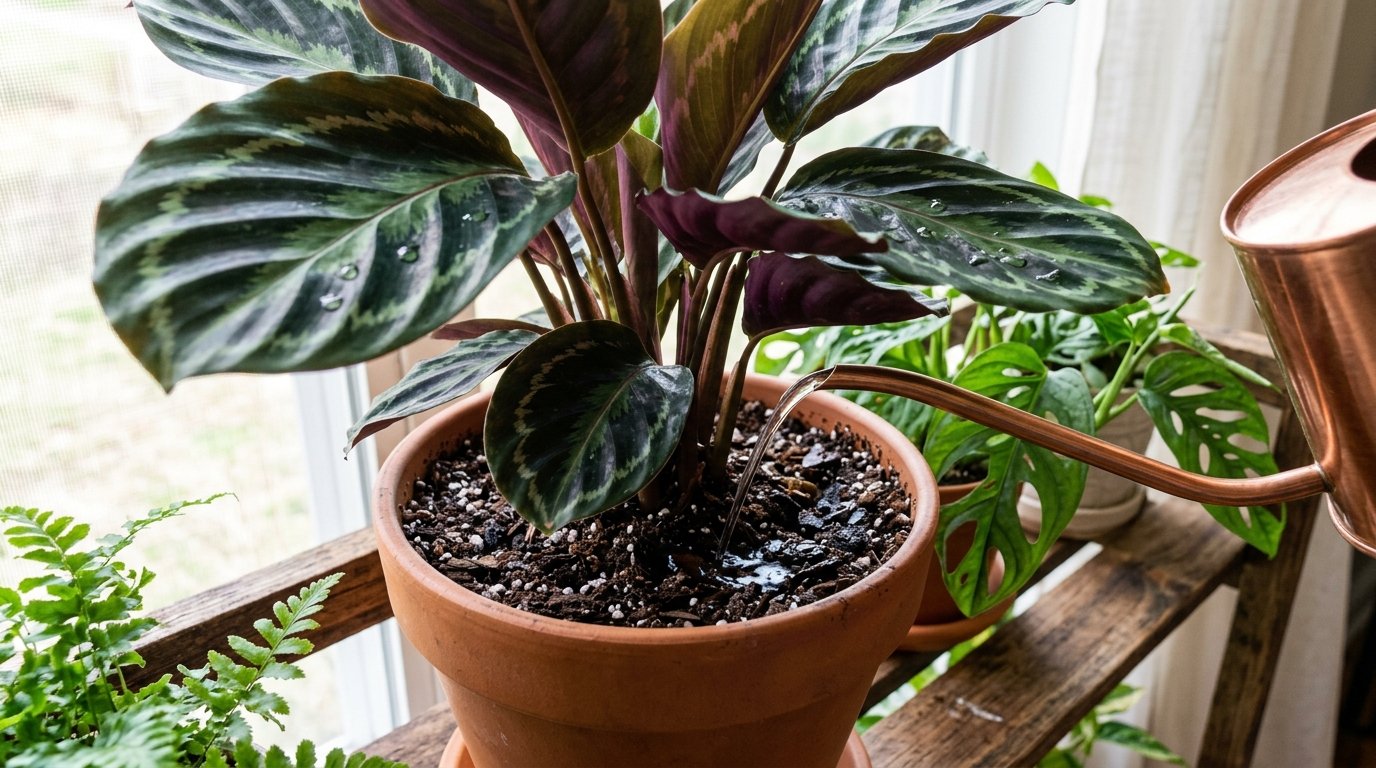
Instead of watering on a fixed day every week, check the soil first.
Insert your finger about an inch into the potting mix. If the upper layer feels slightly dry while the lower soil remains moderately moist, it may be time to water.
When watering:
- Water thoroughly until excess moisture drains from the bottom.
- Allow the pot to drain completely.
- Empty standing water from a saucer or decorative container.
- Check the soil again before watering next time.
The exact frequency depends on temperature, humidity, light, pot size, soil composition, and plant size.
A Calathea growing in warm, bright conditions may use water considerably faster than one growing in a cool, dim room.
Why a Watering Schedule Can Fail
A common beginner mistake is assuming that a plant needs water every seven days simply because a care label says so.
That schedule ignores environmental changes.
For example, the same Calathea may need more frequent watering during warm, active growth and considerably less during cooler, darker periods.
Water the soil according to its condition, not the calendar.
What Type of Water Is Best for Calatheas?
Calatheas can be sensitive to minerals and salts present in some tap water.
If your plant repeatedly develops brown, crispy leaf edges despite appropriate humidity and watering, the water quality may deserve attention.
Depending on local water quality, growers may use:
- Filtered water.
- Rainwater collected safely.
- Distilled water.
- Another low-mineral water source.
You do not necessarily need to change water immediately if your Calathea is growing well. Look for a pattern of recurring leaf-edge browning before assuming water quality is the cause.
If mineral buildup is suspected, periodically flushing the pot thoroughly with suitable water can help remove accumulated salts from the potting mix.
Best Soil for Calathea Plants
Calatheas need a potting mix that holds moisture while still allowing excess water and air to move through the root zone.
A useful mix can contain:
- Quality indoor potting mix.
- Coco coir or another moisture-retentive component.
- Perlite or pumice for aeration.
- Fine bark for additional structure.
The exact recipe is less important than the result.
You want soil that remains gently moist without becoming a heavy, airless mass.
What Happens in Poor Soil?
If soil is too dense, water may remain around the roots for too long. This can contribute to root stress and eventually root rot.
If the mix drains extremely quickly and dries out soon after watering, the plant may repeatedly experience moisture stress.
The ideal balance is moisture retention plus drainage and aeration.
Image Suggestion: Close-up diagram of an ideal Calathea potting mix showing organic material, bark, and aeration particles.
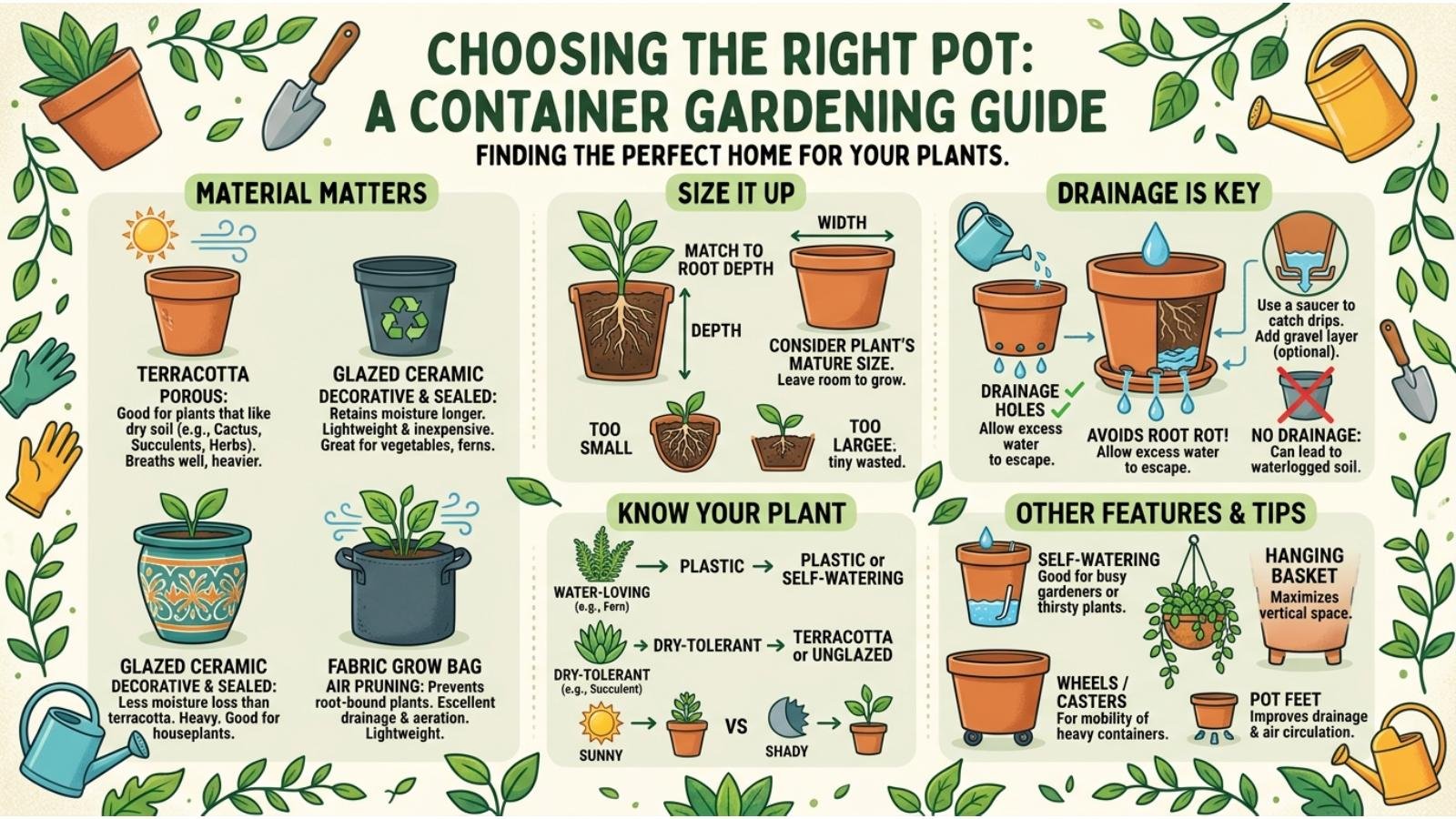
Choosing the Right Pot
A Calathea does not need an enormous container.
Choose a pot with drainage holes and generally move up only one size when the plant becomes root-bound.
An oversized pot can hold more wet soil than the plant’s roots can use. This increases the time the soil remains wet and can make watering problems more difficult.
A practical setup is:
Drainage holes + appropriately sized pot + airy moisture-retentive soil.
Decorative cachepots can be used, but never allow the nursery pot to sit permanently in collected water.
Calathea Humidity Requirements
Humidity is one of the biggest factors affecting Calathea appearance.
Many Calatheas prefer moderate to high humidity, and they often struggle when indoor air becomes very dry.
Dry air can contribute to:
- Brown leaf edges.
- Crispy tips.
- Curling leaves.
- Faster moisture loss.
- Poor-looking new growth.
A relative humidity around 50–60% or higher is often more comfortable for these tropical plants, provided there is adequate airflow.
Ways to Increase Humidity
You can improve humidity by:
- Using a humidifier.
- Grouping compatible plants together.
- Growing the Calathea in a naturally humid room.
- Keeping it away from heating and cooling vents.
A pebble tray may slightly increase humidity immediately around the plant, but it is not a substitute for a humidifier when the surrounding air is consistently very dry.
Should You Mist a Calathea?
Misting can temporarily wet the leaves, but it does not reliably maintain high humidity throughout the day.
If your home is genuinely dry, improving the room’s overall humidity is generally more useful than repeatedly spraying the leaves.
Image Suggestion: Calathea positioned near a humidifier with an indoor humidity meter visible.
Ideal Temperature for Calatheas
Calatheas prefer warm, stable indoor conditions.
A comfortable range is generally around 65–80°F (18–27°C).
Avoid placing them:
- Against cold windows during winter.
- Directly beside air conditioners.
- Directly above heating vents.
- In areas with strong temperature fluctuations.
- Near frequently opened exterior doors during cold weather.
Sudden environmental changes can cause stress even when the plant receives otherwise good care.
Calathea Fertilizer and Feeding
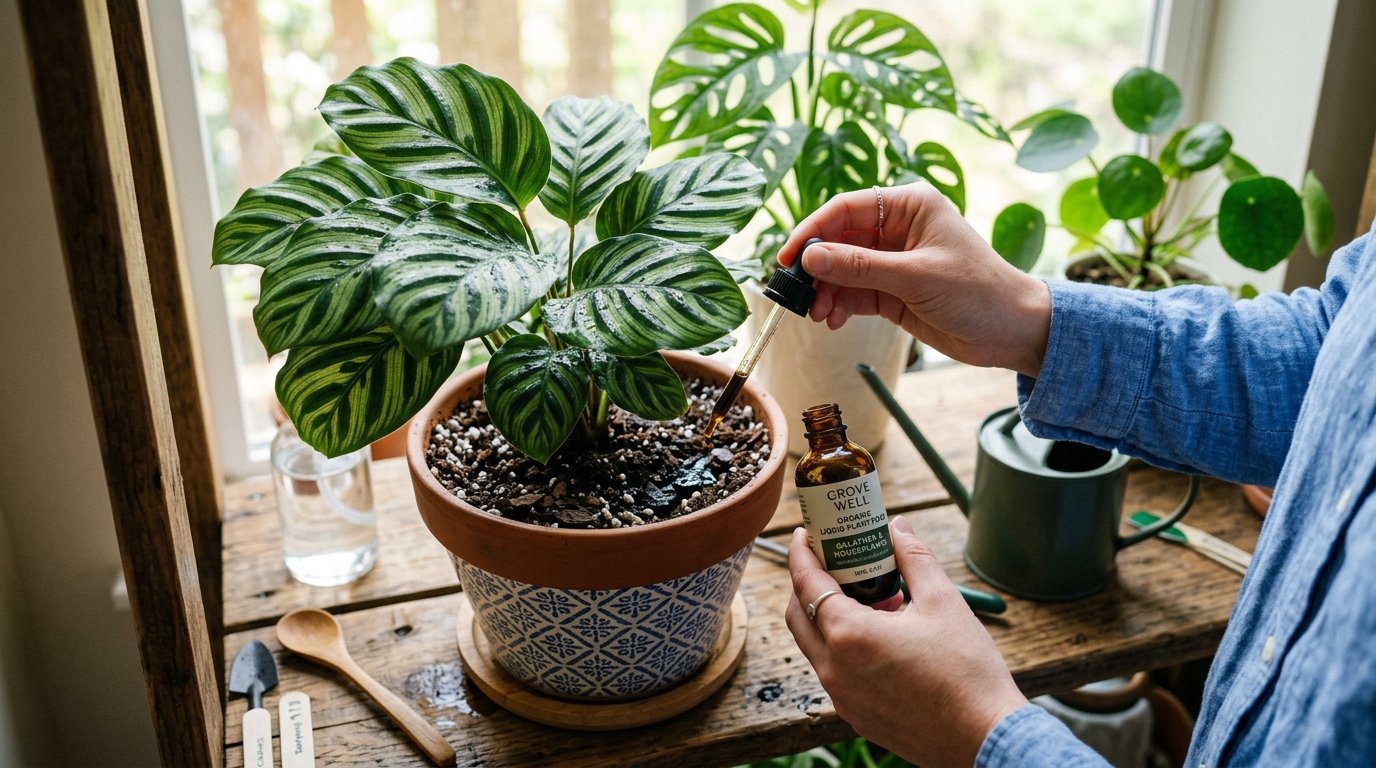
Calatheas benefit from nutrients during active growth, but heavy feeding can damage roots and contribute to leaf-edge problems.
Use a balanced, water-soluble houseplant fertilizer at a diluted strength according to the product’s directions.
During active growth:
- Feed lightly rather than heavily.
- Water appropriately before or while fertilizing according to the fertilizer instructions.
- Avoid repeatedly applying concentrated fertilizer.
- Reduce or stop routine feeding when growth naturally slows.
More fertilizer does not automatically mean faster growth.
Excess fertilizer can accumulate in the soil and may contribute to root stress and browning.
How to Repot a Calathea
Repotting is usually necessary when roots have filled the container, the soil structure has deteriorated, or the plant is drying out unusually quickly.
Step-by-Step Repotting
- Choose a container only slightly larger than the current one.
- Make sure it has drainage holes.
- Prepare a loose, moisture-retentive potting mix.
- Carefully remove the plant from its existing container.
- Inspect the roots for obvious damage or decay.
- Gently loosen severely compacted soil.
- Place the plant at approximately the same depth as before.
- Fill around the root ball with fresh mix.
- Water thoroughly and allow the excess to drain.
- Return the plant to a stable location with indirect light.
Avoid aggressively disturbing healthy roots unnecessarily.
Image Suggestion: Step-by-step Calathea repotting infographic from removing the plant to watering the finished pot.
Why Are My Calathea Leaves Curling?
Curling leaves are a symptom rather than a diagnosis.
Common causes include:
- Dry soil.
- Low humidity.
- Excessive heat.
- Cold drafts.
- Root problems.
- Sudden environmental changes.
- Excessive direct light.
First check the soil moisture. Then examine the location.
If the soil is dry and the air is also dry, dehydration is a reasonable suspect. If the soil is constantly wet, adding more water could make the situation worse.
This is why diagnosing the environment before changing the watering routine is important.
Why Are Calathea Leaves Turning Brown?
Brown leaf edges are among the most common Calathea complaints.
Possible causes include:
| Symptom | Possible Cause | What to Check |
|---|---|---|
| Brown crispy edges | Dry air | Room humidity |
| Brown tips | Water quality or dry conditions | Water source and humidity |
| Brown patches | Excessive direct light | Window exposure |
| Brown leaves with wet soil | Root stress | Drainage and roots |
| Widespread browning | Multiple environmental stresses | Light, water, humidity, temperature |
Do not automatically cut off every brown leaf or increase watering.
Start by identifying the pattern.
A few brown tips on an otherwise healthy plant may simply reflect older damage. Widespread browning accompanied by drooping or declining growth deserves a closer inspection.
Why Are Calathea Leaves Turning Yellow?
Yellow leaves can result from several different conditions.
Potential causes include:
- Excessive watering.
- Poor drainage.
- Naturally aging leaves.
- Low light combined with slow soil drying.
- Root stress.
- Nutritional imbalance.
One yellow lower leaf is not necessarily an emergency. Plants naturally shed older foliage.
However, if multiple leaves turn yellow while the soil remains wet for extended periods, inspect the roots and drainage conditions.
Calathea Leaves Drooping
Drooping can occur when a Calathea needs water, but moisture stress is not the only explanation.
Check:
- Soil moisture.
- Recent watering.
- Root condition.
- Room temperature.
- Humidity.
- Light exposure.
If the soil is dry, water thoroughly and observe the plant over the following hours.
If the soil is already saturated, watering again is unlikely to solve the problem.
This distinction is especially important because both underwatering and root problems can produce drooping foliage.
Why Is My Calathea Losing Its Leaf Pattern?
Calathea foliage is one of its main attractions, so fading patterns can be frustrating.
Insufficient light can contribute to weaker-looking growth and less impressive coloration. Excessive direct sunlight can also fade or damage leaves.
Move the plant gradually rather than making an extreme change overnight.
The best location is usually bright enough to support active growth while protecting the foliage from intense direct sun.
Do Calatheas Need Pruning?
Calatheas do not require aggressive pruning.
Remove:
- Completely dead leaves.
- Severely damaged leaves.
- Brown sections when desired for appearance.
Use clean, sharp scissors and cut damaged tissue neatly.
Removing a damaged leaf will not reverse the underlying environmental problem. Think of pruning as cleanup, not treatment.
If new leaves continue emerging healthy, the plant is recovering even if older foliage still looks imperfect.
Calathea Propagation
Calatheas are generally propagated through division, particularly when a mature plant has developed multiple growth points.
Basic Division Process
- Remove the mature plant carefully from its container.
- Examine the root system and natural clumps.
- Identify sections with their own roots and growing points.
- Separate suitable divisions carefully.
- Plant each division in an appropriately sized container.
- Use fresh, well-draining but moisture-retentive soil.
- Keep the divisions warm and adequately humid while they establish.
Propagation through leaf cuttings is not generally a reliable way to create a new Calathea.
Calathea Care Through the Seasons
Calathea requirements can change as indoor conditions change.
Spring
Increasing light and warmth can stimulate new growth.
Check the soil more frequently as the plant begins using water faster.
Summer
Higher temperatures can increase water consumption.
Protect the plant from intense direct sunlight and monitor humidity, especially in air-conditioned rooms.
Fall
Growth may gradually slow.
Avoid automatically maintaining a summer watering schedule if the soil is staying wet longer.
Winter
Indoor heating can make the air considerably drier.
Keep the plant away from heating vents and cold drafts, and pay attention to slower soil drying.
Seasonal adjustment is more reliable than following the same watering routine throughout the year.
Common Calathea Care Mistakes
Watering on a Fixed Schedule
Calendar-based watering ignores changes in light, temperature, humidity, and soil moisture.
Keeping the Soil Permanently Wet
Moist soil is desirable. Waterlogged soil is not.
Putting the Plant in Harsh Sunlight
Tropical does not mean full, intense indoor sunlight.
Ignoring Humidity
A Calathea may remain alive in dry air while developing increasingly unattractive leaf edges.
Using Too Much Fertilizer
More fertilizer can create more problems instead of more growth.
Choosing a Huge Pot
A large pot can keep unused soil wet for too long.
Constantly Moving the Plant
Frequent changes make it difficult to determine which conditions are actually working.
Once you find a suitable location, consistency is valuable.
A Simple Calathea Care Routine
For beginners, a simple routine is often more effective than trying to optimize everything at once.
Weekly Check
Inspect:
- Soil moisture.
- Leaf condition.
- New growth.
- Room temperature.
- Humidity.
- Signs of pests.
Monthly Check
Look for:
- Mineral buildup.
- Root crowding.
- Soil compaction.
- Accumulating dead foliage.
- Changes in light exposure.
When Something Goes Wrong
Do not change five variables simultaneously.
Instead, identify the strongest clue.
For example, if the plant has curling leaves and bone-dry soil, investigate moisture first. If it has yellow leaves while sitting in constantly saturated soil, investigate drainage and root health.
This approach makes troubleshooting much easier.
Image Suggestion: Printable Calathea care checklist showing light, water, humidity, temperature, soil, and feeding.
Calathea Pest Problems
Calatheas can occasionally experience common houseplant pests such as spider mites, mealybugs, scale, or thrips.
Inspect:
- Leaf undersides.
- New growth.
- Leaf joints.
- Stems.
- Areas with fine webbing or unusual spotting.
Spider mites can become particularly troublesome when conditions are hot and dry.
If pests are discovered, isolate the affected plant from other houseplants and identify the pest before choosing a treatment. Different pests respond differently to control methods.
Regular inspection is often more useful than waiting until damage becomes obvious.
Are Calatheas Safe Around Pets?
Calatheas are commonly regarded as non-toxic to cats and dogs, making them a popular choice for households with pets.
However, pets can still experience digestive upset from eating plant material, and individual animals can react differently.
If a pet regularly chews plants, placing houseplants somewhere inaccessible can still be a sensible precaution.
Calathea Care Checklist
| Care Factor | Target |
|---|---|
| Light | Bright, indirect light |
| Water | Keep soil evenly moist but not saturated |
| Humidity | Moderate to high, preferably around 50–60% or higher |
| Temperature | Approximately 65–80°F (18–27°C) |
| Soil | Moisture-retentive but airy and well-draining |
| Pot | Drainage holes and appropriately sized |
| Fertilizer | Light, diluted feeding during active growth |
| Location | Warm, stable, draft-free |
| Pruning | Remove dead or severely damaged leaves |
| Repotting | When root-bound or soil has deteriorated |
Frequently Asked Questions
How often should I water a Calathea?
Water when the upper portion of the soil begins to dry while the deeper soil remains slightly moist. The exact interval varies with light, temperature, humidity, pot size, and soil.
Do Calatheas need direct sunlight?
No. Most Calatheas perform best in bright indirect light. Strong direct sunlight can scorch or fade their delicate foliage.
Why do Calathea leaves turn brown?
Brown edges can result from low humidity, dry soil, mineral-heavy water, excessive fertilizer, direct sunlight, or root stress. Examine the whole growing environment before choosing a solution.
Should I mist my Calathea?
Misting can temporarily wet the leaves but does not reliably maintain room humidity. A humidifier is generally more effective when indoor air is consistently dry.
Can Calatheas grow in low light?
They can tolerate lower light, but growth may become slow and the plant may not maintain its best appearance. Bright indirect light is generally preferable.
Why is my Calathea drooping after watering?
If the plant remains droopy despite wet soil, investigate drainage, root health, temperature, and environmental stress rather than adding more water.
Can I use tap water for Calathea?
It depends on the quality of your local tap water. If recurring brown edges persist despite otherwise good care, mineral content may be contributing to the problem.
How do I make my Calathea grow faster?
Focus on consistent conditions rather than forcing growth with extra fertilizer. Provide appropriate indirect light, warmth, humidity, adequate nutrition, and healthy roots.
Should I cut off brown Calathea leaves?
You can remove severely damaged leaves for appearance. Brown tissue will not turn green again, but pruning will not fix the environmental cause of the damage.
How do I know if my Calathea needs repotting?
Check for roots circling heavily around the container, very rapid drying, severely compacted soil, or a plant that has clearly outgrown its pot.
Can Calathea leaves move?
Yes. Many Calathea relatives display noticeable daily leaf movements in response to light and their internal biological rhythms. This movement is normal and does not necessarily indicate a watering problem.
What is the best humidity for Calatheas?
Moderate to high humidity is generally preferred. Around 50–60% or higher can provide a more comfortable indoor environment, particularly for sensitive varieties.
Final Thoughts
Successful calathea plant care comes down to consistency rather than perfection. Give the plant bright indirect light, evenly moist but well-draining soil, warm temperatures, suitable humidity, and protection from harsh environmental changes.
When problems appear, resist the temptation to immediately add more water or fertilizer. Look at the complete picture: soil moisture, drainage, light, humidity, temperature, and root health.
Once those conditions become stable, many Calatheas reward you with healthier new leaves and the intricate foliage patterns that make these tropical plants so appealing.
This version is structured around beginner care, troubleshooting, seasonal adjustments, and practical EEAT-style observations rather than padding the article to an arbitrary word count.