Quick Answer
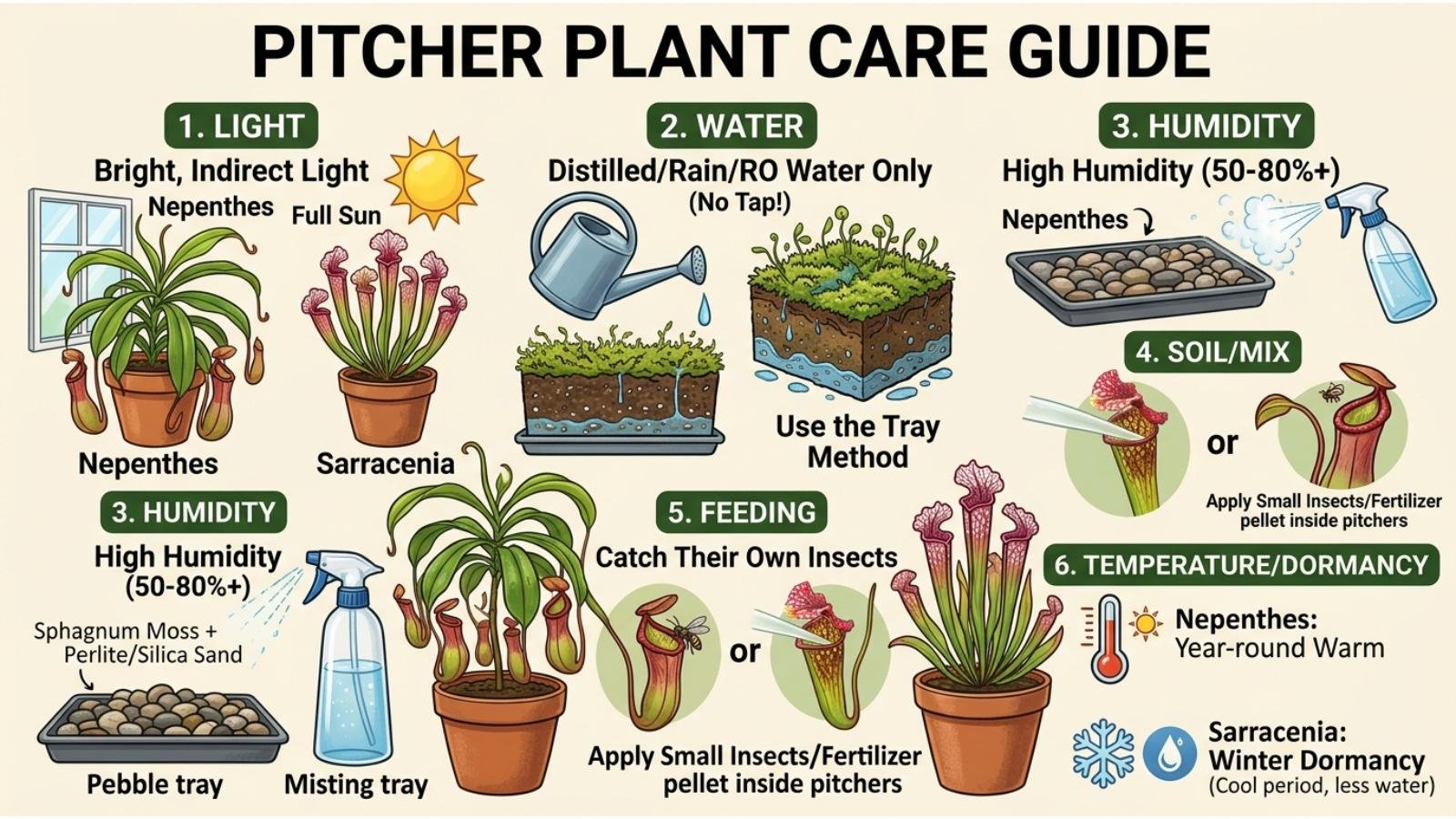
Successful pitcher plant care depends mainly on identifying your type of pitcher plant and recreating its natural growing conditions. Tropical Nepenthes generally prefer bright filtered light, high humidity, warmth, and consistently moist but airy media. Temperate Sarracenia need much stronger sunlight, mineral-free water, wet acidic media, and a cool winter dormancy. Avoid ordinary potting soil, tap water with significant mineral content, and conventional fertilizer.
Introduction
Pitcher plants look unusual because their leaves have evolved into traps that capture and digest insects. But despite their exotic appearance, the biggest challenge is usually not feeding them—it is providing the correct water, light, growing medium, temperature, and seasonal conditions.
One of the most common beginner mistakes is treating a pitcher plant like an ordinary houseplant. Standard potting soil, mineral-rich tap water, or routine fertilizer can gradually damage the roots. Carnivorous plants evolved in environments where nutrients are scarce, so their growing requirements are quite different from those of typical indoor plants.
There is another important detail: “pitcher plant” describes several different groups of plants. A tropical Nepenthes and a North American Sarracenia can look similar because both produce pitchers, but their ideal care is not identical. The first step toward healthier growth is therefore identifying which type you have.


What Is a Pitcher Plant?
Pitcher plants are carnivorous plants with modified leaves that form pitcher-shaped traps. Insects and other small organisms may fall into these structures, where digestive fluids help break them down and provide nutrients.
The name is used for several unrelated or distantly related carnivorous plant groups. Two especially popular types are:
| Type | Common example | Typical growing conditions |
|---|---|---|
| Tropical pitcher plants | Nepenthes | Warm, bright, humid conditions |
| North American pitcher plants | Sarracenia | Strong sunlight, wet acidic media, seasonal dormancy |
| Cobra lilies | Darlingtonia | Specialized cool-root conditions |
| Albany pitcher plant | Cephalotus | Distinct conditions; generally more specialized |
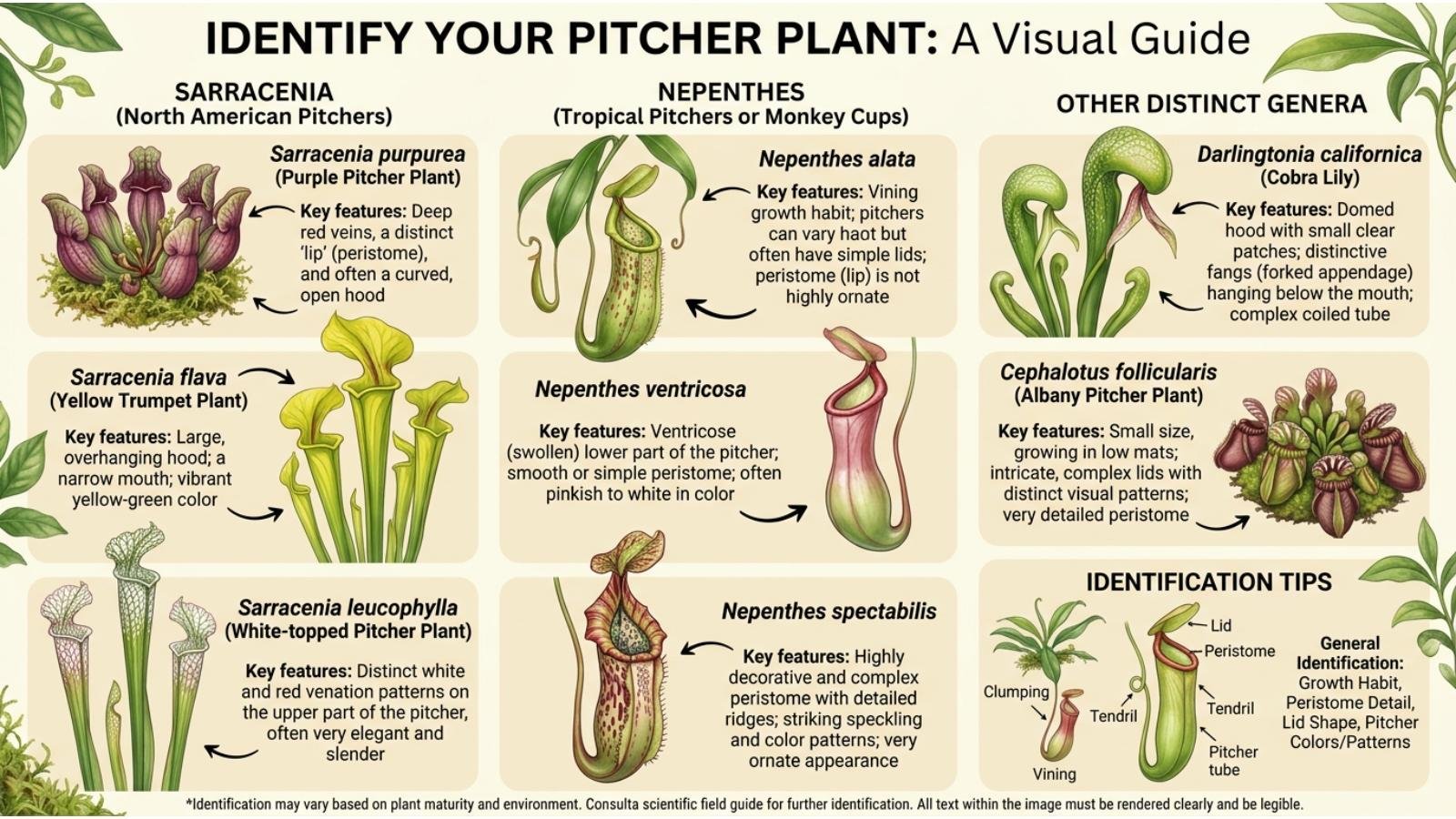
For beginners, Nepenthes and Sarracenia are the two types most important to distinguish. Nepenthes are mostly evergreen, often epiphytic plants with hanging pitchers, while Sarracenia produce upright tubular pitchers and include species adapted to seasonal dormancy.
Why this matters: advice that works beautifully for a Sarracenia can be inappropriate for a tropical Nepenthes. Before changing your plant’s environment, identify it whenever possible.
How to Identify Your Pitcher Plant
Look at the pitcher shape
Nepenthes
- Pitchers usually hang from the ends of leaves.
- Plants often develop climbing or trailing stems.
- Pitchers have a prominent lid and colorful rim called a peristome.
- They are commonly sold as tropical houseplants.
Sarracenia
- Pitchers usually grow upright from the base.
- They often resemble tubes, trumpets, or flared cups.
- Many have dramatic red, purple, yellow, or green markings.
- Plants form clumps from a central rhizome.
Image Suggestion: Side-by-side identification graphic showing Nepenthes versus Sarracenia.
Pitcher Plant Light Requirements
Light is one of the biggest factors controlling pitcher production, color, and overall growth.
However, the ideal amount depends on the species.
Light for Nepenthes
Most commonly grown tropical Nepenthes appreciate bright light without prolonged exposure to harsh, scorching afternoon sun, especially when they have been raised under protected conditions.
A bright window with filtered sunlight or a suitable grow light can work well indoors.
Watch the plant rather than following a rigid number of hours:
- Long, weak growth may indicate insufficient light.
- Small pitchers can be associated with inadequate light or other environmental stress.
- Good light often improves pitcher coloration.
- Sudden exposure to intense direct sun can cause leaf or pitcher damage.
Light for Sarracenia
Sarracenia generally wants much more light. The full sun for several Sarracenia species and notes that strong light supports healthy growth.
If growing one indoors, a strong grow light may be necessary because an ordinary dim room is rarely equivalent to the intense outdoor light these plants naturally experience.
A useful rule
Nepenthes: bright filtered light is a good starting point.
Sarracenia: aim for strong light and, where climate permits, substantial direct sun after gradual acclimation.
The Most Important Part of Pitcher Plant Care Water
If you remember only one thing about carnivorous plant care, make it this:
Water quality matters enormously.
Pitcher plants are adapted to nutrient-poor environments. Water containing substantial dissolved minerals can introduce salts and minerals into the growing medium over time.
Carnivorous plant cultivation guidance recommends low-mineral water such as:
- Rainwater.
- Distilled water.
- Reverse-osmosis water.
- Deionized water.
Can you use tap water?
It depends on the mineral content.
Rather than assuming all tap water is safe or unsafe, check its TDS (total dissolved solids) if possible. If your tap water is mineral-rich, choose distilled, RO, or suitable rainwater instead.
Also avoid assuming that boiled tap water becomes appropriate. Boiling does not reliably remove the dissolved minerals that are the concern here.
What about softened water?
Water from a household softener is not automatically a good substitute. Carnivorous plant cultivation guidance specifically advises against softened water.
How Often Should You Water a Pitcher Plant?
There is no useful universal schedule such as “water every three days.”
Instead, monitor the growing medium and environmental conditions.
For plants that prefer consistently wet conditions:
- Check the medium regularly.
- Do not allow it to become bone dry.
- Use appropriate low-mineral water.
- Increase monitoring during hot, dry weather.
- Reduce watering appropriately when a species enters dormancy.
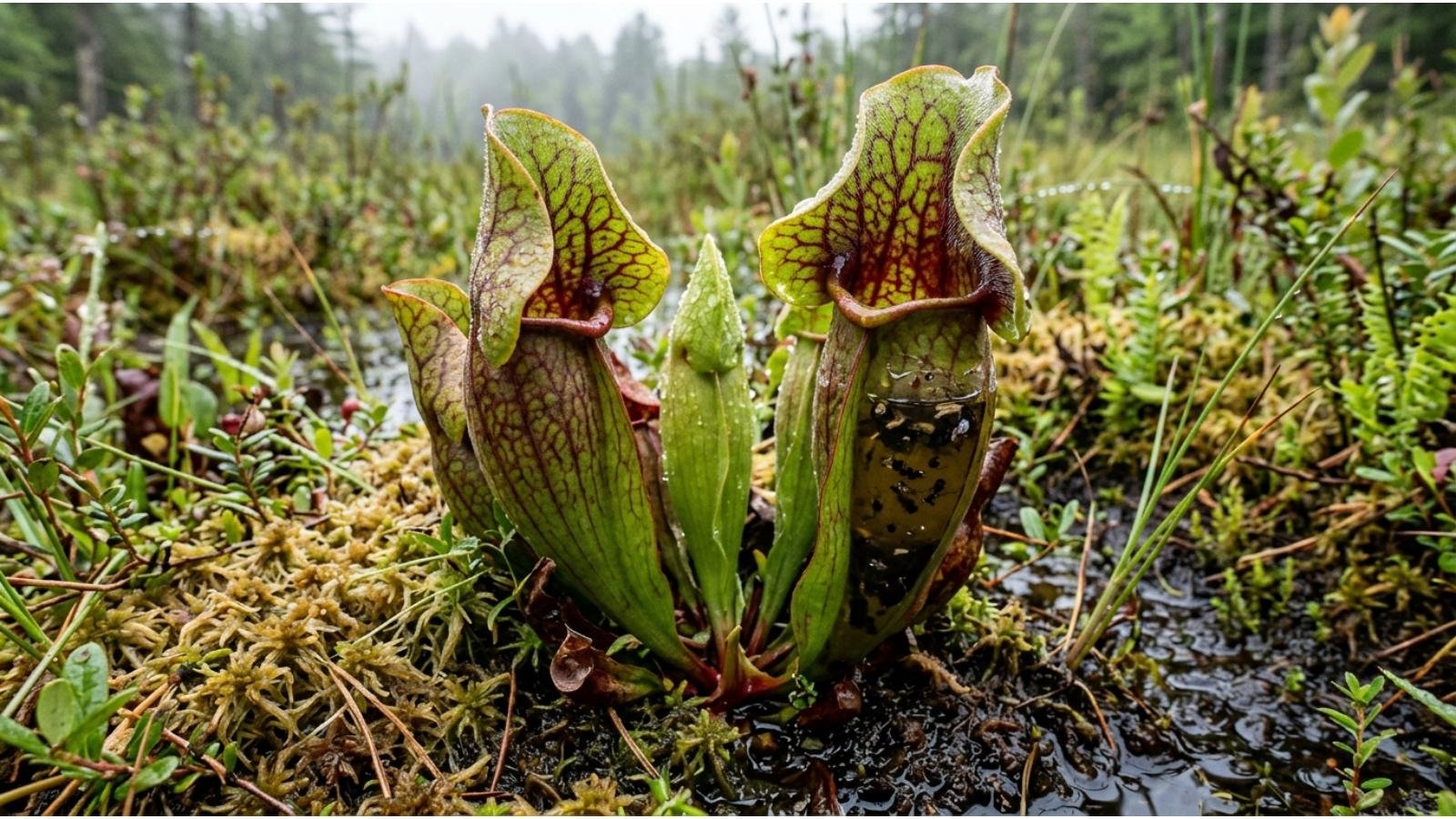
Sarracenia are commonly grown with their pots standing in trays of suitable water during active growth.
Important: “keep wet” does not mean the plant should sit in stagnant, foul-smelling water indefinitely. Good drainage and an appropriate carnivorous-plant medium remain important.
Should You Put Water Inside the Pitchers?
This is a common source of confusion.
Pitchers are not simply empty cups waiting for gardeners to fill them. Different pitcher plants produce their own digestive fluid. Historical guidance from the Nepenthes, Sarracenia, and Cephalotus produce fluid in their pitchers.
So do not routinely fill every pitcher with water.
If a pitcher has lost its fluid because of evaporation or accidental spillage, the correct response depends on the species and circumstances. Avoid making pitcher-filling a routine watering technique.
Best Soil for Pitcher Plants
This is where conventional houseplant advice can cause problems.
Do not automatically plant a pitcher plant in ordinary multipurpose potting soil.
Carnivorous plants generally need an acidic, nutrient-poor growing medium that retains moisture while allowing sufficient aeration.
Common components include:
- Long-fiber sphagnum moss.
- High-quality peat suitable for carnivorous plants.
- Washed silica sand.
- Perlite in appropriate mixes.
The exact recipe should be adapted to the species.
For example,The Sarracenia recommends an acidic medium containing moss and specifically describes specialist carnivorous compost for container cultivation.
Avoid
- Garden soil.
- Compost enriched with fertilizer.
- Manure.
- Standard houseplant potting mix.
- Fertilized seed-starting mix.
- Mineral-heavy amendments.
The goal is not to make the soil nutrient-rich. The plant gets much of its unusual nutrition through its carnivorous adaptation.
Do Pitcher Plants Need Fertilizer?
Generally, do not fertilize a pitcher plant like an ordinary houseplant.
Their natural habitats are typically nutrient-poor, and their carnivorous traps help supplement nutrients obtained from the soil.
Overfertilizing the roots can be particularly damaging.
This is one of those situations where more food does not automatically mean more growth.
A healthy carnivorous plant should have an appropriate growing environment first. Light, water quality, humidity, temperature, and the correct medium matter more than trying to force growth with fertilizer.
Do Pitcher Plants Need to Eat Insects?
No, you generally do not need to feed a healthy outdoor pitcher plant manually.
If it has access to appropriate insects, it can catch prey itself.
For indoor plants with few insects, occasional feeding can be considered, but it should be done carefully and according to the species.
Avoid:
- Large pieces of meat.
- Human food.
- Random household scraps.
- Heavy feeding.
- Fertilizer poured into pitchers.
The goal is to supplement the plant’s natural carnivorous behavior—not turn every pitcher into a feeding container.
Humidity Requirements
Humidity is especially important for many tropical Nepenthes.
If the air becomes extremely dry, the plant may produce fewer pitchers, develop poorly, or struggle with new growth.
However, humidity alone cannot compensate for inadequate light or poor water quality.
For indoor Nepenthes, helpful strategies include:
- Grouping compatible plants together.
- Using a humidifier when necessary.
- Providing good air circulation.
- Avoiding a sealed, stagnant environment.
- Keeping the plant away from harsh heating or cooling vents.
Humidity affects how quickly plants lose water through transpiration, and environmental conditions should be considered alongside light and temperature rather than in isolation.
What about misting?
Misting may temporarily increase moisture around foliage, but it is not a substitute for maintaining suitable growing conditions.
Consistent environmental humidity is generally more useful than repeatedly spraying leaves throughout the day.
Temperature: Tropical vs Temperate Pitcher Plants
Temperature is another major difference between pitcher plant types.
Nepenthes
Many commonly grown Nepenthes are tropical and prefer warm conditions. Some species are adapted to cooler highland environments, so there is no single temperature range that fits every species.
If your plant is unidentified, determine the species or hybrid before making major temperature changes.
Sarracenia
Many Sarracenia are temperate plants and require a winter dormancy period.
The RHS notes that Sarracenia generally experience winter dormancy, with reduced growth and some leaf loss. (RHS)
This is not automatically a sign that the plant is dying.
Winter Dormancy: A Critical Step for Sarracenia
One of the most overlooked parts of pitcher plant care is dormancy.
Temperate Sarracenia often need a seasonal period of cooler conditions and reduced growth.
During dormancy:
- Growth slows significantly.
- Some older pitchers may decline.
- The plant may look less attractive.
- Watering should be adjusted rather than completely stopped.
- The plant should remain appropriately moist.
- The dormant plant should receive suitable light and ventilation.
The keeping Sarracenia cool, moist, and well ventilated during winter while allowing them to be somewhat drier than during active growth.
Do not force tropical and temperate plants into the same winter routine
A warm indoor Nepenthes and a dormant Sarracenia have fundamentally different seasonal requirements.
That distinction can prevent a lot of unnecessary plant loss.
How to Repot a Pitcher Plant
Repotting is not something you need to do constantly.
Consider repotting when:
- The growing medium has significantly broken down.
- The plant has outgrown its container.
- Roots or rhizomes need attention.
- The medium has become contaminated with unsuitable material.
- Water management has become difficult.
Repotting steps
- Prepare a clean container.
- Prepare an appropriate carnivorous-plant medium.
- Moisten the medium using suitable low-mineral water.
- Carefully remove the plant.
- Minimize unnecessary root disturbance.
- Position the plant at an appropriate depth.
- Fill around the roots without aggressively compacting the medium.
- Water thoroughly with suitable water.
- Return it to appropriate light gradually if conditions have changed.
Avoid burying the growing point or rhizome incorrectly.
Image Suggestion: Step-by-step illustration showing pitcher plant removal, root inspection, fresh carnivorous medium, and repotting.
Choosing the Right Pot
A suitable pot should provide good drainage and be compatible with consistently moist growing conditions.
Plastic pots are commonly practical because they are lightweight and do not behave like porous terracotta.
For water-sensitive carnivorous plants, the material of the container matters less than creating a stable root environment with suitable water and an appropriate growing medium.
A drainage hole is particularly important.
Common Pitcher Plant Care Mistakes
1. Using ordinary tap water
This can gradually introduce unwanted minerals into the growing medium.
Better approach: use appropriate low-mineral water when your local water is unsuitable.
2. Using regular potting soil
Nutrient-rich soil is not a substitute for a carnivorous-plant growing medium.
Better approach: use a species-appropriate acidic, nutrient-poor medium.
3. Keeping a Sarracenia too dark
A bright-looking room may still provide insufficient light.
Better approach: give Sarracenia substantially stronger light, with gradual acclimation.
4. Fertilizing heavily
More fertilizer does not equal healthier carnivorous plants.
Better approach: focus on light, water, medium, and appropriate prey availability.
5. Assuming every pitcher plant needs high humidity
This oversimplifies a diverse group of plants.
Better approach: identify the genus and species or hybrid.
6. Panicking when Sarracenia slows down
Winter dormancy can look like decline.
Better approach: learn the plant’s seasonal cycle before diagnosing a problem.
7. Constantly filling pitchers with water
Pitcher fluid is part of the plant’s biology.
Better approach: concentrate on root-zone care and species-specific requirements.
Pitcher Plant Troubleshooting Guide
| Problem | Likely causes | What to check |
|---|---|---|
| No new pitchers | Insufficient light, unsuitable humidity, stress, wrong seasonal conditions | Light, temperature, humidity, water quality |
| Pitchers dry quickly | Dry air, heat, water stress | Humidity and root-zone moisture |
| Leaves turning brown | Environmental stress, mineral buildup, excessive sun exposure, root problems | Water quality and recent environmental changes |
| Plant becoming weak | Poor light, unsuitable medium, mineral-rich water | Growing conditions |
| Sarracenia slows in winter | Normal dormancy | Temperature and season |
| New pitchers remain small | Insufficient light or unsuitable conditions | Light first, then humidity and temperature |
| Black or rotting growth | Excessive stress, poor ventilation, root/rhizome problems | Medium, moisture, airflow, temperature |
| Pests appear | Aphids, scale, mealybugs or other insects | Inspect new growth and undersides of leaves |
The lists pests including aphids, scale insects, mealybugs and other insects among potential problems for Sarracenia.
Why Is My Pitcher Plant Not Making Pitchers?
This is one of the most common questions from new growers.
Before assuming the plant needs fertilizer, check these factors in order:
1. Light
Insufficient light is one of the first environmental variables worth investigating.
2. Plant type
A Nepenthes and Sarracenia have different environmental preferences.
3. Recent changes
Plants may temporarily stop producing impressive traps after repotting, relocation, shipping, or abrupt changes in humidity and temperature.
4. Humidity
For many tropical Nepenthes, extremely dry conditions can interfere with pitcher development.
5. Water quality
Mineral-heavy water can create long-term root-zone problems.
6. Seasonal growth
A temperate plant may naturally slow down during dormancy.
Expert tip: don’t change five things at once. If you move the plant, repot it, change the water, increase fertilizer, and alter humidity simultaneously, you won’t know which factor helped or hurt.
Can Pitcher Plants Grow Indoors?
Yes, but success depends heavily on the species.
Tropical Nepenthes are particularly popular for indoor cultivation because many can adapt to warm indoor environments when they receive enough light and humidity.
Sarracenia can also be grown in containers indoors, but providing the intense light and winter dormancy they need can be more challenging.
If you are choosing your first pitcher plant specifically for indoor growing, knowing the species before purchase can save you considerable frustration.
Growing Pitcher Plants Outdoors
Outdoor cultivation can be excellent when the climate matches the species.
For Sarracenia, outdoor cultivation can provide naturally strong light and seasonal changes.
However, outdoor conditions also introduce:
- Heat waves.
- Strong afternoon sun.
- Heavy rainfall.
- Pests.
- Wind.
- Sudden temperature changes.
Acclimate plants gradually when moving them from indoor or greenhouse conditions into stronger sunlight.
Pitcher Plant Care in Hot Climates
Hot weather deserves special attention.
A plant can tolerate high temperatures yet still suffer if its roots overheat, its growing medium dries excessively, or humidity falls sharply.
During very hot weather:
- Monitor moisture more frequently.
- Protect sensitive Nepenthes from intense afternoon exposure.
- Maintain airflow.
- Avoid placing containers on surfaces that become extremely hot.
- Use appropriate water.
- Watch newly emerging pitchers carefully.
For Sarracenia, strong sunlight can be beneficial, but sudden changes in exposure should still be handled gradually.
How to Keep Pitcher Plants Healthy Long Term
Instead of reacting to individual symptoms, build a stable routine.
Your basic checklist
Water: Low-mineral water.
Light: Match light intensity to the genus.
Soil: Acidic, nutrient-poor carnivorous-plant medium.
Humidity: Particularly important for many tropical Nepenthes.
Temperature: Match the species.
Feeding: Avoid conventional fertilizer.
Pot: Good drainage and an appropriate moisture environment.
Seasonality: Provide dormancy for plants that require it.
Observation: Watch new growth rather than judging the plant only by older pitchers.
This approach is more reliable than following a rigid watering calendar.
A Simple Pitcher Plant Care Routine
Weekly
- Check the moisture level of the growing medium.
- Inspect new leaves and pitchers.
- Check for pests.
- Confirm that the plant receives appropriate light.
- Refill the water supply as appropriate for your setup.
Monthly
- Inspect the condition of the growing medium.
- Look for mineral deposits.
- Check whether the plant has outgrown its container.
- Evaluate whether environmental conditions have changed.
Seasonally
For Sarracenia:
- Prepare for winter dormancy.
- Reduce growth expectations during the dormant period.
- Maintain appropriate moisture.
- Resume stronger active-growth conditions as the plant exits dormancy.
For Nepenthes:
- Monitor indoor humidity and temperature as heating or cooling systems change.
- Adjust light as seasonal daylight changes.
Pitcher Plant Care: Nepenthes vs Sarracenia
| Care factor | Nepenthes | Sarracenia |
|---|---|---|
| General type | Tropical pitcher plant | North American pitcher plant |
| Light | Bright filtered to strong light depending on species | Strong light/full sun for many species |
| Humidity | Often important | Usually less critical than for tropical Nepenthes |
| Water | Low-mineral water | Low-mineral water |
| Medium | Airy, acidic, nutrient-poor | Acidic, moisture-retentive carnivorous medium |
| Fertilizer | Avoid routine conventional fertilizer | Avoid routine conventional fertilizer |
| Dormancy | Depends on species | Commonly required |
| Indoor growing | Often practical | Possible but lighting can be challenging |
| Outdoor growing | Species and climate dependent | Excellent for suitable climates |
The important lesson is simple: don’t search for one universal pitcher-plant recipe. Match the care routine to the plant.
Frequently Asked Questions
How often should I water a pitcher plant?
Water whenever necessary to maintain the moisture level appropriate for the species. Many pitcher plants prefer consistently moist media, but watering frequency changes with temperature, light, humidity, pot size, and season. Use low-mineral water.
Can I use tap water for my pitcher plant?
Only if its mineral content is suitably low. If your tap water is mineral-rich, distilled, reverse-osmosis, deionized, or suitable rainwater is a safer choice.
Should I put water inside a pitcher plant?
Not routinely. Pitchers naturally produce digestive fluid, so filling them should not be treated as normal watering.
Why is my pitcher plant turning brown?
Brown tissue can result from several factors, including natural aging, water stress, inappropriate light, mineral buildup, or other environmental problems. Examine the entire growing environment rather than treating brown leaves as a diagnosis by themselves.
Does a pitcher plant need fertilizer?
Usually not in the conventional houseplant sense. Avoid routine fertilizer unless you have species-specific evidence and know exactly how to apply it safely.
Does a pitcher plant need direct sunlight?
It depends on the type. Many Sarracenia thrive in strong light and full sun, while many Nepenthes prefer bright filtered light or species-specific exposure.
Why is my Sarracenia dying in winter?
It may not be dying. Many Sarracenia naturally enter winter dormancy and can lose some foliage. The plant’s winter requirements should be distinguished from genuine rot or other problems.
Can pitcher plants live indoors?
Yes. Nepenthes are particularly suitable for indoor cultivation when their light, humidity, temperature, and water requirements are met. Sarracenia can also be grown indoors, but providing sufficient light and seasonal dormancy may be more difficult.
Do pitcher plants eat mosquitoes?
They can capture insects, but they should not be purchased solely as a mosquito-control solution. Their primary purpose as cultivated plants is their fascinating carnivorous adaptation.
Final Takeaways for Successful Pitcher Plant Care
The secret to healthy pitcher plants is not complicated feeding schedules or constant attention. It is matching the growing environment to the plant’s biology.