Silver pothos is an attractive, easy-care houseplant known for its heart-shaped leaves and silvery-green patterning. However, “easy care” does not mean it can thrive in any conditions. The biggest problems—yellow leaves, root rot, faded markings, and slow growth—usually come from incorrect watering, poor light, or heavy soil. Learning the basics of silver pothos care helps you maintain healthier roots, stronger vines, and more attractive foliage.
Quick Answer
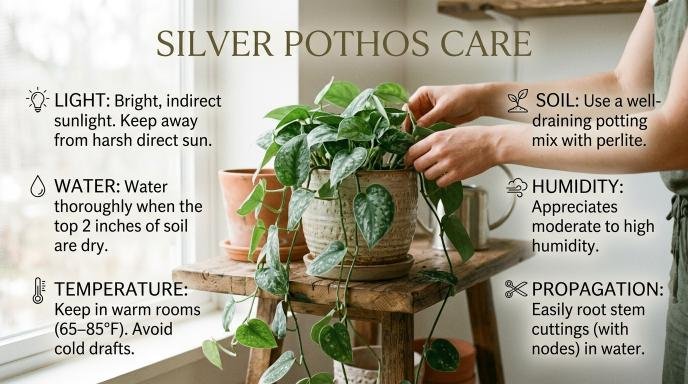
Silver pothos grows best in bright, indirect light, well-draining soil, and moderate watering. Let the upper portion of the soil dry before watering again, and keep the plant in a warm, moderately humid location. Avoid prolonged wet soil and harsh direct sunlight, which can damage the roots or scorch the leaves.
What Is Silver Pothos?
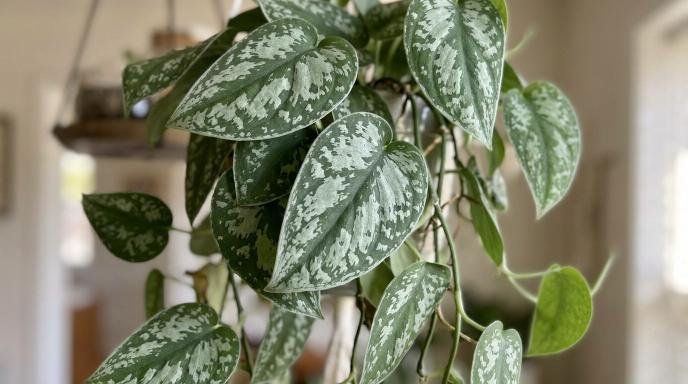
Silver pothos commonly refers to Scindapsus pictus, a tropical vining plant prized for its velvety green leaves marked with silver patches or speckles. Despite the common name, it is botanically different from true pothos (Epipremnum aureum).
This distinction matters because silver pothos generally appreciates more consistent humidity and can be somewhat less tolerant of prolonged dry conditions than common golden or marble queen pothos.
Its trailing growth makes it particularly useful for:
- Hanging baskets.
- Shelves and plant stands.
- Trellises.
- Indoor plant displays.
- Offices and other warm indoor spaces.
Silver Pothos Care Requirements at a Glance
| Care Factor | Best Condition |
|---|---|
| Light | Bright, indirect light |
| Water | Water when the upper soil begins to dry |
| Soil | Loose, airy, well-draining mix |
| Humidity | Moderate to high humidity |
| Temperature | Warm, stable indoor temperatures |
| Fertilizer | Balanced houseplant fertilizer during active growth |
| Pot | Container with drainage holes |
| Growth habit | Trailing or climbing vine |
| Pruning | Trim leggy or damaged growth as needed |
Light: Bright Indirect Light Is Ideal
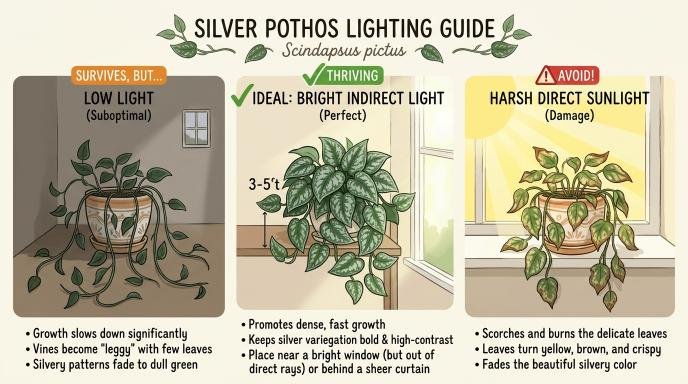
Light has a major influence on both growth and leaf appearance. Silver pothos does best in bright, filtered light rather than intense direct sun.
Place it near an east- or north-facing window, or position it several feet away from a brighter window where strong sunlight is filtered through a sheer curtain.
Too little light
Low light can cause:
- Slower growth.
- Longer spaces between leaves.
- Smaller new leaves.
- Less noticeable silver coloration.
- Weak or stretched vines.
A common mistake is moving the plant into a very dark corner simply because it tolerates low light. Tolerating low light is different from thriving in it.
Too much direct sunlight
Strong afternoon sunlight can cause pale, bleached, or scorched patches on the leaves. If the plant is receiving intense direct sun, move it farther from the window or filter the light.
Practical tip: If new growth becomes increasingly small and the stems stretch toward a window, light is one of the first conditions worth checking.
How Often Should You Water Silver Pothos?
There is no reliable calendar schedule for watering silver pothos because indoor conditions vary. Instead, check the soil.
Insert your finger into the upper portion of the potting mix. If it feels noticeably dry, it is generally time to water. If the soil is still wet, wait and check again later.
When watering:
- Water thoroughly until excess moisture drains from the bottom.
- Allow the pot to drain completely.
- Empty any standing water from the saucer or cachepot.
- Do not water again simply because several days have passed.
Why overwatering causes problems
Roots need both moisture and oxygen. Constantly saturated soil reduces air around the roots and can create conditions that encourage root damage.
Typical warning signs include:
- Yellowing leaves.
- Soft or collapsing stems.
- Persistent wet soil.
- A sour or unpleasant soil smell.
- Sudden leaf loss.
What underwatering looks like
A thirsty silver pothos may develop:
- Drooping leaves.
- Dry or curling leaf edges.
- Very dry potting mix.
- Slower growth.
The important distinction is that a wilted plant does not automatically mean it needs more water. Always inspect the soil before watering.
Best Soil for Silver Pothos
Silver pothos needs a potting mix that retains some moisture while allowing excess water and air to move through the root zone.
A useful homemade approach is to combine:
- Quality indoor potting mix.
- Perlite or another drainage material.
- A chunky component such as orchid bark.
The goal is an airy, fast-draining mixture rather than dense garden soil.
Avoid using heavy outdoor garden soil by itself in an indoor container. It can compact around the roots and drain poorly.
Expert tip: If water sits on the soil surface for a long time or drains extremely slowly, the problem may be the potting mix rather than how frequently you water.
Choosing the Right Pot
A drainage hole is more important than an expensive container.
Choose a pot that:
- Has at least one functional drainage hole.
- Is only moderately larger than the root ball.
- Allows excess water to escape.
- Can support the plant’s trailing or climbing growth.
An oversized pot can hold moisture for longer than the roots can use it, increasing the risk of root problems.
When repotting, moving only one pot size larger is often safer than placing a small root system into a very large container.
Humidity and Temperature
Silver pothos generally performs well in warm indoor environments with moderate humidity.
Dry indoor air may contribute to:
- Brown leaf edges.
- Curling foliage.
- Slower-looking growth.
- Increased stress during hot or dry periods.
If your home is particularly dry, a humidifier can provide more consistent humidity than occasional misting.
Keep the plant away from:
- Cold drafts.
- Heating vents.
- Air-conditioning outlets.
- Rapid temperature changes.
You do not need to create a tropical greenhouse. Stable indoor conditions are usually more useful than constantly changing the environment.
Fertilizing Silver Pothos
Silver pothos benefits from nutrients during periods of active growth.
Use a balanced liquid houseplant fertilizer according to the product’s label directions. Applying fertilizer to already dry or stressed roots can increase the risk of damage, so watering appropriately is important.
Avoid the common mistake of assuming more fertilizer means faster growth. Excess fertilizer can accumulate in the soil and cause leaf-edge damage or other problems.
If growth is healthy and the plant is producing new leaves, aggressive feeding is usually unnecessary.
Pruning for Fuller Growth
Silver pothos naturally wants to trail. If you want a fuller-looking plant rather than a few long vines, pruning can help encourage a denser appearance over time.
Use clean, sharp scissors to:
- Remove damaged leaves.
- Trim excessively long vines.
- Cut just above a suitable node when taking cuttings.
- Shape the plant to maintain a balanced appearance.
Do not remove large amounts of healthy growth at once unless there is a specific reason. Gradual pruning is usually easier for the plant to handle.
Practical observation: A plant can look “leggy” even when it is healthy. Long spaces between leaves are often a sign that the plant is seeking more light rather than simply needing more fertilizer.
How to Propagate Silver Pothos
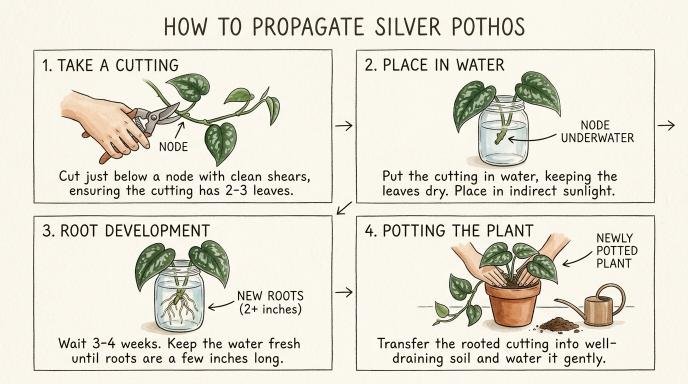
Stem cuttings are a practical way to propagate silver pothos.
Step 1: Choose a healthy vine
Select a healthy stem with several leaves and visible nodes.
Step 2: Make the cutting
Use clean scissors to cut below a node. The node is important because it is where new roots can develop.
Step 3: Root the cutting
You can place the cutting in water or a suitable moist propagation medium.
Keep it in bright, indirect light and maintain reasonably warm conditions.
Step 4: Wait for roots
Change water regularly if using water propagation and watch for developing roots.
Step 5: Pot the rooted cutting
Once the cutting has developed a useful root system, transfer it carefully into an airy potting mix.
Avoid burying leaves below the soil because submerged foliage can decay.
Common Silver Pothos Problems
Yellow Leaves
One or two older yellow leaves can occur naturally, but widespread yellowing deserves investigation.
Check:
- How wet the soil remains.
- Whether the pot drains properly.
- Whether the plant is receiving enough light.
- Whether the roots show signs of damage.
Repeated yellowing combined with constantly wet soil is a strong reason to reconsider watering and drainage.
Brown Leaf Tips
Brown tips can result from several factors, including dry air, inconsistent watering, salt buildup, or environmental stress.
Do not immediately assume humidity is the only cause.
First check the soil moisture pattern and growing environment.
Curling Leaves
Curling can occur when the plant is thirsty, exposed to excessive heat, or experiencing environmental stress.
Check the roots and soil before changing your watering routine dramatically.
Fading Silver Markings
If the foliage becomes less attractive or new leaves show reduced variegation, insufficient light may be contributing.
Move the plant gradually toward brighter indirect light rather than placing it directly into intense sunlight.
Slow Growth
Slow growth can be completely normal during periods of low light or cooler conditions. If growth remains weak during an active growing period, review:
- Light.
- Root health.
- Soil drainage.
- Nutrient availability.
- Temperature.
- Watering consistency.
Why Is My Silver Pothos Not Growing?
The most common causes are insufficient light, poor root conditions, unsuitable temperatures, and inconsistent watering.
Before adding more fertilizer, inspect the plant’s environment.
A useful troubleshooting order is:
- Check light.
- Check soil moisture.
- Inspect drainage.
- Examine roots if the soil remains wet for an unusually long time.
- Consider whether the plant is naturally growing more slowly because of seasonal conditions.
- Review fertilization only after the basic conditions are appropriate.
This approach prevents a common mistake: trying to solve every growth problem with fertilizer.
Should You Mist Silver Pothos?
Misting may temporarily increase moisture around the foliage, but it is not a reliable substitute for maintaining appropriate room humidity.
For consistently dry indoor air, a humidifier is generally a more practical solution.
More importantly, avoid keeping the foliage constantly wet with poor air circulation. Good airflow and sensible watering remain more important than frequent misting.
Seasonal Silver Pothos Care
Spring and Summer
During active growth:
- Check soil moisture more frequently.
- Provide bright indirect light.
- Monitor new growth.
- Fertilize appropriately.
- Prune and propagate when needed.
Fall and Winter
Growth may slow as light levels decrease.
During this period:
- Check the soil before every watering.
- Avoid maintaining a fixed summer watering schedule.
- Keep the plant away from cold drafts.
- Reduce fertilization if growth has substantially slowed.
The key seasonal adjustment is usually watering frequency, not simply giving the plant less water every time.
Common Silver Pothos Care Mistakes
Watering on a Fixed Schedule
Watering every Sunday regardless of soil condition can lead to problems. Indoor temperature, light, pot size, and season all affect how quickly soil dries.
Using a Pot Without Drainage
Decorative containers can be attractive, but trapped water is dangerous for roots.
Putting It in Deep Shade
Silver pothos can survive lower light, but survival is not the same as strong growth and attractive foliage.
Overfertilizing
More nutrients do not compensate for poor light, compacted soil, or damaged roots.
Repotting Too Frequently
Repotting should solve a genuine root or soil problem, not become a routine chore.
Ignoring the Roots
If watering seems correct but the plant repeatedly declines, inspect the root environment. Problems below the soil surface can explain symptoms appearing on the leaves.
Silver Pothos Care: Beginner-Friendly Routine
A simple routine is often more effective than constantly adjusting the plant.
Weekly:
Check the soil, inspect leaves, and look for pests or environmental changes.
Every few weeks:
Check whether vines need training or pruning and examine the pot for drainage problems.
During active growth:
Monitor new leaves and fertilize appropriately when needed.
Seasonally:
Adjust watering frequency according to light, temperature, and growth rather than following a rigid calendar.
Frequently Asked Questions
Is silver pothos easy to care for?
Yes. Silver pothos is relatively manageable indoors when provided with bright indirect light, appropriate watering, airy soil, and reasonable humidity.
Does silver pothos need direct sunlight?
No. Bright indirect light is generally preferable. Strong direct sunlight, especially through hot windows, can scorch the foliage.
How often should I water silver pothos?
Water when the upper portion of the soil has begun to dry rather than following a fixed weekly schedule. Thoroughly water the soil, then allow excess water to drain.
Why are my silver pothos leaves turning yellow?
Overwatering, poor drainage, insufficient light, and normal aging can all contribute. If several leaves are yellow and the soil stays wet, investigate the root environment first.
Can silver pothos grow in low light?
It can tolerate lower light, but growth may become slower and less compact. Brighter indirect light generally produces better growth and foliage appearance.
Can silver pothos grow in water?
Stem cuttings can root successfully in water. For long-term growth, however, the plant eventually needs an appropriate nutrient supply and growing environment.
How do I make silver pothos fuller?
Provide suitable indirect light and prune long vines strategically. Rooting healthy cuttings and planting them back into the same container can also create a fuller display.
Why are my silver pothos leaves curling?
Check soil moisture first, then consider heat, dry air, drafts, and other environmental stress. Avoid increasing watering without confirming that the soil is actually dry.
Is silver pothos the same as golden pothos?
No. Silver pothos commonly refers to Scindapsus pictus, while golden pothos is Epipremnum aureum. They are related tropical vining houseplants but are different plants.
Does silver pothos like humidity?
It generally appreciates moderate to higher humidity, particularly when indoor air is very dry. Consistent room conditions are more important than frequent misting.
Final Takeaways
Successful silver pothos care comes down to getting a few fundamentals right: bright indirect light, well-draining soil, appropriate watering, good drainage, and stable indoor conditions.
Do not rely on a rigid watering calendar. Instead, learn to read the soil and the plant together. When leaves begin changing, investigate the growing conditions before automatically adding water or fertilizer.
For beginners, the most useful rule is simple: give silver pothos enough light to grow well, but never compensate for poor conditions with excessive watering or fertilizer. With that balance, the plant can produce attractive foliage and healthy trailing growth for years.