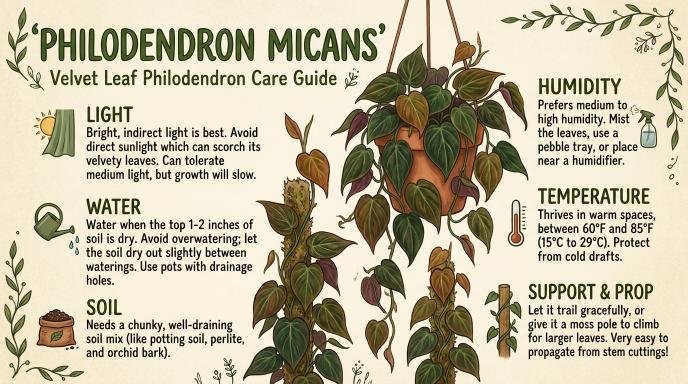
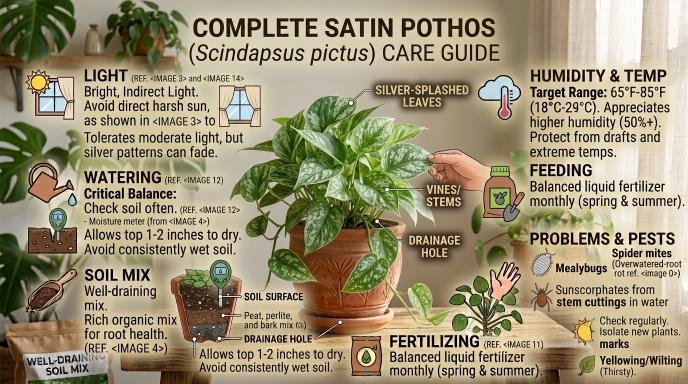
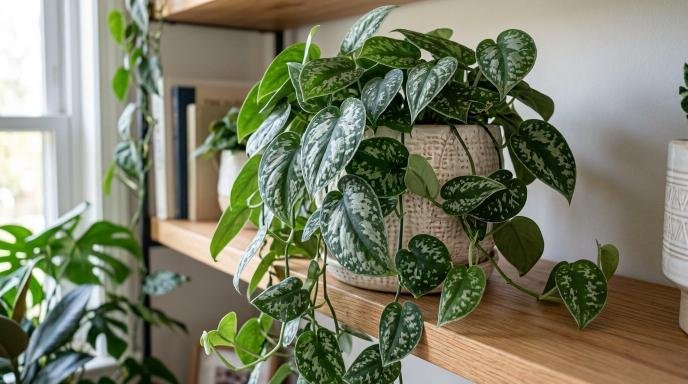
Satin Pothos is loved for its dark green, heart-shaped leaves covered with attractive silver markings. Although it is often called a pothos, Satin Pothos is botanically different from true pothos.
Its trailing growth and relatively easy-care nature make it an excellent choice for shelves, hanging baskets, and indoor plant displays. With the right balance of light, watering, humidity, and soil, satin pothos care is surprisingly simple.
The biggest mistake beginners make is treating this plant like a drought-tolerant houseplant. Satin Pothos prefers evenly appropriate moisture, good drainage, and bright indirect light rather than either constantly wet soil or prolonged dryness. Understanding these few preferences can prevent most common problems before they start.
Quick Answer
Satin Pothos grows best in bright, indirect light, well-draining soil, moderate to high humidity, and a warm indoor environment. Water when the upper portion of the soil begins to dry, then allow excess water to drain completely. Avoid soggy soil, harsh direct sunlight, and frequent overwatering.
What Is Satin Pothos?
Satin Pothos, commonly sold under the name Satin Pothos, is Scindapsus pictus, a tropical climbing plant known for its velvety green leaves and silver variegation.
Unlike true pothos, which belong to the genus Epipremnum, Satin Pothos belongs to Scindapsus. The care requirements are somewhat similar, which explains the common name, but Satin Pothos can be less forgiving of poor watering habits than some common pothos varieties.
Its natural climbing habit also explains why mature plants can look particularly attractive when given a support such as a moss pole or trellis.
Key characteristics
- Heart-shaped green leaves.
- Distinctive silver or silvery-gray markings.
- Trailing or climbing growth.
- Warm, humid conditions are preferred.
- Bright indirect light encourages attractive growth.
- Sensitive to prolonged waterlogged soil.
- Can be propagated from healthy stem cuttings.
Satin Pothos Care Requirements at a Glance
| Care Factor | Best Condition |
|---|---|
| Light | Bright, indirect light |
| Water | Water when the upper soil begins to dry |
| Soil | Airy, well-draining potting mix |
| Humidity | Moderate to high humidity |
| Temperature | Warm, stable indoor temperatures |
| Fertilizer | Balanced houseplant fertilizer during active growth |
| Pot | Drainage hole required |
| Growth habit | Trailing or climbing |
| Propagation | Stem cuttings |
| Pruning | Remove damaged or excessively long growth |
The most important point is balance. Satin Pothos does not need complicated care, but its roots need both moisture and access to air.
How Much Light Does Satin Pothos Need?
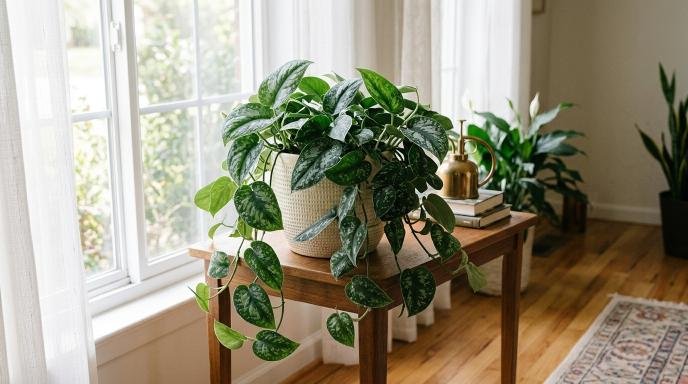
Bright, indirect light is usually the best choice for Satin Pothos.
Place it near a bright window where the plant receives plenty of filtered light without sitting in intense direct afternoon sun. A few hours of gentle morning sunlight can be tolerated in many indoor environments, but strong direct sunlight can scorch the leaves.
Light affects more than growth speed. It also influences how attractive the silver pattern remains.
Signs of insufficient light
A plant receiving too little light may show:
- Slower growth.
- Longer spaces between leaves.
- Smaller new leaves.
- Reduced vigor.
- Less attractive variegation or contrast.
Signs of excessive direct light
Too much intense sunlight can cause:
- Brown or bleached patches.
- Crispy leaf edges.
- Faded-looking foliage.
- Rapid moisture loss from the soil.
Practical tip
Instead of placing Satin Pothos directly against a bright window, position it slightly away from the glass or use a sheer curtain if the sunlight is intense.
How Often Should You Water Satin Pothos?
There is no single watering schedule that works for every Satin Pothos.
The plant should be watered based on soil moisture, pot size, temperature, light exposure, and humidity. As a practical starting point, check the soil every several days rather than watering automatically on a fixed calendar.
When the upper part of the potting mix has begun to dry, water thoroughly until excess moisture drains from the bottom of the pot.
Then empty any water sitting in the saucer or outer container.
Why overwatering causes problems
Roots need oxygen as well as water. When soil remains saturated for too long, air spaces disappear and roots can become stressed. Continued excessive moisture can contribute to root deterioration and eventually affect the leaves.
Why underwatering is also a problem
A severely dry Satin Pothos may develop:
- Drooping leaves.
- Dry or crispy edges.
- Curling foliage.
- Slower growth.
- Soil pulling away from the sides of the pot.
The goal is not to keep the soil permanently wet. The goal is to provide moisture while allowing the root zone to receive air between waterings.
What Soil Is Best for Satin Pothos?
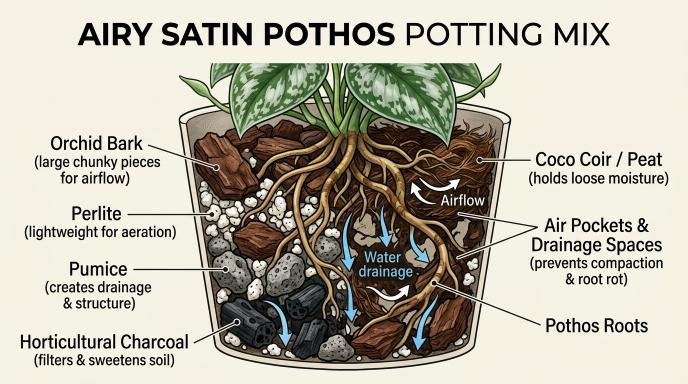
Satin Pothos needs a potting mix that holds some moisture without becoming dense and waterlogged.
A useful indoor mix can combine:
- Quality indoor potting mix.
- Perlite or another aerating material.
- Orchid bark or another chunky organic component.
The exact ratio does not need to be perfect. What matters most is that water can move through the mix and the roots are not sitting in stagnant moisture.
Why soil structure matters
Heavy soil may stay wet for too long, especially in a large container. This creates a difficult environment for roots and makes watering mistakes more likely.
An airy mix gives you a wider margin for error.
Choose the Right Pot
A container with drainage holes is essential for reliable Satin Pothos care.
Do not choose a very large pot simply because you want the plant to grow faster. A much larger container holds more soil, and that soil can remain wet for a long time after watering.
Choose a pot that is appropriately sized for the root system and move up gradually when the plant becomes root-bound.
Signs the plant may need repotting
Consider repotting when:
- Roots are densely circling the root ball.
- Roots are emerging from drainage holes.
- Water runs through the pot unusually quickly because the root mass has become dense.
- Growth has slowed despite otherwise good care.
- The plant dries out much faster than it previously did.
Repotting is usually best when the plant is actively growing rather than during a period of environmental stress.
Best Temperature for Satin Pothos
Satin Pothos prefers warm, stable conditions similar to those found in tropical indoor environments.
Avoid placing the plant directly beside:
- Cold drafts.
- Air-conditioning vents.
- Strong heaters.
- Frequently opened exterior doors.
- Extremely hot windows.
Sudden temperature changes can stress foliage even when the average room temperature appears comfortable.
For most homes, a consistently warm indoor location is more important than maintaining an exact temperature.
Does Satin Pothos Need High Humidity?
Satin Pothos generally appreciates moderate to high humidity.
Higher humidity can be particularly helpful when indoor air becomes very dry. This can happen during periods of heating, strong air conditioning, or naturally dry weather.
However, increasing humidity does not compensate for poor watering or inadequate light.
Better ways to increase humidity
Useful options include:
- A room humidifier.
- Grouping compatible plants together.
- Keeping the plant in a naturally humid room with adequate light.
- Moving it away from drying air vents.
Avoid relying on constant leaf misting as the primary humidity strategy. Surface moisture that repeatedly remains on foliage can create additional problems without providing the consistent humidity that the plant actually needs.
How to Fertilize Satin Pothos
Satin Pothos benefits from regular but moderate feeding during active growth.
A balanced indoor plant fertilizer can be used according to its label directions. Avoid assuming that more fertilizer means faster or healthier growth.
Excess fertilizer can accumulate in the potting mix and damage roots.
A practical feeding approach
During active growth:
- Make sure the plant is not severely dry or stressed.
- Use fertilizer at the recommended dilution.
- Apply it to the soil rather than concentrating it on the leaves.
- Reduce or stop routine feeding when growth naturally slows.
If the plant is freshly repotted into nutrient-rich potting mix, additional fertilizer may not be necessary immediately.
How to Prune Satin Pothos
Pruning helps maintain the plant’s shape and encourages a fuller appearance when done thoughtfully.
Use clean, sharp scissors or pruning shears to remove:
- Dead leaves.
- Severely damaged foliage.
- Weak or unwanted stems.
- Excessively long growth.
Do not remove large amounts of healthy foliage at once unless there is a specific reason.
How to make a trailing plant look fuller
A common problem is a plant that becomes long and sparse.
Rather than allowing every stem to keep extending, trim selected healthy stems and propagate the cuttings. Rooted cuttings can eventually be planted back into the container, creating a fuller arrangement.
This is one of the easiest ways to improve the appearance of a mature Satin Pothos.
How to Propagate Satin Pothos
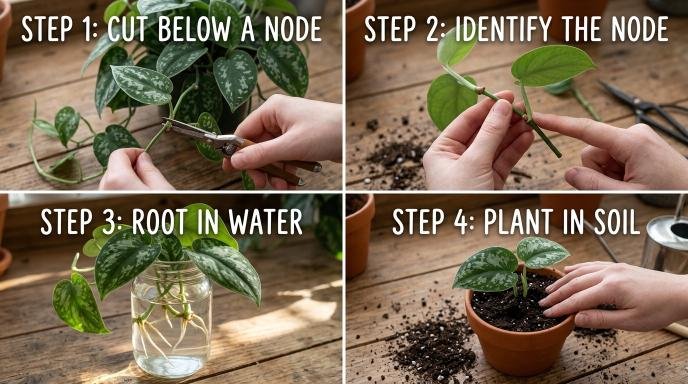
Stem cutting propagation is the most practical method for home growers.
Step-by-step propagation
- Choose a healthy stem with at least one viable node.
- Make a clean cut below the node.
- Remove lower leaves if necessary.
- Place the cutting in water or a suitable propagation medium.
- Keep it warm in bright, indirect light.
- Monitor the cutting regularly.
- Once a healthy root system develops, transfer it carefully to an appropriate potting mix.
The node is important because new roots develop from the appropriate part of the stem.
Water versus soil propagation
Water propagation makes root development easy to observe and is beginner-friendly.
Soil propagation can reduce the transition between rooting and growing in potting mix, but moisture management becomes more important.
Neither method is automatically superior. Choose the method that allows you to maintain consistent conditions.
Why Are Satin Pothos Leaves Turning Yellow?
Yellow leaves are one of the most common warning signs.
One yellow leaf does not necessarily mean the plant is unhealthy. Older leaves naturally age and eventually decline.
However, multiple yellow leaves appearing quickly can indicate an environmental or care problem.
Possible causes
Overwatering:
The soil stays wet for too long and roots become stressed.
Poor drainage:
Even correct watering can become problematic if excess water cannot escape.
Insufficient light:
Very low light can slow growth and contribute to declining foliage.
Natural aging:
An older lower leaf may simply be reaching the end of its life.
Root problems:
Persistent moisture-related root damage can cause widespread foliage decline.
Look at the entire situation rather than diagnosing the plant from leaf color alone. Check the soil, roots, pot drainage, recent watering pattern, and lighting conditions.
Why Are Satin Pothos Leaves Turning Brown?
Brown leaves or edges can result from several different conditions.
Common possibilities include:
- Excessively dry soil.
- Very dry indoor air.
- Intense direct sunlight.
- Root stress.
- Fertilizer buildup.
- Physical damage.
Crispy brown edges combined with very dry soil point toward a different problem than soft, dark, rapidly spreading discoloration.
That distinction is important because treating every brown leaf with more water can make an already overwatered plant worse.
Why Is My Satin Pothos Drooping?
Drooping does not always mean the plant needs water.
First check the soil.
If the soil is very dry, underwatering may be responsible. If the soil is still saturated, adding more water is likely to make the situation worse.
Other causes can include:
- Sudden temperature changes.
- Root damage.
- Transplant stress.
- Excessive heat.
- Severe environmental changes.
The fastest solution is usually not to change everything at once. Inspect the root zone and recent care first, then correct the most likely problem.
Why Is Satin Pothos Growing Slowly?
Slow growth can be perfectly normal when environmental conditions are less favorable.
Possible causes include:
- Insufficient light.
- Cool conditions.
- Limited nutrients.
- Root restriction.
- Seasonal slowdown.
- Recent repotting or environmental stress.
If the plant looks healthy but grows slowly, do not automatically fertilize more heavily. Check light and root conditions first.
A healthy plant producing occasional new growth is often preferable to a stressed plant pushed into rapid growth through excessive fertilizer.
Satin Pothos Pests to Watch For
Indoor Satin Pothos can occasionally attract common houseplant pests such as:
- Spider mites.
- Mealybugs.
- Scale insects.
- Thrips.
Inspect both the upper and lower surfaces of leaves, especially around new growth and leaf joints.
Early detection makes pest management considerably easier.
Practical pest-prevention habit
Whenever you bring a new plant indoors, inspect it carefully before placing it next to your existing plants. Regularly wiping or examining foliage also makes it easier to notice unusual spots, webbing, insects, or distorted new growth.
Common Satin Pothos Care Mistakes
Watering on a fixed schedule
Calendar-based watering ignores changes in light, temperature, pot size, and humidity.
Better approach: Check the soil before watering.
Using a pot without drainage
Excess water has nowhere to escape.
Better approach: Use a container with drainage holes and remove standing water.
Placing it in harsh direct sunlight
Strong sunlight can damage foliage.
Better approach: Choose bright filtered or indirect light.
Keeping the soil constantly wet
More moisture is not automatically better.
Better approach: Allow the appropriate upper portion of the soil to dry before watering again.
Choosing an oversized pot
A large container can retain moisture longer than expected.
Better approach: Increase pot size gradually as the root system develops.
Fertilizing a struggling plant heavily
Extra fertilizer cannot fix poor light, damaged roots, or improper watering.
Better approach: Correct the growing environment first.
How to Make Satin Pothos Grow Fuller
A fuller Satin Pothos usually comes from a combination of adequate light, healthy roots, proper pruning, and multiple stems.
Try this approach:
- Provide bright indirect light.
- Keep the root zone appropriately hydrated.
- Prune selected long stems.
- Propagate healthy cuttings.
- Replant rooted cuttings into the same container when appropriate.
- Rotate the pot periodically so growth receives more even light.
If the plant has become extremely sparse, improving light is often more important than simply cutting it back.
Should Satin Pothos Climb or Trail?
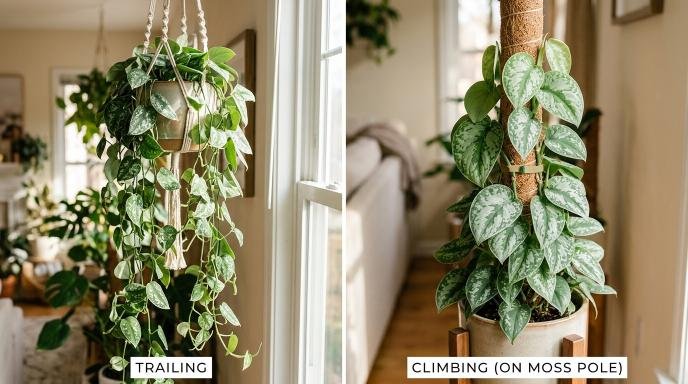
Satin Pothos can be grown either way.
Trailing
A hanging basket or high shelf allows the stems to cascade downward. This creates a relaxed decorative appearance.
Climbing
A moss pole, trellis, or other suitable support encourages the plant to grow upward.
Climbing can be particularly useful when you want to encourage larger-looking foliage and a more structured display.
The important point is to provide support gradually and guide the stems without damaging them.
Seasonal Satin Pothos Care
Spring
As growth increases, monitor soil moisture more frequently and begin or increase feeding when appropriate.
Summer
Higher temperatures and brighter conditions can increase water use. Check the soil more often, but do not automatically water every day.
Fall
As light levels decline, the plant may use water more slowly. Adjust watering rather than maintaining a summer routine.
Winter
Indoor heating can dry the air while reduced light slows plant growth. Avoid compensating for slow growth with excessive watering or fertilizer.
Seasonal adjustment is one of the simplest ways to prevent recurring care problems.
Satin Pothos Care Routine
A simple routine is more useful than a complicated schedule.
Weekly
- Inspect leaves.
- Check for pests.
- Feel the soil moisture.
- Look for new growth.
- Check whether the plant is receiving appropriate light.
Every few weeks
- Rotate the container if needed.
- Inspect stems and leaf joints.
- Remove dead foliage.
- Check the drainage area.
During active growth
- Monitor watering needs more frequently.
- Fertilize appropriately.
- Prune and propagate when useful.
This routine helps you identify problems early rather than waiting until the plant shows severe symptoms.
Is Satin Pothos Easy to Care For?
Yes, Satin Pothos is generally considered a manageable indoor plant for beginners, provided its basic environmental needs are met.
Its care becomes much easier when you understand one central principle: do not treat watering as a calendar task.
Give it suitable indirect light, an airy potting mix, a container with drainage, appropriate moisture, and stable indoor conditions. Most problems can then be prevented rather than treated after they appear.
Satin Pothos vs. Traditional Pothos
Although their names are similar, Satin Pothos and true pothos are different plants.
| Feature | Satin Pothos | True Pothos |
|---|---|---|
| Botanical genus | Scindapsus | Epipremnum |
| Leaf appearance | Velvety with silver markings | Usually smoother green or variegated |
| Growth | Trailing or climbing | Trailing or climbing |
| Light | Bright indirect light preferred | Adaptable to various indoor light levels |
| Watering | Avoid prolonged saturation | Also benefits from drying somewhat between waterings |
| Visual appeal | Silver-patterned foliage | Wide range of green and variegated forms |
The similar common name can cause confusion, but the care principles should be based on the plant itself rather than its nickname.
Frequently Asked Questions
How often should I water Satin Pothos?
Water when the upper portion of the soil has begun to dry rather than following a strict weekly schedule. Water thoroughly and allow excess water to drain completely.
Does Satin Pothos need direct sunlight?
It generally performs best in bright indirect light. Strong direct sunlight, especially through hot glass, can scorch or fade the leaves.
Why is my Satin Pothos losing its silver color?
Low light can contribute to less vigorous growth and reduced visual contrast. Move the plant gradually toward a brighter indirect-light location.
Can Satin Pothos grow in low light?
It can tolerate less light for a period, but very low light is not ideal. Growth may become slower and less vigorous.
Should I mist my Satin Pothos?
Misting is not necessary for successful care. If your indoor air is consistently dry, a humidifier provides more dependable humidity than occasional misting.
Can Satin Pothos grow in water?
Stem cuttings can root successfully in water. However, long-term growth in water requires a suitable nutrient and root environment and is different from simply propagating a cutting.
How do I make Satin Pothos grow faster?
Provide bright indirect light, appropriate watering, warm conditions, healthy roots, and adequate nutrition during active growth. Avoid trying to force growth with excessive fertilizer.
Can I prune Satin Pothos?
Yes. Remove damaged growth and trim excessively long stems with clean cutting tools. Healthy cuttings can also be used for propagation.
Why are my Satin Pothos leaves curling?
Curling may occur because of underwatering, excessive heat, dry conditions, root stress, or other environmental problems. Check soil moisture and the plant’s location before changing your watering routine.
Is Satin Pothos toxic to pets?
Satin Pothos contains calcium oxalate crystals and should not be considered safe for pets to chew. Keep it out of reach of cats, dogs, and other animals that may nibble houseplants.
Final Satin Pothos Care Tips
Successful satin pothos care is less about following a rigid schedule and more about learning how the plant responds to its environment.
Focus on the fundamentals:
- Give it bright, indirect light.
- Use loose, well-draining soil.
- Choose a pot with drainage holes.
- Water according to soil moisture rather than the calendar.
- Avoid keeping the roots constantly wet.
- Maintain warm conditions and reasonable humidity.
- Feed moderately during active growth.
- Prune long or damaged growth when needed.
- Check regularly for pests and early signs of stress.
- Adjust care as seasons and indoor conditions change.
The healthiest Satin Pothos is not necessarily the one receiving the most water, fertilizer, or attention. It is the one growing in a stable environment where light, moisture, airflow, and root health remain in balance.