Quick Answer
Swiss cheese plant care is mainly about providing bright, indirect light, well-draining soil, moderate-to-high humidity, warmth, and careful watering. The most common mistake is keeping the soil constantly wet. Let the growing medium become almost dry before watering thoroughly, then allow excess water to drain away. A moss pole or other support can encourage climbing and larger, more mature leaves with attractive fenestrations.
Introduction
The Swiss cheese plant, most commonly Monstera deliciosa, is one of the most recognizable tropical houseplants, thanks to its glossy leaves and distinctive natural holes. Despite its dramatic appearance, it is relatively forgiving when its basic needs are met. The challenge is that a Monstera can look healthy for months while slowly suffering from poor light, compacted soil, or excessive watering.
Good Swiss cheese plant care is less about following a rigid watering calendar and more about understanding what the plant is telling you. Yellowing leaves, brown edges, slow growth, small leaves, and root problems can all point to different environmental issues. Once you learn to read those signals, caring for a Monstera becomes much easier.
The goal isn’t simply to keep your Monstera alive—it is to create the conditions that allow it to produce strong stems, healthy roots, and increasingly impressive mature leaves.
What Is a Swiss Cheese Plant?
The name “Swiss cheese plant” most commonly refers to Monstera deliciosa, a tropical climbing plant in the Araceae family. It is native to tropical regions of Central America and naturally grows as a climber, using aerial roots to help attach itself to supporting structures.
Its famous leaf holes are called fenestrations. Young plants may have solid leaves, so buying a small Monstera without holes does not necessarily mean anything is wrong.
As the plant matures under suitable conditions, its leaves can become much larger and develop more pronounced splits and holes. Good light, adequate nutrition, appropriate moisture, and climbing support all contribute to healthy mature growth.
Monstera deliciosa vs. Monstera adansonii
These plants are sometimes confused because both are called Swiss cheese plants.
| Feature | Monstera deliciosa | Monstera adansonii |
|---|---|---|
| Growth | Large, vigorous climber | Smaller, more compact |
| Mature leaves | Very large | Smaller |
| Fenestrations | Large splits and holes | Numerous holes |
| Best for | Statement plant | Smaller spaces |
| Support | Strongly beneficial | Beneficial |
The care principles are similar, although Monstera deliciosa can eventually become considerably larger and heavier.
Image Suggestion: Side-by-side comparison of mature Monstera deliciosa and Monstera adansonii.
How Much Light Does a Swiss Cheese Plant Need?
Swiss cheese plants prefer bright, indirect light. In nature, they climb through tropical forests rather than sitting exposed to intense midday sunlight. Indoors, a bright room near an east- or west-facing window can work well, while a sheer curtain can soften stronger sunlight.
Too much light
Strong direct sunlight, particularly through hot glass, can scorch leaves. Signs may include:
- Pale or bleached patches
- Brown crispy areas
- Leaf scorching
- Sudden damage after moving the plant into stronger sunlight
Too little light
A Monstera kept in very low light may survive, but growth can become weak and slow. Leaves may remain smaller and develop fewer characteristic fenestrations.
The practical test
Instead of asking whether your plant gets “six hours of light,” look at the quality of that light.
A useful indoor position is:
Bright room → filtered light → plant positioned away from harsh direct midday sun.
Rotate the pot occasionally if the plant is leaning strongly toward one direction.
How Often Should You Water a Swiss Cheese Plant?
There is no universally correct watering schedule because indoor conditions vary with temperature, light, pot size, soil, and season.
The better approach is to check the soil before watering.
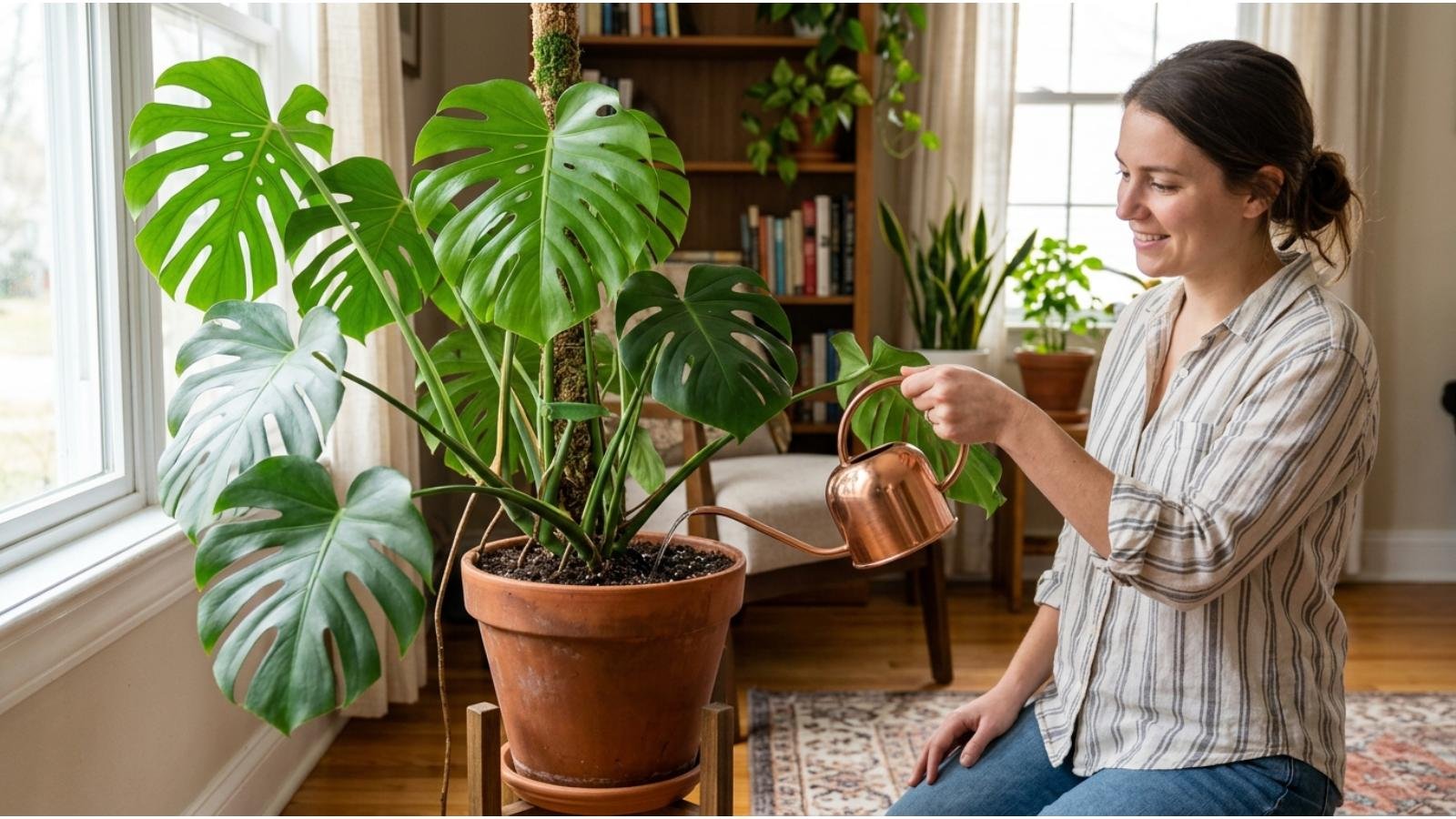
Allow the growing medium to become almost dry, then water thoroughly until excess water escapes through the drainage holes. Do not leave the pot sitting in standing water because persistently waterlogged roots can rot. The RHS recommends watering less frequently during winter.
A simple watering routine
- Push your finger several centimeters into the growing medium.
- Check whether it is still noticeably moist.
- If it is nearly dry, water thoroughly.
- Allow excess water to drain completely.
- Empty any water collected beneath the pot.
- Check again before the next watering.
Why overwatering is so dangerous
Beginners often assume that drooping leaves automatically mean a plant needs water. That’s not always true.
A plant with damaged roots may also droop because unhealthy roots cannot efficiently absorb water. Adding even more water can make the problem worse.
Practical rule: Don’t water simply because the calendar says it is “watering day.”
Water quality
The RHS recommends rainwater or filtered water where possible, particularly in hard-water areas, because repeated use of alkaline tap water can affect the growing medium over time.
Best Soil for Monstera
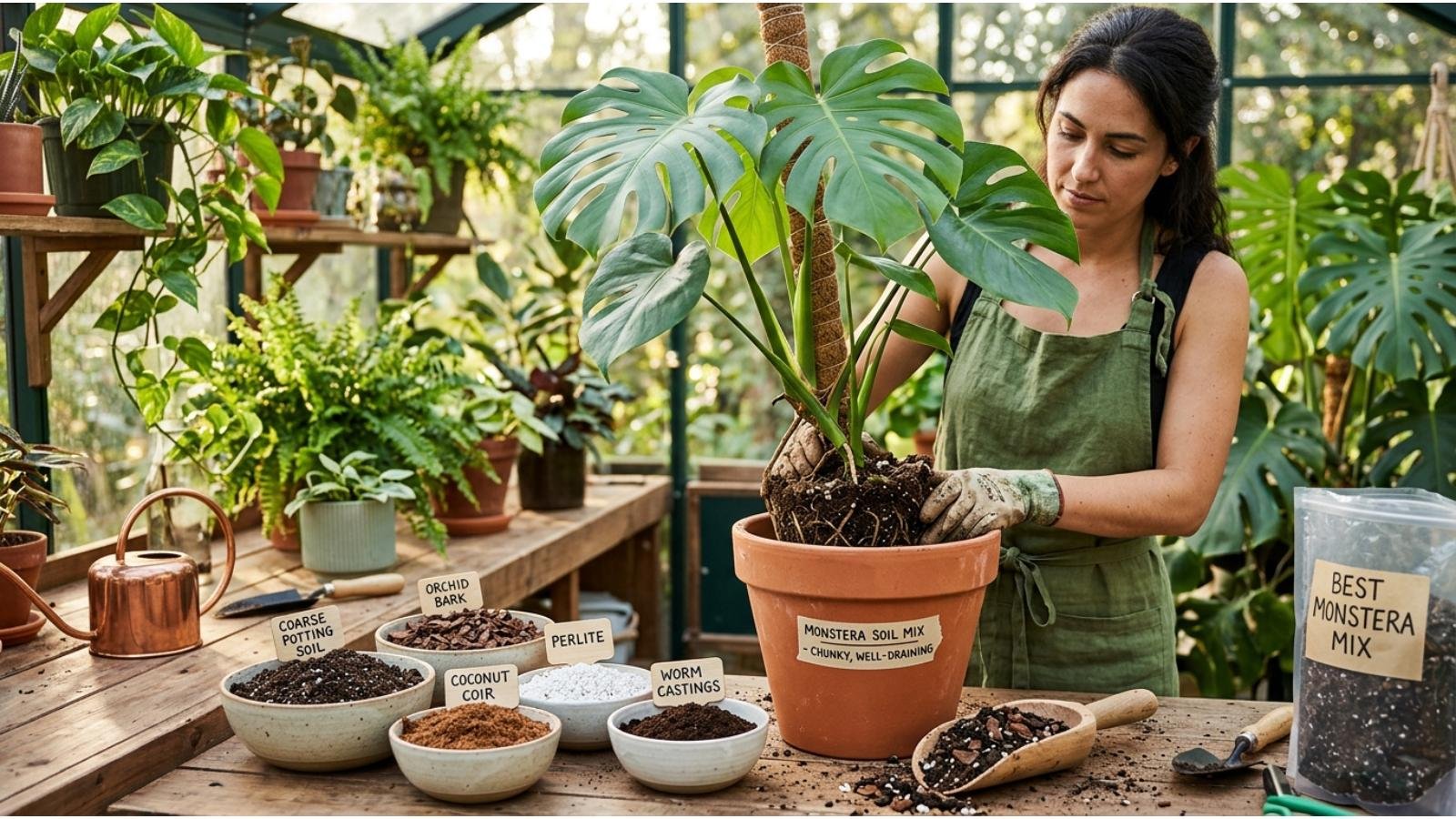
A Swiss cheese plant needs a growing medium that holds some moisture while allowing excess water and air to move through the root zone.
The RHS recommends an open, well-drained, slightly acidic growing medium. Its example mix uses peat-free ericaceous compost combined with orchid compost.
For an indoor plant, the important characteristics are:
- Good drainage
- Air-filled spaces around the roots
- Moderate moisture retention
- Organic matter
- A container with drainage holes
Avoid heavy soil that stays saturated for long periods.
Why soil structure matters
Two plants can receive exactly the same amount of water but react very differently if one is growing in compacted soil.
In poorly draining soil, oxygen around the roots can become limited. This creates conditions that favor root problems.
Image Suggestion: Cross-section diagram showing healthy Monstera roots in airy soil versus roots sitting in waterlogged soil.
Temperature and Humidity Requirements
Swiss cheese plants are tropical plants and perform best in warm conditions. The RHS recommends approximately 18–25°C (65–77°F) for general indoor cultivation.
Avoid placing the plant:
- Directly beside a cold draft
- Against a very cold window
- Immediately beside a radiator
- In front of strong air-conditioning
- In an area with extreme temperature fluctuations
Does Monstera need high humidity?
Monstera appreciates humid air, particularly when growing actively. Dry indoor conditions can cause brown leaf edges, especially when combined with inadequate watering or strong heat sources.
You can improve humidity by:
- Using a humidifier
- Grouping tropical plants together
- Growing the plant in a naturally humid room
- Keeping it away from drying heat sources
A humidifier is generally more controllable than repeatedly misting leaves.
When Should You Repot a Swiss Cheese Plant?
You do not need to repot a Monstera every year simply because the calendar says so.
Consider repotting when:
- Roots are heavily filling the container
- Water runs through unusually quickly
- Growth has slowed despite suitable conditions
- The plant repeatedly dries out extremely fast
- The existing soil has broken down
- The plant has become unstable in its current container
Choose a pot only modestly larger than the existing root ball. The RHS specifically warns against dramatically oversized pots because excess unused soil can remain wet for too long and increase the risk of root rot.
Choosing the right container
A good container should have:
- Drainage holes
- Enough stability for the plant’s increasing weight
- Room for the root system without excessive empty soil
Because mature Monsteras can become top-heavy, a heavier container can help prevent tipping.
Why Does My Swiss Cheese Plant Need a Moss Pole?
This is one of the most overlooked aspects of Monstera care.
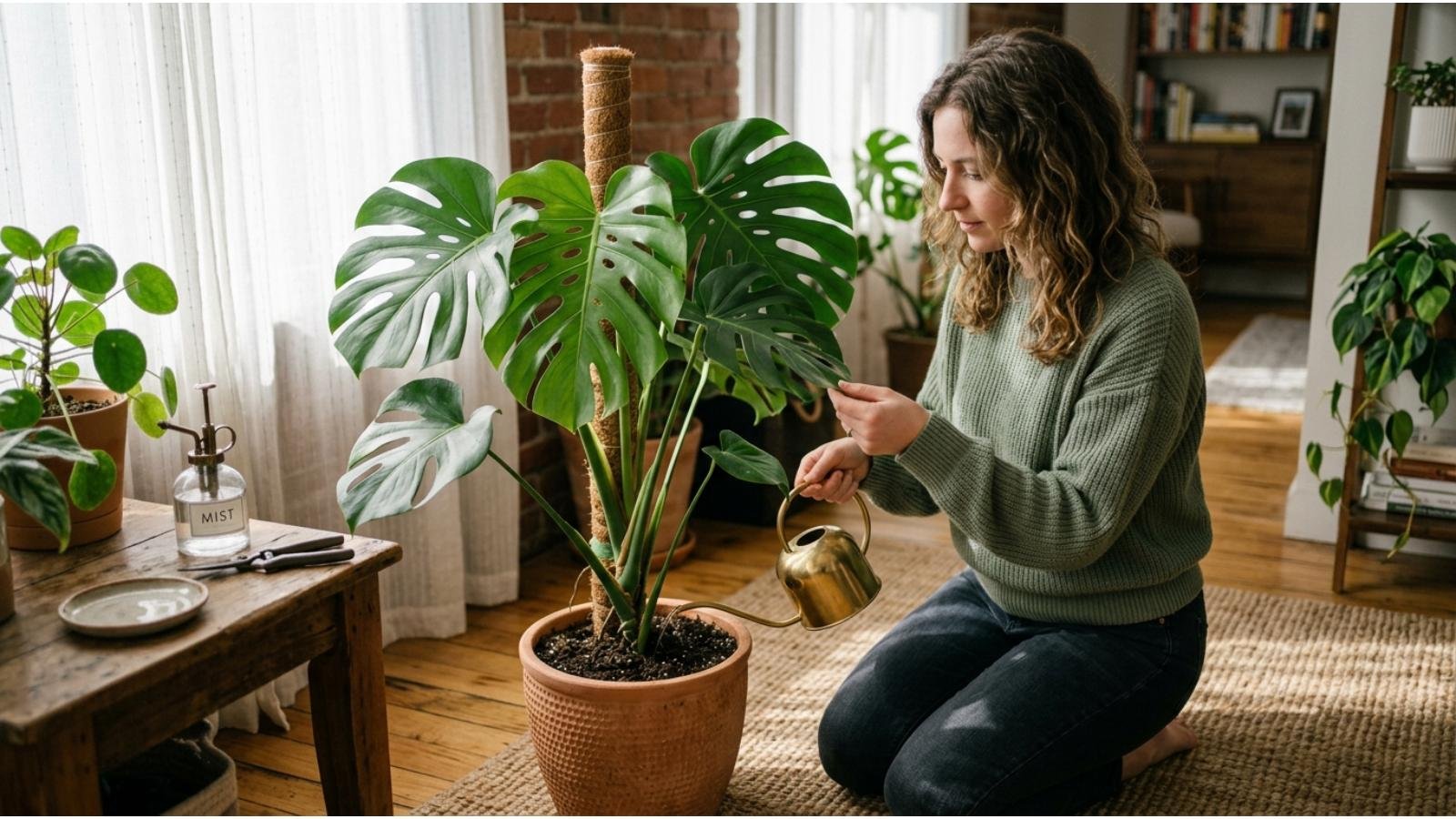
Monstera deliciosa is naturally a climber, not simply a plant that sprawls across the floor. It produces aerial roots that can attach to supporting structures. In a home, a moss pole, coir pole, trellis, or similar support can imitate part of its natural climbing habit.
Benefits of supporting your Monstera
A climbing support can:
- Keep stems upright
- Reduce sprawling
- Make the plant easier to manage
- Encourage upward growth
- Help mature leaves develop
- Create a more natural growth shape
The RHS notes that when Monsteras are encouraged to climb, they can produce larger, more mature leaves with more fenestrations.
How to train it
Place the support close to the main stem and gently secure the stem using soft plant ties.
Don’t tightly bind the stem. As the plant grows, restrictive ties can damage it.
Expert tip: The support is most useful when introduced while the plant is still manageable. Waiting until a huge Monstera is already sprawling across the room makes training much harder.
Why Doesn’t My Monstera Have Holes in Its Leaves?
This is one of the most common questions about Swiss cheese plants.
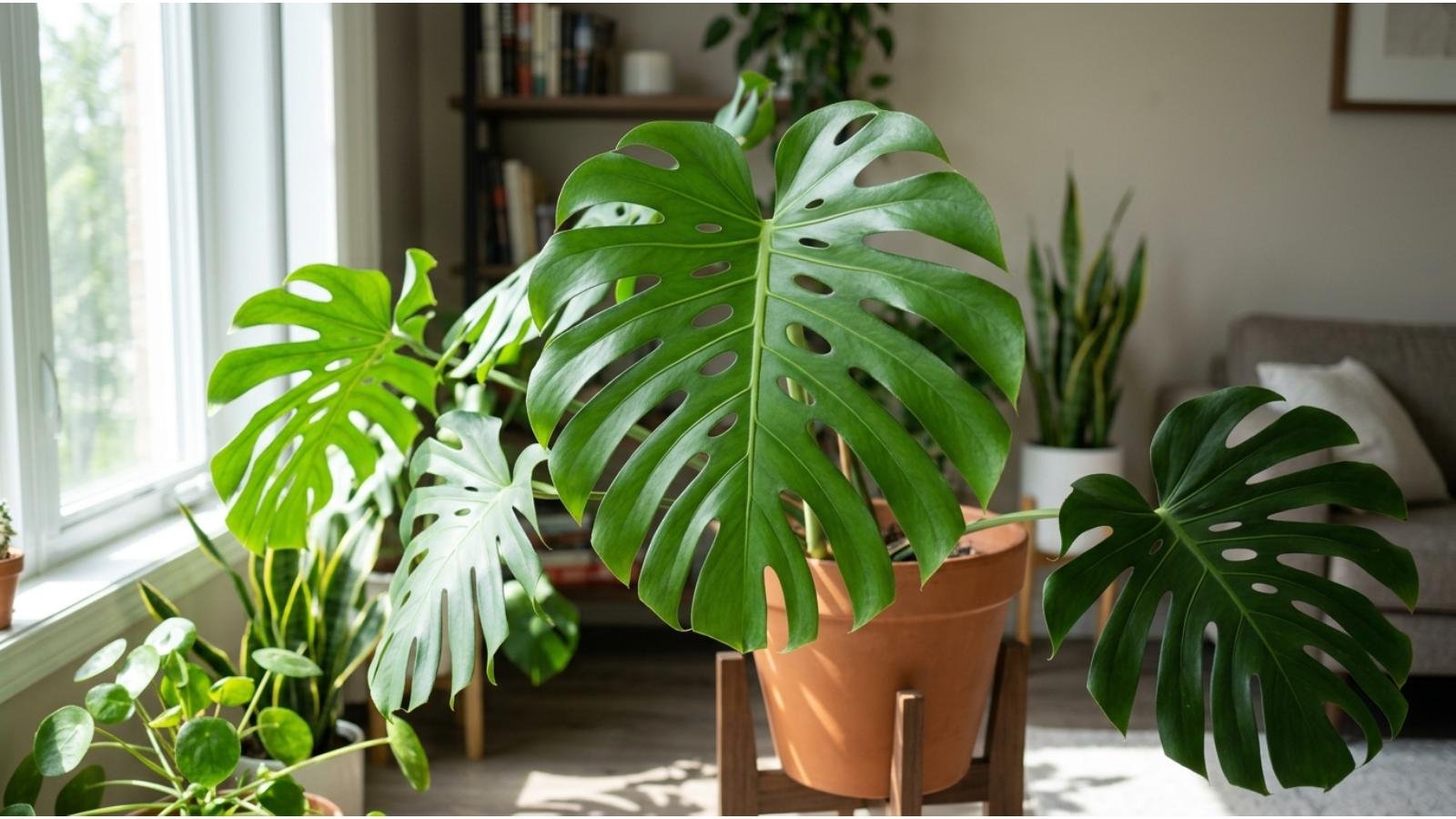
Young Monstera leaves may naturally be solid. Fenestrations become more characteristic as the plant matures. Poor growing conditions can also contribute to a lack of mature-looking leaves.
Common reasons for solid leaves
The plant is young:
Young plants commonly produce simpler leaves.
Insufficient light:
Very low light can result in smaller leaves with fewer holes.
Lack of climbing support:
A mature climbing Monstera can develop more impressive foliage than one allowed to sprawl indefinitely.
General stress:
Poor watering, inadequate nutrition, root problems, or unsuitable temperatures can limit healthy development.
What not to do
Don’t cut holes into young leaves to make them look “fenestrated.” The holes are part of the plant’s natural development and cannot be artificially created in a healthy way.
Image Suggestion: Progression graphic showing young solid Monstera leaves developing into mature fenestrated leaves.
Feeding and Fertilizing Your Monstera
Swiss cheese plants benefit from regular nutrition during active growth.
The RHS recommends a balanced liquid fertilizer during the growing season, with its growing guide suggesting feeding from April through September.
However, your plant’s growth conditions matter.
If the plant receives little light and is barely growing, heavy fertilization is unlikely to solve the underlying problem.
Better fertilizing practice
- Fertilize during active growth.
- Follow the fertilizer manufacturer’s dilution instructions.
- Avoid excessive applications.
- Reduce feeding when growth naturally slows.
- Water appropriately before or around feeding according to the fertilizer directions.
Signs of possible nutritional problems
Nutrient issues can sometimes contribute to:
- Pale foliage
- Slow growth
- Small new leaves
- Poor overall vigor
But don’t automatically diagnose every yellow leaf as a fertilizer deficiency. Root problems, watering mistakes, natural aging, and environmental stress can produce similar symptoms.
Pruning a Swiss Cheese Plant
Pruning helps control size, remove damaged material, and shape the plant.
Use clean, sharp scissors or pruning shears and make deliberate cuts rather than repeatedly removing small pieces.
When to prune
Spring is generally a good time for substantial pruning because the plant can recover during active growth. The RHS notes that pruning a large Swiss cheese plant can help keep it within its available space.
Keep in mind that heavily pruning a plant can result in newer growth with smaller, less mature leaves until it develops again.
What should you remove?
You can remove:
- Dead leaves
- Severely damaged foliage
- Weak or unwanted stems
- Growth that has outgrown its space
Avoid removing healthy leaves simply because they are older unless you have a specific reason.
How to Propagate a Swiss Cheese Plant
Monstera deliciosa is relatively easy to propagate from stem cuttings.
The important detail is that a useful cutting needs an appropriate section of stem containing a node. A leaf by itself generally isn’t enough to create a new complete plant.
Simple water-propagation method
- Select a healthy stem section containing a node.
- Make a clean cut with sterilized scissors or shears.
- Place the appropriate node in water.
- Keep the cutting in bright, indirect light.
- Change the water periodically.
- Wait for a healthy root system to develop.
- Transfer the rooted cutting into an appropriate growing medium.
The RHS recommends stem cuttings and notes that cuttings can be rooted in water in a bright location before potting them up.
Image Suggestion: Step-by-step infographic showing a Monstera cutting with a visible node, water roots, and the final potted cutting.
Swiss Cheese Plant Problems and Solutions
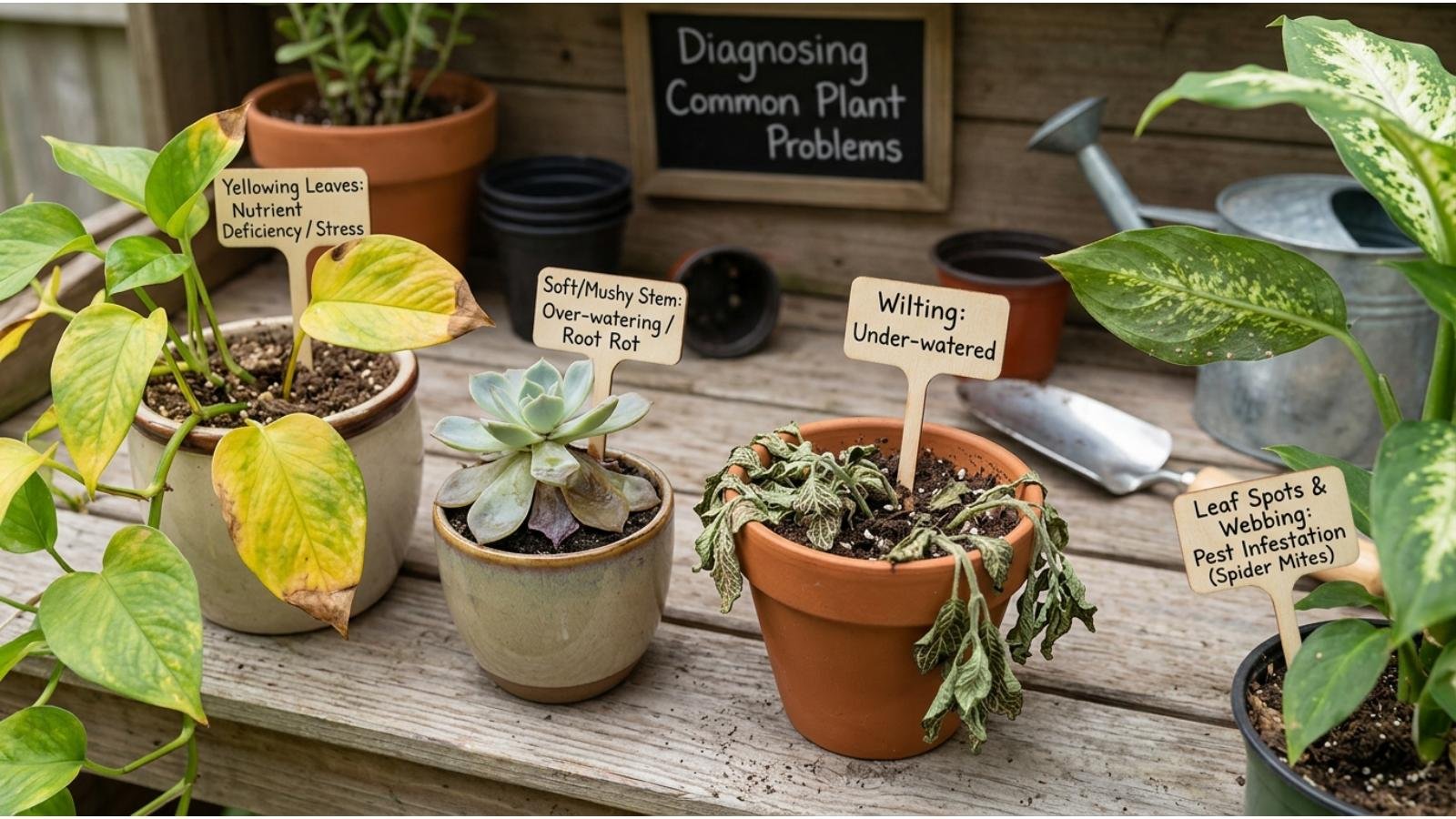
| Problem | Likely causes | What to check |
|---|---|---|
| Yellow leaves | Excess moisture, aging leaves, stress | Soil moisture and roots |
| Brown crispy edges | Dry air, inconsistent watering, heat | Humidity and watering |
| Brown/bleached patches | Excessive direct sunlight | Window exposure |
| Drooping leaves | Dry soil or root problems | Check soil before watering |
| Small new leaves | Immaturity, low light, poor conditions | Light and overall growth |
| Few fenestrations | Young plant or insufficient light | Age, light and support |
| Mushy roots | Waterlogged conditions | Drainage and soil |
| Sticky leaves | Possible sap-sucking pests | Inspect leaf undersides |
| Leggy growth | Insufficient light | Move toward brighter indirect light |
The RHS identifies overwatering and poor drainage as major risks, while pests such as mealybugs can also affect Swiss cheese plants.
Yellow leaves: don’t panic immediately
One older yellow leaf is not necessarily a crisis. Plants naturally shed older foliage.
The concern is a pattern—especially multiple yellowing leaves combined with wet soil, poor drainage, or a declining stem.
Brown leaf tips
Brown edges can be associated with dry air, but don’t assume humidity is always the culprit. Check the whole growing environment, including watering consistency, direct sunlight, heat, and root health.
Root rot
Root problems deserve immediate attention.
If the soil remains wet for extended periods and the plant is declining, inspect the roots. Healthy roots should not be treated as an afterthought; they are the foundation of healthy foliage.
Common Swiss Cheese Plant Care Mistakes
1. Watering on a fixed schedule
“Water every Sunday” sounds convenient, but plants don’t consume water at exactly the same rate every week.
Check the soil instead.
2. Using an oversized pot
A huge container is not automatically better. Excess soil can stay wet around the roots for too long.
3. Putting it in a dark corner
Monsteras tolerate some lower-light conditions, but impressive mature growth generally requires much better light.
4. Giving it intense direct sun
Bright light and direct scorching sunlight are not the same thing.
5. Ignoring the climbing habit
A Monstera that naturally wants to climb can become awkward when allowed to sprawl everywhere.
6. Fertilizing a struggling plant excessively
More fertilizer isn’t a substitute for appropriate light, roots, water, or temperature.
7. Expecting every leaf to have holes
Young Monsteras commonly produce simpler leaves. Give the plant time and suitable growing conditions.
Seasonal Swiss Cheese Plant Care
Spring
Spring is an excellent time to:
- Increase watering as growth accelerates
- Begin regular fertilization
- Repot if necessary
- Prune unwanted growth
- Add or improve climbing support
- Propagate healthy plants
Summer
Monitor moisture more frequently because warmer conditions and stronger growth can increase water use.
Keep the plant away from harsh direct sunlight and extreme heat.
Fall
As growth slows, gradually reduce watering frequency rather than continuing a summer routine automatically.
Winter
Indoor plants often use less water during slower growth. Keep the plant warm and away from cold drafts, and avoid keeping the soil constantly wet.
Advanced Tips for Bigger, Healthier Leaves
If your goal is not merely survival but large, mature Monstera leaves, focus on the entire growing system rather than one “secret” trick.
Prioritize light
A plant cannot produce consistently impressive foliage if it is chronically starved of usable light.
Encourage climbing
Give the plant a suitable support and gently train it upward.
Maintain healthy roots
Large leaves require a strong root system. Poor drainage can undermine everything else.
Keep growth consistent
Repeated cycles of severe drying followed by excessive watering can stress the plant.
Don’t chase humidity numbers blindly
Humidity matters, but a humidifier cannot compensate for poor drainage, inadequate light, or unhealthy roots.
Keep leaves clean
Dust can accumulate on the broad foliage. Gently cleaning the leaves can improve their appearance and remove some surface debris. The RHS also recommends regular leaf cleaning as part of routine care.
Are Swiss Cheese Plants Toxic to Pets?
Yes. Monstera deliciosa is considered harmful if eaten and can irritate the skin and eyes. The RHS recommends wearing gloves when handling the plant and keeping it away from children and pets.
This matters particularly in homes with curious cats, dogs, or young children.
Place the plant somewhere it cannot easily be chewed or pulled over. If you suspect a pet or child has eaten part of the plant, contact an appropriate medical or veterinary professional for advice.
Frequently Asked Questions
How much sunlight does a Swiss cheese plant need?
Swiss cheese plants prefer bright, indirect light. Avoid harsh direct sunlight that can scorch the foliage, while very low light may reduce growth and fenestration development.
How often should I water my Monstera?
Water when the growing medium has become almost dry, then water thoroughly and allow excess water to drain. The exact interval depends on light, temperature, pot size, soil, and season.
Why are my Monstera leaves turning yellow?
Yellow leaves can have several causes, including excessive moisture, root problems, natural aging, and environmental stress. Check the soil and roots before automatically adding fertilizer.
Why does my Monstera have no holes?
Young Monsteras often have solid leaves. Mature fenestrations develop as the plant grows, and low light can contribute to fewer holes.
Should I cut off damaged Monstera leaves?
Remove completely dead or severely damaged leaves with clean tools. If a leaf still has substantial healthy green tissue, there may be value in keeping it.
Does Monstera need a moss pole?
It doesn’t strictly need one to survive indoors, but a climbing support can help the plant grow more naturally and may encourage larger, more mature foliage.
Can I grow Monstera in a bathroom?
A warm, bright bathroom can be an excellent environment because Monsteras appreciate humidity. However, the room still needs adequate indirect light.
What is the best soil for Monstera?
Use an open, well-draining growing medium that retains some moisture without becoming waterlogged. The RHS recommends a slightly acidic, free-draining mixture.
How do I make Monstera leaves bigger?
Provide strong indirect light, appropriate watering, good nutrition during active growth, healthy roots, and climbing support. Mature leaf size develops gradually rather than overnight.
Can I propagate Monstera from a single leaf?
A leaf without a suitable stem node generally cannot produce a complete new Monstera. Propagation is normally done using a stem cutting containing a viable node.
How fast does a Swiss cheese plant grow?
Growth varies substantially depending on light, temperature, nutrition, root health, plant age, and growing conditions. Healthy plants can become vigorous climbers and eventually require substantial space.
Final Takeaways
Successful Swiss cheese plant care comes down to balancing several basic conditions: bright indirect light, warm temperatures, appropriate humidity, well-draining soil, and careful watering.
The most important lesson is to avoid treating Monstera care as a fixed calendar routine. Check the soil, observe the leaves, inspect the roots when necessary, and adjust your care according to the plant’s actual environment.
For the biggest and most attractive foliage, think beyond watering. Give your Monstera enough light, provide climbing support, maintain healthy roots, feed it during active growth, and give young plants time to mature.
With those fundamentals in place, Monstera deliciosa can become a long-lived statement houseplant rather than simply another plant that survives on a windowsill.