Quick Answer
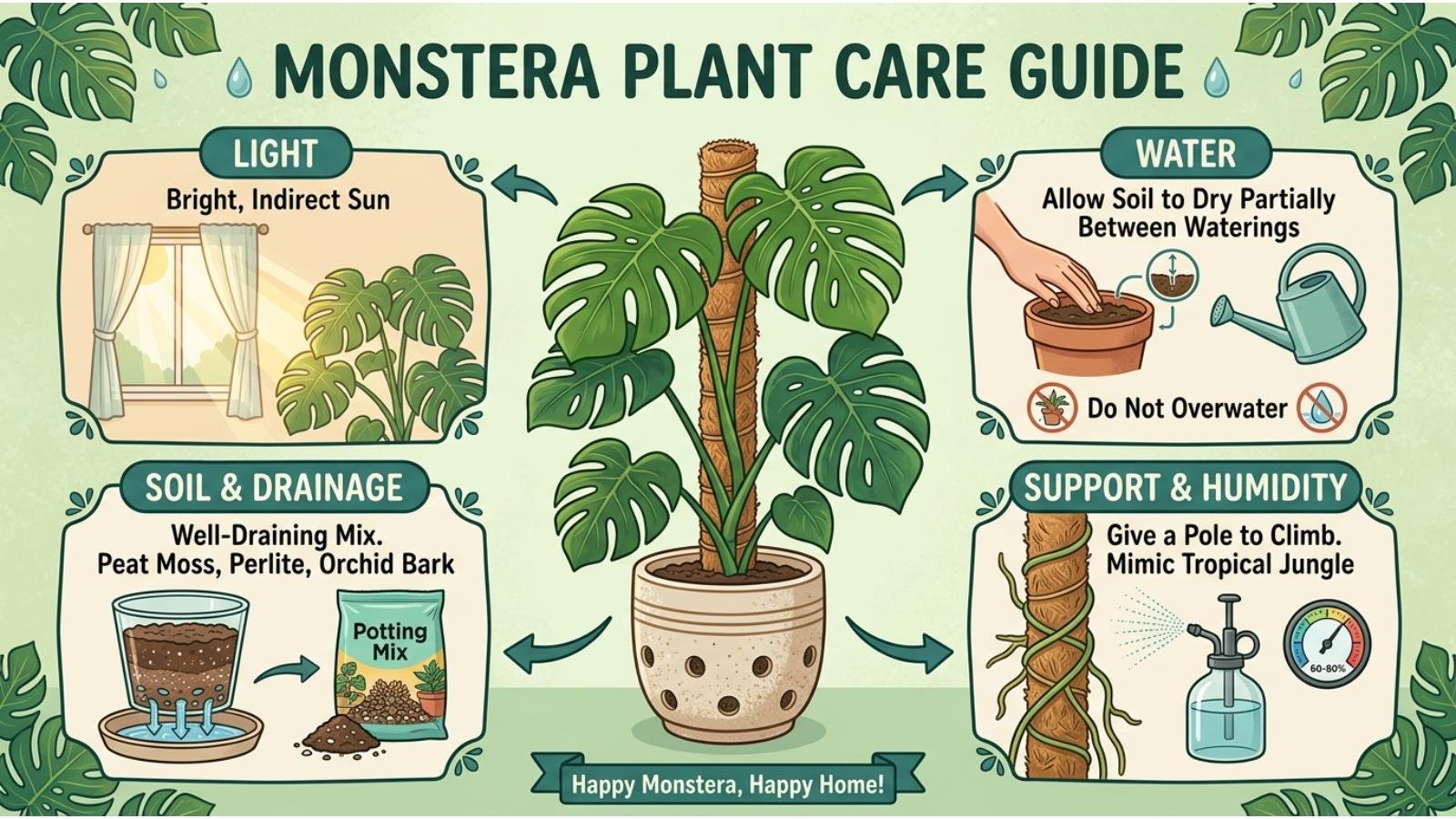
Monstera plant care is mainly about providing bright, indirect light, well-draining soil, thorough but appropriately timed watering, warmth, moderate-to-high humidity, and enough space for the plant to climb. Let the upper layer of soil dry before watering again, avoid standing water, and give mature plants a moss pole or other sturdy support. With good light and proper care, Monstera deliciosa can become a large, long-lived tropical houseplant.
Introduction
Monstera plants are popular for good reason: their large, glossy leaves and natural splits and holes can turn an ordinary room into a miniature indoor jungle. But while Monstera is often described as an easy houseplant, healthy growth depends much more on getting the basics right than on following a rigid watering schedule.
The biggest problems usually come from conditions that look harmless at first—watering too frequently, keeping the plant in a dark corner, exposing leaves to harsh afternoon sun, or giving a large climbing plant no support. This guide explains how to care for Monstera from the first watering through repotting, pruning, propagation, troubleshooting, and encouraging larger, more mature leaves.
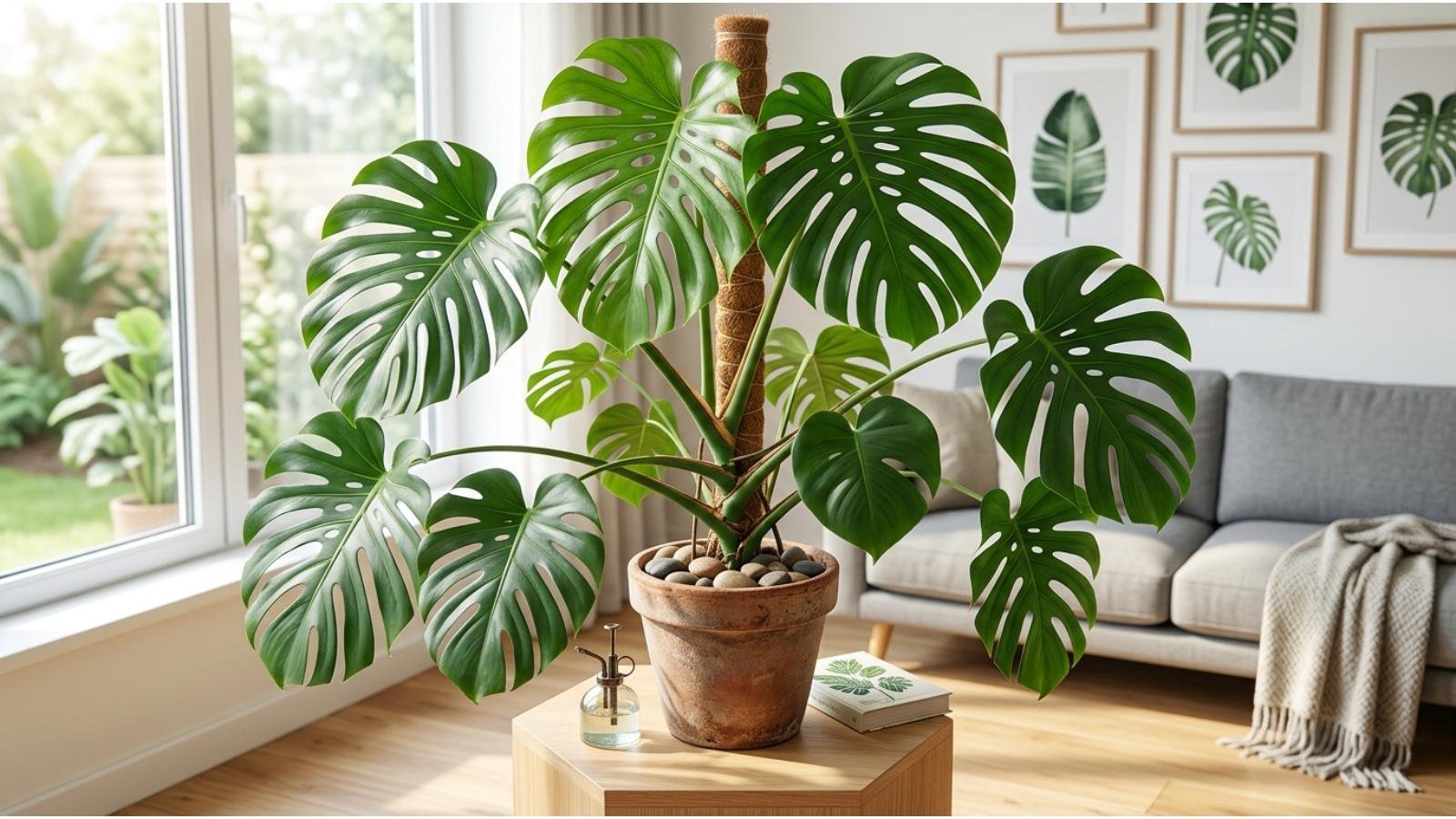
Image Suggestion: A realistic, well-established Monstera deliciosa beside a healthy window, showing large fenestrated leaves and a moss pole.
What Is a Monstera Plant?
Monstera is a genus of tropical climbing plants in the arum family, Araceae. The species most commonly grown indoors is Monstera deliciosa, commonly called the Swiss cheese plant.
In its natural environment, Monstera grows as a climbing plant rather than as a compact tabletop plant. It uses aerial roots and surrounding vegetation for support as it moves upward. That climbing habit explains why mature plants can become surprisingly large indoors. The Royal Horticultural Society lists Monstera deliciosa as capable of reaching several metres in suitable conditions.
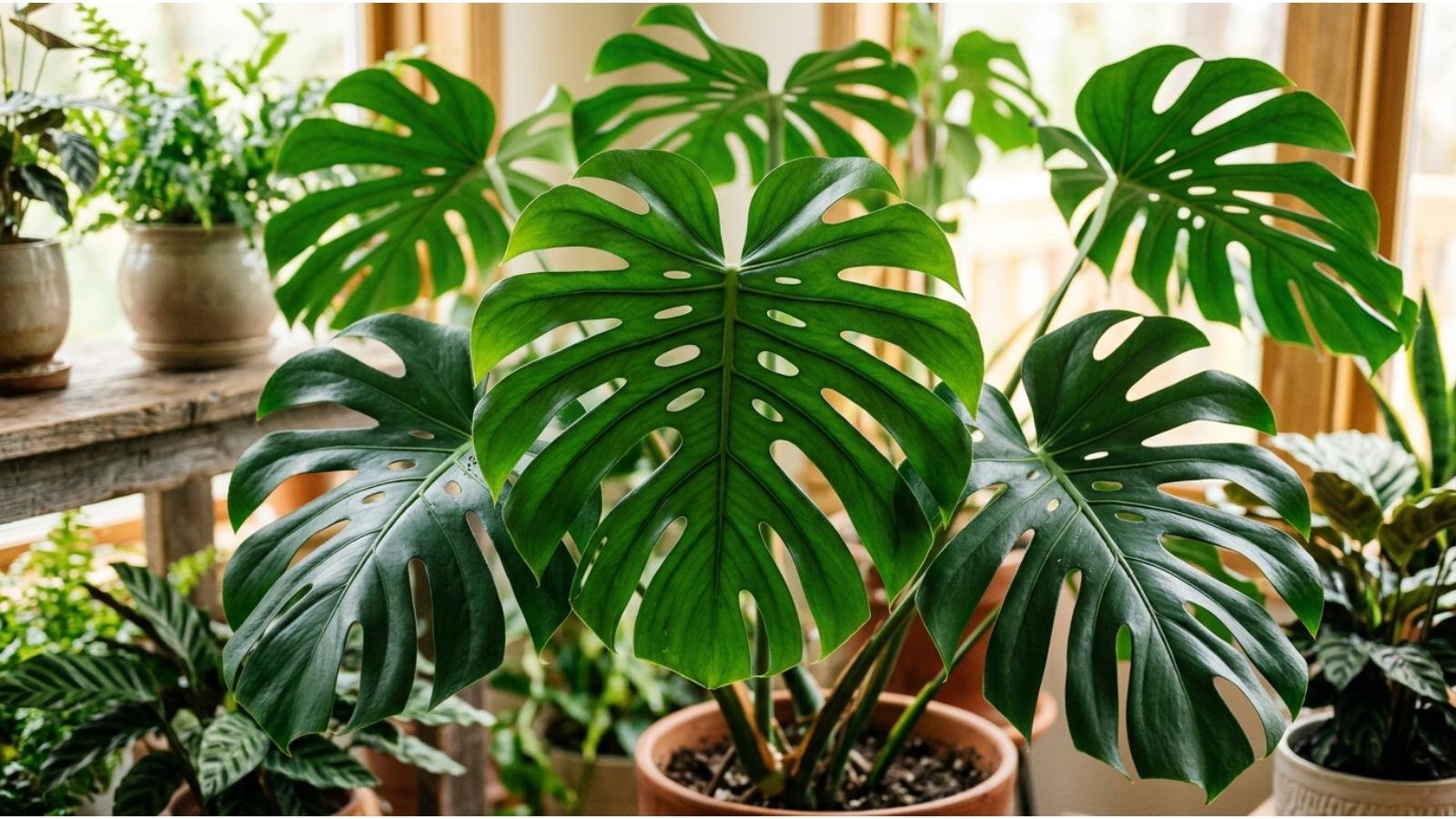
The characteristic holes and splits in mature leaves are called fenestrations. Younger plants may produce solid leaves, so a small Monstera without holes is not necessarily unhealthy.
Monstera deliciosa vs. Monstera adansonii
These plants are related but have noticeably different appearances.
| Feature | Monstera deliciosa | Monstera adansonii |
|---|---|---|
| Mature size | Very large | Generally smaller |
| Leaf appearance | Large leaves with splits and holes | Smaller leaves with prominent holes |
| Growth habit | Strong climber | Climber or trailer |
| Best for | Statement indoor plants | Smaller spaces |
| Support | Strongly recommended | Helpful |
For most beginners searching for Monstera plant care, Monstera deliciosa is the plant they have in mind.
How Much Light Does a Monstera Need?
Monstera generally performs best in bright, indirect light.
Think of the light found beneath a tropical forest canopy: bright enough for vigorous growth, but filtered rather than continuously exposed to intense midday sunlight. The RHS recommends indirect light and notes that poor light can contribute to less dramatic fenestration.
The ideal location
A good indoor position is:
- Near a bright east-facing window
- A few feet from a bright south- or west-facing window
- Behind a sheer curtain where sunlight is intense
- In a bright room with plenty of filtered daylight
A dark corner may keep a Monstera alive, but it usually will not produce the strongest growth.
What happens with too little light?
You may notice:
- Smaller new leaves
- Longer gaps between leaves
- Slow growth
- Leaves leaning strongly toward a window
- Fewer or smaller fenestrations
- Weak, stretched stems
Move the plant gradually toward brighter conditions rather than suddenly putting a low-light Monstera into intense direct sun.
Can Monstera tolerate direct sunlight?
Some gentle morning or filtered sunlight can be useful, but intense direct summer sun through glass can scorch foliage. The pale sections of variegated Monsteras are particularly vulnerable to sun damage.
Image Suggestion: Diagram showing ideal Monstera placement near an east-facing window versus excessive direct afternoon sun.
How Often Should You Water a Monstera?
There is no universally correct schedule such as “water every seven days.”
The better approach is to check the soil before watering.
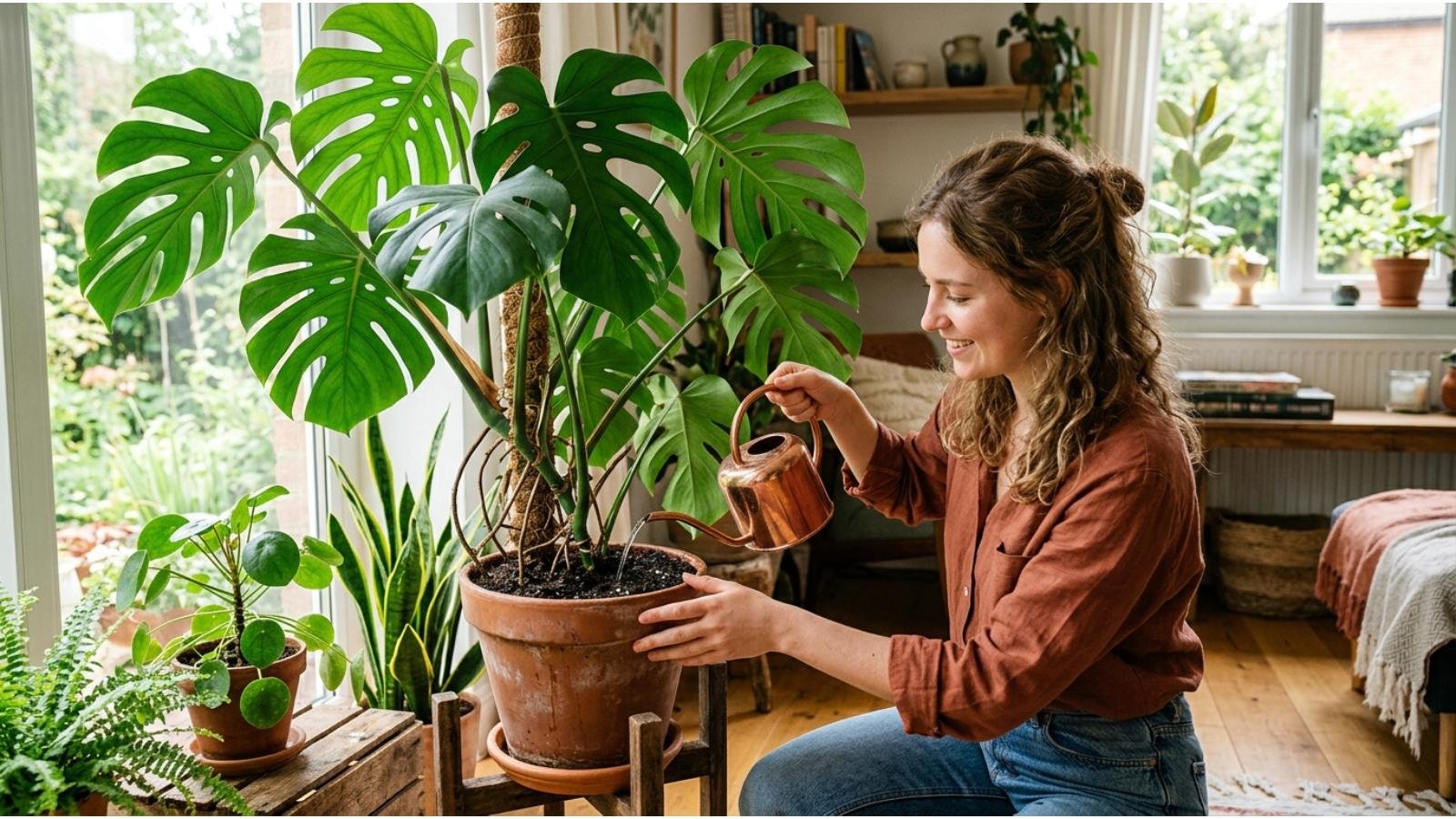
When the upper portion of the potting mix has dried, water thoroughly until excess water drains from the bottom. Then empty any water collected in the saucer or outer container.
The RHS specifically recommends watering when the compost surface becomes dry and emphasizes that pots should have drainage holes.
A simple watering routine
- Push your finger into the upper layer of soil.
- Check whether the surface has dried.
- If it is still noticeably wet, wait.
- If the upper layer is dry and the plant needs water, soak the soil thoroughly.
- Allow excess water to drain completely.
- Return the plant to its normal position.
Why watering schedules fail
A Monstera in a warm, bright room may use water much faster than one sitting in a cool, dim room.
Pot size also matters. A small plant in a small pot can dry considerably faster than a large Monstera in a deep container.
The goal is not to keep the soil permanently wet. Monstera roots need both moisture and access to air.
Signs of possible overwatering
Watch for:
- Persistently wet soil
- Yellowing leaves
- Drooping despite wet soil
- A sour or unpleasant soil smell
- Declining roots
- Slow growth
Overwatering is particularly dangerous when poor drainage keeps roots wet for long periods. The RHS warns against leaving Monstera pots standing in water because roots can rot.
Signs of underwatering
Possible symptoms include:
- Drooping leaves
- Very dry soil
- Crispy brown edges
- Leaves curling or becoming limp
- A pot that feels unusually light
Remember that brown edges can have multiple causes, so do not automatically assume the plant needs more water.
What Soil Is Best for Monstera?
Monstera needs a potting mix that retains some moisture without becoming waterlogged.
A practical indoor mix can contain:
- Quality indoor potting mix
- Orchid bark
- Perlite or another coarse aeration material
The exact percentages are less important than the final result: the mix should drain freely while still holding enough moisture for the roots.
The RHS describes Monstera as preferring moist but well-drained conditions and recommends a slightly acidic to neutral growing medium.
Why drainage matters
Imagine two identical Monsteras receiving the same amount of water.
One is planted in a loose, aerated mix with drainage holes. The other is sitting in dense, poorly draining soil.
The second plant may remain wet for much longer. That difference—not simply the amount of water poured into the pot—can determine whether roots remain healthy.
Choosing a container
Always use a container with drainage holes.
A decorative cachepot without drainage can still be used, but keep the Monstera in a properly draining nursery pot inside it.
What Temperature and Humidity Does Monstera Need?
Monstera comes from tropical environments and generally appreciates warm temperatures and humid air.
The RHS recommends approximately 18–25°C (65–77°F) for Monstera grown as a houseplant, with moderate humidity.
Humidity
Higher humidity can support healthier tropical foliage, especially when indoor air becomes very dry.
You can increase humidity by:
- Running a humidifier
- Grouping plants together
- Keeping the plant away from drying heat sources
- Using a naturally humid room with sufficient light
The important point is that humidity should not replace good ventilation or proper watering.
What about misting?
Misting can temporarily increase moisture around leaves, but it is not a substitute for maintaining appropriate room humidity.
If your home is consistently dry, a humidifier is generally a more controllable approach.
Keep Monstera away from temperature extremes
Avoid placing it directly beside:
- Heating vents
- Radiators
- Very cold windows
- Strong air-conditioning drafts
- Doors that expose the plant to repeated cold air
Why Do Monstera Leaves Develop Holes?
The holes and splits in mature Monstera leaves are called fenestrations.
They are a normal characteristic of mature plants, but a young Monstera may produce mostly solid leaves.
The RHS notes that Monsteras often begin producing holey leaves only after they are a few years old and that plants grown in poor light may have fewer holes.
How to encourage larger, more mature leaves
Focus on the fundamentals:
- Provide strong indirect light.
- Keep watering consistent without waterlogging the roots.
- Feed appropriately during active growth.
- Give the plant something sturdy to climb.
- Avoid repeatedly disturbing the roots.
- Give the plant time to mature.
One common mistake is buying a young Monstera and expecting every new leaf to immediately look like the dramatic leaves seen on mature specimens online.
Maturity matters.
Why Your Monstera Needs a Moss Pole or Support
A Monstera is naturally a climbing plant, so allowing it to sprawl across the floor may not produce the same growth pattern as training it upward.
A sturdy moss pole, coir pole, trellis, or similar support gives the plant something to grow against.
Benefits of vertical support
A support can:
- Encourage upward growth
- Keep the plant more compact
- Help organize aerial roots
- Make large leaves easier to display
- Create a more natural climbing structure
As the Monstera grows, gently attach stems to the support with soft plant ties.
Do not tightly bind the stem. The plant needs room to expand.
Image Suggestion: Step-by-step illustration showing a young Monstera being attached loosely to a moss pole.
How to Fertilize a Monstera
Fertilizer provides nutrients that plants use to build new leaves, roots, and stems, but more fertilizer does not automatically mean faster or healthier growth.
The RHS recommends a balanced liquid fertilizer monthly while Monstera deliciosa is actively growing.
A sensible feeding approach
During active growth:
- Use a balanced houseplant fertilizer.
- Follow the product’s dilution instructions.
- Avoid repeatedly increasing the dose because growth seems slow.
- Reduce feeding when growth naturally slows.
If the plant is struggling because of poor light, damaged roots, or improper watering, fertilizer is not a magic fix.
Fix the growing conditions first.
When and How to Repot a Monstera
Repotting becomes useful when the plant has substantially outgrown its container or the growing medium has deteriorated.
You may notice:
- Roots circling densely inside the pot
- Roots emerging from drainage holes
- Water passing through unusually quickly
- The plant becoming unstable
- Growth slowing despite otherwise good conditions
How to repot
- Choose a container only moderately larger than the existing one.
- Prepare fresh, well-draining potting mix.
- Remove the plant carefully.
- Inspect the roots.
- Trim only clearly dead or severely damaged roots with clean tools.
- Position the plant at approximately the same depth.
- Fill around the root ball with fresh mix.
- Water thoroughly.
- Place it back in suitable indirect light.
Avoid moving a small Monstera into an enormous pot simply because you want it to grow faster. Excess soil can stay wet for too long.
How to Prune a Monstera Without Damaging It
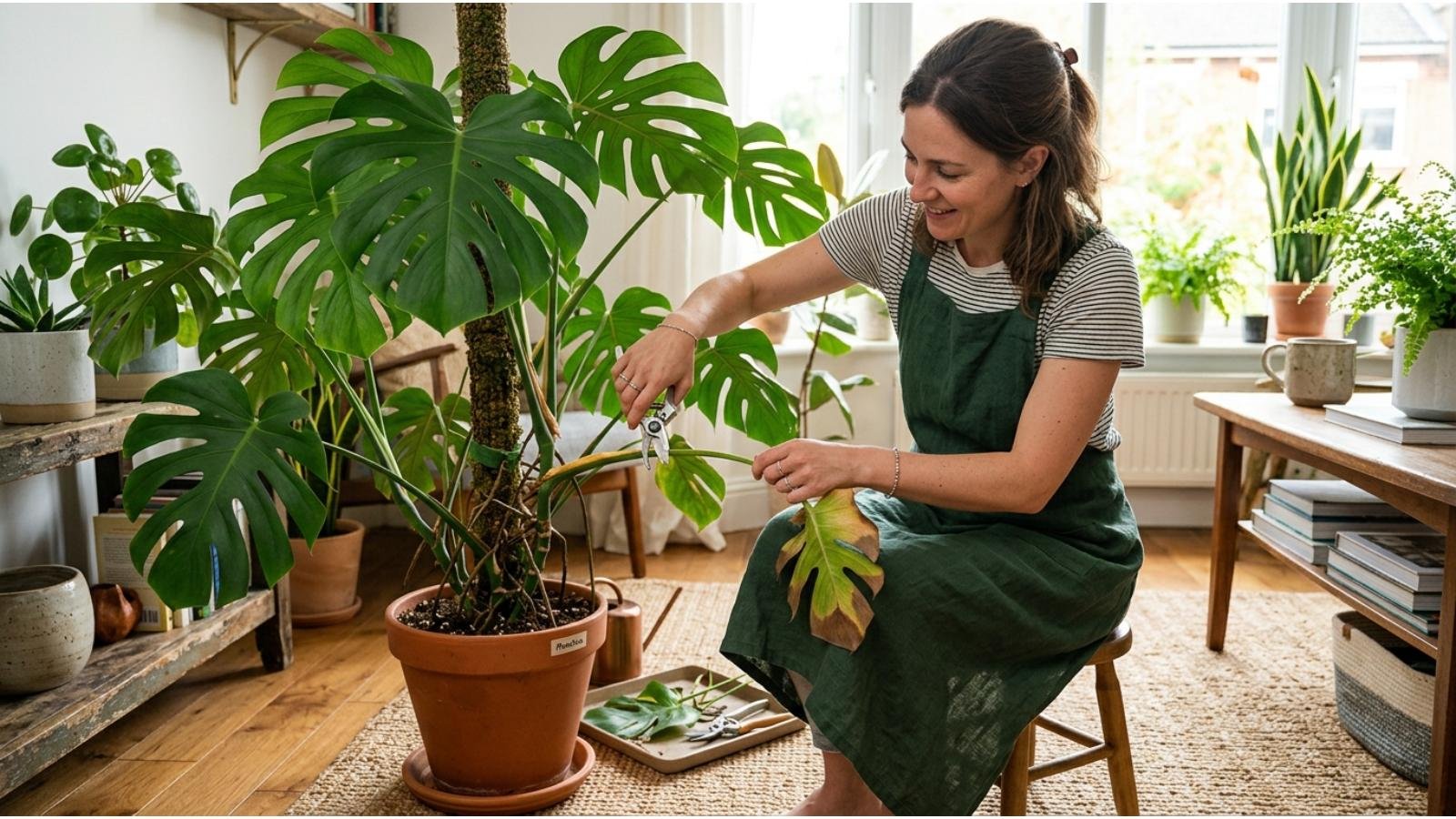
Pruning is useful for controlling size, removing damaged foliage, and shaping the plant.
Use clean, sharp pruning shears.
Remove:
- Completely dead leaves
- Severely damaged foliage
- Unwanted growth
- Stems that are making the plant difficult to manage
Avoid removing healthy leaves simply because they are older. A functioning leaf still contributes energy to the plant.
If you want to make a cutting for propagation, choose a stem section containing an appropriate node rather than cutting a random piece of leaf.
How to Propagate Monstera From a Cutting
Monstera can be propagated from suitable stem cuttings.
The key word is node.
A leaf by itself generally does not contain the growth point necessary to produce a new Monstera plant.
Basic propagation process
- Select a healthy stem.
- Identify a node.
- Make a clean cut around the appropriate section.
- Place the cutting in water or a suitable propagation medium.
- Provide warmth and bright indirect light.
- Wait for roots to develop.
- Transfer to an appropriate growing medium once established.
The RHS lists stem cuttings among the propagation methods for Monstera deliciosa.
Image Suggestion: Close-up diagram labeling a Monstera cutting’s leaf, stem, node, aerial root, and new roots.
Monstera Leaf Problems: What the Symptoms Mean
Plant problems are easier to solve when you diagnose the pattern rather than reacting to one symptom.
| Symptom | Possible cause | What to check |
|---|---|---|
| Yellow leaves | Excess moisture, aging leaf, stress | Soil moisture and drainage |
| Brown crispy edges | Dry air, inconsistent watering, environmental stress | Humidity and watering |
| Brown sun patches | Excessive direct light | Window exposure |
| Drooping with wet soil | Root or watering problem | Roots and drainage |
| Small new leaves | Insufficient light or immature plant | Light level and age |
| No fenestrations | Young plant or insufficient light | Maturity and lighting |
| Slow growth | Low light, poor roots, season | Light, roots and growing conditions |
| Pale leaves | Light or nutrient issue | Location and feeding |
| Fine webbing | Possible spider mites | Undersides of leaves |
| White cottony insects | Possible mealybugs | Stems and leaf joints |
The RHS identifies pests such as scale insects and glasshouse red spider mites as possible Monstera problems.
Yellow leaves: don’t automatically add fertilizer
Yellowing is one of the most misunderstood houseplant symptoms.
A yellow leaf does not automatically mean nutrient deficiency. Check the soil, drainage, light, recent watering history, and whether the affected leaf is naturally aging.
Diagnose the growing environment before adding more fertilizer.
Common Monstera Care Mistakes
1. Watering on a fixed calendar
“Sunday is watering day” sounds convenient, but plants do not consume water at exactly the same rate every week.
Check the soil instead.
2. Keeping the plant in a dark corner
Monstera can tolerate less-than-ideal light for a while, but poor light can limit growth and fenestration.
3. Using a pot without drainage
A beautiful container cannot compensate for permanently waterlogged roots.
4. Giving the plant harsh midday sunlight
Bright light is useful; intense direct sunlight through glass can scorch leaves.
5. Expecting holes on every young leaf
Fenestrations develop as the plant matures.
6. Ignoring aerial roots
Aerial roots are normal for climbing Monsteras. They are not automatically a sign that something is wrong.
7. Fertilizing a stressed plant heavily
More fertilizer cannot repair damaged roots or compensate for inadequate light.
8. Repotting too aggressively
Repeatedly moving a plant into much larger containers can create unnecessary moisture-management problems.
How to Make a Monstera Grow Faster
There is no safe shortcut that replaces good growing conditions.
For stronger growth, optimize the environment:
Light → Water → Roots → Nutrition → Support
Step 1: Improve light
Give the plant bright, indirect light.
Step 2: Correct watering
Water thoroughly when the upper soil has dried sufficiently rather than watering automatically.
Step 3: Check the roots
If the soil remains wet for excessive periods, investigate drainage and the root system.
Step 4: Feed during active growth
Use a balanced fertilizer according to its label.
Step 5: Provide climbing support
A mature Monstera generally benefits from being trained upward.
Step 6: Be patient
A plant cannot manufacture mature leaves overnight. Good conditions allow natural growth; they cannot force maturity instantly.
Variegated Monstera Care
Variegated varieties require some extra attention because sections of their leaves contain less chlorophyll.
Bright, indirect light is especially important, but excessive direct sunlight can burn pale areas. The RHS recommends bright, indirect light and careful watering for variegated Monstera, noting their increased sensitivity to overwatering.
Important considerations
- Provide bright filtered light.
- Protect pale leaf sections from harsh direct sun.
- Avoid keeping the soil constantly wet.
- Watch for gradual changes in variegation.
- Maintain stable growing conditions.
Popular variegated types can also be considerably more expensive than standard green Monstera, making proper care especially important.
Seasonal Monstera Plant Care
Spring
As daylight increases:
- Watch for faster soil drying.
- Resume or increase feeding according to active growth.
- Check whether the plant needs support.
- Consider repotting if root-bound.
Summer
During hot weather:
- Monitor soil more frequently.
- Protect foliage from harsh direct sunlight.
- Maintain reasonable humidity.
- Check for pests.
Fall
As growth slows:
- Reduce watering frequency according to soil moisture.
- Avoid continuing heavy fertilization if the plant is no longer actively growing.
- Inspect for pests before indoor heating begins.
Winter
Winter care depends heavily on your indoor environment.
A plant in a warm, bright room may continue growing, while one in a cooler, darker room may need considerably less water.
Do not maintain summer watering habits simply because the calendar says the plant should be watered.
Is Monstera Toxic to Pets?
Yes. Monstera deliciosa contains insoluble calcium oxalate crystals and is listed by the ASPCA as toxic to dogs and cats.
Possible signs after ingestion include oral irritation, pain or swelling of the mouth and tongue, excessive drooling, vomiting, and difficulty swallowing.
If you have pets or young children who may chew plants, keep Monstera somewhere inaccessible. If a pet has ingested part of the plant and develops concerning symptoms, contact a veterinarian or an appropriate animal poison-control service.
A Simple Monstera Care Routine
If you want a straightforward routine, use this checklist.
Weekly
- Check the soil moisture.
- Inspect leaves for pests.
- Look for new growth.
- Rotate the plant if growth is becoming strongly one-sided.
- Check whether stems need additional support.
Monthly
- Inspect roots and drainage if watering behavior seems unusual.
- Clean dusty leaves gently.
- Check for pests around leaf joints and undersides.
- During active growth, fertilize according to your chosen fertilizer’s directions.
Every Few Months
- Assess whether the plant needs more climbing support.
- Check whether roots are becoming crowded.
- Reconsider the plant’s light as the seasons change.
- Remove badly damaged or dead foliage.
This approach is more reliable than trying to memorize a single watering or feeding schedule.
Frequently Asked Questions About Monstera Plant Care
How often should I water a Monstera?
Water when the upper portion of the growing medium has dried sufficiently, then water thoroughly and allow excess water to drain. Frequency varies with light, temperature, humidity, pot size, and season.
Why are my Monstera leaves turning yellow?
Yellow leaves can result from excessive moisture, root problems, environmental stress, natural aging, or other issues. Check the soil moisture and drainage before assuming the plant needs fertilizer.
Why does my Monstera have no holes?
Young Monsteras commonly produce solid leaves. Poor light can also contribute to less dramatic fenestration. Mature leaves develop their characteristic holes and splits over time.
Does Monstera need direct sunlight?
Monstera generally prefers bright, indirect light. Strong direct sunlight, particularly through glass, can scorch foliage.
Should I cut off brown Monstera leaves?
If a leaf is mostly dead or severely damaged, removing it can improve the plant’s appearance. If only a small portion is brown, the healthy tissue can continue functioning, so there is usually no need to remove the entire leaf.
Why are my Monstera leaves curling?
Curling can occur for several reasons, including insufficient moisture, dry air, excessive heat, root problems, or environmental stress. Check the soil and surrounding conditions before changing the watering routine.
Does Monstera need a moss pole?
A moss pole is not mandatory, but a sturdy climbing support is highly useful because Monstera is naturally a climbing plant. Support can help the plant grow upward and display larger mature foliage.
Can Monstera grow in low light?
It may survive in lower light, but bright indirect light is generally better for vigorous growth and mature foliage. Poor light can contribute to fewer fenestrations.
How do I make my Monstera produce bigger leaves?
Provide strong indirect light, appropriate watering, adequate nutrition during active growth, warmth, and a suitable climbing support. Mature plants naturally produce larger foliage under good conditions.
Can I propagate Monstera from a leaf?
A leaf without an appropriate node generally cannot produce a new complete Monstera plant. Propagation is normally performed using stem sections containing a node.
Is Monstera safe for cats and dogs?
No. Monstera deliciosa contains insoluble calcium oxalates and is toxic to cats and dogs.
Final Monstera Plant Care Checklist
For a healthy Monstera, remember these fundamentals:
- Light: Bright, indirect light
- Water: Water thoroughly when the upper soil has dried sufficiently
- Soil: Moisture-retentive but well-draining
- Pot: Always use adequate drainage
- Humidity: Moderate to high humidity is beneficial
- Temperature: Keep conditions warm and stable
- Fertilizer: Feed appropriately during active growth
- Support: Give mature plants a sturdy climbing structure
- Pruning: Remove dead or severely damaged growth
- Repotting: Increase pot size gradually when necessary
- Propagation: Use stem cuttings containing nodes
- Pets: Keep away from cats and dogs because the plant is toxic if eaten
Conclusion
Successful Monstera plant care is less about complicated tricks and more about creating the conditions the plant naturally prefers. Give it bright filtered light, well-draining soil, thoughtful watering, warmth, reasonable humidity, and room to climb, and it can reward you with increasingly impressive foliage.
Most importantly, learn to read the plant rather than following a rigid calendar. Check the soil before watering, observe new growth, inspect leaves regularly, and change one condition at a time when something looks wrong. Once those habits become routine, caring for a Monstera becomes much easier—and your plant has a much better chance of developing the large, fenestrated leaves that make it such a popular houseplant.
Suggested Related Internal Topics
For a houseplant-care content cluster, this article can naturally link to:
- Snake Plant Care
- Pothos Plant Care
- Spider Plant Care
- Jade Plant Care
- Prayer Plant Care
- Bird of Paradise Plant Care
- Swiss Cheese Plant Care
- Aloe Plant Care
- Kalanchoe Plant Care
- Elephant Ear Plant Care
Recommended Image Opportunities
- Hero image: Mature Monstera deliciosa in a bright modern room.
- Light guide: Correct indirect light vs. harsh direct sunlight.
- Watering guide: Properly watered vs. overwatered Monstera.
- Propagation diagram: Monstera node and stem cutting labeled clearly.
- Support guide: Monstera climbing a moss pole.
- Troubleshooting infographic: Yellow, brown, curling, and healthy leaves.
- Variegated Monstera: Healthy variegation versus sun-scorched foliage.