Quick Answer
Goldfish plant care is easiest when Nematanthus gets bright, indirect light, a loose well-draining potting mix, consistent but moderate moisture, warm temperatures, and good humidity. Let the surface of the mix dry slightly before watering, but avoid prolonged dryness or soggy roots. Prune lightly to encourage branching, feed during active growth, and protect the plant from cold drafts and harsh direct sun.
Introduction
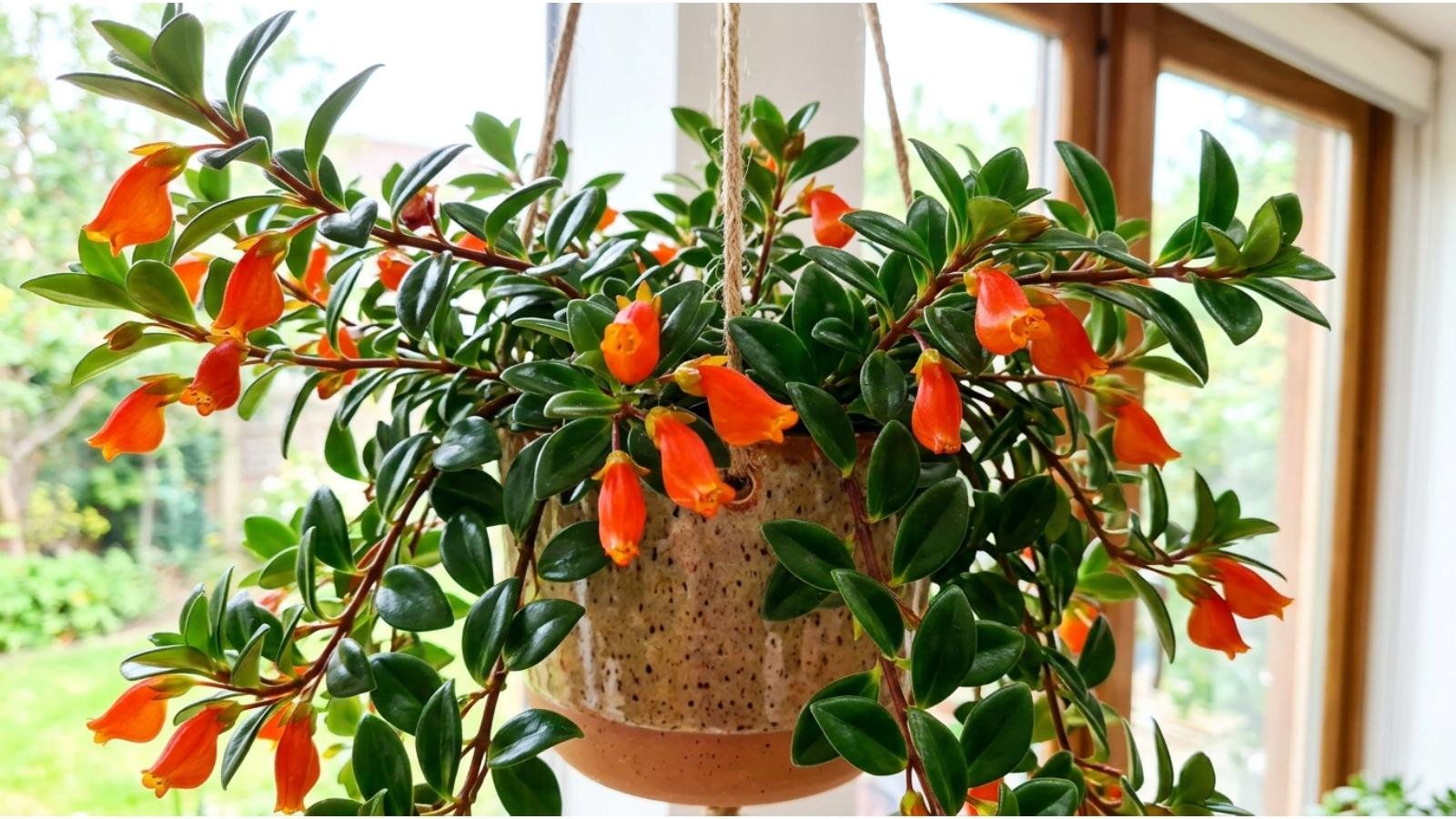
The goldfish plant (Nematanthus) is a tropical-looking houseplant prized for its glossy foliage and unusual orange, tubular flowers that resemble tiny goldfish. Its trailing growth makes it especially attractive in hanging baskets, shelves, and elevated planters.
Although goldfish plants are not particularly difficult, they can be frustrating when they stop flowering, drop leaves, develop yellow foliage, or become long and sparse. The problem is usually not that the plant is inherently difficult—it is that one part of its growing environment is slightly off.
Good goldfish plant care is therefore less about following a rigid watering schedule and more about understanding light, moisture, drainage, temperature, humidity, and pruning as a complete system.
Goldfish Plant Care at a Glance
| Care factor | Best approach |
|---|---|
| Light | Bright, filtered or indirect light |
| Water | Keep mix lightly and evenly moist; allow the surface to dry slightly |
| Soil | Loose, well-draining, moisture-retentive potting mix |
| Humidity | Moderate to high humidity is beneficial |
| Temperature | Warm, stable indoor conditions |
| Fertilizer | Regular feeding during active growth |
| Pruning | Pinch shoot tips to encourage branching |
| Pot | Container with drainage holes |
| Growth habit | Trailing or cascading |
| Flowers | Usually tubular and orange to orange-red |
| Propagation | Softwood/stem-tip cuttings |
Nematanthus gregarius as a trailing evergreen sub-shrub with fleshy glossy leaves and clusters of tubular orange flowers. It recommends bright filtered light, moist but well-drained compost, and sheltered conditions.
What Is a Goldfish Plant?
The name goldfish plant commonly refers to plants in the genus Nematanthus, members of the Gesneriaceae family.
The plant is native to Brazil and naturally grows as a trailing plant. Its fleshy leaves help give it a somewhat succulent appearance, while its distinctive flowers provide the feature that gives the plant its common name.
Depending on the species or cultivar, you may see:
- Glossy green leaves.
- Trailing stems.
- Orange or orange-red flowers.
- Compact or cascading growth.
- Variegated foliage in some cultivars.
Because of its trailing habit, a hanging basket can be an excellent way to display mature growth.
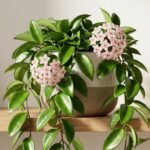
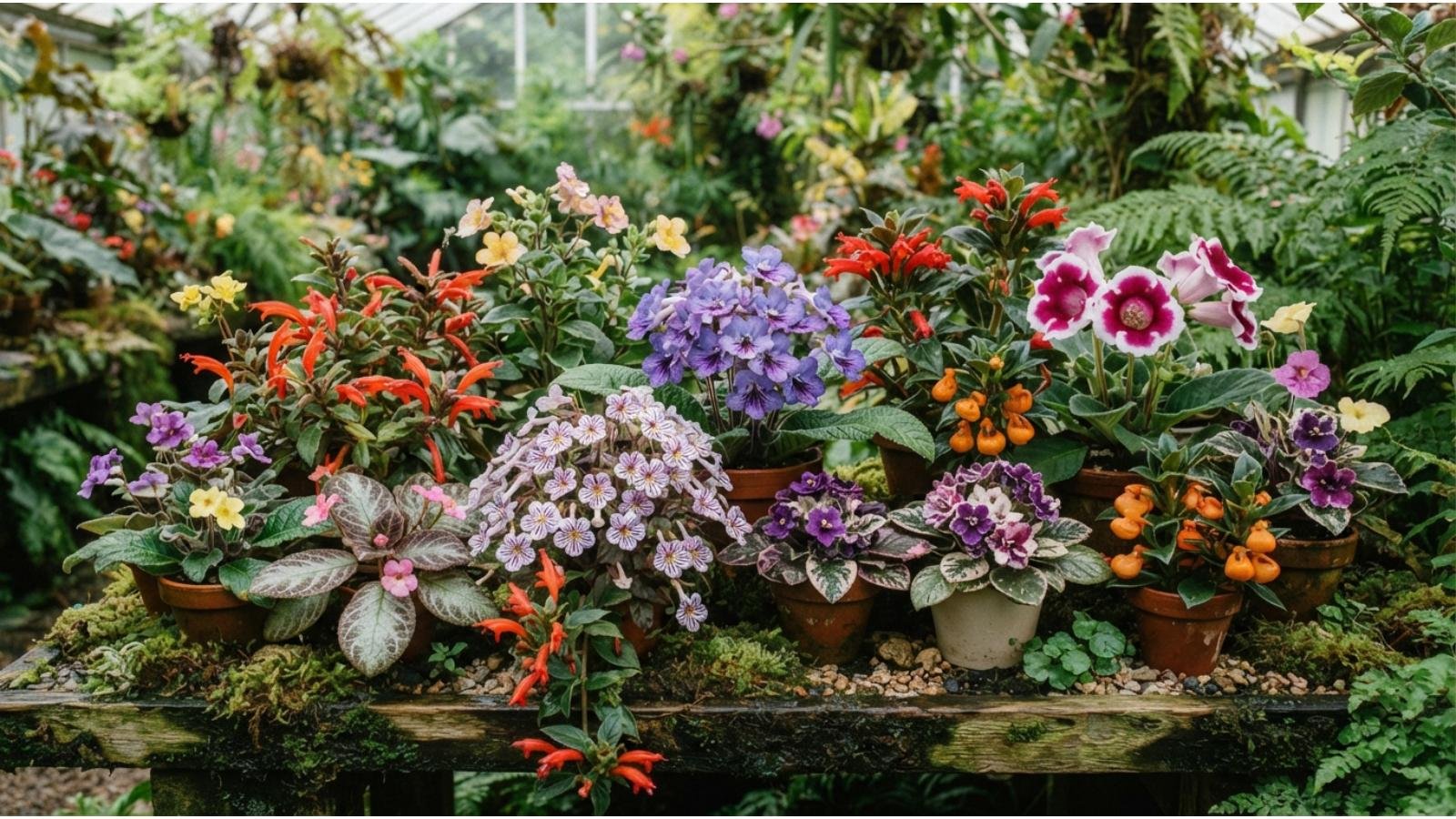
Image Suggestion: Close-up photograph showing glossy goldfish plant foliage and its distinctive orange tubular flowers.
How Much Light Does a Goldfish Plant Need?
Bright, indirect or filtered light is usually the best choice.
Goldfish plants need enough light to maintain compact foliage and support flowering, but intense direct sunlight—particularly through hot glass—can scorch foliage.
A good location might be:
- Near an east-facing window.
- Near a bright west-facing window with protection from intense afternoon sun.
- A few feet from a bright south-facing window, depending on climate and glass.
- In a bright room with filtered sunlight.
Bright, filtered light for Nematanthus gregarius and lists partial shade as its preferred position.
Signs of insufficient light
Your plant may:
- Produce long spaces between leaves.
- Become thin or leggy.
- Flower poorly.
- Lean toward the window.
- Produce weaker new growth.
Signs of excessive light
You may notice:
- Scorched leaf patches.
- Faded foliage.
- Crispy margins.
- Excessive drying of the potting mix.
Practical tip: If your goldfish plant is healthy but refuses to flower, check its light before immediately increasing fertilizer.
How to Water a Goldfish Plant
Watering is one of the most important parts of successful goldfish plant care.
The goal is consistent moisture without permanently wet soil.
Rather than watering every Sunday or following a fixed calendar, check the potting mix.
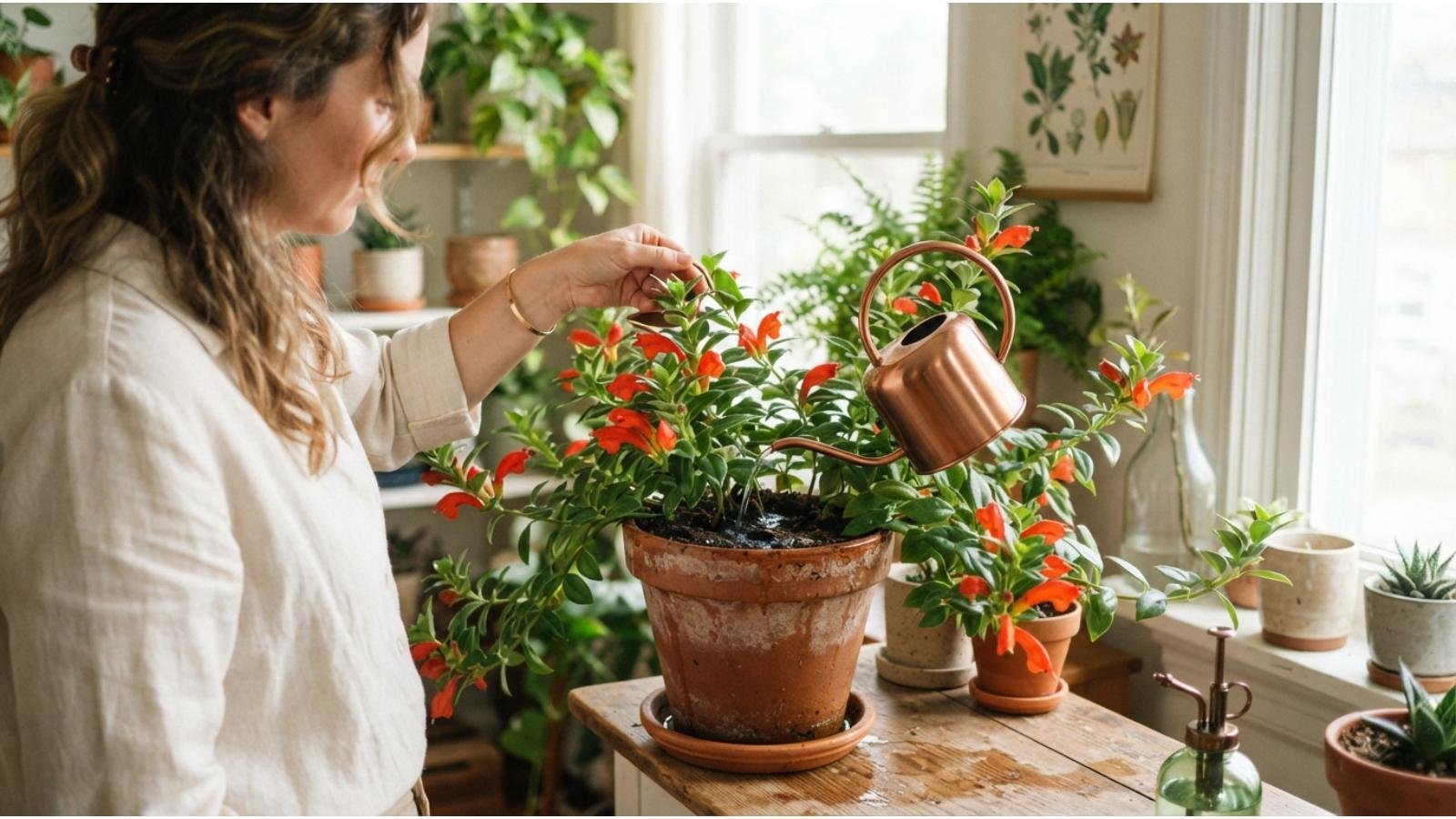
A simple watering method
- Check the surface of the potting mix with your finger.
- If the upper layer has dried slightly, assess the moisture deeper in the pot.
- Water thoroughly when the plant needs it.
- Allow excess water to drain completely.
- Empty water collected in an outer container or saucer.
- House plant compost rather than watering automatically and advises thorough watering until water escapes through the drainage hole.
Avoid both extremes
Too much water can keep the root zone oxygen-poor and contribute to root problems.
Too little water can cause:
- Wilting.
- Leaf drop.
- Dry, crispy foliage.
- Reduced flowering.
- Slow recovery after drought stress.
The important lesson is that watering frequency depends on conditions. A plant in a warm, bright room may dry faster than one in a cool, dim location.
Does a Goldfish Plant Need High Humidity?
Goldfish plants generally appreciate humid conditions because they originate from tropical environments.
Higher humidity can be especially helpful when indoor air becomes very dry.
Useful approaches include:
- Grouping several houseplants together.
- Using a humidifier.
- Keeping the plant away from strong heating or cooling airflow.
- Growing it in an appropriate naturally humid room if lighting is sufficient.
Should you mist your goldfish plant?
Misting is not a substitute for proper watering or adequate room humidity.
If you frequently have fungal or leaf-spot problems, avoid keeping foliage continuously wet. Improving overall environmental humidity is generally more useful than repeatedly spraying the leaves.
Best Soil for Goldfish Plants
Goldfish plants need a potting mix that holds some moisture while allowing excess water to escape.
A suitable mix should be:
- Airy.
- Well-draining.
- Organic-matter rich.
- Moisture-retentive without becoming waterlogged.
A practical homemade mix can combine:
- Quality indoor potting mix.
- Perlite or another aerating amendment.
- A small amount of fine bark or similar material.
The exact recipe is less important than the final structure.
If water sits around the roots for a long time, the mix is too dense or the pot is poorly drained.
Choosing the Right Pot
A drainage hole is essential.
Do not choose a decorative container simply because it looks attractive. A beautiful pot without adequate drainage can create a difficult root environment.
Choose a container that:
- Has drainage holes.
- Is only moderately larger than the root ball.
- Allows excess water to escape.
- Is stable enough for trailing growth.
A very large pot can hold excess moisture for longer, particularly if the plant has a small root system.
Image Suggestion: Diagram comparing a correctly sized drainage pot with an oversized water-retaining container.
Goldfish Plant Temperature Requirements
Goldfish plants prefer warm, stable conditions.
Protect them from:
- Cold drafts.
- Sudden temperature changes.
- Air-conditioning vents.
- Cold windows during winter.
- Outdoor frost or freezing conditions.
If your home becomes significantly cooler during winter, growth may slow and the plant may require less frequent watering.
How to Fertilize a Goldfish Plant
Goldfish plants benefit from feeding during active growth, particularly when they are producing new foliage.
A balanced liquid houseplant fertilizer can be used according to its label directions.
A sensible routine is:
- Water the plant when needed.
- Apply diluted fertilizer according to the product instructions.
- Feed during active growth.
- Reduce feeding when growth slows significantly.
Avoid assuming that more fertilizer will automatically produce more flowers.
Excess fertilizer can contribute to salt buildup and root stress, while poor light cannot be corrected with fertilizer.
Houseb plants during their growing season and notes that flowering plants can benefit from fertilizer containing phosphorus and potassium.
How to Prune a Goldfish Plant
Pruning is particularly useful when your plant becomes long, sparse, or uneven.
Instead of cutting large sections randomly, focus on the growing tips.
To encourage bushier growth
- Identify long or bare stems.
- Use clean, sharp scissors or pruners.
- Trim just above a suitable leaf node.
- Repeat selectively around the plant.
- Give the plant adequate light afterward.
Why pruning matters
Without occasional tip pruning, a trailing plant may put much of its growth into long stems rather than developing the dense appearance many growers want.
Expert tip: Light pruning is usually better than giving an unhealthy, stressed plant a severe haircut. Correct the environmental problem first.
Why Is My Goldfish Plant Not Flowering?
This is one of the most common questions about goldfish plant care.
If the foliage looks healthy but flowers are absent, investigate the following factors.
1. Insufficient light
Low light is one of the first things to check.
Move the plant gradually toward a brighter location with filtered light rather than immediately placing it in intense direct sun.
2. Excessive pruning
Constantly removing new growth can reduce the plant’s opportunity to develop flowering growth.
3. Incorrect watering
Both prolonged drought and constantly saturated roots can weaken overall growth.
4. Too much fertilizer
Heavy feeding does not necessarily translate into better flowering.
5. Seasonal growth patterns
Indoor plants can naturally slow down when light levels change.
6. Poor overall health
A plant struggling with pests, root problems, insufficient light, or temperature stress may prioritize survival over flowering.
Why Are Goldfish Plant Leaves Turning Yellow?
Yellow leaves can have several causes, so avoid diagnosing the problem from color alone.
Possible causes include:
| Symptom | Possible issue |
|---|---|
| Yellow leaves + wet soil | Excess moisture or root stress |
| Yellow leaves + very dry soil | Underwatering |
| Yellow older leaves | Natural aging or environmental stress |
| Yellowing + weak growth | Insufficient light |
| Yellowing + pests | Pest damage |
| Yellowing after repotting | Transplant stress |
The best troubleshooting approach is to inspect soil moisture, roots, light, temperature, and recent changes together.
Why Is My Goldfish Plant Dropping Leaves?
Leaf drop can happen after environmental stress.
Common triggers include:
- Sudden changes in location.
- Overwatering.
- Severe underwatering.
- Cold drafts.
- Low light.
- Root problems.
- Pest infestations.
Do not automatically respond to leaf drop by watering more.
For example, a plant dropping leaves while sitting in constantly wet compost may have a moisture problem rather than a water shortage.
Common Goldfish Plant Pests
Goldfish plants can experience common houseplant pests, particularly when growing conditions are stressful.
Potential pests include:
- Aphids.
- Spider mites.
- Mealybugs.
- Scale insects.
What to do
Inspect:
- New growth.
- Leaf undersides.
- Stem joints.
- Areas where leaves meet stems.
Early detection is much easier than dealing with a large infestation.
If you find pests, isolate the affected plant from other houseplants and choose a treatment appropriate for the pest and plant.
Goldfish Plant Care Through the Seasons
Spring
Spring is often a good time to:
- Increase watering as growth resumes.
- Begin regular feeding.
- Prune lightly.
- Propagate healthy stems.
- Check whether the plant needs repotting.
Summer
Watch the plant more closely during hot weather.
Higher temperatures and brighter light can increase water loss, but this does not mean the plant should sit permanently in wet soil.
Protect it from harsh direct afternoon sun.
Autumn
As light levels decrease:
- Growth may slow.
- Watering frequency may decrease.
- Fertilizer requirements may decline.
Winter
Keep the plant away from cold drafts and heating vents.
Because growth can slow in lower light, be especially careful not to maintain a summer watering routine when the pot is drying much more slowly.
How to Propagate a Goldfish Plant
Stem cuttings are a practical way to propagate Nematanthus.
Basic propagation method
- Select a healthy, non-flowering stem.
- Take a clean cutting with several nodes.
- Remove lower leaves if necessary.
- Place the cutting in an appropriate propagation medium.
- Keep the medium lightly moist rather than saturated.
- Provide warm conditions and bright filtered light.
- Once roots develop and new growth is established, pot the young plant into an appropriate container.
Taking several cuttings at once can improve your chances of establishing a fuller plant.
Image Suggestion: Step-by-step diagram showing a goldfish plant stem cutting, nodes, propagation medium, roots, and newly established plant.
When Should You Repot a Goldfish Plant?
Repotting is useful when the plant has genuinely outgrown its container or the existing potting mix has deteriorated.
Possible signs include:
- Roots filling the container.
- Roots emerging from drainage holes.
- Water passing through unusually quickly.
- Growth becoming restricted despite otherwise good care.
- Potting mix breaking down and draining poorly.
Avoid repotting simply because a calendar says it is time.
When repotting, choose a container only modestly larger than the existing one and use fresh, well-draining potting mix.
7 Common Goldfish Plant Care Mistakes
1. Watering on a fixed schedule
The plant does not know what day of the week it is. Room temperature, light, humidity, pot size, and soil composition all affect drying speed.
2. Using a pot without drainage
This makes moisture management much harder.
3. Putting it in harsh afternoon sun
Bright light is useful, but intense direct sunlight can scorch foliage.
4. Keeping it too far from a window
Low light can produce weak, sparse growth and poor flowering.
5. Fertilizing a struggling plant heavily
Fertilizer cannot compensate for poor roots, inadequate light, or incorrect watering.
6. Ignoring the underside of leaves
Pests can remain unnoticed when only the upper foliage is inspected.
7. Pruning without improving light
Pruning may temporarily make a plant look fuller, but sufficient light is still necessary for strong new growth.
Goldfish Plant Care: A Simple Weekly Routine
You do not need an elaborate maintenance schedule.
Once a week, inspect:
- Soil: Is it still wet or has it started drying?
- Leaves: Are they firm and healthy?
- Stems: Is new growth developing?
- Pests: Can you see insects or webbing?
- Light: Is the plant receiving enough filtered brightness?
- Pot: Is drainage working properly?
Then respond to what you observe rather than automatically performing every task.
This approach is especially useful for beginners because it teaches you to read the plant instead of relying on an arbitrary watering calendar.
Goldfish Plant Care for Beginners
If you are growing your first goldfish plant, focus on just five things:
- Give it bright filtered light.
- Use a well-draining pot.
- Water when the plant actually needs it.
- Keep it warm and protected from drafts.
- Prune the growing tips when you want fuller growth.
You do not need perfect conditions.
Consistency is more important than constantly changing the plant’s environment.
Frequently Asked Questions
How often should I water a goldfish plant?
Water when the potting mix has begun to dry rather than following a strict schedule. Water thoroughly, then allow excess water to drain. Your plant may need water more frequently during warm, bright periods and less frequently during cooler, darker conditions.
Does a goldfish plant need direct sunlight?
It generally performs best in bright filtered or indirect light. Strong direct sunlight, especially through hot glass, can damage foliage.
Why is my goldfish plant not blooming?
Check light first, then review watering, temperature, pruning, nutrition, and overall plant health. Insufficient light is a particularly important factor to investigate when foliage is healthy but flowering is poor.
Are goldfish plants easy to grow indoors?
Yes, they can make rewarding houseplants when provided with suitable light, moisture, drainage, warmth, and humidity. They are especially attractive in hanging containers because of their trailing growth.
Can goldfish plants grow in hanging baskets?
Yes. Their naturally trailing habit makes hanging baskets an excellent way to display mature stems and flowers.
Should I mist my goldfish plant?
Misting may temporarily increase moisture around foliage, but it is not the most reliable way to maintain overall humidity. A humidifier or grouping plants can provide more consistent environmental humidity.
Can I prune a goldfish plant?
Yes. Pinching or trimming shoot tips can encourage branching and create a fuller plant. RHS specifically recommends removing shoot tips from young plants to promote branching.
Can I propagate goldfish plants from cuttings?
Yes. Softwood or stem-tip cuttings are a recommended propagation method for Nematanthus.
Why are my goldfish plant leaves falling off?
Look for sudden environmental changes, incorrect watering, cold temperatures, low light, root problems, or pests. Check the growing conditions before increasing watering.
What type of soil does a goldfish plant need?
Use a loose, well-draining potting mix that retains some moisture without staying saturated. Good drainage is particularly important for container-grown plants.
Final Thoughts on Goldfish Plant Care
Successful goldfish plant care comes down to creating a stable environment rather than chasing individual symptoms. Give your Nematanthus bright filtered light, a well-draining container, appropriately moist soil, warmth, and reasonable humidity. Then observe how the plant responds.
The biggest improvement most growers can make is simple: stop treating watering as a calendar task and start treating it as an observation-based decision. Once the plant’s environment is balanced, its glossy foliage, trailing stems, and distinctive goldfish-shaped flowers can become one of the most rewarding features of an indoor plant collection