Quick Answer
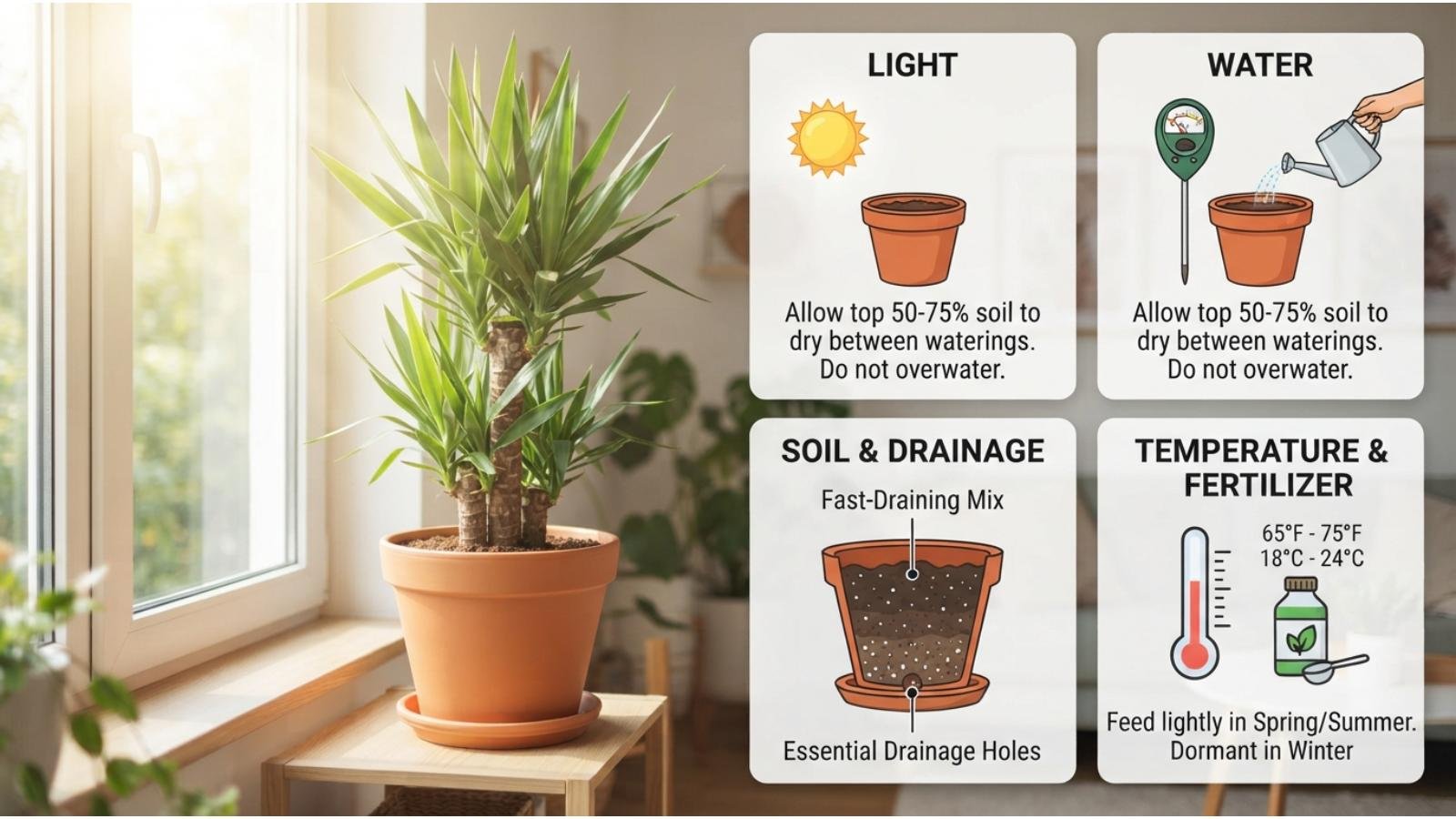
Yucca plant care is relatively simple because yuccas are drought-tolerant plants that prefer bright light, fast-draining soil, and infrequent watering. Let the soil dry substantially between waterings, avoid letting the roots sit in water, and provide good airflow. Indoor yuccas usually thrive near a bright window, while outdoor yuccas need well-drained soil and plenty of sunlight. Adjust watering seasonally and watch the leaves and soil for signs of stress.
Introduction
Yucca plants are popular because they combine a striking architectural appearance with surprisingly low maintenance. Their stiff, sword-shaped leaves and sturdy trunks can make a room, patio, or landscape look established with relatively little effort.
The biggest mistake with yucca plant care is treating a yucca like a typical leafy houseplant. Yuccas are adapted to dry conditions, so frequent watering and poorly draining soil can create more problems than underwatering. If your yucca has yellow leaves, a soft trunk, brown tips, or slow growth, the solution often starts with examining light, moisture, drainage, and seasonal changes rather than simply adding fertilizer.
The good news is that once you understand how a yucca uses water and light, its care routine becomes straightforward.
Understanding Yucca Plants
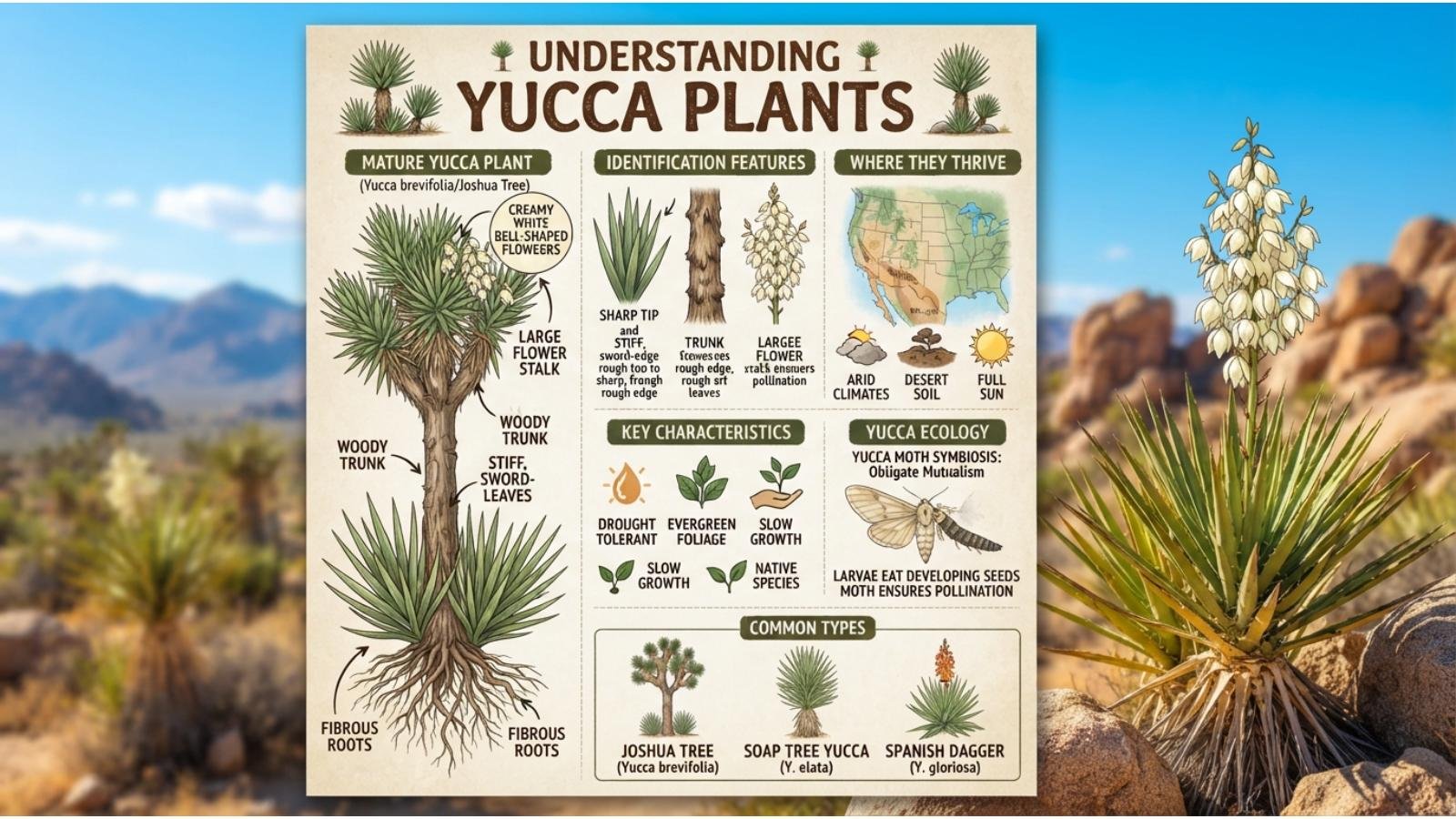
Yucca is a genus of drought-adapted plants native primarily to arid and semi-arid regions of North and Central America. Several species are grown as landscape plants, while others are commonly kept indoors.
Popular yuccas include:
- Yucca elephantipes, often sold as spineless yucca or giant yucca.
- Yucca filamentosa, commonly called Adam’s needle.
- Yucca gloriosa, a hardy landscape yucca.
- Yucca rostrata, valued for its blue-gray foliage and architectural form.
Not every yucca has identical cold tolerance or mature size. Before planting one outdoors, identify the species or cultivar because its hardiness and eventual dimensions can vary considerably.
Image Suggestion: Collage showing several common yucca species with labels.
Yucca Plant Care Requirements at a Glance
| Care factor | What yucca prefers | What to avoid |
|---|---|---|
| Light | Bright light, often several hours of direct sun | Very dark rooms |
| Soil | Fast-draining soil | Heavy, water-retentive soil |
| Water | Deep watering followed by substantial drying | Frequent small waterings |
| Humidity | Average household humidity is usually adequate | Constantly wet conditions |
| Temperature | Warm conditions with species-specific cold tolerance | Sudden severe temperature changes |
| Fertilizer | Light, occasional feeding during active growth | Heavy fertilization |
| Pot | Drainage hole essential | Decorative pots with trapped water |
| Airflow | Good circulation | Persistently stagnant, damp conditions |
The most important combination is strong light + excellent drainage + restrained watering.
How Much Light Does a Yucca Need?
Light is one of the most important factors in successful yucca plant care.
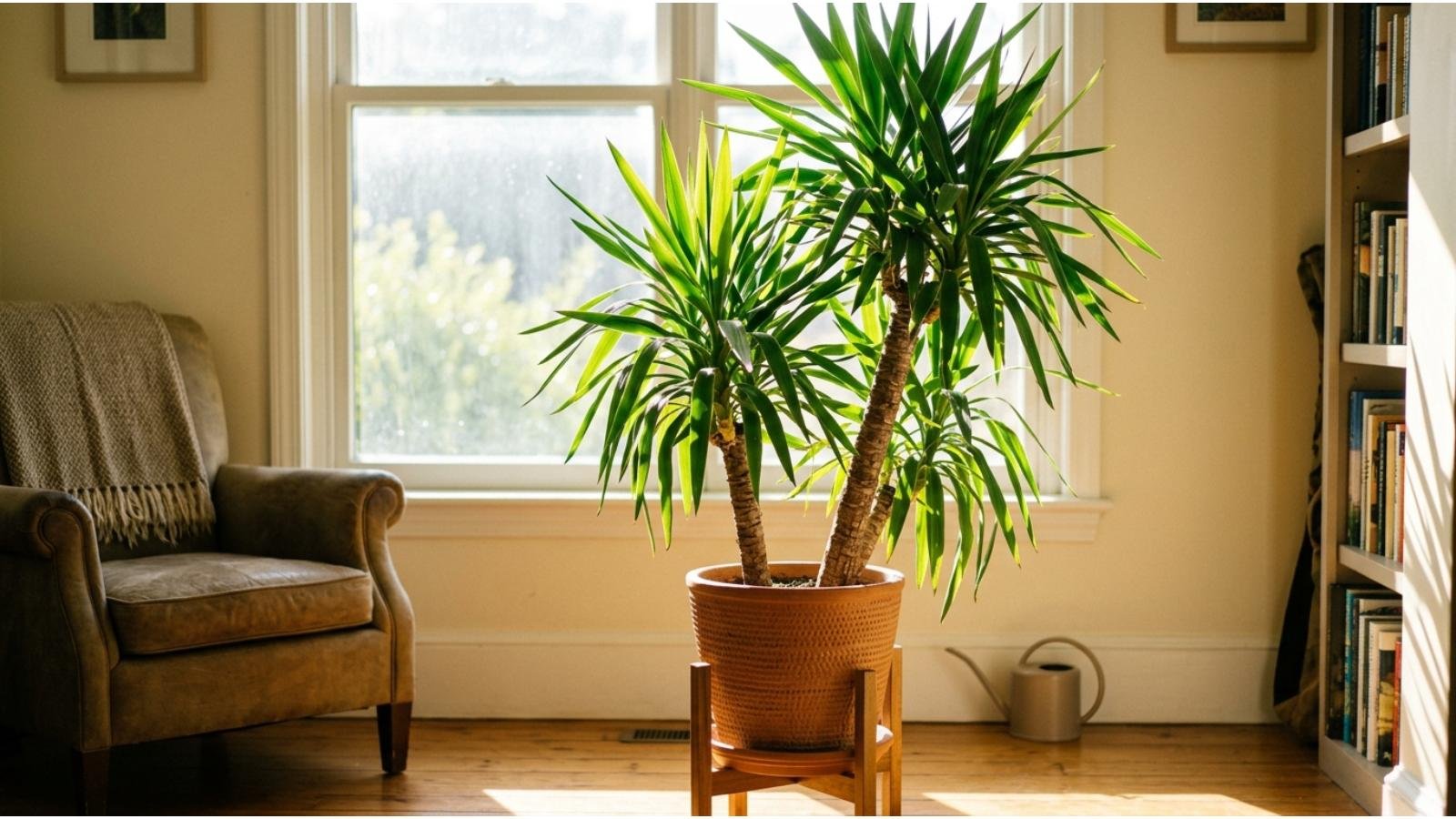
Indoor yuccas generally perform best in a bright location close to a sunny window. They can tolerate somewhat lower light for a period, but inadequate light may produce slower growth and weaker, less attractive foliage.
A plant that has been growing in a dim location should not necessarily be moved directly into intense outdoor sunlight. Sudden exposure can cause leaf scorch.
For indoor yuccas
A good location is usually:
- Near a bright south-, west-, or east-facing window.
- Several feet from very intense glass-filtered sunlight if the leaves show scorching.
- Away from consistently dark corners.
- Positioned where the plant receives consistent light throughout the day.
Rotate the pot occasionally if the plant leans strongly toward the window.
For outdoor yuccas
Many landscape yuccas prefer full sun or strong light. However, requirements vary by species and climate.
If moving an indoor yucca outdoors, acclimate it gradually. Start with bright indirect light or gentle morning sun, then increase exposure over several days or weeks.
Expert Tip: A yucca sitting in low light can dry more slowly than one receiving strong sunlight. Therefore, watering should be based on soil moisture rather than a fixed calendar.
Image Suggestion: Indoor yucca positioned beside a bright window versus a yucca kept in a dark corner.
How Often Should You Water a Yucca?
Yucca plants should generally be watered deeply and then allowed to dry considerably before watering again.
There is no universally correct schedule because watering frequency depends on:
- Pot size.
- Soil composition.
- Temperature.
- Light intensity.
- Humidity.
- Plant size.
- Season.
- Drainage.
During warm, bright growing conditions, a yucca may use water more quickly. During winter or periods of low light, the soil may remain wet for much longer.
The correct watering method
- Check the soil before watering.
- If the upper portion of the soil has dried substantially, prepare to water.
- Water thoroughly until excess moisture drains from the bottom.
- Empty any water collected in the saucer or outer container.
- Allow the soil to dry substantially before watering again.
Do not give a yucca a tiny splash of water every few days simply because the surface looks dry.
The goal is to moisten the root zone thoroughly while preventing prolonged saturation.
How do you know when a yucca needs water?
Check the soil with your finger or a moisture meter, but also consider the plant’s overall condition.
A thirsty yucca may develop:
- Drooping or curling foliage.
- Dry, crispy leaf edges.
- Very dry potting soil.
- Slower growth.
However, these symptoms can overlap with other problems, so do not diagnose watering problems from leaves alone.
Why Overwatering Is a Common Yucca Problem
Yuccas are drought-adapted plants, and their roots need access to oxygen. Soil that stays wet for too long can create unfavorable conditions around the roots and increase the risk of root problems.
Beginners sometimes respond to yellow leaves by adding more water. That can make the situation worse when excessive moisture is actually responsible.
Possible signs of excessive moisture
- Yellowing leaves.
- Soft or collapsing lower foliage.
- Soil that stays wet for many days.
- An unpleasant smell from the root zone.
- A soft trunk in severe cases.
- Root discoloration or decay when the plant is removed from its pot.
If you suspect overwatering, do not automatically increase the watering interval while leaving the plant in waterlogged soil. Check the drainage and root condition.
Expert Tip: The potting mix is often more important than the watering calendar. A yucca in fast-draining soil can be much easier to manage than a yucca planted in dense, moisture-retaining soil.
Best Soil for Yucca Plants
Yucca plants need soil that drains efficiently.
A suitable indoor mix should hold enough moisture to support the plant but release excess water quickly. A quality potting mix amended with materials that improve drainage can work well.
Useful components can include:
- Regular potting mix.
- Coarse perlite or pumice.
- Other appropriate drainage-improving materials.
Avoid compacted garden soil in indoor containers. It can become dense and restrict drainage.
Why drainage matters
When water drains quickly:
- Roots receive better airflow.
- Excess moisture leaves the root zone.
- Watering becomes easier to manage.
- The risk of prolonged saturation is reduced.
A drainage hole in the container is essential.
Image Suggestion: Diagram comparing well-draining yucca soil with compacted, waterlogged soil.
Choosing the Right Yucca Pot
The container should match the size of the root system rather than being dramatically larger than the existing pot.
An oversized pot can hold a large volume of unused soil, which may remain wet for a long time after watering.
Choose a container with:
- At least one effective drainage hole.
- Enough room for healthy root development.
- A stable base for tall varieties.
- A size appropriate for the plant’s current root system.
If your yucca is top-heavy, a heavier pot can improve stability.
Decorative cachepots can still be used, but make sure the nursery pot can drain freely and that water does not remain trapped inside the outer container.
Temperature and Humidity for Yucca
Most commonly grown indoor yuccas are comfortable in normal household temperatures.
Keep indoor plants away from:
- Very cold drafts.
- Heating vents.
- Air-conditioning blasts.
- Abrupt temperature changes.
Humidity usually does not need to be artificially increased for a typical indoor yucca.
This is another area where yuccas differ from tropical houseplants. Constant misting is generally unnecessary and does not compensate for poor drainage or inappropriate watering.
Outdoor yucca hardiness varies considerably by species. A landscape yucca that tolerates freezing temperatures may be very different from a tender species grown primarily as a houseplant.
Before leaving a potted yucca outdoors through winter, check the cold tolerance of its specific species or cultivar.
How to Fertilize a Yucca
Yuccas are not heavy feeders.
During active growth, a balanced fertilizer applied according to its label directions can support healthy development. Avoid excessive feeding because more fertilizer does not automatically mean faster or healthier growth.
A reasonable approach is:
- Feed during active growth when the plant is actively producing foliage.
- Follow the fertilizer’s dilution and frequency instructions.
- Reduce or stop routine feeding during periods of slow winter growth.
- Avoid fertilizing a severely stressed or recently repotted plant until it has recovered.
If the plant is already growing well in suitable soil and light, aggressive fertilization is rarely necessary.
Pruning Yucca Plants
Pruning can be useful for removing damaged foliage, controlling appearance, or managing certain mature indoor yuccas.
Remove damaged leaves
Use clean, sharp tools to remove:
- Completely dead leaves.
- Severely damaged foliage.
- Leaves that interfere with the plant’s appearance.
Avoid removing large amounts of healthy foliage unnecessarily.
Managing a tall indoor yucca
Some cane-forming yuccas can eventually become too tall for their indoor location. Established plants can sometimes be cut back, allowing new growth to develop from the remaining cane.
This is a more advanced technique, so make sure the plant is healthy before attempting major structural pruning.
Expert Tip: Do not confuse naturally brown older leaves with a rapidly declining plant. Yuccas can naturally shed older lower leaves as they grow.
Image Suggestion: Step-by-step illustration showing safe removal of dead yucca leaves.
How to Repot a Yucca
A yucca usually does not need frequent repotting.
Consider repotting when:
- Roots are emerging extensively from drainage holes.
- Water passes through unusually quickly because the root mass has become very dense.
- The plant has become unstable.
- The potting mix has deteriorated significantly.
- The current container no longer supports healthy growth.
Repotting steps
- Choose a container only moderately larger than the current one.
- Make sure it has drainage holes.
- Prepare a fast-draining potting mix.
- Remove the yucca carefully.
- Inspect the roots for obvious damage or decay.
- Place the plant at approximately the same depth.
- Fill around the root ball with fresh mix.
- Water appropriately and allow excess water to drain.
- Return the plant to a suitable light location.
Avoid burying the trunk deeper than it was previously planted.
Yucca Plant Care Indoors vs Outdoors
The basic principles remain the same, but the environment changes dramatically.
| Factor | Indoor Yucca | Outdoor Yucca |
|---|---|---|
| Light | Bright window light | Often full sun |
| Water loss | Usually slower | Often faster |
| Rain | None unless manually supplied | Natural rainfall may contribute |
| Soil | Container mix | Well-drained landscape soil |
| Temperature | More controlled | Species and climate dependent |
| Space | Limited by container | Can develop substantial size |
| Acclimation | Usually unnecessary | Important when moving outdoors |
An outdoor yucca may require surprisingly little supplemental water once established, especially in a climate with suitable rainfall.
However, newly planted yuccas need different care from mature, established specimens. Their root systems need time to become established.
Seasonal Yucca Plant Care
Spring
Spring is a good time to:
- Check whether repotting is needed.
- Resume active-growth fertilization if appropriate.
- Inspect for pests.
- Increase watering gradually as growth and light increase.
- Move plants outdoors gradually when temperatures permit.
Summer
During summer:
- Monitor soil moisture more frequently.
- Protect recently moved plants from sudden intense sunlight.
- Check drainage after heavy rainfall.
- Watch for pests.
- Avoid assuming every hot day requires watering.
Fall
As temperatures and daylight decrease:
- Reduce watering frequency according to soil drying.
- Stop routine fertilization as growth slows.
- Bring tender potted yuccas indoors before damaging cold.
- Inspect plants for insects before bringing them inside.
Winter
Winter is often the season when indoor yuccas are accidentally overwatered.
Lower light and cooler conditions can slow water use, so the soil may remain moist longer.
During winter:
- Water less frequently.
- Keep the plant in its brightest practical location.
- Avoid cold drafts.
- Do not fertilize heavily.
- Monitor the soil instead of following a summer watering schedule.
Common Yucca Problems and How to Fix Them
Yellow Leaves
Yellow leaves can have several causes, including natural aging, excessive moisture, poor drainage, or environmental stress.
What to check:
- Is the soil staying wet?
- Does the pot drain freely?
- Is the plant receiving enough light?
- Are only old lower leaves affected?
Do not automatically water more just because leaves are yellow.
Brown Leaf Tips
Brown tips may result from inconsistent watering, dry conditions, accumulated salts, excessive fertilizer, or environmental stress.
Start by checking the root-zone moisture and overall care routine rather than treating the leaf tip alone.
Soft Trunk
A soft or collapsing trunk is a serious warning sign, particularly when combined with persistently wet soil.
Check the root and trunk area for signs of decay and address drainage immediately.
Drooping Leaves
Drooping can occur from both underwatering and root problems caused by excessive moisture.
Check the soil before watering.
If the soil is extremely dry, watering may be appropriate. If it is wet and the plant is declining, adding more water is likely the wrong response.
Slow Growth
Slow growth is not automatically a problem.
Yuccas naturally grow more slowly under:
- Low light.
- Cool conditions.
- Winter conditions.
- Limited root space.
- Poor nutrition.
If the plant looks healthy but grows slowly, avoid trying to force growth with excessive fertilizer.
Leaning Plant
A yucca may lean toward its strongest light source.
Try rotating the container periodically and improving light exposure. For tall plants, also check whether the pot is stable enough.
Yucca Plant Pests
Yucca plants can occasionally experience common houseplant pests such as:
- Scale insects.
- Mealybugs.
- Spider mites.
- Aphids.
Inspect the undersides of leaves, leaf bases, and stems when bringing plants indoors or whenever growth appears abnormal.
Early detection is much easier to manage than a large infestation.
If pests are present, identify the insect before selecting a treatment. Follow the product label carefully, especially when using horticultural soaps or oils.
Image Suggestion: Close-up diagram showing common yucca pest locations around leaves and stems.
Can You Grow Yucca From Cuttings?
Some yuccas, particularly cane-forming types, can be propagated from stem sections or offsets depending on the species.
Propagation is more successful when the material is healthy and conditions encourage rooting without keeping the medium excessively wet.
For beginners, propagation from established offsets can be simpler when the particular yucca naturally produces them.
Avoid treating every yucca species identically because propagation methods vary.
How to Make a Yucca Healthier
If your yucca looks weak, work through the fundamentals before adding complicated treatments.
Use this troubleshooting sequence
1. Check the light.
Is the plant receiving enough bright light?
2. Check the soil.
Is it dry, appropriately moist, or staying wet?
3. Check drainage.
Does excess water actually leave the container?
4. Inspect the roots and stem.
Look for signs of decay if the plant is declining despite reasonable care.
5. Check for pests.
Look closely around leaf bases and undersides.
6. Review recent changes.
Did you move the plant, repot it, increase watering, or expose it to intense sunlight?
7. Correct one major problem at a time.
Avoid changing light, water, fertilizer, soil, and temperature simultaneously because it becomes difficult to determine what helped.
This diagnostic approach is usually more effective than applying a quick fix based on a single symptom.
Common Yucca Care Mistakes
Watering on a fixed schedule
A calendar cannot account for seasonal changes, room temperature, sunlight, or pot size.
Better approach: Check the soil and environmental conditions.
Keeping the soil constantly moist
Yuccas are not bog plants.
Better approach: Use a fast-draining mix and allow substantial drying between waterings.
Putting a yucca in a dark corner
A plant may survive there but fail to maintain vigorous, attractive growth.
Better approach: Give it a brighter location.
Using a huge decorative pot
Extra soil can retain moisture around the roots.
Better approach: Choose an appropriately sized pot with drainage.
Fertilizing heavily
More fertilizer can damage roots and create salt buildup.
Better approach: Feed lightly and only when the plant is actively growing.
Moving directly from indoors to intense outdoor sun
Leaves adapted to indoor light can scorch after sudden exposure to strong sunlight.
Better approach: Acclimate gradually.
A Simple Yucca Care Routine
If you want a straightforward routine, use this checklist:
Weekly
- Inspect leaves and stems.
- Check soil moisture.
- Look for pests.
- Check that the plant is receiving adequate light.
Monthly
- Rotate indoor plants if necessary.
- Inspect drainage holes.
- Remove dead foliage.
- Look for signs of salt buildup or deteriorating soil.
Seasonally
- Adjust watering.
- Review fertilizer needs.
- Check temperature exposure.
- Reassess whether the plant needs repotting or pruning.
The important point is not to perform every task every week. Observe the plant first, then respond to what it actually needs.
Frequently Asked Questions About Yucca Plant Care
How often should I water a yucca plant?
Water when the soil has dried substantially rather than following a fixed schedule. Indoor yuccas may need watering more often during bright, warm growth periods and much less often during winter.
Does yucca need full sun?
Many yucca species prefer strong sunlight, especially outdoors. Indoor yuccas generally do best in bright light, and some can tolerate several hours of direct sun. Acclimate plants gradually when moving them from low light to intense sunlight.
Why are my yucca leaves turning yellow?
Yellow leaves may be caused by natural aging, excessive moisture, poor drainage, or environmental stress. Check the soil and drainage before increasing watering.
Can yucca plants grow indoors?
Yes. Several yucca species and cultivars are commonly grown indoors. Give them bright light, well-draining soil, and careful watering.
Should I mist my yucca plant?
Usually, misting is unnecessary. Yuccas generally tolerate normal indoor humidity, and misting does not solve problems caused by overwatering or poor drainage.
Why are the tips of my yucca leaves turning brown?
Brown tips can have several causes, including inconsistent moisture, dry conditions, fertilizer or salt buildup, and environmental stress. Examine the entire care routine rather than assuming the plant simply needs more water.
Can I cut the top off a yucca?
Some cane-forming yuccas can be cut back and may produce new growth. Major pruning is best performed on a healthy, established plant using clean tools.
Is yucca drought tolerant?
Yes. Many yucca species are adapted to dry environments and are highly drought tolerant once established. Newly planted outdoor yuccas still need appropriate establishment watering.
Can a yucca survive in low light?
A yucca may tolerate lower light temporarily, but consistently low light is not ideal for vigorous growth. Move it toward a brighter location when possible.
Do yucca plants need fertilizer?
They can benefit from modest feeding during active growth, but they are not heavy feeders. Excessive fertilizer can create problems rather than improving growth.
How do I know if my yucca is overwatered?
Persistent wet soil, yellowing foliage, soft plant tissue, unpleasant-smelling soil, and root deterioration can indicate excessive moisture. Check drainage and the root zone rather than simply reducing watering without investigating the cause.
Can yucca grow outside?
Yes. Many yuccas are excellent outdoor landscape plants. However, cold tolerance varies by species, so identify the plant before exposing it to freezing temperatures.
Related Plant Care Topics
Readers learning yucca plant care may also benefit from guides covering:
- Snake plant care.
- Aloe vera plant care.
- Jade plant care.
- Pothos plant care.
- Spider plant care.
- Bird of paradise plant care.
- Mandevilla plant care.
- Indoor palm plant care.
- Outdoor plant care.
These plants have different watering and light requirements, so avoid applying a yucca’s drought-focused routine to every houseplant.
Final Thoughts on Yucca Plant Care
Successful yucca plant care comes down to understanding what the plant is adapted to do. Yuccas generally prefer bright light, excellent drainage, thorough but infrequent watering, and relatively little fertilizer.
The most useful habit is to stop watering by calendar and start observing the plant and its soil. A yucca in bright light and fast-draining soil may need very different care from one sitting in a cool, dim room.
If your yucca is struggling, start with the fundamentals: light, soil, drainage, moisture, temperature, and pests. Correcting those conditions is usually more effective than trying to rescue the plant with extra fertilizer or frequent watering.