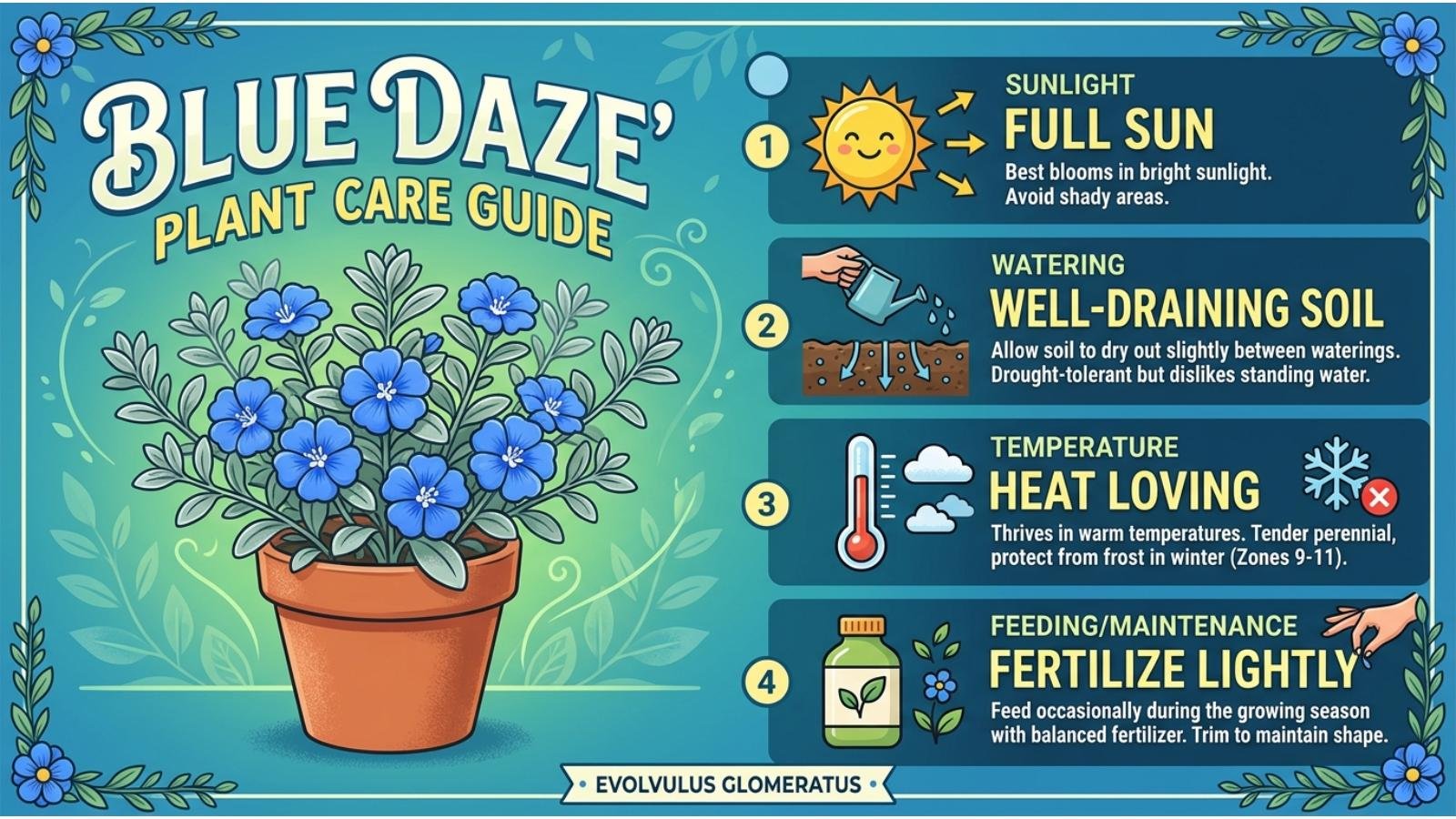
Blue daze plant care is relatively simple when you get three things right: sunlight, drainage, and watering. This low-growing plant is prized for its vivid blue flowers and soft, silvery-green foliage, making it especially attractive in containers, hanging baskets, borders, and sunny ground-cover plantings.
The plant is Evolvulus glomeratus, sometimes called Brazilian dwarf morning glory or dwarf morning glory. Despite the name, it is not a twining vine like traditional morning glory. It forms a spreading or cascading mound and can reach roughly 9 to 18 inches tall while spreading several feet under favorable conditions.
The most common care mistake is treating Blue Daze as a plant that needs constant watering simply because it flowers heavily. It actually prefers moisture that is consistent but not excessive, with excellent drainage.


Image Suggestion: A labeled photograph showing healthy Blue Daze with blue flowers, fuzzy foliage, and its spreading growth habit.
What Is Blue Daze
Blue Daze is a tender, non-vining perennial in the morning-glory family, Convolvulaceae. Its botanical name is Evolvulus glomeratus. The plant originates from tropical and subtropical regions of South America and is commonly treated as an annual in climates where winter temperatures are too cold.
Its appeal comes from the combination of:
- Bright sky-blue, funnel-shaped flowers.
- Soft gray-green foliage covered with fine hairs.
- A low, spreading growth habit.
- Excellent performance during hot weather.
- Suitability for containers and hanging baskets.
- A long flowering season in favorable conditions.
Individual flowers are short-lived, often opening during the day and closing at night or during cloudy weather. The plant compensates by producing new flowers regularly.
Blue Daze Sunlight Requirements
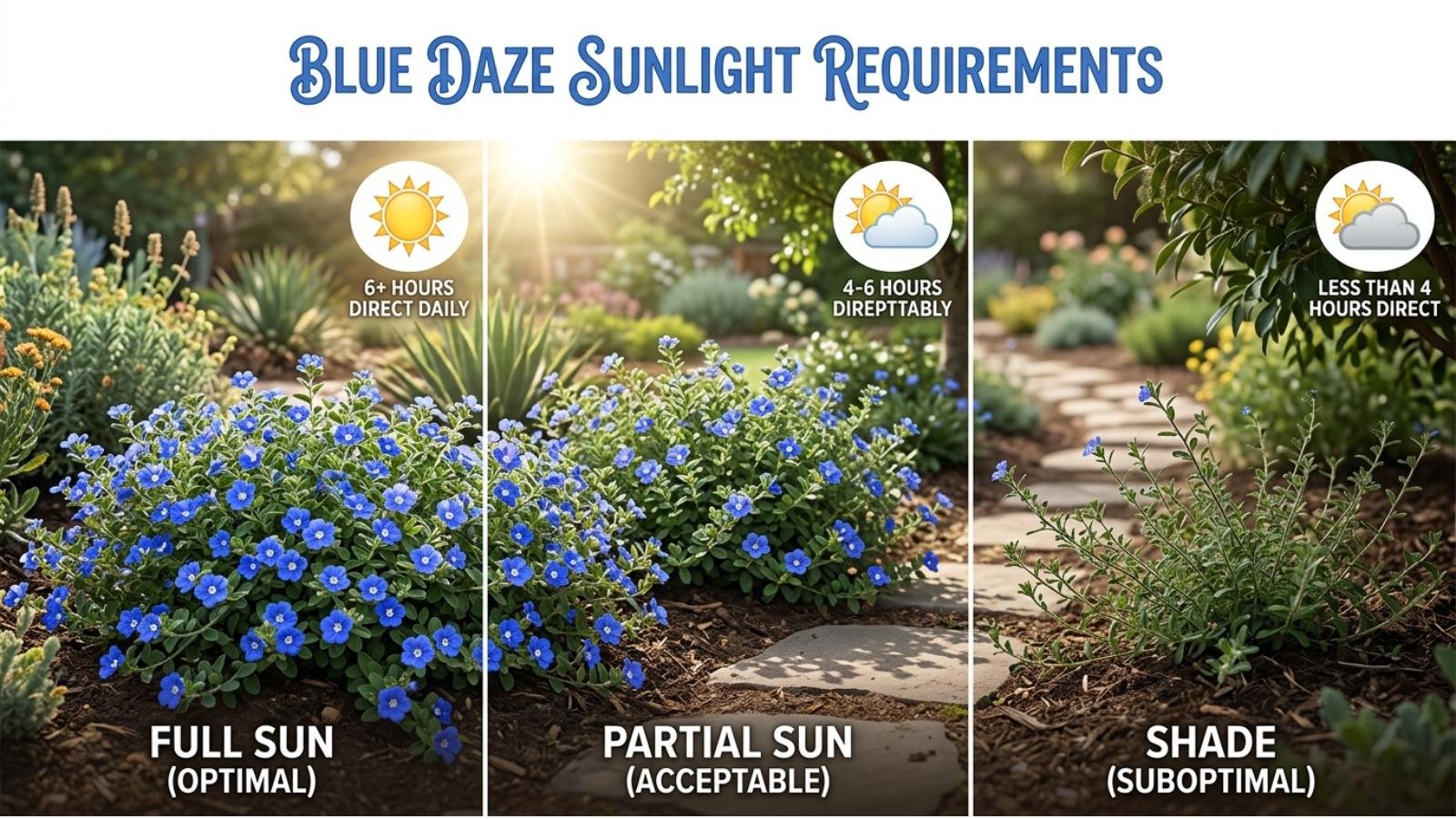
Blue Daze performs best in full sun, generally meaning at least six hours of direct sunlight daily. Strong light encourages compact growth and abundant flowering.
A plant receiving too little light may become:
- Leggy.
- Less compact.
- Less floriferous.
- More sprawling.
- Less attractive in foliage color.
A little afternoon protection can be useful in exceptionally hot locations, particularly where reflected heat from walls or paving becomes intense. However, excessive shade usually comes at the cost of flowers. Mississippi State University Extension notes that too much shade reduces flowering, while some afternoon shade can help in very hot exposures.
Practical tip: If your Blue Daze is producing plenty of leaves but surprisingly few flowers, check sunlight before immediately adding fertilizer.
Best Soil for Blue Daze
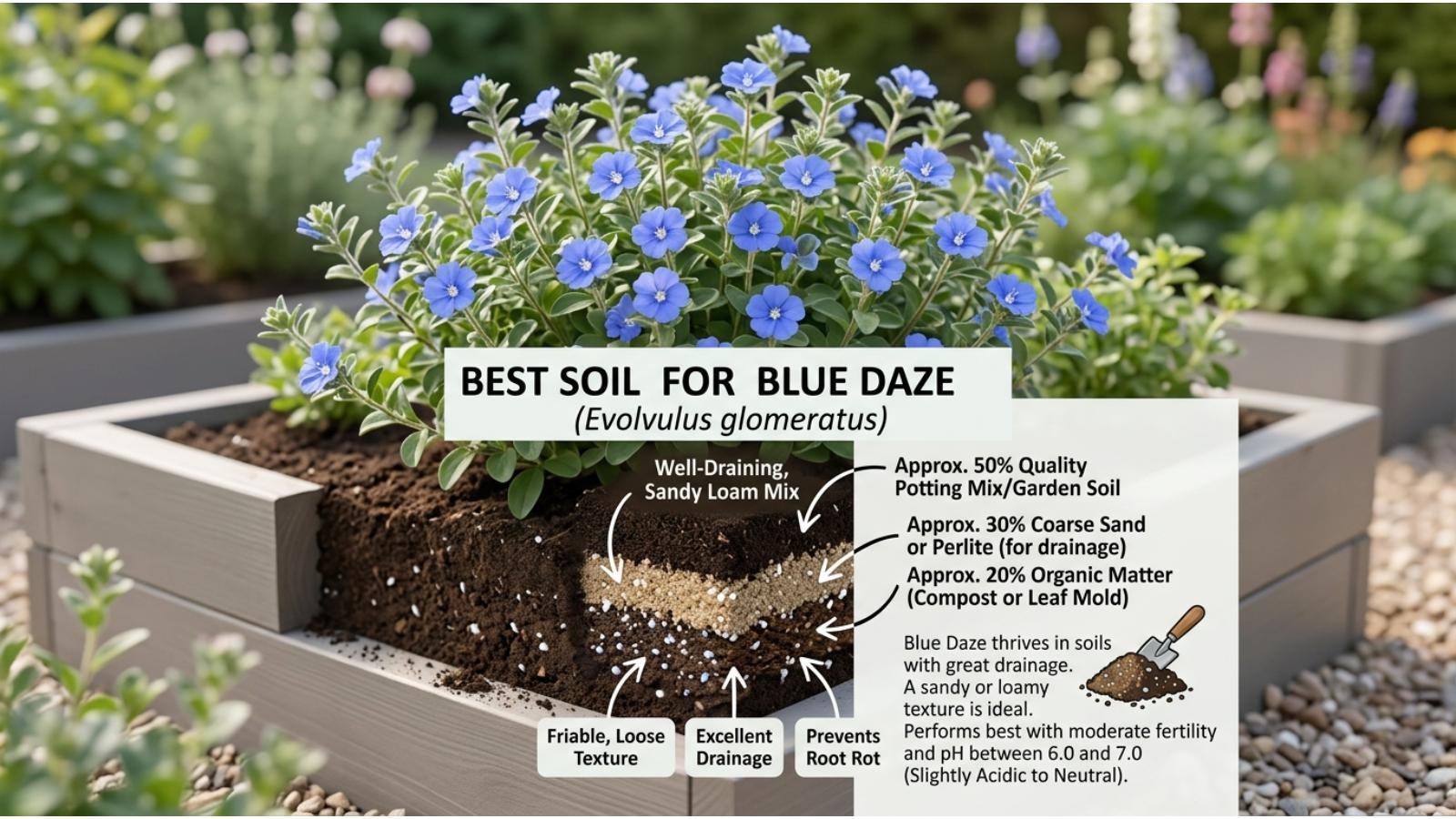
The ideal soil is well drained and reasonably fertile, with enough organic matter to support healthy growth without holding excessive water.
Blue Daze can tolerate different soil conditions, but poor drainage is a serious concern. Extension guidance specifically recommends well-drained soil because prolonged wetness can contribute to fungal and root problems.
For containers, a quality commercial potting mix is generally preferable to heavy garden soil.
A useful container mix should:
- Drain freely after watering.
- Retain enough moisture for the roots.
- Contain organic material.
- Avoid becoming compacted.
- Allow air to reach the root zone.
If water remains around the roots for long periods, improving drainage is more important than simply reducing fertilizer.
How to Water Blue Daze
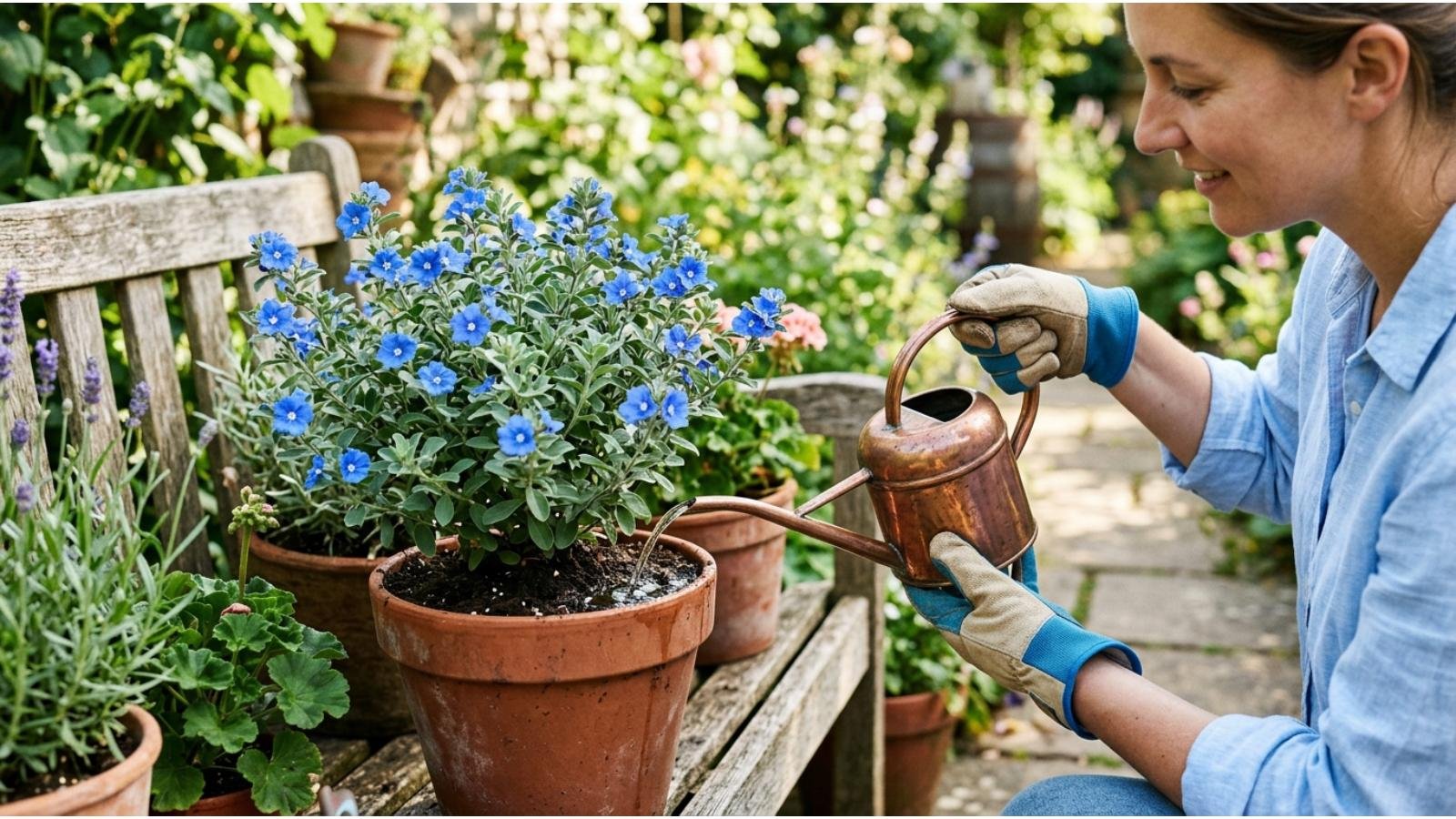
Blue Daze prefers moderate and consistent moisture while actively growing, but it does not appreciate constantly saturated soil.
Water deeply enough to moisten the root zone, then allow the upper portion of the soil to begin drying before watering again.
During hot weather, container-grown plants may require more frequent watering because containers dry considerably faster than garden beds.
Watch the plant rather than following a rigid calendar.
Signs that it may need water include:
- Wilted foliage.
- Dry soil around the root zone.
- Reduced flowering.
- A generally tired appearance during hot weather.
Established plants have useful drought tolerance, but drought tolerance does not mean they perform best when permanently neglected.
Avoid the Most Common Watering Mistake
Overwatering is often more damaging than allowing the plant to become slightly dry between irrigations.
If the soil remains wet for days, roots can struggle and fungal problems become more likely. UF/IFAS guidance specifically emphasizes good drainage and appropriate spacing to reduce disease pressure.
A simple rule: water the soil, not the calendar.
How to Fertilize Blue Daze
Blue Daze does not require an aggressive feeding program.
A balanced fertilizer used during active growth can support foliage and flowering, particularly when the plant is growing in a container where nutrients are gradually lost through watering.
Avoid assuming that more fertilizer means more flowers. Excessive feeding can encourage soft vegetative growth without solving problems caused by inadequate sunlight or poor drainage.
For container plants, follow the fertilizer manufacturer’s recommended dilution and frequency rather than creating a stronger mixture.
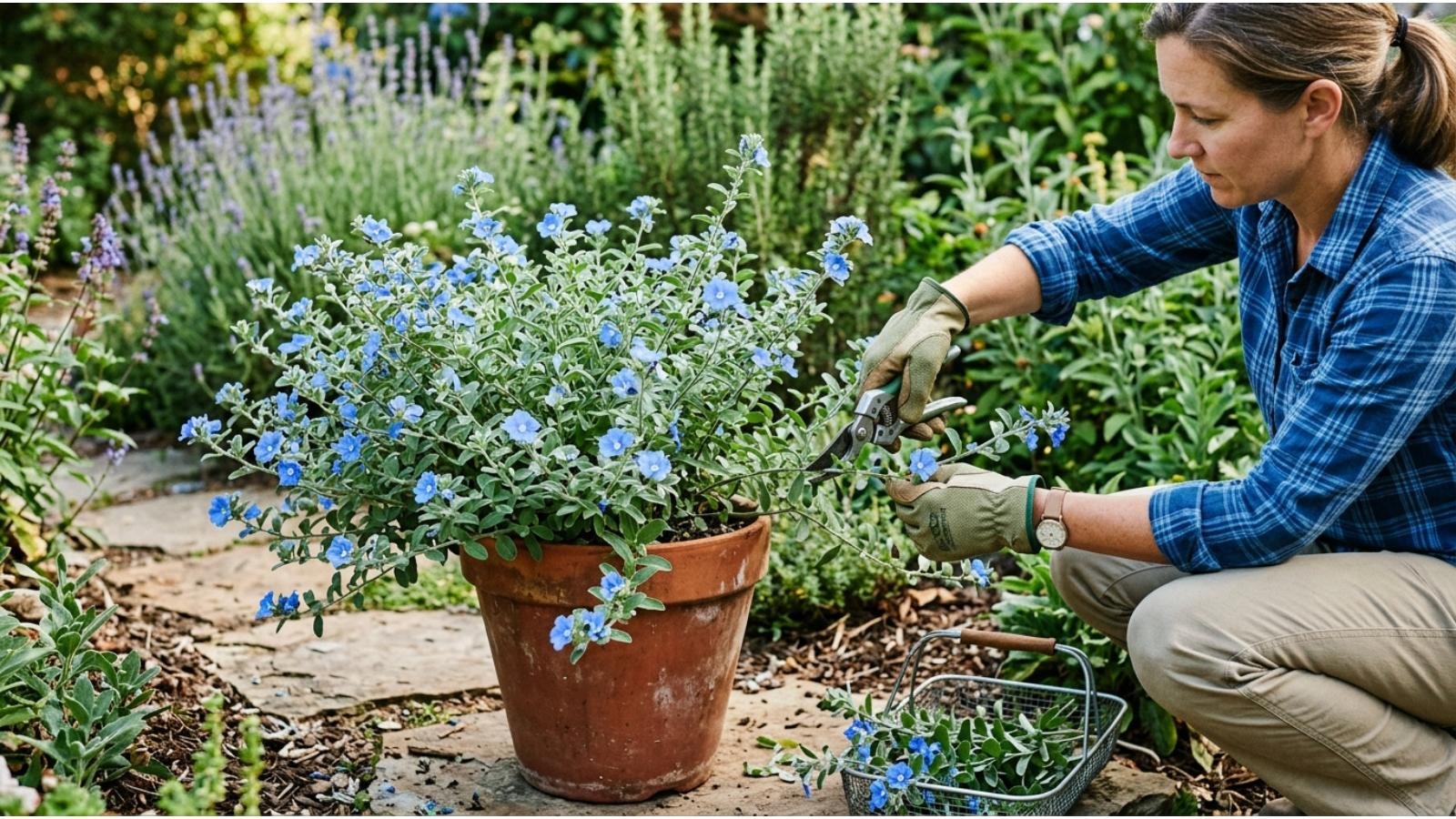
Pruning Blue Daze
Pruning is mainly useful for maintaining a compact, attractive shape.
Blue Daze naturally develops a spreading or trailing habit, so some sprawling is normal. In hanging baskets, that habit is actually an advantage.
If stems become excessively long or untidy:
- Pinch growing tips to encourage branching.
- Trim damaged or weak growth.
- Remove unattractive sections when necessary.
- Use clean pruning tools.
Regular shaping can be particularly helpful when growing Blue Daze in containers or along the front of a flower bed.
Mississippi State Extension also notes that Blue Daze has a low-growing habit and produces flowers toward the shoot tips.
Does Blue Daze Need Deadheading
Usually, Blue Daze does not require intensive deadheading to remain attractive.
Its flowers are short-lived, closing at night and on cloudy days, while replacement flowers continue to appear.
If you prefer an exceptionally tidy display, you can remove visibly spent flowers or damaged growth, but don’t confuse a closed flower with a dead flower. A bloom that closes in the evening may simply be following its normal daily cycle.
This is one reason Blue Daze can look different from morning to afternoon without anything being wrong.
Growing Blue Daze in Containers
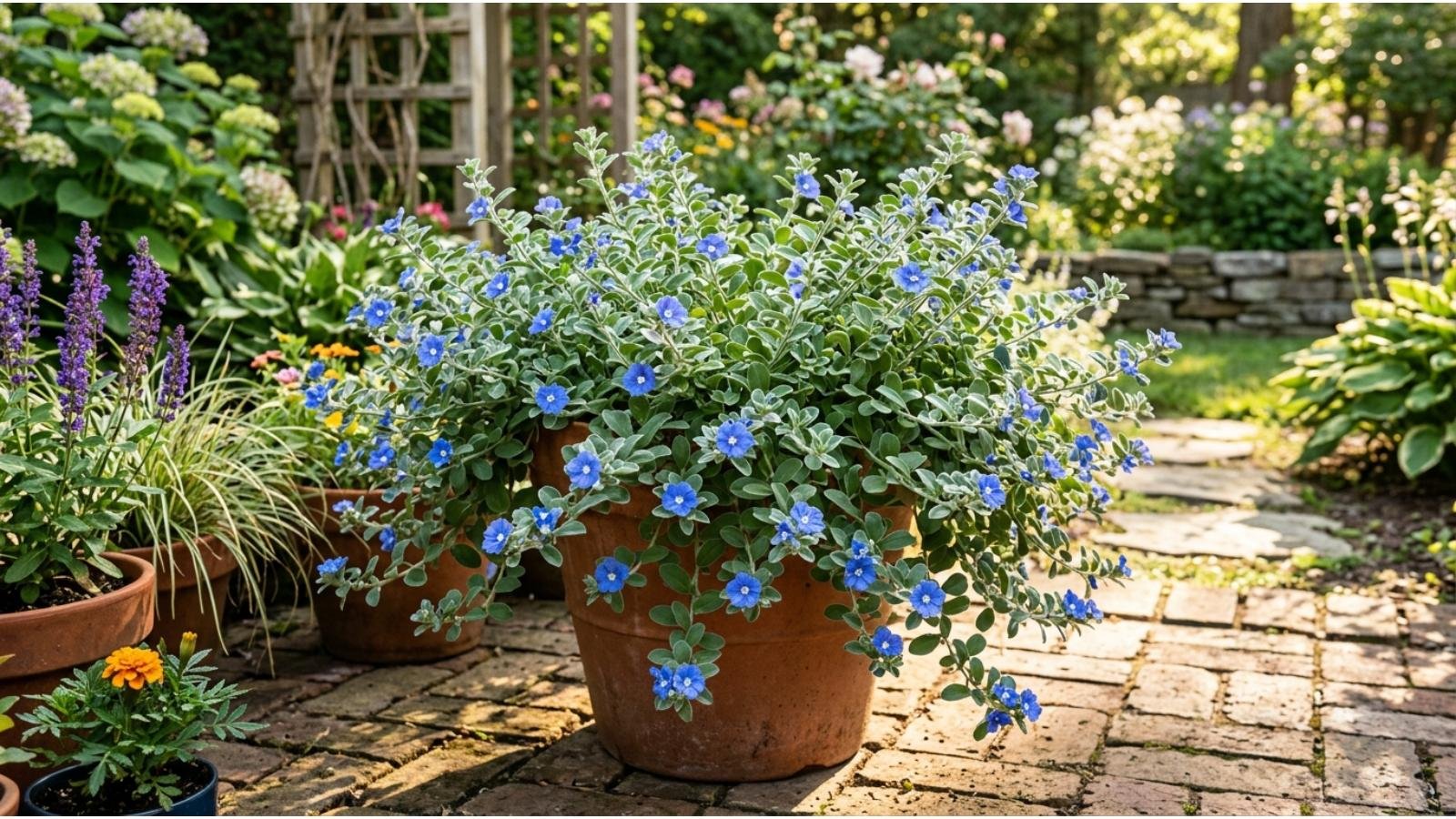
Blue Daze is particularly well suited to containers and hanging baskets because its stems naturally trail outward and downward. (Plant Toolbox)
Choose a container with drainage holes and position it somewhere with plenty of direct sunlight.
Container care differs from garden-bed care because the root zone can dry quickly.
Check containers more frequently during:
- Heat waves.
- Dry, windy weather.
- Periods of rapid growth.
- Peak summer flowering.
At the same time, don’t compensate for fast drying by keeping the soil permanently wet.


Image Suggestion: Side-by-side container and hanging-basket examples showing how Blue Daze naturally cascades over the edges.
Blue Daze in the Garden
In garden beds, Blue Daze works particularly well as a low-growing border plant, ground cover, or cascading plant near walls and raised beds.
North Carolina Extension recommends spacing plants approximately 12 inches to 3 feet apart depending on the intended planting arrangement and notes that the plant can form mounds around 9 to 18 inches tall and approximately 2 to 3 feet wide.
For mass planting, UF/IFAS recommends approximately 18 to 24 inches between plants, allowing room for spreading and helping maintain airflow.
Good locations include:
- Sunny flower borders.
- Rock gardens.
- Raised beds.
- Hanging baskets.
- Patio containers.
- Along retaining walls.
- Warm, well-drained landscape areas.
Blue Daze Temperature and Winter Care
Cold is one of the biggest limitations of Blue Daze.
Although it can behave as a perennial in suitable warm climates, it is commonly grown as an annual in colder regions. North Carolina Extension lists hardiness zones 8a through 11b, while other extension resources describe it as a tender plant that may not survive cold winters reliably.
If you live somewhere with freezing winter temperatures, you have two practical options.
Treat It as an Annual
This is often the easiest approach. Enjoy the plant through the warm season and replace it when cold weather finishes it.
Take Cuttings
Healthy plants can be propagated from stem cuttings. Extension guidance recommends taking cuttings before the plant is damaged by cold and keeping them in a bright, cool location with restrained watering during winter.
This approach is useful if you want to preserve a particularly vigorous plant for the next growing season.
How to Propagate Blue Daze From Cuttings
Stem cuttings are a practical way to propagate Blue Daze.
Start with healthy, non-flowering stems and place the cuttings into a suitable moist rooting medium. Keep them in bright light while avoiding harsh environmental stress.
The basic process is:
- Select healthy stems.
- Take several-inch cuttings.
- Remove lower leaves.
- Place the cuttings into a moist, well-draining propagation medium.
- Keep the medium lightly moist.
- Provide bright light without excessive heat.
- Wait for roots to develop before transplanting.
North Carolina Extension identifies stem cuttings as a recommended propagation method, while Arkansas Extension also recommends cuttings as a strategy for preserving Blue Daze through winter.
Common Blue Daze Problems
Blue Daze is generally considered a low-maintenance plant and does not have a reputation for serious pest problems. However, environmental problems can still affect its appearance.
Blue Daze Is Not Flowering
The first thing to investigate is sunlight.
Move container plants to a brighter location if they are receiving insufficient direct light. Too much shade can reduce flowering.
Also check:
- Excessive nitrogen fertilizer.
- Poor drainage.
- Severe drought.
- Recent transplant stress.
- Extreme weather.
Blue Daze Is Wilting
Wilting can simply indicate that the plant needs water, particularly during hot weather.
Check the soil before watering. If it is dry, water thoroughly. If it is already saturated, adding more water can make the situation worse.
Established Blue Daze can recover from drought stress, but repeated severe drying can reduce flowering and overall appearance.
Leaves Are Turning Yellow
Yellowing leaves can have several causes, so avoid automatically assuming that fertilizer deficiency is responsible.
Check the roots and soil first.
If the soil is consistently wet, drainage may be the real problem. If the soil is excessively dry, drought stress may be responsible.
Blue Daze Looks Leggy
Leggy growth commonly indicates insufficient light or a need for shaping.
Increase sunlight when possible and pinch back long stems to encourage a fuller form.
Blue Daze Has Fungal Problems
Excess moisture, poor drainage, crowded planting, and prolonged wet foliage can increase disease pressure.
UF/IFAS specifically recommends well-drained soil and adequate spacing to improve air circulation and reduce fungal problems.


Image Suggestion: A troubleshooting infographic comparing healthy Blue Daze with drought-stressed and poorly drained plants.
Blue Daze Care Mistakes to Avoid
Some problems can be prevented before they start.
Planting in heavy, poorly drained soil. Blue Daze benefits from drainage, and wet roots can contribute to fungal problems.
Growing it in deep shade. The plant is a sun lover and flowering decreases when light is inadequate.
Watering automatically every day. Soil moisture should determine watering rather than a fixed routine.
Overfertilizing. More fertilizer cannot compensate for insufficient sunlight.
Ignoring winter temperatures. A plant that thrives during a hot summer may still fail when exposed to freezing weather.
Planting too closely. Adequate spacing improves airflow and reduces disease risk.
Blue Daze Seasonal Care
Spring
Spring is a good time to establish new plants after the danger of damaging cold has passed.
Give newly planted Blue Daze consistent moisture while roots establish, then gradually rely more on the plant’s natural drought tolerance.
Summer
Summer is typically when Blue Daze shines.
Provide abundant sunlight, monitor soil moisture, and pay particular attention to container plants during extreme heat.
Fall
In warm climates, plants can continue flowering well into the season. In colder regions, consider taking cuttings before frost threatens.
Winter
In frost-prone regions, Blue Daze is usually better treated as an annual or protected indoors as a cutting or container plant.
Do not keep overwintering plants excessively wet. Arkansas Extension specifically recommends restrained watering for plants being maintained indoors during winter.
Is Blue Daze Good for Pollinators
Blue Daze can contribute to pollinator-friendly gardens. UF/IFAS lists it as particularly attractive to a diversity of bees.
Its flowers also provide a valuable splash of blue that can complement plants with yellow, white, pink, or purple flowers.
For a stronger pollinator planting, combine Blue Daze with other regionally appropriate flowering plants that provide resources across different parts of the growing season.
Blue Daze vs Blue My Mind
Blue Daze and Blue My Mind are closely related and are often discussed together.
Both belong to Evolvulus and share the characteristic blue flowers and soft foliage. Extension sources describe Blue My Mind as an improved cultivar that produces relatively large, showy blue flowers.
For home gardeners, the important point is that basic growing conditions are similar: plenty of sunlight, good drainage, and appropriate moisture.
When purchasing, check the plant label because cultivars can differ in flower size, growth habit, and performance.
Frequently Asked Questions
How much sun does Blue Daze need
Blue Daze performs best with full sun and approximately six or more hours of direct sunlight each day. Less light can result in fewer flowers and weaker growth.
How often should I water Blue Daze
Water when the soil begins to dry rather than following a rigid schedule. Maintain moderate moisture during active growth while avoiding constantly saturated soil.
Can Blue Daze grow in pots
Yes. Blue Daze performs very well in containers and hanging baskets because its stems naturally spread and cascade.
Is Blue Daze a perennial or annual
It can be a perennial in sufficiently warm climates but is commonly grown as an annual in colder regions because it is not reliably cold hardy.
Does Blue Daze come back every year
In warm climates it may return, while freezing temperatures can kill it. Gardeners in colder regions can grow it as an annual or propagate cuttings for the following season.
Why do Blue Daze flowers close
The flowers naturally close at night and during cloudy weather. This is normal behavior and does not necessarily indicate stress.
Should I deadhead Blue Daze
Deadheading is generally not essential. The plant continuously produces new flowers, and its individual blooms naturally last for a short period.
Can Blue Daze tolerate drought
Yes. Established Blue Daze has useful drought tolerance, although consistent moisture during active growth can support stronger performance and flowering. (Plant Toolbox)
What soil does Blue Daze prefer
Use soil that drains well and contains reasonable organic matter. Avoid locations where water remains around the roots for extended periods.
Is Blue Daze easy to grow
Yes. It is considered a relatively low-maintenance plant when grown in suitable conditions, especially when it receives sufficient sunlight and good drainage.
Conclusion
Successful blue daze plant care comes down to a surprisingly short list of priorities: give the plant plenty of sunlight, use well-draining soil, maintain reasonable moisture without waterlogging the roots, and protect it from damaging cold.
If your Blue Daze is struggling, start with the growing conditions before reaching for fertilizer or complicated treatments. In many cases, insufficient light, excessive moisture, or poor drainage explains more than anything else.
Once those fundamentals are right, Blue Daze can reward you with a long display of vivid blue flowers and attractive silvery-green foliage while requiring relatively little maintenance.