Quick Answer
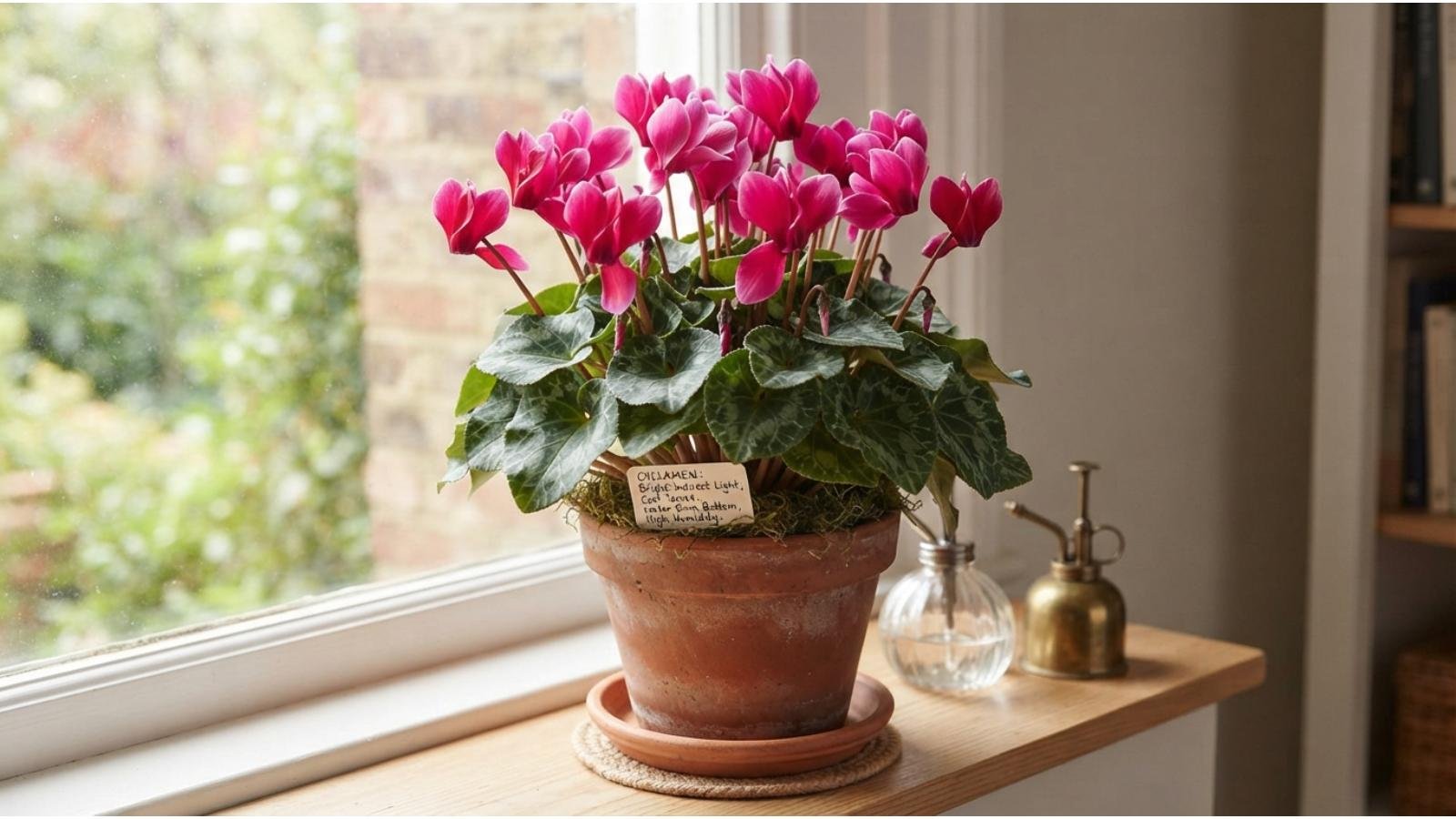
Cyclamen plant care indoors is mainly about providing bright, indirect light, cool temperatures, well-draining soil, and careful watering. Keep the soil lightly moist while the plant is actively growing, but avoid wetting the crown or tuber. Bottom watering is especially useful. Cyclamen prefers cooler rooms rather than hot, dry conditions. After flowering, it may naturally enter dormancy, during which watering should be greatly reduced.
Introduction
Cyclamen is one of those houseplants that can look almost effortless in a garden-center display—compact foliage, attractive silver markings, and flowers rising above the leaves like little butterflies. Keeping it healthy indoors, however, requires a slightly different approach from many common tropical houseplants.
The biggest mistake is treating cyclamen like a typical foliage plant. Cyclamen persicum, the Persian cyclamen commonly sold as an indoor flowering plant, prefers cool conditions, bright filtered light, and controlled moisture. Its underground tuber also makes excessive watering particularly risky.
Once you understand its growth cycle, cyclamen becomes much easier to manage. The goal isn’t to keep the compost constantly wet or to force flowers year-round. Instead, you want to match watering, temperature, light, and feeding to the plant’s active-growth and dormant periods.
Understanding Cyclamen Before You Start
The cyclamen commonly sold for indoor use is usually Cyclamen persicum, a tuberous perennial in the Primulaceae family. It has heart-shaped, often marbled leaves and flowers in shades including white, pink, purple, and red.
Unlike many houseplants, cyclamen has a pronounced seasonal rhythm.
During active growth, it produces foliage and flowers and needs regular—but controlled—moisture. After flowering, foliage may yellow and die back as the plant enters dormancy. This is not necessarily a sign that the plant is dying.
That distinction is important because one of the most common beginner mistakes is responding to yellowing leaves by adding more water. With cyclamen, that can make the problem worse.
Image Suggestion: Close-up botanical illustration showing cyclamen leaves, flowers, stems, and the underground tuber.
The Ideal Indoor Conditions for Cyclamen
| Care factor | Best indoor approach |
|---|---|
| Light | Bright, filtered or indirect light |
| Temperature | Cool conditions; around 13–16°C minimum in winter is recommended by RHS |
| Soil | Moisture-retentive but well-drained |
| Water | Moderate during active growth |
| Watering method | Bottom watering is a useful option |
| Humidity | Moderate humidity; avoid hot, dry air |
| Fertilizer | Low-nitrogen liquid feed during active growth |
| Dormancy | Reduce watering substantially |
| Tuber’s position | Keep the top of the tuber above the compost |
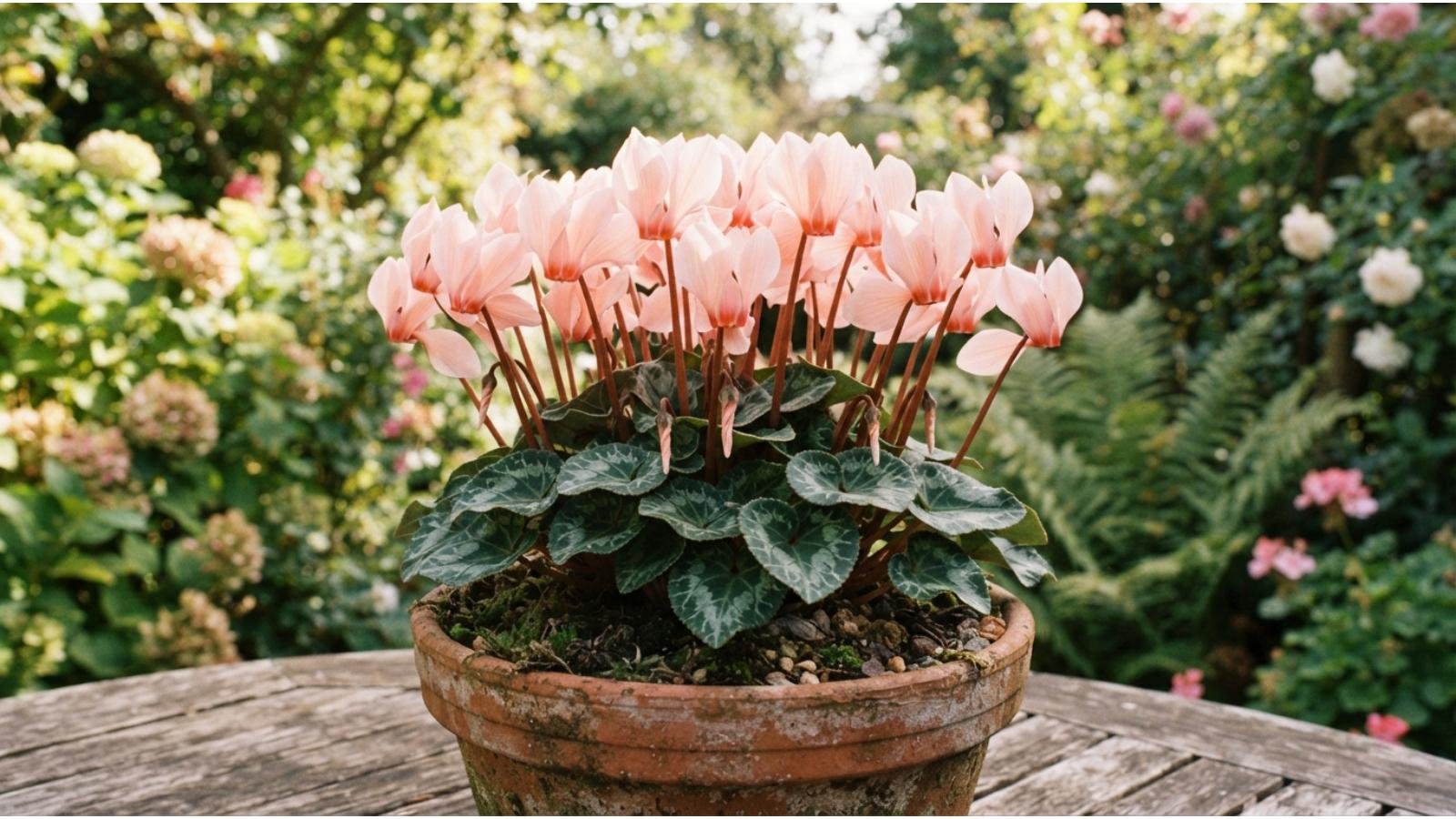
The bright filtered light, moderate humidity, well-drained compost, and a winter minimum of approximately 13–16°C for indoor cultivation.
How Much Light Does an Indoor Cyclamen Need?
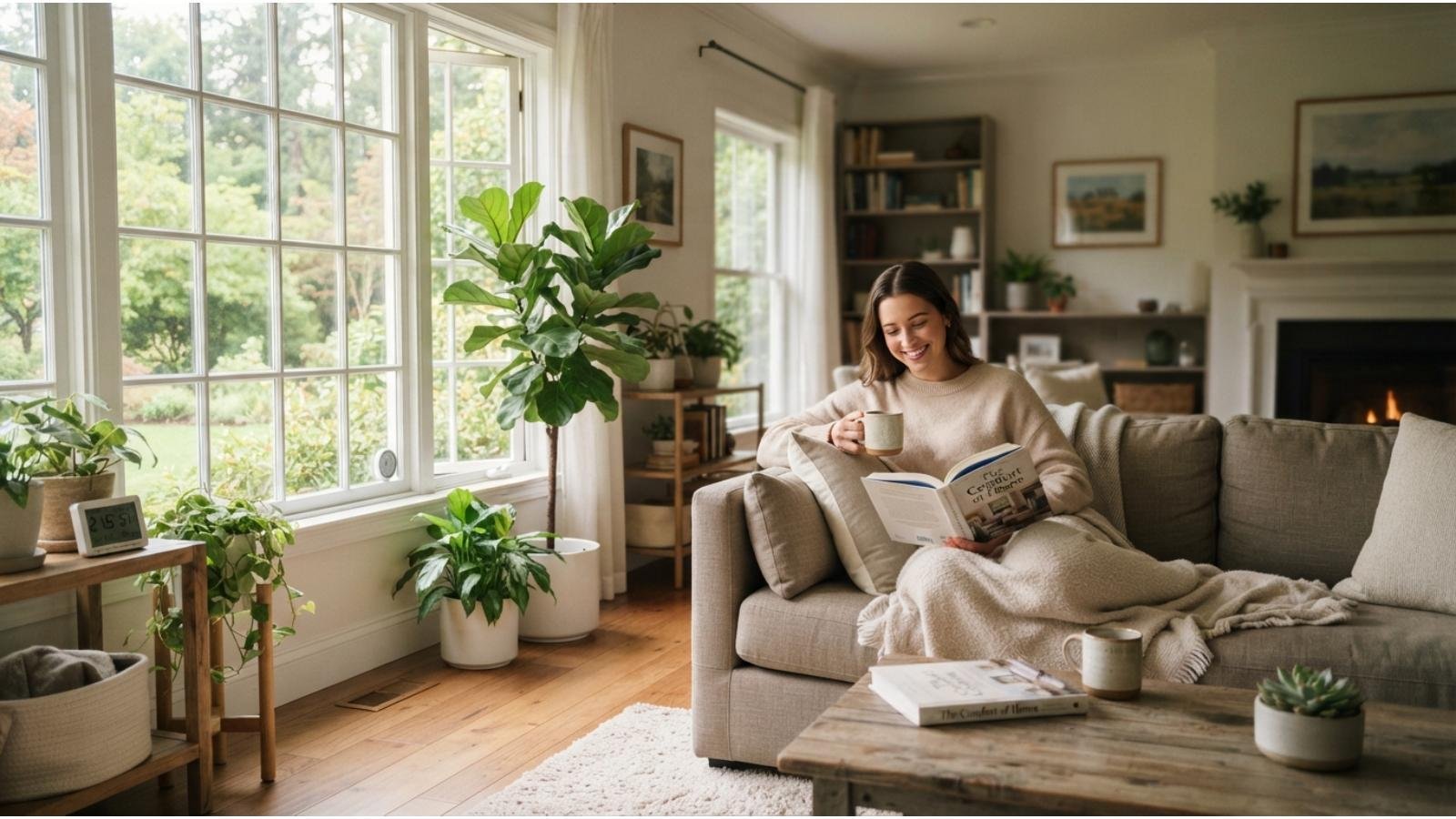
Cyclamen needs bright light without harsh, prolonged direct sunlight.
An east- or west-facing window can work well, particularly if strong sunlight is filtered through a sheer curtain. A bright north-facing location may also work depending on the room and season.
Signs the light is suitable
A healthy cyclamen generally has:
- Firm, upright leaves.
- Strongly colored foliage.
- Compact growth.
- Flower stems that remain reasonably upright.
- Continued production of flowers during its blooming period.
If the plant becomes stretched or produces weak, floppy growth, insufficient light may be contributing.
On the other hand, intense sunlight through hot glass can raise leaf and soil temperatures and stress a plant that naturally prefers cooler conditions.
Practical tip: Rather than asking whether a window is “sunny,” observe the plant’s actual conditions. A bright room with filtered daylight is often more suitable than a very hot window receiving intense afternoon sun.
Why Temperature Matters So Much
Temperature is one of the most overlooked parts of cyclamen plant care indoors.
Cyclamen generally performs better in a cool room than in a hot one.
This creates an interesting challenge for indoor gardeners: the room that feels comfortable to you may be warmer than the cyclamen prefers.
Keep cyclamen away from
- Radiators.
- Heaters.
- Hot air vents.
- Fireplaces.
- Very warm appliances.
- Strong drafts.
- Extremely hot windows.
A cool, bright location can significantly improve flower longevity.
How to Water Cyclamen Indoors
Watering is probably the most important part of successful cyclamen care.
The plant should not sit in constantly saturated compost. At the same time, you don’t want to allow the actively growing plant to become severely dehydrated repeatedly.
A practical approach is to check the compost before watering rather than following a rigid calendar.
Step-by-step watering method
- Check the upper layer of the compost with your finger.
- If it has started to dry, prepare to water.
- Water thoroughly enough to moisten the root zone.
- Allow excess water to drain completely.
- Empty standing water from the saucer or outer container.
- Return the plant to its normal position.
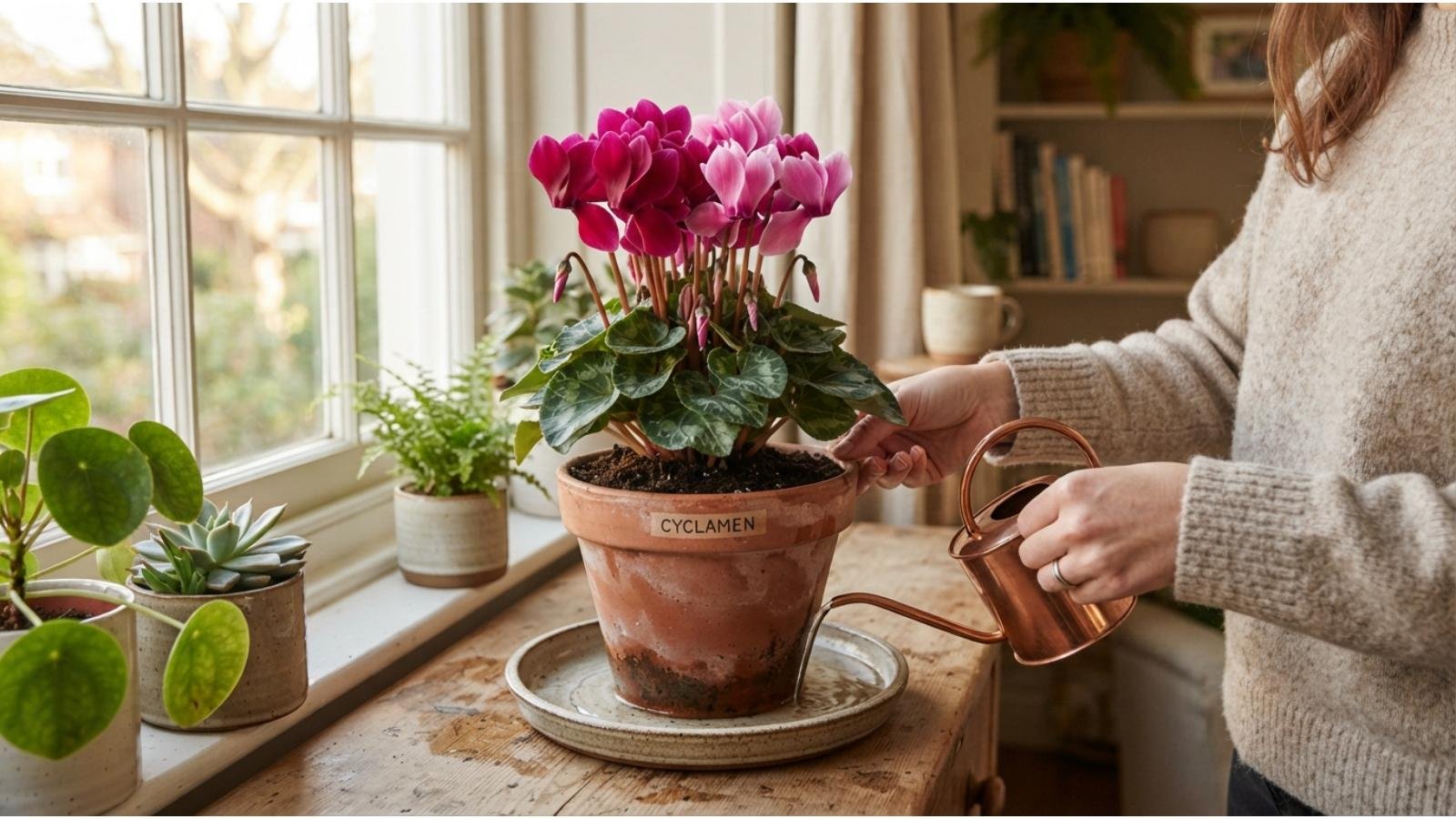
For cyclamen, bottom watering can be particularly useful. Place the pot in a shallow tray or saucer of water and allow the compost to absorb moisture, then drain away remaining water.
Why bottom watering helps
The crown and tuber are vulnerable to prolonged wetness. Watering from below can reduce the amount of water sitting around the central crown and foliage.
University of Minnesota Extension likewise recommends bottom watering for cyclamen to help prevent crown rot.
Important: Bottom watering does not mean leaving the pot permanently submerged. Allow the plant to absorb water, then remove excess water.
How Often Should You Water Cyclamen?
There is no universally correct schedule such as “every three days.”
Indoor temperature, pot size, soil composition, humidity, light level, and plant size all affect drying speed.
During active growth, check the plant regularly and water when the compost has begun to dry rather than automatically watering on a fixed day.
A cyclamen in a cool room may use water much more slowly than one kept in a warmer environment.
Better rule: Water according to the condition of the compost, not the calendar.
The Most Important Watering Mistake to Avoid
Do not repeatedly pour water directly over the center of the plant.
The tuber and crown are sensitive to prolonged wetness. Keeping these areas wet can contribute to rot.
This is why a plant can simultaneously suffer from “too much water” while the owner believes they are simply being attentive.
Image Suggestion: Side-by-side diagram showing correct bottom watering versus water collecting around the cyclamen crown.
Choosing the Right Soil and Pot
Cyclamen needs a growing medium that holds some moisture while draining excess water efficiently.
The most important characteristics are:
- Good drainage.
- Good air movement around roots.
- Moderate moisture retention.
- No tendency to remain waterlogged.
What about the pot?
A drainage hole is essential.
A decorative container without drainage can trap water around the roots and tuber, dramatically increasing the risk of rot.
If your cyclamen is sitting inside a decorative cachepot, remove the nursery pot for watering and let it drain before putting it back.
Keep the Cyclamen Tuber Properly Positioned
One unusual feature of cyclamen care is that the tuber should not be buried deeply.
RHS recommends keeping the top of the tuber just above the soil surface. (RHS)
This matters because burying the tuber deeply can keep the crown area excessively wet.
If you repot your cyclamen, resist the temptation to cover the entire tuber with compost.
Do Cyclamen Need Humidity?
Cyclamen appreciates moderate humidity, but increasing humidity isn’t a substitute for proper watering and ventilation.
The more important priority is avoiding hot, dry air from heaters and similar indoor sources.
Instead of constantly misting the plant, focus on:
- Keeping it away from heat sources.
- Providing good air circulation.
- Avoiding crowded conditions.
- Maintaining appropriate soil moisture.
Excess moisture around foliage combined with poor airflow can encourage fungal problems.
Fertilizing Cyclamen Indoors
Cyclamen does not need heavy feeding.
During active growth, a low-nitrogen liquid fertilizer can be applied periodically.
Avoid the common assumption that more fertilizer automatically produces more flowers.
Excess fertilizer can create unnecessary salt buildup and may encourage foliage at the expense of balanced growth.
If your plant has recently been purchased in full flower, check whether it has already been growing in a fertilized commercial medium before immediately starting a heavy feeding program.
How to Deadhead Cyclamen
Removing faded flowers helps keep the plant tidy and can encourage continued flowering.
Don’t simply snip off the visible flower head and leave a long stem behind.
Instead:
- Locate the entire flower stem.
- Follow it down toward the base.
- Remove the faded stem cleanly.
- Avoid damaging surrounding leaves or the tuber.
This same technique can be used for yellowing or completely dead foliage.
What to Do After Cyclamen Finishes Flowering
This is where many indoor gardeners accidentally lose their cyclamen.
After flowering, the plant may naturally begin preparing for dormancy. Leaves can yellow and gradually disappear.
Don’t automatically interpret this as a watering emergency.
During the transition to dormancy
- Gradually reduce watering.
- Stop treating the plant as if it is in peak growth.
- Remove dead foliage.
- Keep the tuber in a suitable location.
- Avoid keeping dormant compost continuously wet.
The exact timing can vary with growing conditions and cultivar, so watch the plant rather than forcing a particular calendar schedule.
Can Cyclamen Bloom Again Next Year?
Yes, cyclamen is a tuberous perennial and can be maintained beyond its initial flowering display if its seasonal cycle is respected.
The key is recognizing that dormancy is part of the plant’s natural cycle.
When new growth begins again, gradually resume appropriate watering and feeding rather than suddenly soaking a dormant tuber.
This is one reason cyclamen care differs from caring for a typical evergreen houseplant.
Cyclamen Care Through the Seasons
During active growth
Focus on:
- Bright filtered light.
- Cool temperatures.
- Moderate watering.
- Good drainage.
- Occasional low-nitrogen fertilizer.
- Removal of fading flowers.
During flowering
Maintain consistent conditions rather than constantly moving the plant.
A cool, bright room can help prolong the display.
After flowering
Begin reducing water as foliage naturally declines.
During dormancy
Keep the tuber relatively dry according to its condition and avoid treating the plant like an actively growing houseplant.
When new growth returns
Gradually return to regular watering and active-growth care.
Common Cyclamen Problems and What They Mean
| Problem | Likely causes | What to check |
|---|---|---|
| Yellow leaves | Overwatering, natural seasonal decline, stress | Soil moisture and growth stage |
| Drooping leaves | Dry soil, heat stress, root/tuber problems | Moisture and temperature |
| Flowers fading quickly | Excessive warmth or unsuitable conditions | Move to a cooler bright room |
| Crown rot | Excess moisture around crown | Change watering technique |
| Mushy tuber | Persistent wetness or rot | Inspect roots/tuber |
| Few flowers | Poor light, heat, stress, seasonal cycle | Light and temperature |
| Weak growth | Insufficient light or unsuitable conditions | Window position |
| Moldy plant material | Excess moisture and poor airflow | Ventilation and watering |
Why Are Cyclamen Leaves Turning Yellow?
Yellow leaves can have several causes, so don’t diagnose the problem from leaf color alone.
1. Overwatering
If the compost stays wet for long periods and multiple leaves turn yellow, excessive moisture is a strong possibility.
RHS specifically identifies yellowing leaves as a possible sign of overwatering and recommends allowing the compost to start drying before bottom watering.
2. Natural dormancy
If flowering has finished and the plant is gradually losing leaves, dormancy may be completely normal.
3. Heat stress
A cyclamen placed near a heater or in a very warm room may deteriorate even when watering is technically correct.
The important lesson: Look at the whole plant—soil, temperature, season, roots, leaves, and flowering stage—rather than reacting to one yellow leaf.
Why Is My Cyclamen Drooping?
Drooping doesn’t automatically mean the plant needs water.
Check:
- Is the compost actually dry?
- Is the room too warm?
- Has the plant been sitting in water?
- Are the stems soft?
- Is the tuber firm or becoming mushy?
- Is the plant entering dormancy?
If the soil is dry, watering may solve the problem. If the compost is already saturated, adding more water can make the underlying problem worse.
Why Is My Cyclamen Not Flowering?
If the plant is healthy but isn’t producing flowers, examine its environment.
Potential issues include:
- Insufficient light.
- Excessive heat.
- Poor overall growing conditions.
- Incorrect seasonal expectations.
- Stress following flowering or dormancy.
Cyclamen is naturally associated with cooler growing conditions, and keeping it in a consistently warm room can work against its preferred environment. (RHS)
Cyclamen Pests and Diseases
Indoor cyclamen can experience pest and disease problems, particularly when conditions are crowded, overly humid, or poorly ventilated.
RHS lists pests such as cyclamen mites, red spider mites, aphids, mealybugs, thrips, fungus gnats, and vine weevil among potential problems depending on growing conditions. Diseases can include cyclamen grey mould and root-related problems.
Inspect regularly for
- Distorted new leaves.
- Fine webbing.
- Sticky foliage.
- White insects or cottony deposits.
- Gray fuzzy growth.
- Soft or rotting plant tissue.
- Unusual leaf discoloration.
Early detection is much easier to manage than an established infestation.
Image Suggestion: Cyclamen troubleshooting chart showing healthy leaves, overwatering symptoms, gray mould, and pest damage.
Five Cyclamen Care Mistakes to Avoid
1. Treating it like a tropical houseplant
Cyclamen prefers cooler conditions.
2. Watering on a fixed schedule
The plant’s water needs change with temperature, light, pot size, and growth stage.
3. Keeping the tuber constantly wet
This can encourage rot.
4. Placing it beside a heater
Hot, dry air is particularly unsuitable.
5. Throwing it away after flowering
A cyclamen may be entering its natural dormant phase rather than dying.
A Simple Weekly Cyclamen Care Routine
You don’t need to spend a lot of time caring for cyclamen.
Once or twice a week, check:
Light: Is the plant still receiving bright filtered light?
Temperature: Has the room become unusually warm?
Soil: Has the compost started to dry?
Water: If needed, can you bottom-water and drain the excess?
Leaves: Are any leaves yellowing, soft, damaged, or moldy?
Flowers: Remove faded flowers and stems.
This observation-based approach is more reliable than blindly following a watering calendar.
Where Should You Put a Cyclamen Indoors?
A bright, cool location is usually the best choice.
Good candidates include:
- A bright east-facing window.
- A bright west-facing window with filtered afternoon light.
- A cool conservatory.
- A bright room away from heating appliances.
Avoid positioning it where intense heat builds up around the foliage.
Is Cyclamen Safe Around Pets?
This deserves attention if you have pets.
If pets or children may chew plants, keep cyclamen somewhere inaccessible and seek appropriate veterinary or medical advice if ingestion occurs.
Frequently Asked Questions
How often should I water an indoor cyclamen?
Water when the compost has begun to dry rather than using a fixed schedule. During active growth, maintain moderate moisture without keeping the compost constantly saturated. Bottom watering is a useful technique.
Should I water cyclamen from the top or bottom?
Bottom watering is often preferable because it reduces the amount of water sitting around the crown and foliage. Allow the plant to absorb water, then drain away excess.
Does cyclamen like direct sunlight?
Cyclamen needs good light but generally performs well with bright filtered light. Strong, hot direct sunlight can create excessive heat around the plant.
Why are my cyclamen leaves turning yellow?
Overwatering is one possibility, especially if the compost remains wet. However, yellowing can also occur naturally as the plant approaches dormancy.
Should I remove dead cyclamen flowers?
Yes. Remove faded flowers and their stems back toward the base to keep the plant tidy and support continued flowering.
Can cyclamen survive indoors after flowering?
Yes. Cyclamen can enter dormancy after flowering. Reduce watering as the foliage dies back rather than assuming the plant has failed.
Does cyclamen like humidity?
It appreciates moderate humidity, but good watering practices and protection from hot, dry air are more important than simply maximizing humidity.
Can I keep cyclamen in a warm room?
It can survive for a time, but consistently warm indoor conditions are not ideal. A cooler room with good light is generally better for flowering and overall performance.
What soil is best for cyclamen?
Use a well-draining growing medium that retains some moisture without becoming waterlogged. RHS recommends a loam-based, well-drained compost for indoor cyclamen.
Should the cyclamen tuber be buried?
No. For Cyclamen persicum, the top of the tuber should remain just above the compost surface.
Related Plant-Care Topics
Readers caring for flowering houseplants may also benefit from guides covering:
- Indoor plant watering techniques.
- How to prevent root rot.
- Indoor plant light requirements.
- Houseplant dormancy.
- How to improve drainage in containers.
- Common indoor plant pests.
- How to care for flowering houseplants after blooming.
Conclusion
Successful cyclamen plant care indoors comes down to working with the plant’s natural preferences rather than forcing it into a typical houseplant routine.
Give it bright filtered light, cool conditions, well-draining soil, careful watering, and good airflow. During active growth, keep the compost moderately moist without saturating the tuber or crown. Bottom watering can help reduce crown problems, while a cool room can help flowers last longer.
Most importantly, learn to recognize the transition into dormancy. Yellowing leaves after flowering don’t always mean failure. Sometimes the best care is simply to reduce watering, leave the tuber alone, and allow the cyclamen to complete its natural cycle.
When you stop treating cyclamen like an ordinary evergreen houseplant, its care becomes much more predictable—and keeping it healthy from one flowering season to the next becomes considerably easier.