Neon pothos is one of the easiest tropical houseplants to grow, but its bright chartreuse leaves look their best when light, watering, soil, and humidity are balanced. Good neon pothos care is less about constant attention and more about understanding what the plant is telling you through its leaves and growth.
Quick Answer
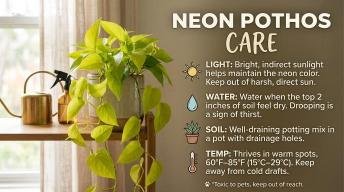
For healthy neon pothos care, place the plant in bright, indirect light and water when the top 1–2 inches of soil becomes dry. Use a well-draining potting mix and a container with drainage holes. Keep it warm, avoid soggy soil, and prune long or damaged vines to encourage fuller growth.
What Is a Neon Pothos?
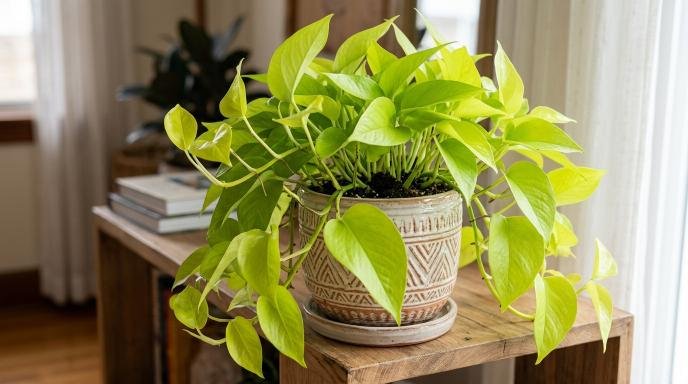
Neon pothos is a popular cultivar of Epipremnum aureum, recognized for its striking lime-green to yellow-green foliage. Unlike darker pothos varieties, its leaves naturally have a vivid neon appearance, making it especially attractive in bright indoor spaces.
It is a vining tropical plant that can grow upward when supported by a trellis or moss pole, or trail downward from a hanging basket or shelf.
The plant is relatively forgiving, which makes it suitable for beginners. However, “easy care” does not mean it can tolerate every condition. The most common problems come from too much water, insufficient light, or sudden environmental changes.
How Much Light Does Neon Pothos Need?
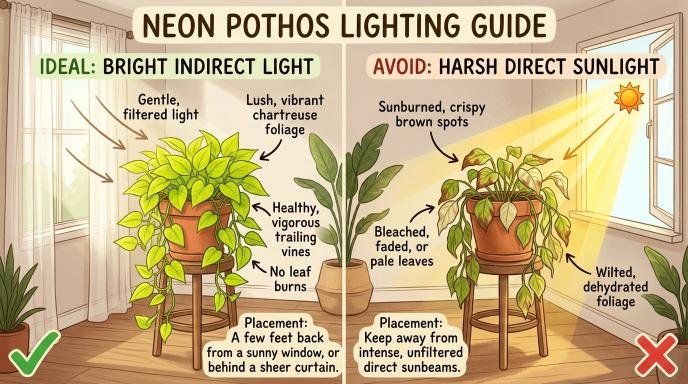
Bright, indirect light is generally the best choice for neon pothos.
Place it near a bright window where it receives plenty of filtered daylight without intense direct afternoon sun hitting the leaves for hours.
What different light conditions do
| Light condition | Likely result |
|---|---|
| Bright indirect light | Strong growth and vibrant foliage |
| Moderate indirect light | Slower but generally healthy growth |
| Very low light | Leggy growth and smaller leaves |
| Harsh direct sun | Possible leaf scorching or fading |
One important point is often overlooked: light affects growth more than many beginners realize. If your neon pothos is surviving but producing long spaces between leaves, moving it closer to a bright source of indirect light may make a noticeable difference.
Direct sunlight is not automatically harmful, but strong midday or afternoon sun through glass can heat and scorch foliage.
A practical placement test
If the plant is several feet away from a window and the room feels fairly dim during the daytime, it may not be receiving enough usable light. A brighter position with filtered light is usually a better starting point.
Watering Neon Pothos Correctly
Watering is where many neon pothos problems begin.
Instead of watering on a fixed calendar schedule, check the soil first. When the upper portion of the potting mix has dried, water thoroughly until excess water drains from the bottom.
Then empty any collected water from the saucer or decorative container.
Why overwatering causes trouble
Roots need both moisture and oxygen. Constantly saturated soil reduces the air available around the roots and can contribute to root damage.
Symptoms associated with watering problems can overlap, so don’t diagnose the issue from one leaf alone.
Watch for patterns such as:
- Yellowing leaves combined with consistently wet soil.
- Wilting despite wet soil.
- Soft or deteriorating roots.
- Brown, mushy areas.
- Very dry soil combined with limp or curling foliage.
How often should you water?
There is no universal schedule.
A plant in a bright, warm room may dry considerably faster than one in a cool, low-light room. Pot size, soil composition, season, humidity, and root growth also influence drying time.
Best rule: check the soil rather than watering simply because a certain number of days has passed.
Best Soil for Neon Pothos
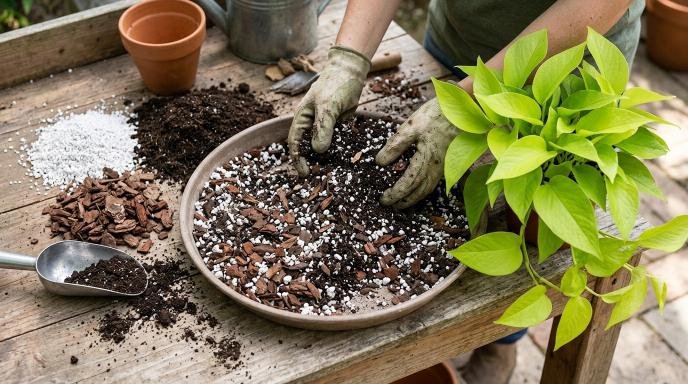
Neon pothos performs best in a loose, well-draining potting medium that retains some moisture without staying waterlogged.
A practical mix can contain:
- Quality indoor potting soil.
- Perlite or another material that improves drainage and aeration.
- Coco coir or another moisture-retaining component in moderation.
The goal is not to make the soil dry instantly. You want a balance where roots receive moisture while excess water can move away.
A dense garden soil that stays wet for long periods is generally a poor choice for an indoor container.
Choose the right pot
The container should have drainage holes.
A decorative pot without drainage can trap excess water around the roots even when your watering technique seems careful.
If you use a decorative cachepot, keep the plant in a draining nursery container inside it and remove excess water after watering.
Temperature and Humidity
Neon pothos prefers warm indoor conditions and generally grows best when protected from cold drafts and sudden temperature changes.
Avoid placing it directly beside:
- Cold exterior doors.
- Drafty windows during cold weather.
- Strong heating vents.
- Air-conditioning vents.
Moderate household humidity is often sufficient for healthy growth. Higher humidity can encourage lush tropical-looking foliage, but you do not need to turn your entire home into a greenhouse.
If the air is extremely dry, leaf edges may become more prone to browning.
A humidifier can help in very dry environments, but improving watering, light, and root health should come before obsessing over humidity.
Fertilizing Neon Pothos
Neon pothos does not need heavy feeding.
During active growth, a balanced houseplant fertilizer applied according to its product instructions can provide nutrients that the potting mix may eventually lack.
Avoid the common mistake of assuming that more fertilizer means faster growth.
Excess fertilizer can contribute to salt accumulation in the soil and damage roots.
A sensible approach
- Fertilize primarily during active growth.
- Follow the fertilizer’s recommended dilution and frequency.
- Avoid repeatedly applying stronger concentrations.
- Reduce or pause feeding when growth naturally slows.
If the plant is newly repotted into nutrient-rich potting mix, immediate heavy fertilization is usually unnecessary.
How to Make Neon Pothos Grow Fuller
A neon pothos can become long and sparse when it receives inadequate light or simply grows naturally as a vine.
If you want a fuller-looking plant, pruning is one of the most useful techniques.
Step-by-step pruning
- Inspect the vines and identify excessively long or bare sections.
- Use clean, sharp scissors or pruning shears.
- Cut just above a healthy node.
- Remove damaged or severely unhealthy foliage.
- Continue normal light and watering afterward.
The node is important because new growth can emerge from growth points along the vine.
You can also propagate healthy cuttings and root them before planting them back into the same container, helping create a denser appearance over time.
Neon Pothos Propagation
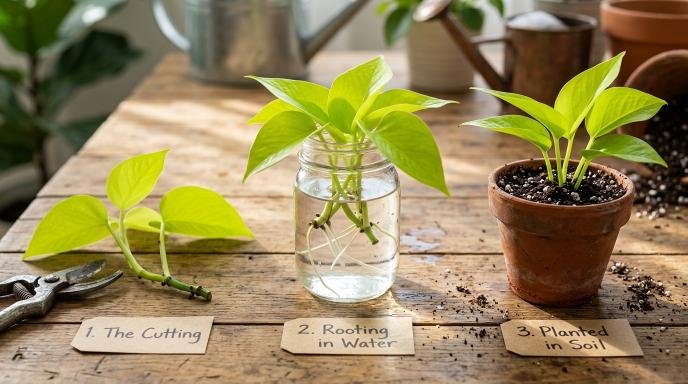
Stem cuttings are a straightforward way to propagate neon pothos.
Water propagation
Take a healthy cutting containing at least one viable node. Place the node in water while keeping most of the leaves above the waterline.
Change the water regularly and provide bright, indirect light.
Once a useful root system develops, transfer the cutting into an appropriate potting medium.
Soil propagation
A cutting can also be placed directly into a lightly moist, well-draining growing medium.
The key is that the node needs to be included. A piece of stem without a node cannot reliably produce a new vine in the same way.
Why Are Neon Pothos Leaves Turning Yellow?
Yellow leaves do not automatically mean the plant needs more water.
Look at the whole situation.
If the soil stays wet
Frequent watering, poor drainage, or a heavy potting mix may be contributing to root stress.
If the soil is extremely dry
Underwatering can cause foliage to wilt, curl, brown, or eventually yellow.
If only an older leaf changes color
An occasional older leaf naturally aging and being shed is less concerning than widespread yellowing.
If many leaves change at once
Check:
- Soil moisture.
- Drainage.
- Light level.
- Root condition.
- Recent environmental changes.
- Fertilizer use.
The most useful diagnostic habit is to look for a pattern rather than reacting to one yellow leaf.
Why Are Neon Pothos Leaves Turning Green?
One of the most interesting issues with neon pothos is loss of its intense color.
Lower light can make foliage appear less vibrant, and new leaves may not always have exactly the same coloration as mature leaves.
If the plant has become noticeably darker and growth is weak or stretched, evaluate its light first.
Move it gradually toward a brighter location with indirect light rather than suddenly placing it in intense direct sun.
Remember that color alone is not the only measure of plant health. Strong growth, healthy roots, and firm foliage are also important indicators.
Why Is My Neon Pothos Not Growing?
Slow growth can have several causes.
Common reasons
Insufficient light:
Low light can keep the plant alive but limit vigorous growth.
Cold conditions:
Growth naturally slows when temperatures are unfavorable.
Root problems:
Damaged roots cannot support healthy new growth effectively.
Nutrient depletion:
An older, heavily used potting mix may eventually need replenishment.
Seasonal slowdown:
Indoor plants often grow more slowly when environmental conditions become less favorable.
Before adding fertilizer, check the basics. Giving a struggling plant more fertilizer will not fix poor light or damaged roots.
Brown Leaves and Brown Tips
Brown foliage can result from several different stresses, including inconsistent watering, very dry conditions, excessive fertilizer salts, or leaf damage.
Inspect the affected area carefully.
If only the tip is brown while the rest of the leaf looks healthy, the issue may be localized stress rather than a serious root problem.
If browning is spreading rapidly, affecting many leaves, or accompanied by mushy stems and wet soil, investigate the root environment.
Remove severely damaged leaves if they are unlikely to recover, but correcting the underlying condition is more important than pruning symptoms.
Repotting Neon Pothos
Neon pothos does not need frequent repotting simply because a certain amount of time has passed.
Consider repotting when:
- Roots are heavily crowded.
- Water runs rapidly through because the container is densely root-filled.
- The plant repeatedly dries out unusually quickly.
- The pot is clearly too small for the root system.
- The potting medium has significantly deteriorated.
Choose a container only moderately larger than the existing root ball.
Moving a small root system into a very large pot can leave a large volume of soil wet for too long after watering.
Seasonal Neon Pothos Care
Spring and summer
Active growth often increases when light and temperatures are favorable.
This is generally the best period to:
- Encourage growth.
- Prune long vines.
- Propagate cuttings.
- Fertilize appropriately.
- Monitor soil moisture more frequently.
Fall and winter
Growth may slow.
Reduce watering frequency according to how quickly the soil dries rather than following your summer routine.
Keep the plant away from cold drafts and pay attention to changes in indoor lighting.
The biggest seasonal mistake is continuing a summer watering routine after the plant’s water consumption has dropped.
Common Neon Pothos Care Mistakes
Watering by calendar
“Water every Sunday” sounds simple but ignores changing environmental conditions.
Better approach: check the soil before watering.
Keeping the soil constantly wet
Moist soil is not the same as saturated soil.
Better approach: allow the appropriate upper layer of the mix to dry before watering again.
Putting it in a dark corner
Neon pothos may survive, but weak light can lead to slower, leggier growth.
Better approach: provide bright, indirect light.
Using a pot without drainage
Even careful watering becomes difficult when excess water has nowhere to escape.
Better approach: use a container with drainage holes.
Overfertilizing
More fertilizer is not automatically more growth.
Better approach: follow the fertilizer label and avoid excessive applications.
Pruning without a purpose
Randomly cutting vines does not necessarily create a fuller plant.
Better approach: prune strategically around healthy nodes and propagate useful cuttings.
A Simple Neon Pothos Care Routine
Use this routine as a practical starting point:
Every few days:
Look at the plant for obvious changes such as wilting, yellowing, pests, or damaged foliage.
Before watering:
Check the moisture level of the potting mix.
During active growth:
Monitor new leaves and vines and fertilize appropriately when needed.
Every few weeks:
Rotate the pot if growth is becoming noticeably one-sided.
When vines become too long:
Prune strategically and use healthy cuttings for propagation.
When problems appear:
Check light, soil moisture, drainage, roots, temperature, and recent care changes before treating the plant.
Frequently Asked Questions
Is neon pothos easy to care for?
Yes. Neon pothos is generally forgiving and adapts well to typical indoor conditions. Its biggest care risks are prolonged overwatering, inadequate light, poor drainage, and extreme environmental conditions.
Does neon pothos need direct sunlight?
No. Bright indirect light is generally preferable. Strong direct sunlight, particularly through glass during intense parts of the day, can scorch leaves.
How often should I water neon pothos?
Water when the upper portion of the potting mix has dried rather than following a fixed schedule. The exact interval depends on light, temperature, pot size, soil, and season.
Can neon pothos grow in low light?
It can tolerate lower light, but growth may become slower and more stretched. Brighter indirect light generally supports stronger growth and helps maintain its characteristic appearance.
Why is my neon pothos leggy?
Low light is a common reason for long spaces between leaves. Older vines can also naturally become sparse. Improve the light and prune strategically to encourage a fuller appearance.
Can neon pothos grow in water?
Yes. Stem cuttings containing nodes can develop roots in water. Once adequately rooted, they can be transferred to a suitable potting medium.
How do I make neon pothos bushier?
Prune long vines above healthy nodes and consider rooting the cuttings and planting them back into the container. Adequate light is also important for maintaining strong, compact growth.
Is neon pothos toxic to pets?
Yes. Pothos plants contain insoluble calcium oxalates and can cause irritation if chewed or swallowed. Keep the plant away from pets and children who may try to eat the foliage.
Should I mist my neon pothos?
Regular misting is not essential for healthy growth. Consistent moisture management, appropriate light, and good airflow are more important. If your indoor air is extremely dry, a humidifier can provide more consistent humidity than occasional misting.
When should I repot neon pothos?
Repot when the plant becomes significantly root-bound or the existing growing medium has deteriorated. Choose a pot only somewhat larger than the current root system.
Final Takeaways
Successful neon pothos care comes down to a few fundamentals: bright indirect light, appropriate watering, well-draining soil, drainage holes, warmth, and sensible pruning.
Don’t try to solve every problem with more water or fertilizer. When your neon pothos struggles, examine the growing environment first. A simple change in light, watering habits, or drainage can often make a bigger difference than adding another product to your routine.
With consistent care, neon pothos can produce vigorous vines and maintain the bright foliage that makes this cultivar such a standout houseplant.