Golden pothos is one of the easiest houseplants to grow, but “easy” does not mean it can tolerate every mistake. The right balance of light, watering, drainage, temperature, and pruning determines whether your plant produces full, vibrant foliage or becomes sparse, yellow, and weak.
This golden pothos care guide explains exactly what the plant needs, how to recognize problems early, and how to encourage stronger vines and better variegation without relying on complicated routines.
Quick Answer
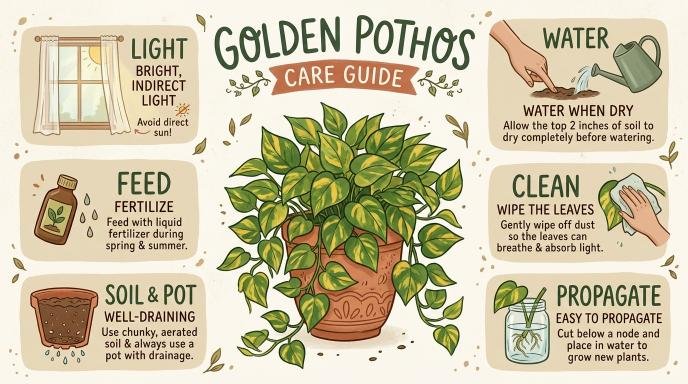
Golden pothos grows best in bright, indirect light, well-draining soil, and a pot with drainage holes. Water when the upper 1–2 inches of soil feels dry, keep it warm, and prune long vines to encourage fuller growth. Avoid constantly wet soil, harsh direct sun, and sudden temperature changes.
What Is Golden Pothos?
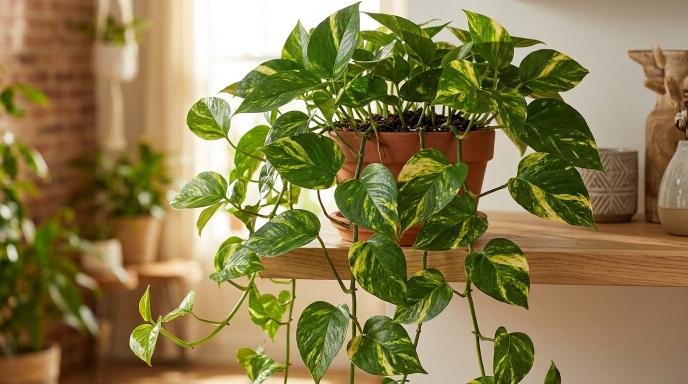
Golden pothos (Epipremnum aureum) is a tropical vining plant recognized by its heart-shaped green leaves marked with yellow or golden variegation. It is commonly grown indoors because it adapts well to a range of household conditions.
Its trailing growth makes it useful for:
- Hanging baskets
- Shelves and plant stands
- Tall cabinets
- Indoor trellises
- Offices and bedrooms with suitable light
One important point is often overlooked: golden pothos is tolerant, not indestructible. A plant may survive poor conditions for a while, but long-term low light, overwatering, or compacted soil can gradually weaken it.
Golden Pothos Light Requirements
Light is one of the biggest factors affecting golden pothos appearance.
Bright, indirect light is ideal
Place the plant near a bright window where it receives plenty of filtered or indirect sunlight. A few hours of gentle morning sunlight can be acceptable, but intense afternoon sun through glass may scorch the leaves.
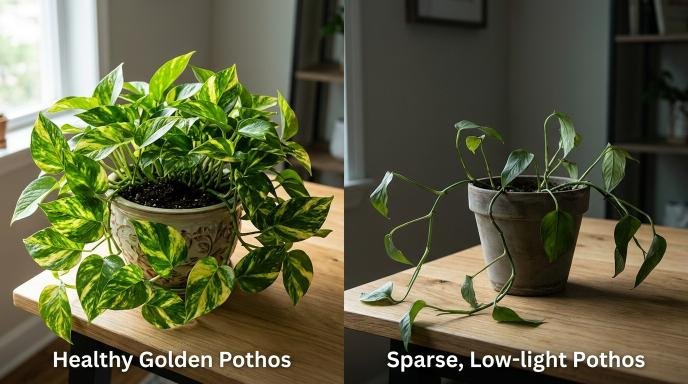
Light affects more than growth. Golden pothos needs sufficient light to maintain strong variegation.
When light is too low, you may notice:
- Smaller new leaves
- Longer spaces between leaves
- Slower growth
- More solid-green foliage
- Weak, stretched vines
If the plant is losing its golden pattern, improving its light gradually is often more useful than immediately changing fertilizer or watering.
Can golden pothos tolerate low light?
Yes, but it usually grows more slowly and may lose some of its yellow variegation. Low light can keep the plant alive, but it is not necessarily the best environment for attractive, vigorous growth.
Practical tip: If you move a pothos from a dark corner to a brighter location, do it gradually rather than placing it immediately in strong direct sunlight.
How Often Should You Water Golden Pothos?
There is no reliable watering schedule that works for every home.
Instead, check the soil.
Water your golden pothos when the top 1–2 inches of soil feels dry. Insert your finger into the soil rather than judging moisture from the surface alone.
When watering:
- Water thoroughly until excess moisture drains from the bottom.
- Let the pot drain completely.
- Empty any standing water collected in the saucer.
- Allow the soil to dry partially before watering again.
The biggest mistake is watering simply because several days have passed.
Signs of underwatering
A thirsty golden pothos may develop:
- Drooping leaves
- Dry, lightweight soil
- Curling foliage
- Crispy brown leaf edges
- Slower growth
Signs of overwatering
Overwatering is more dangerous when it happens repeatedly.
Watch for:
- Yellowing leaves
- Persistently wet soil
- Soft or dark stems
- A musty smell from the pot
- Leaf drop
- Root problems
A useful rule is check the soil, not the calendar.
Image Suggestion: Golden pothos showing healthy soil moisture versus severely waterlogged soil.
Best Soil for Golden Pothos
Golden pothos needs soil that holds enough moisture for the roots while allowing excess water to escape.
A practical potting mix can contain:
- Quality indoor potting soil
- Perlite or another aerating material
- A small amount of orchid bark or similar chunky material
The exact recipe is less important than the result: the soil should not remain soggy for days after watering.
Dense garden soil is generally a poor choice for indoor pothos because it can become compacted and restrict airflow around the roots.
Choosing the Right Pot
A pot with drainage holes is essential.
Choose a container only slightly larger than the root ball when repotting. Moving a small plant into a very large pot can create a large volume of wet soil that dries slowly.
That increases the risk of root problems.
When should you repot golden pothos?
Consider repotting when:
- Roots are circling heavily around the root ball.
- Roots are emerging from drainage holes.
- Water runs through unusually quickly because the pot is severely root-bound.
- Growth has slowed despite suitable light and care.
- The potting mix has broken down and stays wet for too long.
Usually, there is no need to repot simply because the plant has been in the same container for a particular number of months.
Golden Pothos Temperature and Humidity
Golden pothos prefers warm indoor conditions.
Keep it away from:
- Cold drafts
- Air-conditioning vents
- Heating vents
- Very cold windows
- Sudden temperature fluctuations
Normal comfortable household temperatures are generally suitable.
Does golden pothos need high humidity?
It can tolerate average indoor humidity, which is one reason it is popular with beginners.
Higher humidity may support attractive foliage, particularly in very dry environments, but you do not need to create a tropical greenhouse for a healthy pothos.
If your home is extremely dry, a humidifier can be more useful than constantly misting the leaves.
Fertilizing Golden Pothos
Golden pothos does not require heavy feeding.
During active growth, use a balanced houseplant fertilizer according to the product’s dilution instructions.
Avoid the common mistake of assuming more fertilizer means faster growth.
Excess fertilizer can contribute to salt buildup and root damage.
A better approach
Feed a healthy, actively growing plant modestly. If the plant is suffering from root rot, severe stress, or extremely poor light, fertilizer will not fix the underlying problem.
Fix the growing conditions first.
How to Make Golden Pothos Grow Fuller
A long vine with leaves spaced far apart may be healthy but still look sparse.
Pruning is one of the easiest ways to improve its appearance.
Step-by-step pruning
- Identify excessively long or bare vines.
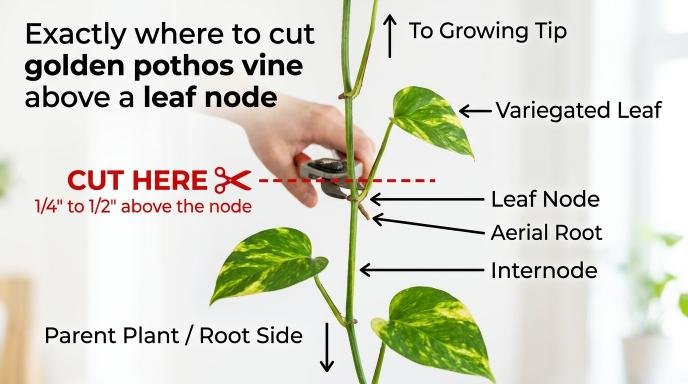
- Use clean, sharp scissors or pruning shears.
- Cut just above a healthy leaf node.
- Keep the healthy cuttings for propagation if desired.
- Encourage several vines to grow from different points rather than allowing one stem to dominate.
Regular pruning can create a bushier appearance over time.
Expert tip: Do not expect cutting one long vine to instantly produce a dense plant. Fuller growth requires suitable light and time for new shoots to develop.
How to Propagate Golden Pothos
Golden pothos is particularly easy to propagate from stem cuttings.
Water propagation
- Cut a healthy stem below a node.
- Remove the lower leaves.
- Place the node in clean water.
- Keep the cutting in bright, indirect light.
- Change the water regularly.
- Once a useful root system develops, transfer it to suitable potting mix.
The node is important because roots develop from the node rather than simply from the cut end of a leafless stem.
Soil propagation
You can also place a prepared cutting directly into moist, well-draining potting mix.
Keep the medium lightly moist while roots establish, but avoid keeping it saturated.
Why Are Golden Pothos Leaves Turning Yellow?
Yellow leaves can have several causes, so the solution depends on the pattern.
Older leaves turning yellow
Occasional yellowing of an older leaf can simply be part of normal aging.
Several leaves turning yellow
If multiple leaves are yellowing and the soil stays wet, investigate overwatering and poor drainage first.
Yellow leaves with dry, crispy edges
This pattern may point toward underwatering, excessive light, or environmental stress depending on the overall condition of the plant.
Do not diagnose the problem from leaf color alone. Check the soil moisture, roots, light exposure, pot drainage, and recent changes in care.
Why Is My Golden Pothos Losing Variegation?
The yellow pattern can become less pronounced when the plant receives insufficient light.
If new leaves are becoming increasingly green:
- Check the plant’s current light.
- Move it closer to a bright source of indirect light if necessary.
- Avoid sudden exposure to intense direct sun.
- Monitor new growth rather than expecting older leaves to change dramatically.
Variegated leaves contain less chlorophyll than fully green leaves, so the plant generally benefits from adequate light to support growth.
Why Is My Golden Pothos Not Growing?
Slow growth does not automatically mean the plant needs fertilizer.
Check these factors in order:
Light → roots → watering → temperature → nutrition
Low light is a particularly common reason for weak growth.
Also inspect the roots if the plant has remained wet for extended periods. Damaged roots cannot support vigorous new growth effectively.
Common Golden Pothos Care Mistakes
Watering on a fixed schedule
A calendar cannot account for seasonal changes, pot size, soil composition, or indoor temperature.
Keeping the soil constantly wet
Pothos likes moisture but does not want permanently saturated roots.
Putting it in a dark corner
Survival in low light is not the same as thriving in low light.
Using a huge pot
Too much soil around a small root system can remain wet for too long.
Overfertilizing
Extra fertilizer cannot compensate for inadequate light or damaged roots.
Never pruning
Long vines can become sparse when growth is allowed to extend indefinitely without strategic pruning.
Ignoring drainage
Even excellent soil cannot compensate for a container that traps excess water.
Golden Pothos Care Through the Seasons
| Season | Main Priority |
|---|---|
| Spring | Encourage growth with good light and appropriate feeding |
| Summer | Monitor watering as soil may dry faster |
| Autumn | Watch for slower growth and adjust watering |
| Winter | Reduce watering frequency when growth and evaporation slow |
The important principle is to adjust care according to the plant’s environment, rather than following a rigid monthly schedule.
A Simple Golden Pothos Care Routine
For beginners, this routine covers most of what the plant needs:
Weekly:
Check soil moisture, inspect leaves, and look for pests or unusual growth.
When soil dries:
Water thoroughly and allow excess water to drain.
During active growth:
Provide appropriate fertilizer according to its label instructions.
Every few weeks:
Rotate the pot if growth is becoming noticeably one-sided.
As needed:
Prune overly long or bare vines.
When problems appear:
Check light, soil moisture, drainage, roots, and recent environmental changes before adding fertilizer or other treatments.
Frequently Asked Questions
How much sunlight does golden pothos need?
Golden pothos prefers bright, indirect light. It can tolerate lower light, but growth may become slower and yellow variegation may become less noticeable.
How often should I water golden pothos?
Water when the upper 1–2 inches of soil becomes dry. The exact frequency varies with light, temperature, pot size, soil, and season.
Can golden pothos grow in low light?
Yes. It can survive in relatively low light, but it generally grows more slowly and may produce less variegated foliage.
Why are my golden pothos leaves turning yellow?
Overwatering, poor drainage, aging leaves, underwatering, and environmental stress can all cause yellowing. Check the soil and growing conditions before changing your routine.
How do I make golden pothos bushier?
Prune long vines above healthy nodes and provide sufficient bright, indirect light. Rooted cuttings can also be planted back into the pot to create a fuller appearance.
Should I mist golden pothos?
Misting is not essential for healthy growth. Consistent watering, suitable humidity, good light, and proper drainage are much more important.
Can golden pothos grow in water permanently?
It can grow in water for an extended period, but long-term water culture requires appropriate nutrient management and clean conditions. For straightforward houseplant care, a well-draining growing medium is usually simpler.
Is golden pothos safe around pets?
Golden pothos contains calcium oxalate crystals and can cause irritation if chewed or swallowed. Keep it away from pets and children who may chew plant material.
Final Takeaways
Successful golden pothos care is less about following a strict schedule and more about understanding what the plant is telling you. Give it bright indirect light, let the upper layer of soil dry before watering, use a well-draining mix and container, and avoid prolonged saturation.
If growth becomes sparse or the golden coloring fades, check light first. If leaves turn yellow while the soil remains wet, investigate watering and drainage. With these basics right, golden pothos can produce vigorous vines and attractive variegated foliage with relatively little maintenance.
Golden pothos is one of the easiest houseplants to grow, but “easy” does not mean it can tolerate every mistake. The right balance of light, watering, drainage, temperature, and pruning determines whether your plant produces full, vibrant foliage or becomes sparse, yellow, and weak.