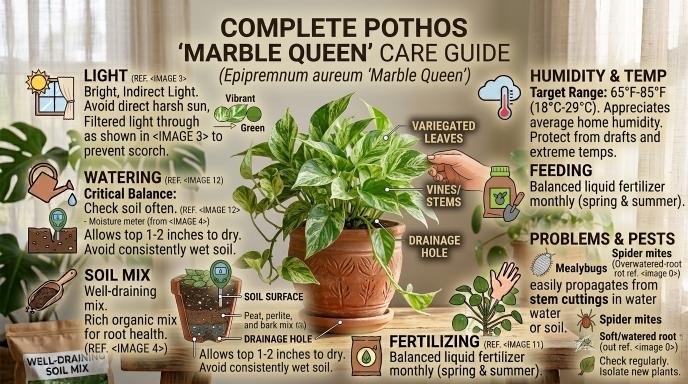
Marble Queen Pothos is one of the most attractive pothos varieties, but its distinctive white-and-green leaves can make it slightly more demanding than solid-green types. The biggest challenge is finding the right balance of light, watering, and pruning so the plant stays full without losing its beautiful variegation.
With the right conditions, pothos marble queen care is straightforward. The key is understanding how its slower-growing, highly variegated leaves respond to light, moisture, soil, temperature, and pruning.
Quick Answer
For healthy Marble Queen Pothos, provide bright indirect light, a well-draining potting mix, and water when the upper portion of the soil begins to dry. Keep it warm, avoid constantly wet soil, and prune long vines to encourage fuller growth. More light generally helps maintain strong white-and-green variegation.
What Is Marble Queen Pothos?
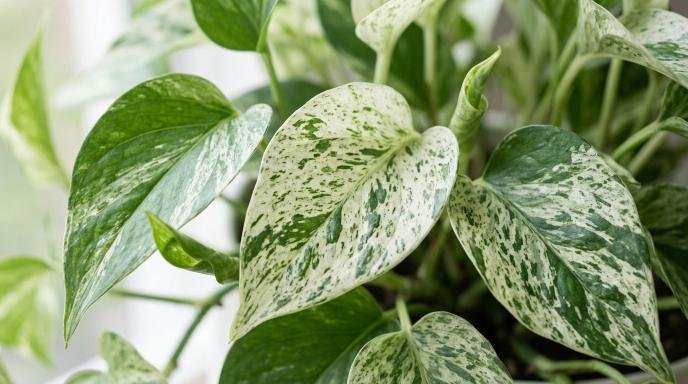
Marble Queen Pothos (Epipremnum aureum ‘Marble Queen’) is a popular evergreen tropical vine recognized for its heart-shaped leaves covered in irregular white, cream, and green marbling.
Unlike green pothos varieties, Marble Queen has substantial areas of white variegation. Those white sections contain less chlorophyll, so the plant can grow more slowly than a predominantly green pothos.
This difference is important when caring for the plant. A Marble Queen may need more patience after pruning, propagation, repotting, or a change in location.
Marble Queen Pothos Care Requirements at a Glance
| Care Factor | Best Condition |
|---|---|
| Light | Bright, indirect light |
| Water | When the upper soil begins to dry |
| Soil | Loose, airy, well-draining mix |
| Humidity | Average indoor humidity is usually acceptable |
| Temperature | Warm, stable indoor temperatures |
| Fertilizer | Balanced fertilizer during active growth |
| Pruning | Regular trimming for a fuller shape |
| Repotting | When roots become crowded or soil dries unusually fast |
| Propagation | Stem cuttings |
| Growth habit | Trailing or climbing vine |
Light: The Most Important Factor for Variegation
Light has a major influence on Marble Queen Pothos growth and appearance.
The ideal location is usually near a bright window where the plant receives plenty of filtered or indirect light. A few hours of gentle morning sunlight can be useful, but harsh direct afternoon sunlight through glass may scorch the leaves.
What happens with too little light?
When light is insufficient, Marble Queen may:
- Produce smaller leaves.
- Develop longer spaces between leaves.
- Grow more slowly.
- Produce leaves with more green and less attractive variegation.
- Become thin and leggy.
A common mistake is moving a poorly variegated Marble Queen into a dark corner because pothos are considered “low-light plants.” Pothos can survive lower light, but survival and attractive growth are not the same thing.
Can Marble Queen Pothos handle low light?
It can tolerate lower light for a while, but it generally performs better in brighter indirect light.
If your plant is becoming increasingly green, weak, or stretched, gradually move it toward a brighter location rather than immediately placing it in intense direct sun.
Can too much light damage it?
Yes. Strong direct sunlight can cause pale patches, brown areas, crispy edges, or bleached-looking leaves.
Practical tip: If the light is strong enough to make the leaves hot to the touch for extended periods, filter it with a sheer curtain or move the plant slightly farther away.
Image Suggestion: Marble Queen Pothos placed near a bright window with indirect light.
How Often Should You Water Marble Queen Pothos?
Watering should be based on soil moisture rather than a fixed calendar.
Check the potting mix with your finger. When the upper layer has dried and the deeper soil is beginning to lose moisture, water thoroughly until excess water drains from the bottom.
Then allow the plant to drain completely.
The goal is not to keep the soil permanently wet. Marble Queen Pothos roots need both moisture and access to oxygen.
Signs your Marble Queen needs water
Look for:
- Slightly drooping leaves.
- Dry soil.
- Curling or less firm foliage.
- A noticeably lighter pot.
- Slow growth when dryness is prolonged.
Do not wait for severe wilting every time. Repeated extreme drying can stress the plant.
Signs of overwatering
Overwatering is more commonly a problem than underwatering indoors.
Warning signs include:
- Yellowing leaves.
- Soft or collapsing stems.
- Soil that stays wet for many days.
- A musty smell from the pot.
- Black or brown roots.
- Sudden leaf loss.
The important distinction is that overwatering usually means watering too frequently or keeping the roots in poorly drained soil, not simply giving the plant a large drink.
The Best Soil for Marble Queen Pothos
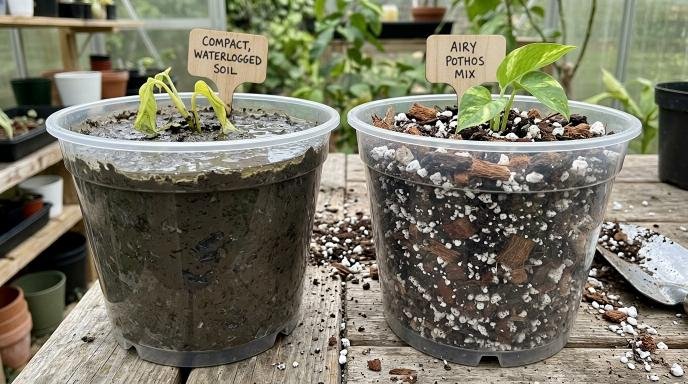
Marble Queen does best in a loose, well-draining growing medium that holds some moisture without becoming waterlogged.
A practical homemade mixture can include:
- Quality indoor potting mix.
- Perlite or another aerating material.
- Orchid bark or another chunky component.
The exact recipe does not need to be complicated. The objective is an airy root environment that drains excess water quickly.
Why heavy soil causes problems
Dense soil can remain wet around the roots long after the surface appears dry.
This reduces airflow around the root system and can create conditions that encourage root problems.
If your plant repeatedly develops yellow leaves despite reasonable watering habits, inspect the soil and drainage rather than immediately adding fertilizer.
Choosing the Right Pot
A pot with drainage holes is strongly recommended.
Do not choose an extremely large container simply because you want the plant to grow faster. Excess soil around a small root system can remain wet for too long.
Choose a container only moderately larger than the existing root ball when repotting.
A decorative cachepot can still be used, but make sure the inner nursery pot can drain freely.
Temperature and Humidity
Marble Queen Pothos prefers warm, stable conditions.
Keep it away from:
- Cold drafts.
- Air-conditioning vents.
- Heating vents.
- Frequently opened exterior doors.
- Sudden temperature changes.
Average household humidity is often sufficient for healthy growth. Higher humidity can improve comfort and leaf appearance, particularly in very dry indoor environments, but extremely high humidity is not a substitute for proper watering and airflow.
Do you need a humidifier?
Not necessarily.
If the plant is growing normally and leaves look healthy, there is usually no reason to chase a specific humidity number.
If your home is exceptionally dry and you notice crispy leaf edges, slow growth, or other signs of environmental stress, increasing ambient humidity may help.
Fertilizing Marble Queen Pothos
Marble Queen Pothos benefits from nutrients during active growth.
Use a balanced, complete houseplant fertilizer according to the product’s dilution instructions. Applying fertilizer too heavily can damage roots and create salt buildup in the soil.
A safer approach is to fertilize conservatively rather than assuming more fertilizer produces faster growth.
When should you fertilize?
The main growing period is generally the best time.
Reduce or pause routine feeding when growth naturally slows because of lower light or cooler conditions.
If the plant has recently been repotted into fresh, nutrient-containing potting mix, additional fertilizer may not be immediately necessary.
Pruning Marble Queen Pothos for Fuller Growth
Marble Queen naturally wants to trail. If you want a bushier appearance, pruning is one of the most effective tools.
Cut vines just above a healthy node.
A node is the point on the stem where leaves and roots can develop.
Why pruning helps
Long vines can make a plant look sparse even when it is perfectly healthy. Strategic pruning encourages the plant to produce new growth from nodes farther back on the vine.
Instead of allowing one vine to become extremely long, regularly trimming several vines can help create a fuller overall appearance.
Expert tip: Do not remove large amounts of healthy foliage simply to make the plant look fuller. Moderate, repeated pruning is usually less stressful than one severe haircut.
Why Is My Marble Queen Pothos Turning Green?
This is one of the most common concerns with Marble Queen Pothos.
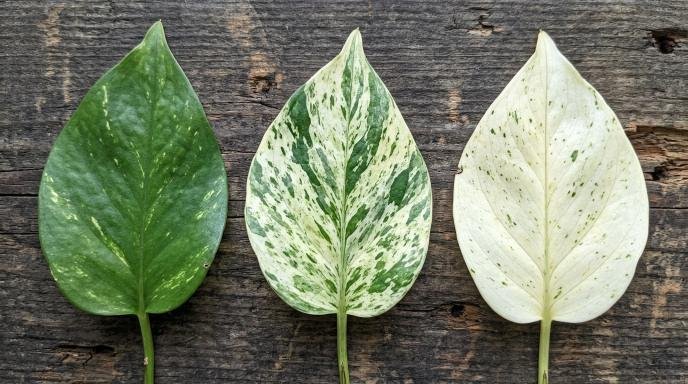
The plant may produce greener leaves when light levels are inadequate. More green tissue allows the plant to capture more light for photosynthesis.
Move the plant gradually toward brighter indirect light and observe new growth.
An important point is that existing leaves generally will not dramatically change their established variegation pattern. The more useful indicator is the appearance of new leaves.
What if new leaves are almost completely white?
Extremely white leaves contain little chlorophyll and may not contribute as much to the plant’s energy production.
If a vine repeatedly produces leaves with very little green tissue, monitor it carefully. Pruning back to a more balanced section of the plant can encourage growth from nodes containing stronger green-and-white variegation.
How to Make Marble Queen Pothos Grow Faster
There is no reliable shortcut that forces rapid growth.
Instead, optimize the factors that control growth:
- Provide bright indirect light.
- Keep the roots in an airy, well-draining medium.
- Water according to soil moisture.
- Avoid temperature extremes.
- Fertilize appropriately during active growth.
- Prune damaged or excessively long vines.
- Give the plant time to establish after repotting.
The biggest mistake is trying to compensate for poor light with fertilizer. Fertilizer cannot replace adequate light.
How to Propagate Marble Queen Pothos
Stem cuttings are the easiest way to propagate Marble Queen Pothos.
Step-by-step propagation
- Select a healthy vine.
- Cut a section containing at least one viable node.
- Remove lower leaves that would sit below the water or growing medium.
- Place the node in water or a suitable propagation medium.
- Keep the cutting warm and in bright indirect light.
- Wait for roots to develop.
- Transfer the rooted cutting into an appropriate potting mix.
The node is essential because new roots develop from the node rather than simply from a random section of leafless stem.
Water propagation vs soil propagation
Water propagation makes root development easy to observe and is beginner-friendly.
Soil propagation can reduce the transition between propagation and permanent growing conditions.
Neither method is universally superior. The best choice depends on your preference and ability to keep the cutting consistently moist without keeping it stagnant.
Image Suggestion: Step-by-step Marble Queen Pothos propagation showing a cutting, node, developing roots, and newly potted plant.
When Should You Repot Marble Queen Pothos?
Repot when the root system has genuinely outgrown its container rather than repotting automatically every year.
Signs can include:
- Roots emerging from drainage holes.
- The plant drying out unusually quickly.
- Roots tightly circling the inside of the pot.
- Growth slowing despite good light and proper care.
- Water passing through the pot unusually quickly.
Repot into a container only slightly larger than the previous one.
After repotting, give the plant time to adjust. A temporary slowdown is not necessarily a sign that something went wrong.
Common Marble Queen Pothos Problems
Yellow Leaves
One or two older yellow leaves can occur naturally, but widespread yellowing deserves investigation.
Check:
- How often you water.
- How long the soil stays wet.
- Whether the pot drains properly.
- Whether the plant receives enough light.
- Whether roots show signs of damage.
Do not automatically fertilize a yellowing plant.
Brown Leaf Tips
Brown tips can result from several environmental stresses, including inconsistent moisture, very dry conditions, accumulated salts, or excessive fertilizer.
Look at the overall pattern rather than treating the symptom alone.
If only a few older leaves have brown tips while new growth is healthy, the problem may be minor.
Drooping Leaves
Drooping can indicate either dryness or root stress from excessive moisture.
Check the soil before watering.
If the soil is dry, watering may solve the problem. If it is already wet, adding more water can make the underlying problem worse.
Root Rot
Root problems are often associated with prolonged excessive moisture and poor drainage.
If you suspect root rot:
- Remove the plant from its container.
- Inspect the roots.
- Remove clearly dead or severely damaged roots with clean tools.
- Repot into fresh, airy growing medium.
- Use a container with adequate drainage.
- Correct the watering routine.
Simply moving a root-damaged plant into another pot without correcting the moisture problem will not solve the underlying issue.
Seasonal Marble Queen Pothos Care
Spring
Spring is often an excellent time for active growth.
Focus on:
- Increasing light gradually.
- Checking whether the plant needs repotting.
- Beginning or increasing appropriate fertilization.
- Pruning leggy growth.
Summer
Higher temperatures and brighter conditions may increase water use.
Check soil more frequently, but do not water automatically just because it is summer.
Protect the plant from intense direct sunlight and extreme heat.
Fall
Growth may begin slowing as light levels decrease.
Reduce fertilizer accordingly and monitor soil moisture more carefully.
Winter
Indoor heating and shorter days can create a tricky combination: dry air but slower plant growth.
Do not respond to dry indoor air by constantly soaking the soil.
Instead, maintain reasonable humidity while allowing the soil to dry appropriately between waterings.
Marble Queen Pothos vs Golden Pothos
Both are popular pothos varieties, but their appearance and growth patterns differ.
| Feature | Marble Queen Pothos | Golden Pothos |
|---|---|---|
| Foliage | White, cream, and green | Green with yellow-golden variegation |
| Light preference | Bright indirect light helps preserve variegation | Tolerates lower light well |
| Growth | Often somewhat slower | Often faster |
| Appearance | High-contrast marbled pattern | Golden splashes and streaks |
| Maintenance | Easy with proper light | Very forgiving |
If your priority is dramatic white variegation, Marble Queen is an excellent choice. If you want a particularly vigorous and forgiving pothos, Golden Pothos may be easier.
Common Mistakes to Avoid
Watering on a fixed schedule
Plants do not use water at exactly the same rate every week. Light, temperature, pot size, soil composition, and season all influence moisture loss.
Keeping the plant in a dark corner
Pothos may survive there, but Marble Queen can lose vigor and develop less attractive variegation.
Using a pot without drainage
Even excellent soil cannot fully compensate for a container that traps excess water.
Overfertilizing
More fertilizer does not automatically mean more growth. Excess nutrients can damage roots and create additional problems.
Repotting too frequently
Every disturbance creates some transplant stress. Repot when the plant actually needs more root space or the existing medium has become unsuitable.
Expecting every leaf to look identical
Marble Queen is naturally variable. Some leaves will have more green, while others may have larger cream or white sections.
Expert Tips for Better Marble Queen Growth
Watch new growth, not just old leaves. New leaves tell you more about whether the current environment is working.
Use light before fertilizer to improve growth. If the plant is receiving inadequate light, feeding it more will not solve the primary limitation.
Rotate the pot periodically. This can help prevent one-sided growth when light comes predominantly from one direction.
Prune strategically. Cutting selected long vines encourages a more compact appearance while providing useful propagation material.
Inspect the roots when problems do not make sense. Yellow leaves, poor growth, and persistent wilting can sometimes originate below the soil line.
Clean dusty leaves gently. Dust can make the foliage look dull and may interfere with efficient light absorption. Wipe leaves carefully with clean water rather than relying on harsh leaf-shine products.
Frequently Asked Questions
Is Marble Queen Pothos easy to care for?
Yes. Marble Queen Pothos is generally beginner-friendly. Its main difference from some greener pothos varieties is that it benefits from brighter indirect light to maintain vigorous growth and attractive variegation.
How much light does Marble Queen Pothos need?
Bright indirect light is ideal. It can tolerate lower light, but insufficient light may lead to slower growth, leggier vines, and greener new leaves.
How often should I water Marble Queen Pothos?
Water when the upper portion of the potting mix has begun to dry rather than following a strict weekly schedule. Water thoroughly and allow excess water to drain.
Why is my Marble Queen Pothos losing its white color?
Insufficient light is a common reason for greener new growth. Move the plant gradually into brighter indirect light and monitor future leaves.
Why is my Marble Queen Pothos growing slowly?
Slow growth can be normal because Marble Queen has significant variegation. Poor light, cold temperatures, root problems, inadequate nutrition, or recent repotting can also slow growth.
Can Marble Queen Pothos grow in low light?
It can tolerate low-light conditions, but it generally performs better with bright indirect light. Low light can reduce growth and variegation quality.
Can Marble Queen Pothos grow in water?
Stem cuttings can be rooted successfully in water. A mature plant can also survive in water under appropriate conditions, but long-term water culture requires attention to nutrition, water quality, and root health.
Should I mist my Marble Queen Pothos?
Misting is not essential for healthy growth. Improving the overall humidity of a very dry room is generally more useful than repeatedly misting individual leaves.
How do I make Marble Queen Pothos bushier?
Prune long vines just above healthy nodes and provide sufficient light. You can also root healthy cuttings and plant them back into the same container to create a fuller appearance.
Is Marble Queen Pothos pet-safe?
No. Pothos contains insoluble calcium oxalate crystals and can cause irritation if chewed or eaten. Keep the plant away from pets and children who may try to consume it.
Final Takeaways
Successful pothos marble queen care comes down to a few fundamentals: give the plant bright indirect light, use an airy and well-draining soil mix, water according to soil moisture, and avoid keeping the roots constantly wet.
For the best variegation, pay particular attention to light. If growth becomes increasingly green, stretched, or weak, improve the lighting before reaching for more fertilizer.
Most importantly, learn to read the plant rather than following a rigid watering calendar. Healthy new growth, firm leaves, appropriate soil moisture, and a strong root system are much better indicators of successful care than any fixed schedule.