Quick Answer
Coffee plant care is mainly about providing bright filtered light, consistently moist but well-draining soil, warm temperatures, and moderate to high humidity. Coffea arabica grows well as a houseplant when protected from cold drafts, harsh afternoon sun, and waterlogged soil. Feed during active growth, repot when roots become crowded, and prune lightly to maintain a compact shape. With suitable conditions, mature plants can eventually produce fragrant white flowers and coffee cherries.
Introduction
A coffee plant can be an attractive houseplant even if you never harvest enough beans for a morning cup. Its glossy evergreen leaves, upright growth, fragrant flowers, and potential to produce coffee cherries make it considerably more interesting than an ordinary foliage plant.
The challenge is that coffee plant care is different from caring for drought-tolerant houseplants. Coffee naturally grows in warm, humid environments, so it responds poorly to prolonged dryness, cold temperatures, and inconsistent care.
The good news is that you do not need a tropical greenhouse to grow one indoors. The key is understanding what the plant is actually responding to: light intensity, moisture around the roots, humidity, temperature, and seasonal growth.
What Is a Coffee Plant?
The coffee plant most commonly sold as a houseplant is Coffea arabica, commonly called Arabian coffee. It is an evergreen shrub in the Rubiaceae family and originates from northeastern Africa. In suitable outdoor conditions it can become a substantial shrub or small tree, but container-grown plants can be maintained at a much smaller size.
Its glossy green foliage is one of its main ornamental features. Mature plants can also produce small, fragrant white flowers followed by fruits that gradually develop into red coffee cherries. Each fruit generally contains two seeds, which are the beans used to make coffee.
Important expectation: growing a coffee plant indoors does not automatically mean you will produce your own coffee. Flowering and fruiting require sufficiently mature plants and favorable growing conditions.
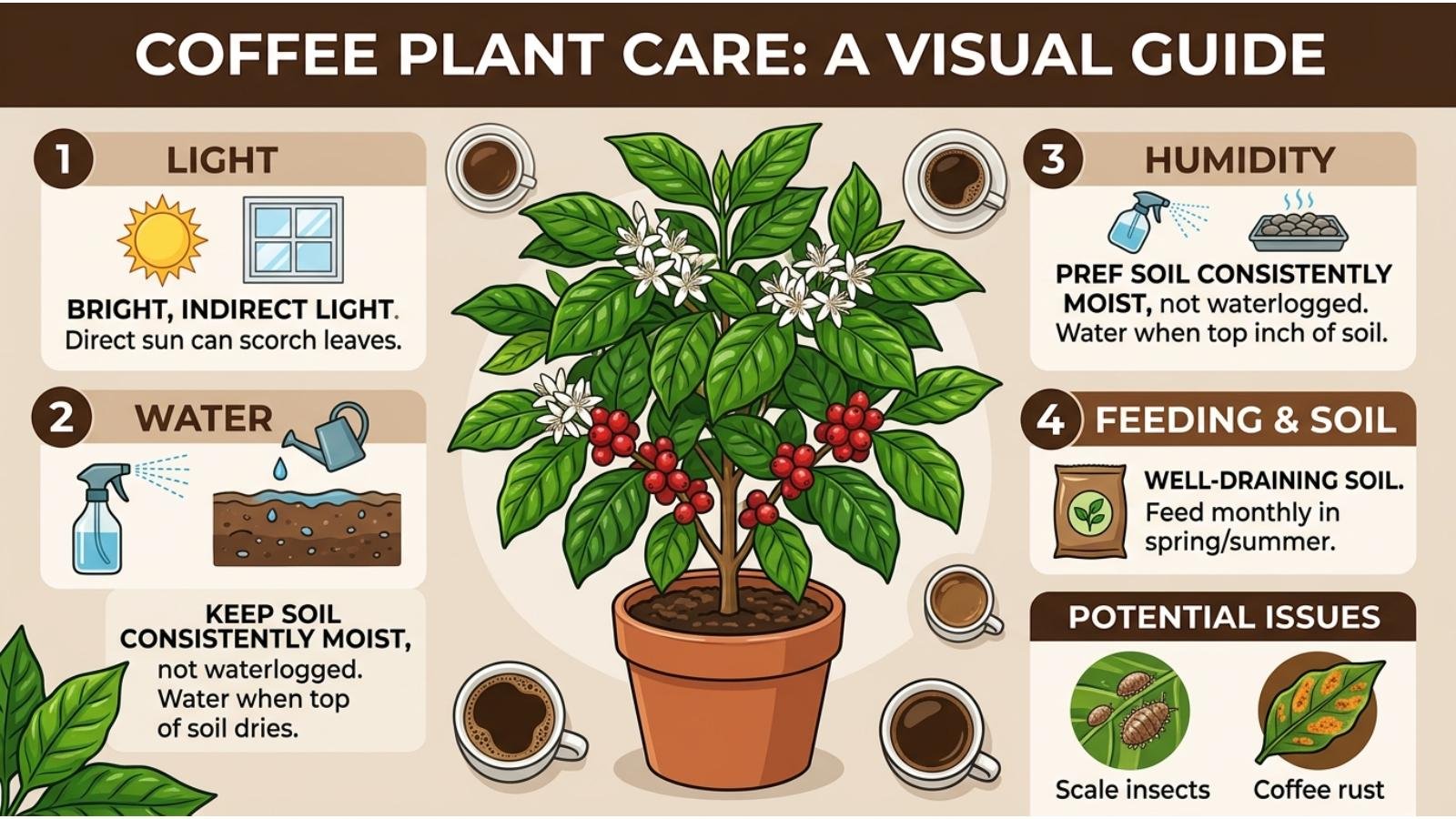
Coffee Plant Care at a Glance
| Care factor | What your coffee plant needs |
|---|---|
| Light | Bright light, preferably filtered or indirect indoors |
| Water | Evenly moist soil without standing water |
| Soil | Rich, organic, well-draining potting mix |
| Humidity | Moderate to high humidity |
| Temperature | Warm, stable conditions |
| Fertilizer | Regular feeding during active growth |
| Pruning | Light pruning or pinching to control shape |
| Repotting | Usually every 2–3 years or when root-bound |
| Common pests | Scale, mealybugs, thrips, mites and caterpillars |
These requirements are consistent with extension and horticultural guidance for Coffea arabica.
Image Suggestion: Labeled infographic showing a healthy coffee plant with ideal light, soil, watering, humidity, and temperature requirements.

How Much Light Does a Coffee Plant Need?
Coffee plants need plenty of light, but indoor plants generally perform best when that light is bright and filtered rather than exposed to intense, scorching afternoon sun.
An east-facing window can provide a useful balance of brightness without the same intensity as prolonged direct afternoon exposure. A bright west or south-facing location can also work if the plant is protected from excessive direct sunlight with a sheer curtain.
Outdoor coffee plants naturally grow in conditions ranging from partial shade to sun depending on the environment and climate.
Signs Your Coffee Plant Needs More Light
Watch the plant rather than relying on a rigid number of hours.
Possible signs of inadequate light include:
- Long, weak stems.
- Large gaps between leaves.
- Slow growth.
- A plant that becomes noticeably top-heavy.
- New growth concentrated near the brightest part of the plant.
Low light is a particularly important issue for indoor coffee plants. The Elisabeth C. Miller Library notes that insufficient light can contribute to slow, spindly growth in coffee plants.
Can Coffee Plants Handle Direct Sun?
They can tolerate substantial light, particularly outdoors when acclimated, but an indoor plant moved suddenly into strong direct sunlight can develop leaf damage.
If moving your coffee plant outside, introduce stronger light gradually instead of placing it immediately in intense midday sun.
Practical tip: If the leaves look healthy but the stems are becoming unusually long and weak, check light levels before immediately adding fertilizer. More fertilizer cannot compensate for inadequate light.
How to Water a Coffee Plant
Watering is one of the most important parts of successful coffee plant care.
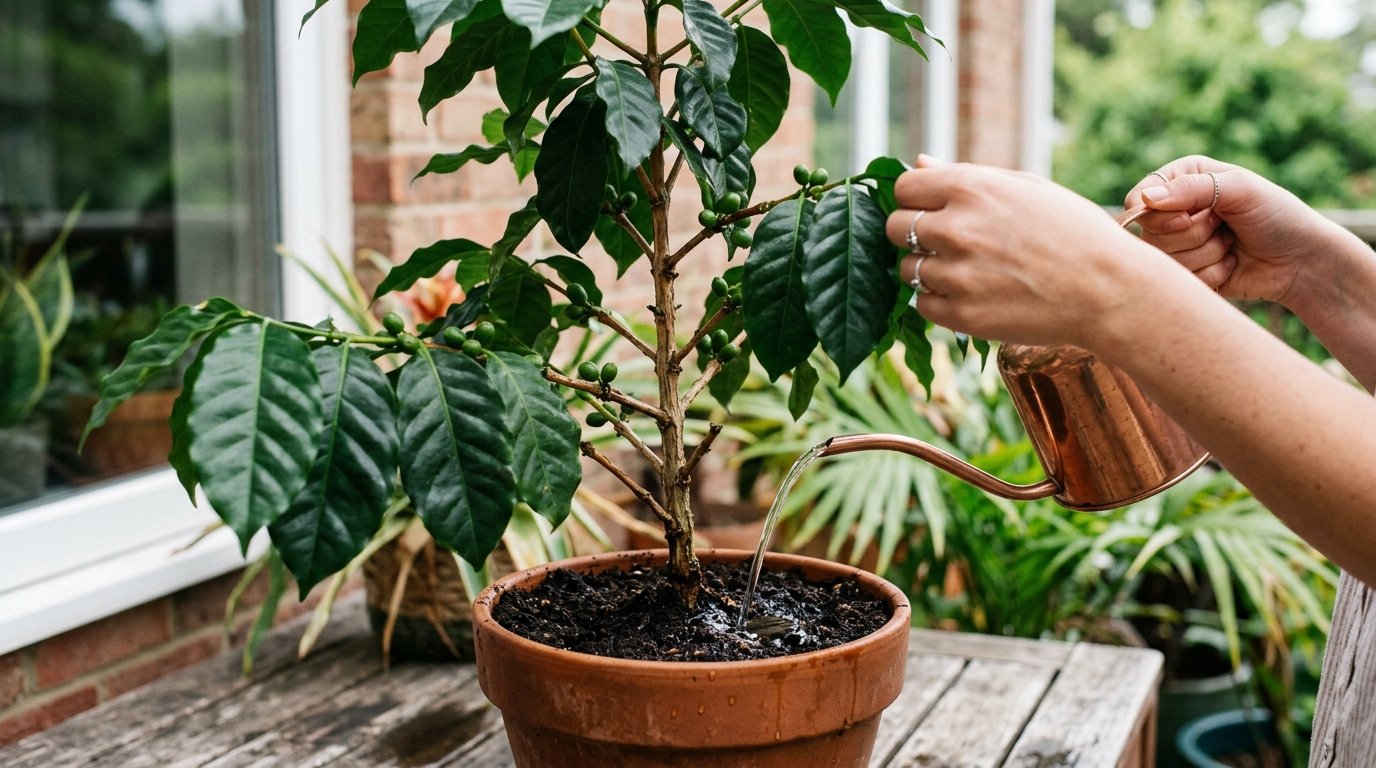
The goal is consistently moist soil, not permanently wet soil. NC State Extension recommends keeping coffee plant soil consistently moist but not soggy, while RHS guidance recommends watering freely during active growth and more moderately during winter.
Instead of watering according to a fixed calendar, check the soil.
A Simple Watering Method
- Check the upper portion of the potting mix with your finger.
- If the soil is beginning to dry but still has some moisture deeper down, assess whether watering is needed.
- Water thoroughly when appropriate.
- Allow excess water to drain from the bottom.
- Empty standing water from a saucer or cachepot.
- Wait until the soil has begun to dry appropriately before watering again.
The exact frequency will change with temperature, light, pot size, soil composition, and season.
Why Overwatering Causes Problems
A common beginner mistake is assuming that a tropical plant should sit in constantly saturated soil.
It should not.
Roots require oxygen as well as water. Poor drainage can leave roots in an environment where they struggle to function properly and may eventually develop root problems.
A drainage hole is therefore much more important than simply adding more water.
Image Suggestion: Side-by-side diagram showing properly moist coffee plant soil versus waterlogged soil.
Best Soil for Coffee Plants
Coffee plants prefer rich, organic, well-drained soil. NC State Extension lists high organic matter as a preferred soil characteristic, while a loam-based, organic-rich potting compost for plants grown under glass.
For an indoor container, choose a quality potting mix that:
- Holds some moisture.
- Drains excess water efficiently.
- Contains organic matter.
- Does not become compacted easily.
You do not want a mix that dries almost immediately, but you also do not want dense soil that remains saturated for days.
What About Soil pH?
Coffee plants generally tolerate slightly acidic to neutral conditions.
If your plant is growing normally, there is usually little reason for a beginner to obsess over repeatedly adjusting soil pH. Good drainage, appropriate moisture, adequate light, and balanced nutrition are often more important practical priorities.
Ideal Temperature for Coffee Plants
Coffee plants prefer warm, stable temperatures.
For Coffea arabica, NC State Extension gives approximately 70–80°F (21–27°C) during the day and 60–65°F (16–18°C) at night for indoor growing. Temperatures below about 55°F (13°C) can cause leaf drop.
A broader optimal range of approximately 59–75°F (15–24°C) for coffee production and warns that freezing temperatures can seriously damage or kill coffee plants.
The practical lesson for houseplant growers is simple:
Keep the plant warm and avoid sudden temperature changes.
Keep it away from:
- Cold windows during winter.
- Air-conditioning vents.
- Heating vents.
- Exterior doors with frequent drafts.
- Extremely hot glass during summer.
How Much Humidity Does a Coffee Plant Need?
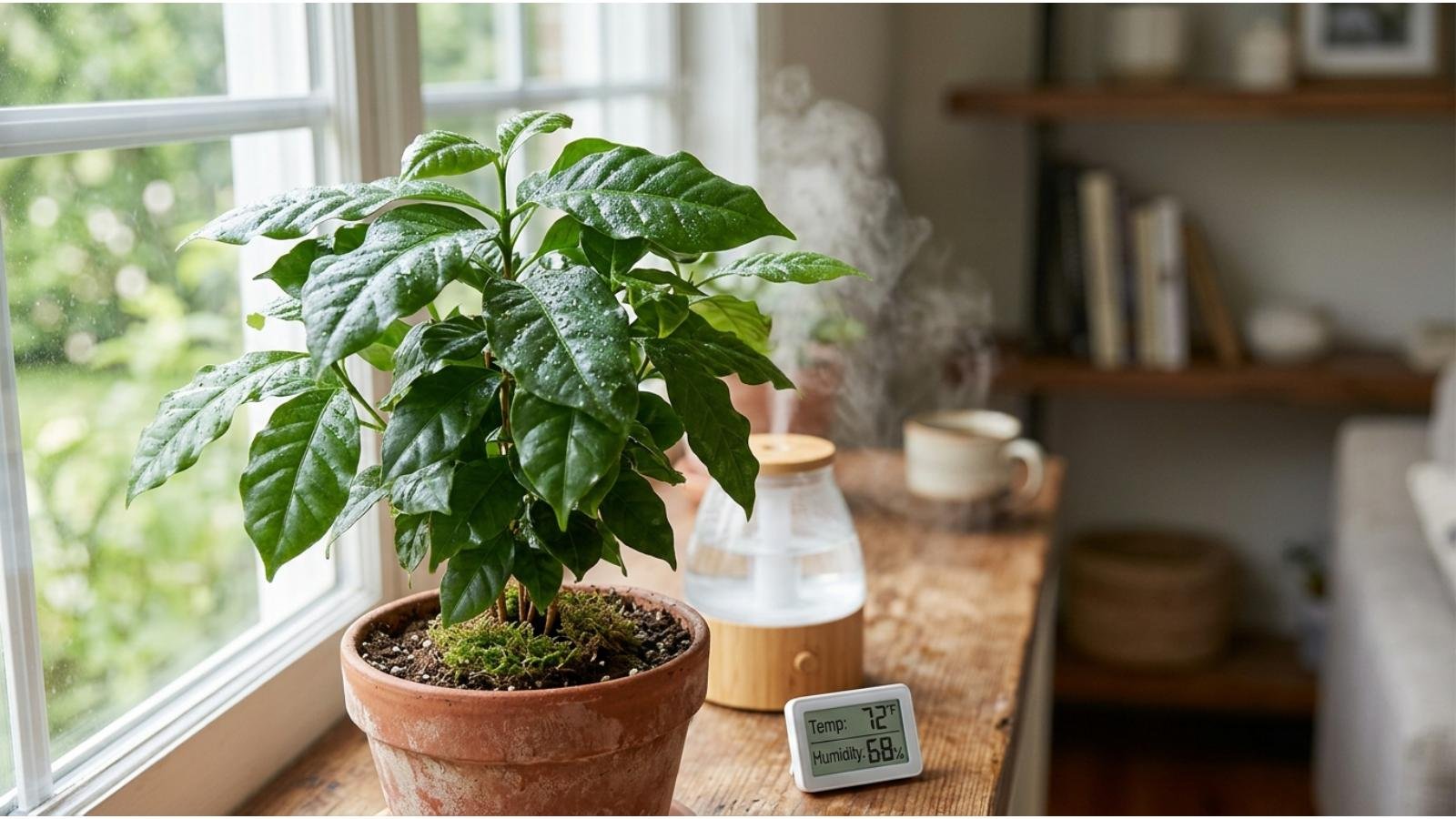
Coffee plants appreciate moderate to high humidity because they originate from warm environments where atmospheric moisture is substantially greater than in many heated or air-conditioned homes.
The specifically lists high humidity as a preferred condition for container-grown coffee plants, and moderate to high humidity for Coffea arabica.
Ways to Increase Humidity
If your home is dry, you can:
- Group several plants together.
- Use a humidifier.
- Place the plant in a naturally more humid room with adequate light.
- Use a pebble tray where appropriate.
The grouping plants and using damp-pebble trays can increase humidity around houseplants.
Brown Leaf Tips
Brown or crispy leaf edges can be associated with dry air, although they can have other causes as well. RHS identifies low humidity as a common cause of brown leaf tips and edges on foliage houseplants.
Do not assume every brown leaf automatically means humidity is the problem. Check watering, roots, fertilizer, light, and pests too.
Fertilizing a Coffee Plant
Coffee plants actively producing new growth benefit from regular nutrition.
The applying a balanced liquid fertilizer every two weeks during active growth for Coffea arabica, while older indoor-gardening guidance cited by the University of Washington recommends mild balanced fertilizer during the growing season.
A practical approach is to:
- Feed during active growth.
- Follow the fertilizer label rather than guessing the concentration.
- Reduce feeding when growth naturally slows.
- Avoid repeatedly applying heavy doses.
More fertilizer does not necessarily mean faster growth. Excess fertilizer can create its own problems, particularly when combined with dry soil or poor root conditions.
Practical tip: If your coffee plant is struggling because of inadequate light or damaged roots, fertilizer is not the first solution. Correct the underlying growing condition first.
Pruning Coffee Plants
Pruning is useful when a coffee plant becomes too tall, sparse, or difficult to fit into its growing space.
Coffee plants can naturally become much larger than many people expect. In commercial production they are often pruned to maintain manageable harvesting height. Container plants can also be pruned to encourage a more compact appearance.
How to Prune
For a houseplant:
- Remove dead or damaged growth.
- Trim excessively long shoots when necessary.
- Pinch growing tips to encourage branching.
- Use clean, sharp pruning tools.
- Avoid removing large amounts of healthy foliage at once.
Pruning should solve a specific problem rather than become a routine haircut.
Image Suggestion: Diagram showing where to pinch a young coffee plant to encourage branching.
When and How to Repot a Coffee Plant
Coffee plants do not need to be repotted every few months.
The Coffea arabica approximately every 2–3 years in spring when grown under glass.
Repot sooner if you see clear evidence that the plant has become severely root-bound.
Signs It May Need Repotting
Look for:
- Roots circling densely around the root ball.
- Roots emerging from drainage holes.
- Soil that dries unusually quickly.
- Stunted growth despite good light and nutrition.
- A plant that has become unstable in its container.
Choose a pot only moderately larger than the existing container. Moving a small root system into a huge pot can leave a large volume of soil wet for too long.
Coffee Plant Care Through the Seasons
Your watering and feeding routine should change as the growing environment changes.
Spring
Spring is a useful time to:
- Repot if necessary.
- Resume stronger feeding as growth increases.
- Prune lightly.
- Increase watering gradually as growth and evaporation increase.
Summer
Summer often means faster growth and greater water use.
Check the soil more frequently, especially if the plant is receiving stronger light or spending time outdoors.
If moving the plant outside, acclimate it gradually to the new light conditions.
Autumn
As temperatures and light levels decline, monitor the soil before automatically continuing a summer watering schedule.
Reduce fertilizer as active growth slows.
Winter
Indoor heating can produce very dry air, while shorter days reduce the plant’s water use.
Avoid placing the plant directly beside a radiator or heating vent. Continue checking the soil rather than allowing the plant to become completely dry for extended periods.
Growing a Coffee Plant Outdoors
In warm, frost-free climates, coffee can be grown outdoors.The warm conditions, high humidity, protection from strong winds, and rich, well-drained soil.
Outdoor coffee plants can receive more light than indoor plants, but the amount should be appropriate for the local climate and the plant’s acclimation.
If you move a houseplant outdoors:
Do not go directly from a dim indoor room to intense midday sunlight.
Gradually expose it to brighter conditions to reduce the risk of leaf scorch.
Coffee also does not tolerate freezing conditions, so plants in climates with cold winters may need to be protected or brought indoors.
Can a Coffee Plant Produce Coffee Beans Indoors?
Yes, a mature coffee plant can flower and produce fruit, but indoor fruiting should be treated as a bonus rather than a guaranteed outcome.
The Coffea arabica can begin producing fragrant white flowers at around four years under suitable conditions, followed by fruits that mature over several months.
The timeline varies with plant age, growing conditions, cultivar, and environment.
Even if your plant never produces enough beans for a full cup of coffee, maintaining healthy foliage is still a worthwhile goal.
What Happens Before You Get Coffee Beans?
The basic sequence is:
Mature plant → flowers → fruit develops → cherries ripen → seeds are harvested → seeds are processed and roasted.
The red fruit is not the same thing as the roasted coffee bean found in a bag of coffee.
Image Suggestion: Lifecycle infographic showing coffee plant → white flowers → green cherries → red cherries → coffee beans.
Common Coffee Plant Problems and Solutions
Yellow Leaves
Yellowing can have multiple causes, including watering problems, root stress, nutritional issues, or inadequate growing conditions.
Start by checking:
- How wet the soil remains.
- Whether the container drains properly.
- Recent changes in light.
- Root condition.
- Feeding history.
Do not automatically add fertilizer whenever a leaf turns yellow.
Brown Leaf Tips
Brown tips are commonly associated with dry air, but inconsistent watering, salt accumulation, root problems, or environmental stress can also contribute.
Check humidity and watering before deciding on a solution.
Dropping Leaves
Leaf drop can result from environmental stress.
Possible triggers include:
- Cold temperatures.
- Sudden temperature changes.
- Watering problems.
- Low light.
- Root stress.
- Pest activity.
Coffee plants can experience leaf drop when temperatures fall too low, so temperature should be one of the first things checked.
Leggy Growth
Long, weak stems with widely spaced leaves often indicate insufficient light.
Move the plant gradually toward a brighter location rather than immediately increasing fertilizer.
Curling or Crispy Leaves
Check:
- Soil moisture.
- Humidity.
- Light intensity.
- Temperature.
- Root health.
A plant experiencing several stresses simultaneously may show symptoms that resemble one another.
Coffee Plant Pests to Watch For
Coffee plants can be affected by several common pests, including:
- Scale insects.
- Mealybugs.
- Thrips.
- Mites.
- Caterpillars.
The specifically lists scale, mealybugs, thrips, caterpillars, and mites among potential coffee plant pests.
Inspect the undersides of leaves and along stems when checking the plant.
Early detection is much easier to manage than a large infestation.
A Simple Pest Inspection Routine
Once a week, look closely at:
- New leaves.
- Leaf undersides.
- Stems and leaf joints.
- Areas where leaves meet the main stem.
- Any unusually sticky or discolored foliage.
Isolating a visibly infested houseplant from nearby plants can also help prevent pests from spreading.
7 Common Coffee Plant Care Mistakes
1. Keeping the Soil Constantly Soaked
Coffee likes moisture, but constantly saturated soil is not the same as healthy moisture.
2. Putting It in a Dark Corner
A coffee plant may survive for a while in inadequate light, but weak growth can eventually become obvious.
3. Exposing It to Cold Drafts
Warmth is an important part of maintaining healthy coffee plant growth.
4. Fertilizing a Stressed Plant Excessively
Fertilizer cannot fix poor light, root damage, or improper watering.
5. Using a Container Without Drainage
Excess water needs somewhere to escape.
6. Moving It Suddenly Into Harsh Sun
Indoor-grown foliage may need time to acclimate to substantially stronger outdoor light.
7. Watering on a Fixed Calendar
A plant’s water requirements change with season, light, temperature, pot size, and humidity.
A Simple Coffee Plant Care Routine
For beginners, a straightforward routine is more useful than trying to control every variable.
Weekly
- Inspect leaves and stems for pests.
- Check soil moisture.
- Rotate the pot if growth is becoming one-sided.
- Look for new growth or signs of stress.
Every Few Weeks During Active Growth
- Check whether the plant needs feeding according to your fertilizer instructions.
- Inspect roots and drainage if watering behavior has changed.
Seasonally
- Adjust watering to changing growth and environmental conditions.
- Move the plant away from cold drafts during winter.
- Increase humidity when indoor air becomes very dry.
- Reassess light as the sun’s seasonal position changes.
Every 2–3 Years
- Check whether the plant has become root-bound.
- Repot if necessary using fresh, well-draining growing media.
Frequently Asked Questions
How often should I water a coffee plant?
Water when the growing medium has begun to dry appropriately, then water thoroughly and allow excess water to drain. Avoid keeping the roots continuously saturated.
Does a coffee plant need direct sunlight?
Coffee plants need good light, but indoor plants generally benefit from bright filtered or indirect light. Outdoor plants can tolerate more sunlight depending on climate and acclimation.
Why are my coffee plant leaves turning brown?
Brown leaf tips can result from low humidity, but watering problems, root stress, excessive fertilizer, or other environmental issues can also contribute. Check the plant’s overall conditions rather than treating the symptom alone.
Why is my coffee plant losing leaves?
Cold temperatures, sudden environmental changes, inadequate light, watering problems, and root stress can all contribute to leaf drop. Temperatures below approximately 55°F (13°C) can cause leaf drop in Coffea arabica.
Can coffee plants grow indoors?
Yes. Coffea arabica can be grown successfully as a houseplant when provided with bright light, warm temperatures, humidity, and well-drained soil.
How tall does an indoor coffee plant get?
Coffee plants can become substantially larger in their natural or outdoor environment, but container plants can be kept smaller through pot culture and pruning. NC State notes that indoor plants are commonly maintained around 4–6 feet.
How long does it take for a coffee plant to produce coffee?
Under suitable conditions, coffee plants may begin flowering after several years. The Coffea arabica produces flowers at about four years, although actual timing depends on growing conditions and the individual plant.
Can I grow a coffee plant from coffee beans?
Propagation is possible from seed, but the seed needs to be viable and fresh. The germination can be erratic.
Does a coffee plant need high humidity?
Coffee plants generally prefer moderate to high humidity. Dry indoor air can contribute to foliage problems, particularly brown leaf tips and edges.
Related Plant Care Topics for Internal Linking
If this article is part of a larger plant-care website, relevant internal links could include:
- Indoor plant care.
- Humidity for houseplants.
- How to water indoor plants.
- Best soil for tropical houseplants.
- Houseplant pest identification.
- How to repot root-bound plants.
- Indoor plant lighting guide.
- Fertilizing houseplants.
- How to increase humidity for plants.
These topics naturally support readers who need more detailed help with individual aspects of coffee plant care.
Final Thoughts
Successful coffee plant care comes down to creating a stable environment rather than following a complicated schedule. Give Coffea arabica bright filtered light, warm temperatures, adequate humidity, rich but well-draining soil, and consistent moisture without waterlogging the roots.
When something goes wrong, resist the urge to change everything at once. Check the plant systematically: light, moisture, drainage, temperature, humidity, nutrition, and pests.
That approach makes troubleshooting much easier and gives your coffee plant the best chance of producing the glossy foliage, fragrant flowers, and eventually coffee cherries that make this houseplant so rewarding