Quick Answer
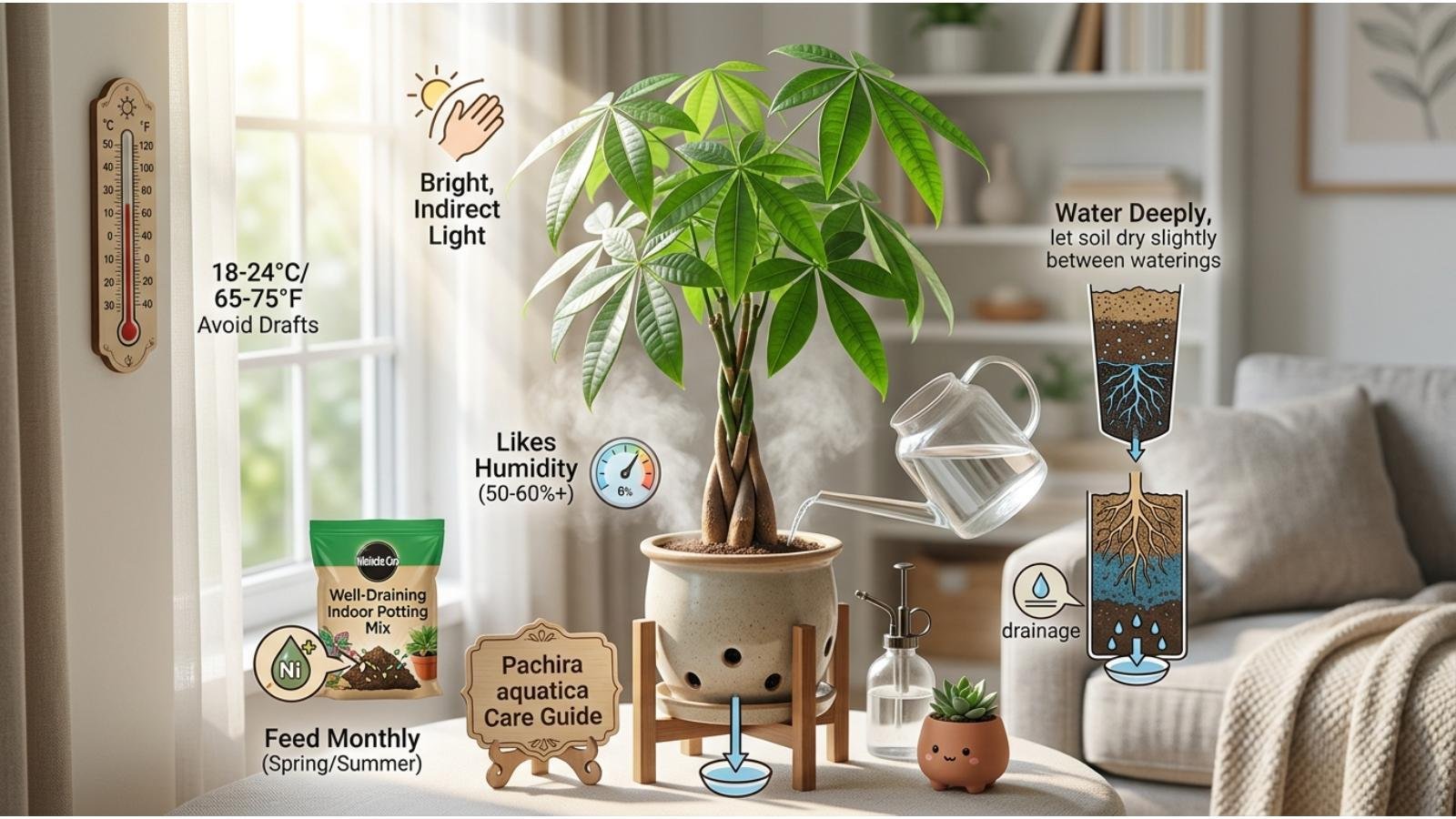
Pachira plant care is simple when you balance light, watering, drainage, humidity, and temperature.
Place your Pachira in bright, indirect light, water when the top 2–3 inches of soil become dry, and use a well-draining pot with drainage holes. Keep it warm, protect it from harsh direct sunlight and cold drafts, and fertilize lightly during active growth. The most common mistake is overwatering, so always check the soil before watering.
Introduction
Pachira aquatica, commonly known as the money tree, is a popular tropical houseplant recognized for its glossy green leaves and attractive braided trunk. It can add a lush, natural look to bedrooms, offices, living rooms, and other indoor spaces without requiring complicated daily care.
The plant is often described as easy to grow, but that does not mean it can tolerate every mistake. Most Pachira problems come from a small number of issues, especially excessive watering, poor drainage, insufficient light, and sudden environmental changes.
One of the most important lessons in Pachira plant care is that a tropical plant does not necessarily want constantly wet soil. Its roots need both moisture and oxygen. Learning how to balance the two is the key to maintaining healthy growth.
Understanding the Pachira Plant
Pachira aquatica is a tropical tree that naturally grows in warm, humid environments. When grown outdoors in suitable climates, it can become considerably larger than the compact plants commonly sold for indoor use.
Indoor Pachira plants are usually grown for their:
- Attractive green foliage.
- Distinctive trunk.
- Braided-stem appearance.
- Relatively easy-care nature.
- Ability to adapt to indoor environments.
- Upright, decorative growth.
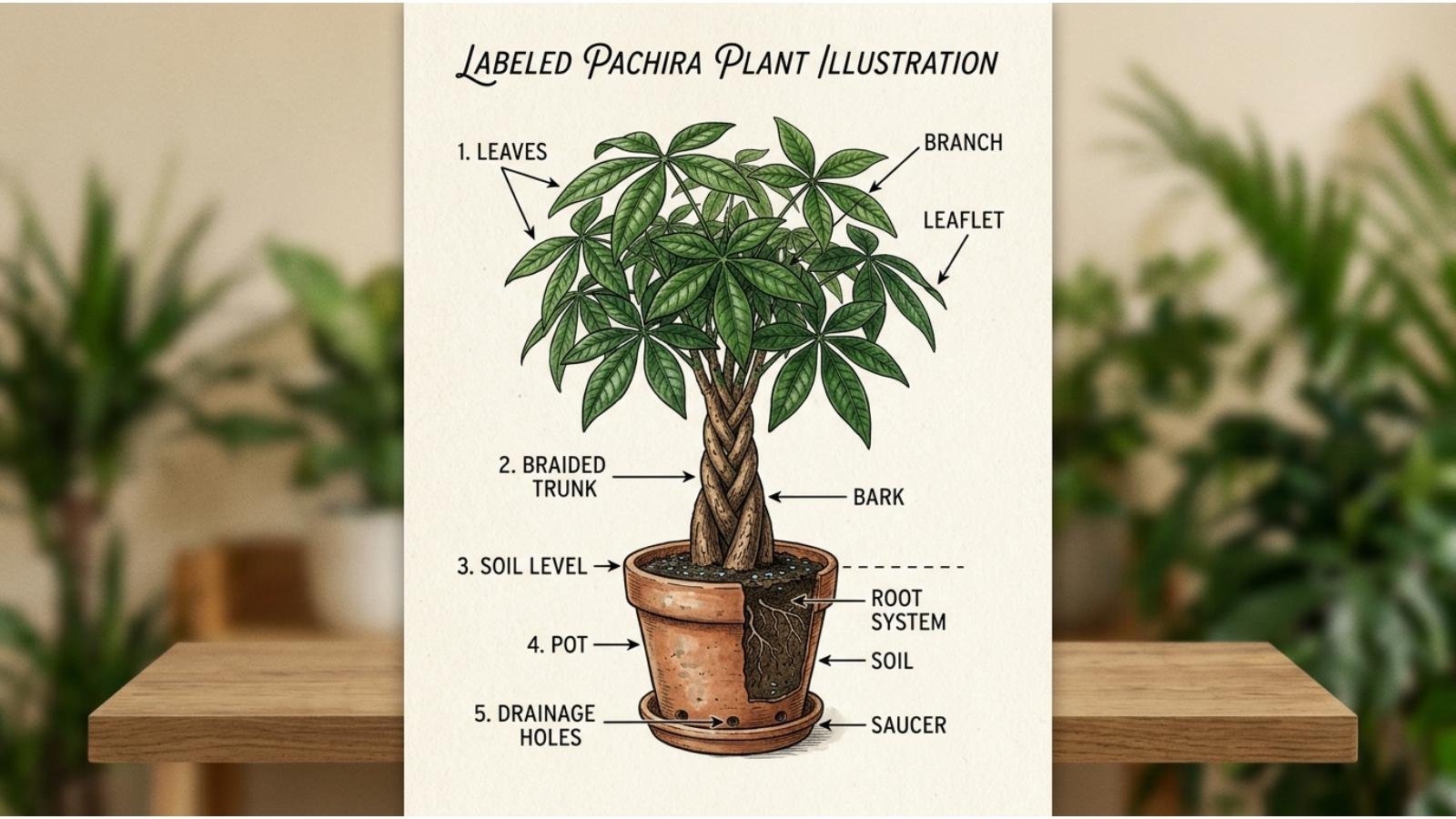
The braided trunk commonly seen in stores is created by growers while the stems are young. It is not necessary for the plant’s health.
Pachira Plant Care Requirements at a Glance
| Care Requirement | Ideal Condition |
|---|---|
| Light | Bright, indirect light |
| Water | When the upper soil dries |
| Soil | Loose and well draining |
| Humidity | Moderate to high |
| Temperature | Warm and stable |
| Fertilizer | Light feeding during active growth |
| Pot | Container with drainage holes |
| Pruning | As needed for shape and size |
| Repotting | When roots become crowded |
| Main concern | Overwatering |
How Much Light Does Pachira Need?
Light has a major effect on the health and appearance of a Pachira.
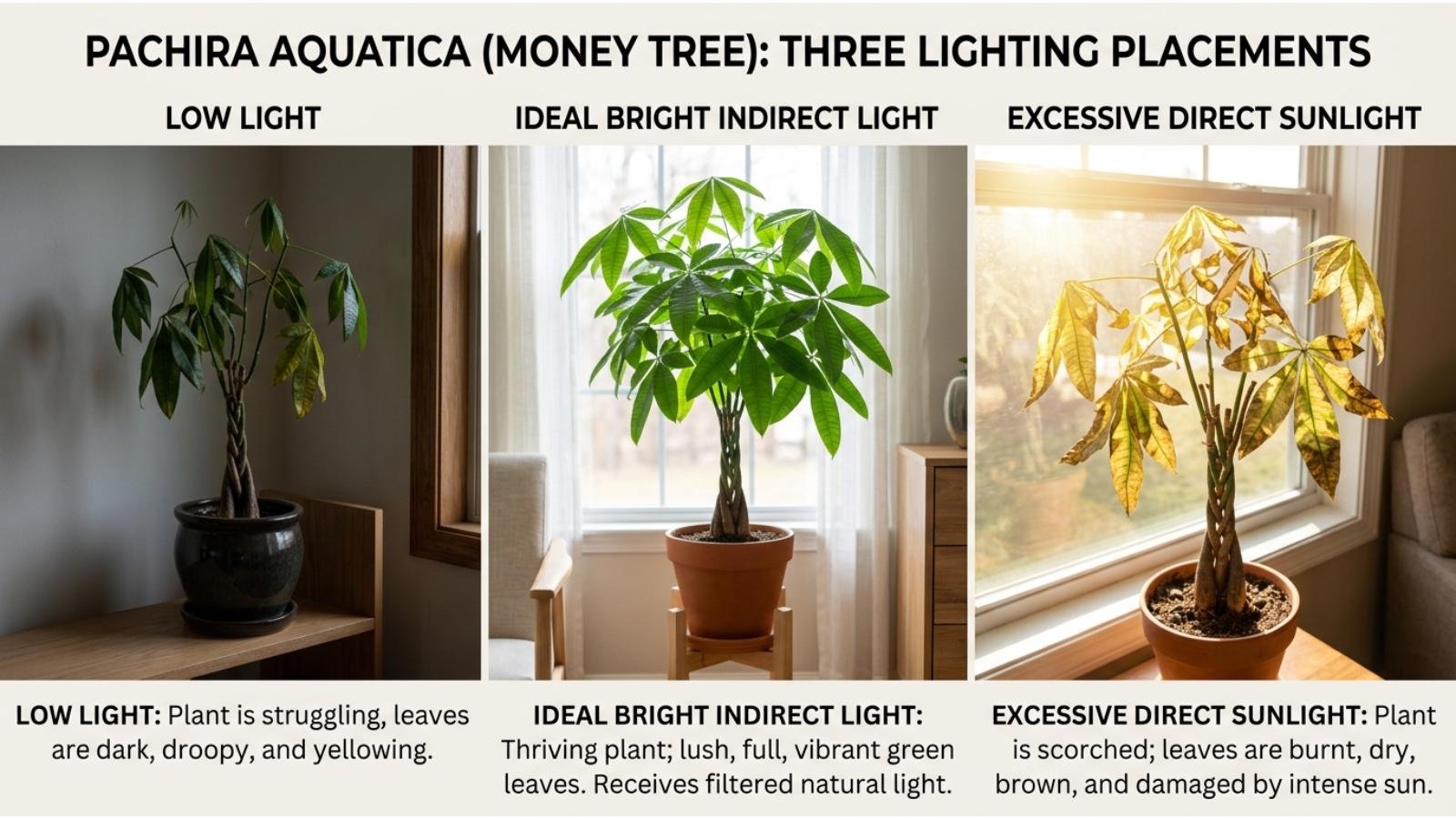
The plant generally prefers bright, indirect light. This means it should receive plenty of ambient daylight without sitting under intense sunlight for long periods.
A location near a bright window is usually suitable when the sunlight is filtered or the plant is positioned far enough away from the glass.
Good locations include:
- Near an east-facing window.
- Near a bright window with a sheer curtain.
- Several feet from a very sunny window.
- A bright office or living room.
Avoid putting Pachira in a dark corner simply because it is considered a low-maintenance plant.
Signs of Too Little Light
A Pachira receiving inadequate light may develop:
- Slow growth.
- Smaller new leaves.
- Long spaces between leaves.
- Thin or stretched stems.
- A noticeably uneven shape.
Low light can also make the soil remain wet longer because the plant uses water more slowly.
Signs of Too Much Direct Sun
Excessive intense sunlight may cause:
- Brown patches.
- Crispy leaves.
- Bleached foliage.
- Scorched leaf edges.
If the plant is growing toward the window, rotate it occasionally so different sides receive similar exposure.
Practical Tip
Do not make large lighting changes suddenly. If your Pachira has been growing in a relatively shaded location, gradually move it toward brighter light rather than immediately placing it in strong afternoon sunlight.
How to Water a Pachira Plant
Watering is probably the most important part of Pachira plant care.
Many beginners see the tropical appearance of a money tree and assume it needs frequent watering. In reality, constantly wet soil can create serious root problems.
The best approach is to check the soil before watering.
Insert your finger approximately 2–3 inches into the soil.
- If it feels wet, wait.
- If the upper layer has dried, check deeper before watering.
- If the soil is dry and the plant is beginning to wilt, water thoroughly.
When you water, soak the soil evenly until excess water begins leaving the drainage holes.
Then allow the pot to drain completely.
Never Leave the Pot Sitting in Water
If the container sits in a saucer or decorative cover, empty accumulated water after watering.
Constantly wet roots have limited access to oxygen, which can contribute to root deterioration.
Why You Shouldn’t Follow a Fixed Schedule
A common mistake is watering every seven days simply because that is what a care label recommends.
Your Pachira may dry at a completely different rate depending on:
- Light.
- Temperature.
- Humidity.
- Pot size.
- Soil type.
- Season.
- Root development.
A plant growing in bright light may need water more frequently than one growing in a dim room.
Check the soil instead of following the calendar.
Best Soil for Pachira
Pachira needs soil that holds some moisture while allowing excess water to drain away.
A good indoor mix should be:
- Loose.
- Airy.
- Moisture-retentive without becoming soggy.
- Well draining.
A basic houseplant potting mix can be improved with a drainage material such as perlite.
Why Drainage Matters
Poorly draining soil can remain wet around the roots for too long.
This creates a particularly dangerous situation because the top of the soil may appear dry while the lower part of the pot remains saturated.
If your Pachira repeatedly develops yellow leaves and the soil stays wet for many days, examine the root environment before increasing watering.
Choosing the Right Pot
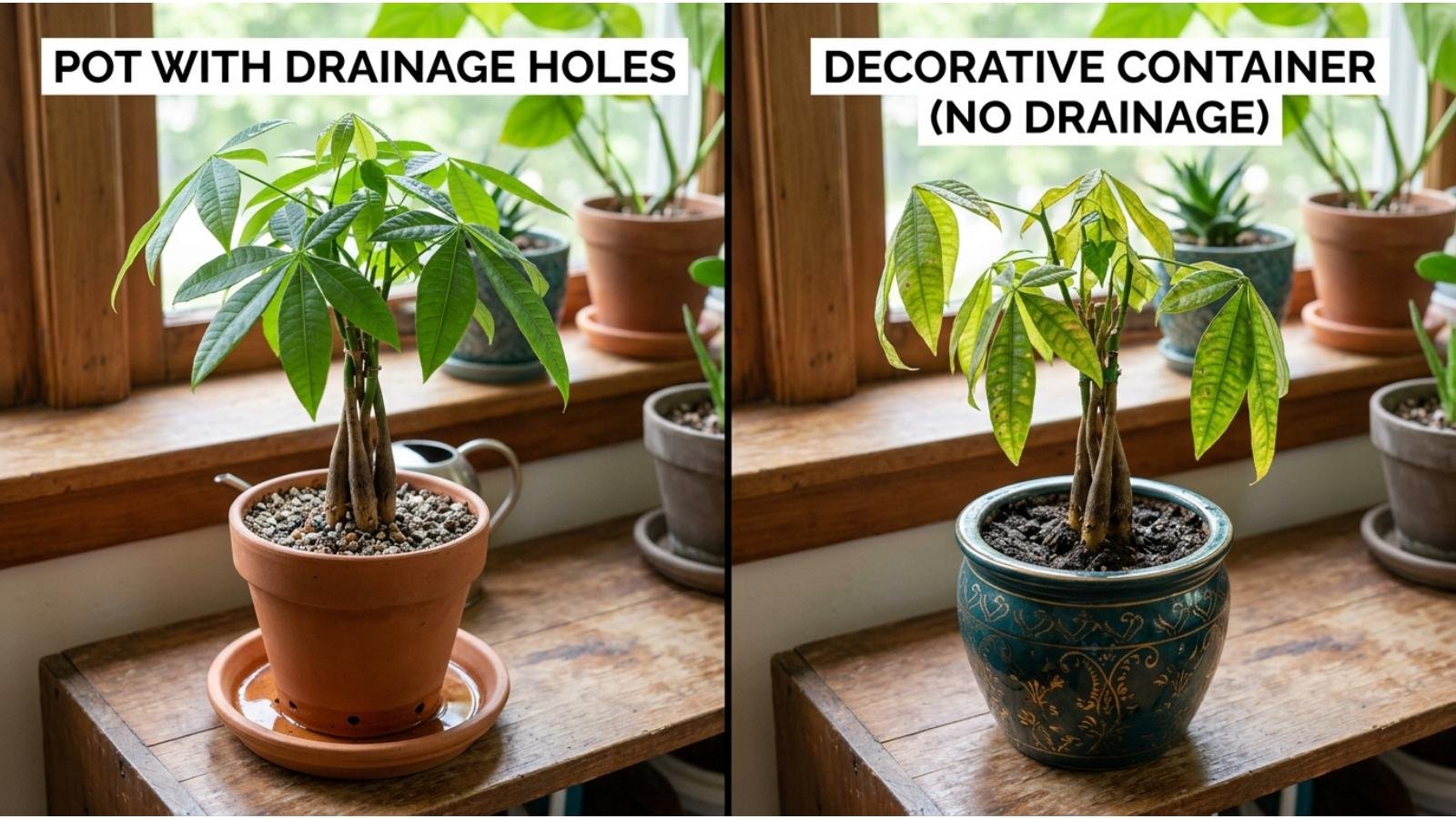
A healthy Pachira needs a container with drainage holes.
Drainage holes allow excess water to escape after watering and reduce the risk of water remaining around the roots.
Avoid Oversized Containers
A large pot may seem like an investment in future growth, but too much unused soil can retain moisture for a long time.
Choose a pot that is only moderately larger than the existing root system when repotting.
A decorative container can be used as an outer cover, but the actual growing pot should allow water to drain.
Pachira Humidity Requirements
Because Pachira originates from tropical environments, it generally appreciates moderate to high humidity.
However, humidity and watering are two different things.
Humid air does not mean constantly wet soil.
You can increase humidity by:
- Using a humidifier.
- Grouping plants together.
- Keeping the plant away from dry heating vents.
- Growing it in a naturally humid room with suitable light.
Avoid placing the plant directly beside an air-conditioning or heating vent.
What About Misting?
Occasional misting may temporarily increase moisture around the leaves, but it does not provide the same consistent humidity as a properly positioned humidifier.
If your indoor air is particularly dry, improving overall room humidity is usually more useful than repeatedly spraying the leaves.
Ideal Temperature for Pachira
Pachira prefers warm, stable conditions.
A comfortable indoor environment is generally around 65–75°F (18–24°C).
Protect the plant from:
- Cold drafts.
- Freezing temperatures.
- Sudden temperature changes.
- Direct heat from radiators.
- Strong air-conditioning airflow.
- Frequently opened exterior doors during cold weather.
A stable environment is especially important after moving or repotting the plant.
How to Fertilize Pachira
Pachira does not need heavy feeding.
During periods of active growth, a balanced houseplant fertilizer can provide nutrients that support healthy foliage.
Follow the fertilizer’s recommended dilution rather than assuming more fertilizer will produce faster growth.
Signs of Excessive Fertilizer
Too much fertilizer may contribute to:
- Brown leaf tips.
- Salt buildup on the soil.
- Root stress.
- Poor overall plant health.
Never use fertilizer as a solution for yellow leaves caused by watering or root problems.
Fix the growing conditions first.
How to Prune a Pachira Plant
Pruning can help maintain a compact and attractive Pachira.
You may prune when the plant becomes:
- Too tall.
- Leggy.
- Uneven.
- Crowded.
- Damaged.
- Too wide for its location.
Use clean, sharp pruning shears.
Remove damaged or unwanted stems just above an appropriate growth point.
How to Encourage Fuller Growth
If your Pachira has become tall and sparse, pruning can encourage branching. However, adequate light is also essential.
Pruning a plant that is severely light-starved without improving its lighting may simply result in another round of weak growth.
Avoid Excessive Pruning
Do not remove a large percentage of healthy foliage at once unless there is a specific reason.
A stressed plant needs time to recover.
Caring for a Braided Pachira Trunk
The braided trunk is one of the features that makes money trees especially recognizable.
The braid itself does not determine whether the plant is healthy.
Pay attention to the base of the trunk and inspect it occasionally.
If the stems are being held tightly by ties or other materials, make sure they are not becoming constricted as the plant grows.
Also avoid repeatedly soaking the trunk.
When watering, focus on thoroughly moistening the soil rather than keeping the trunk wet.
Image Suggestion
Close-up illustration of a healthy braided Pachira trunk with an example of constricting material that should be removed.
When to Repot a Pachira
Pachira does not need repotting simply because a certain amount of time has passed.
Instead, look for signs that the plant has outgrown its container.
Consider repotting if:
- Roots are tightly crowded.
- Roots are emerging from drainage holes.
- Water passes through unusually quickly.
- The soil has deteriorated.
- The plant dries out exceptionally quickly.
- Growth has slowed because of severe root crowding.
Choose a container slightly larger than the previous one.
After Repotting
Do not immediately respond to repotting stress by adding excessive fertilizer or constantly watering.
Place the plant in suitable light, maintain stable conditions, and allow it time to adjust.
How to Propagate Pachira
Pachira can be propagated from seeds or suitable stem cuttings.
For home growers, stem cuttings can be a practical approach when healthy material is available.
Successful propagation depends on:
- Healthy plant material.
- Warm conditions.
- Appropriate moisture.
- Good humidity.
- Clean cutting tools.
- Patience.
The propagation medium should remain appropriately moist without becoming waterlogged.
Image Suggestion
Step-by-step illustration showing a Pachira stem cutting, preparation, planting, and early root development.
Why Are Pachira Leaves Turning Yellow?
Yellow leaves do not automatically mean your Pachira needs more water.
Several conditions can cause yellowing.
| What You Notice | Possible Explanation |
|---|---|
| Yellow leaves with constantly wet soil | Overwatering |
| Yellowing with extremely dry soil | Underwatering |
| Yellowing plus slow growth | Light or root problems |
| Yellowing after relocation | Environmental stress |
| Yellowing with insects | Pest problem |
| Yellowing after heavy feeding | Fertilizer stress |
The first thing to check is the soil.
If it is already wet, adding more water may make the problem worse.
Practical Diagnostic Method
Before changing your care routine:
- Feel the soil.
- Check the drainage holes.
- Look for pests.
- Examine the leaves for spots or damage.
- Evaluate the available light.
- Check for temperature changes.
- Look at the roots if the soil remains wet for an unusually long time.
This approach is much more useful than treating every yellow leaf as an indication of thirst.
Why Is My Pachira Dropping Leaves?
Leaf drop can be caused by several types of stress.
Sudden Environmental Change
Moving a Pachira from one location to another can trigger temporary leaf loss.
Watering Problems
Both excessive watering and prolonged dryness can stress the plant.
Low Light
A plant receiving inadequate light may struggle to maintain vigorous growth.
Temperature Stress
Cold drafts and sudden changes can cause foliage problems.
Root Problems
Damaged roots cannot efficiently supply the plant with water and nutrients.
What Should You Do?
Do not immediately change everything.
Instead:
- Check soil moisture.
- Inspect the roots if necessary.
- Review the lighting.
- Look for pests.
- Check temperature.
- Keep conditions stable.
Making several major changes at once makes it difficult to determine what caused the problem.
Brown Leaves and Brown Tips
Brown tips can develop for different reasons, including:
- Dry indoor air.
- Inconsistent watering.
- Excess fertilizer.
- Excessive direct sunlight.
- Root problems.
If only a small amount of older foliage is affected and new growth looks healthy, the issue may not be serious.
If browning spreads quickly, investigate the plant’s environment.
Trimming brown portions can improve appearance, but pruning does not fix the underlying cause.
Pachira Pests
Pachira can occasionally experience common houseplant pests.
Check the plant regularly for:
- Tiny insects.
- Webbing.
- Sticky residue.
- Speckled leaves.
- Distorted new growth.
- Clusters of insects around stems or leaf undersides.
Inspect both sides of leaves, especially the undersides and areas where stems meet leaves.
Early detection is much easier to manage than a large infestation.
If pests are discovered, isolate the affected plant from nearby houseplants until the problem is under control.
Common Pachira Plant Care Mistakes
Watering on a Calendar
Watering every week regardless of soil condition can keep the roots too wet.
Keeping the Plant in Darkness
Pachira may survive in lower light, but good growth requires adequate light.
Using a Pot Without Drainage
Excess water needs a way to escape.
Choosing an Extremely Large Pot
More soil can mean slower drying and greater moisture retention.
Exposing It to Harsh Sun
Strong direct sunlight can damage foliage.
Ignoring the Trunk
The trunk should be checked for soft areas, damage, and constricting ties.
Fertilizing a Stressed Plant
Nutrients cannot correct poor drainage, inadequate light, or root damage.
Moving It Constantly
Repeated changes can create additional environmental stress.
Indoor Pachira Care
Indoor Pachira care becomes much easier when you create a stable location.
Choose a spot with:
- Bright indirect light.
- Stable temperature.
- Reasonable humidity.
- Good air circulation.
- No direct heat or cold airflow.
Keep the plant where you can easily inspect it.
A location that makes watering and checking the soil convenient is often better than a decorative corner where problems go unnoticed.
Outdoor Pachira Care
In warm climates, Pachira can be grown outdoors.
Outdoor plants generally have access to more natural light, humidity, and air movement, but they are also exposed to stronger environmental changes.
Protect outdoor Pachira from:
- Freezing temperatures.
- Strong winds.
- Extreme afternoon sun.
- Poorly draining soil.
- Sudden temperature drops.
Container-grown plants can be moved to a protected location when weather conditions become unsuitable.
Seasonal Pachira Plant Care
Spring
As growth increases:
- Check the plant for new growth.
- Gradually adjust watering according to soil moisture.
- Consider light fertilization.
- Check whether the pot has become crowded.
Summer
Pay attention to:
- Faster soil drying.
- Heat.
- Strong sunlight.
- Humidity.
- Pest activity.
Fall
As growth slows, the plant may use less water.
Do not continue watering at a summer frequency without checking the soil.
Winter
Winter often brings lower light and slower growth.
Reduce watering according to actual soil moisture and keep the plant away from cold drafts and heating vents.
Can Pachira Grow in Low Light?
Pachira can tolerate less light than some tropical houseplants, but it generally grows better when given bright, indirect light.
If the plant is in a very dark location, you may notice:
- Slow growth.
- Sparse foliage.
- Smaller leaves.
- Leggy stems.
- Soil remaining wet for longer.
If natural light is inadequate, supplemental plant lighting can help.
How to Make a Pachira Grow Fuller
A fuller Pachira usually requires more than pruning.
Focus on three things:
Adequate Light
Good light supports stronger, more compact growth.
Proper Pruning
Remove excessively long or unwanted growth to encourage a better shape.
Consistent Care
Avoid repeatedly switching between severe dryness and heavy watering.
A plant that receives stable conditions is more likely to produce healthy new growth.
Pachira Plant Care for Beginners
If you are caring for your first money tree, focus on these five habits:
- Give it bright indirect light.
- Check the soil before watering.
- Use a pot with drainage holes.
- Keep it away from extreme temperatures.
- Inspect the leaves and soil regularly.
You do not need to create a complicated routine.
The most useful habit is simply learning to observe the plant.
A Simple Pachira Care Routine
Weekly
Check:
- Soil moisture.
- Leaf condition.
- New growth.
- Pests.
- Light exposure.
When Soil Dries
Water thoroughly and allow excess water to drain.
Every Few Weeks
Rotate the plant slightly if it is leaning toward its light source.
During Active Growth
Monitor whether the plant needs light feeding.
Periodically
Inspect:
- Drainage holes.
- Roots.
- Trunk.
- Soil condition.
- Leaf undersides.
This simple routine can prevent many problems before they become serious.
Frequently Asked Questions About Pachira Plant Care
How often should I water a Pachira?
There is no universal watering schedule. Check the soil and water when the upper portion has dried sufficiently. Water thoroughly and allow excess water to drain completely.
Does Pachira need direct sunlight?
No. Bright, indirect light is generally preferable. Gentle morning sunlight may be tolerated, but intense direct sunlight can scorch the leaves.
Why are my Pachira leaves turning yellow?
Overwatering is a common cause, especially when the soil stays wet for long periods. Underwatering, poor light, root problems, and environmental stress can also cause yellowing.
Can I keep a Pachira in a bedroom?
Yes. A bedroom can be suitable if it provides adequate indirect light and stable temperatures.
Does a Pachira need high humidity?
Pachira appreciates moderate to high humidity, particularly in dry indoor environments. However, high humidity does not mean the soil should remain constantly wet.
Can Pachira survive in low light?
It can tolerate lower light, but growth is generally stronger and more attractive in bright, indirect light.
Why is my money tree losing leaves?
Possible causes include overwatering, underwatering, low light, temperature changes, relocation stress, pests, or root damage. Check the growing conditions before changing your routine.
Should I mist my money tree?
Misting may temporarily increase moisture around the foliage, but it is not a reliable replacement for maintaining suitable overall humidity.
What type of soil does Pachira need?
Use a loose, well-draining houseplant mix that retains some moisture without becoming saturated.
Does Pachira need fertilizer?
Light feeding during active growth can support healthy development. Avoid excessive fertilizer, particularly when the plant is already stressed.
How do I know if my Pachira needs repotting?
Look for severely crowded roots, roots emerging from drainage holes, rapidly drying soil, or deteriorated potting mix.
Can I prune a Pachira?
Yes. Pruning can control size, remove damaged growth, and improve the plant’s shape.
Can Pachira grow outdoors?
Yes, when grown in a warm climate with appropriate light, drainage, and protection from cold temperatures.
Why are the tips of my Pachira leaves turning brown?
Dry air, inconsistent watering, strong sunlight, excessive fertilizer, and root problems can all contribute to brown tips.
Why is my Pachira trunk becoming soft?
A soft or deteriorating trunk can indicate serious moisture or root-related problems. Check the soil, drainage, and roots immediately rather than increasing watering.
Final Pachira Plant Care Checklist
For consistently healthy growth, remember these essentials:
- Provide bright, indirect light.
- Check the soil before watering.
- Water thoroughly but allow excess water to drain.
- Never leave the roots sitting in water.
- Use a loose, well-draining potting mix.
- Always use a container with drainage holes.
- Keep the plant warm and away from cold drafts.
- Provide reasonable humidity.
- Protect foliage from harsh direct sunlight.
- Fertilize lightly during active growth.
- Prune when necessary.
- Repot when the roots become crowded.
- Inspect leaves regularly for pests.
- Check the trunk and drainage conditions periodically.
Conclusion
Successful Pachira plant care is less about following a strict schedule and more about understanding what the plant is telling you.
Give your money tree sufficient indirect light, allow the soil to dry appropriately between waterings, provide excellent drainage, and maintain warm, stable conditions. When problems appear, examine the soil, roots, light, temperature, and foliage before making major changes.
Most importantly, do not mistake a tropical plant’s preference for humidity and moisture for a need for constantly wet roots. Balanced moisture, good drainage, and adequate light are the foundation of a healthy Pachira.